The smallest mona lisa in the world created using DNA
"Mona Lisa" by Leonardo da Vinci - the greatest work, the significance of which cannot be underestimated. For centuries, the painting has influenced entire schools of artists, the minds and imagination of painters. "Mona Lisa" repeatedly tried to copy, also representatives of various trends painted pictures with her in their own way. Someone created a huge canvas, and someone fit the girl's face on a miniature the size of a postage stamp.
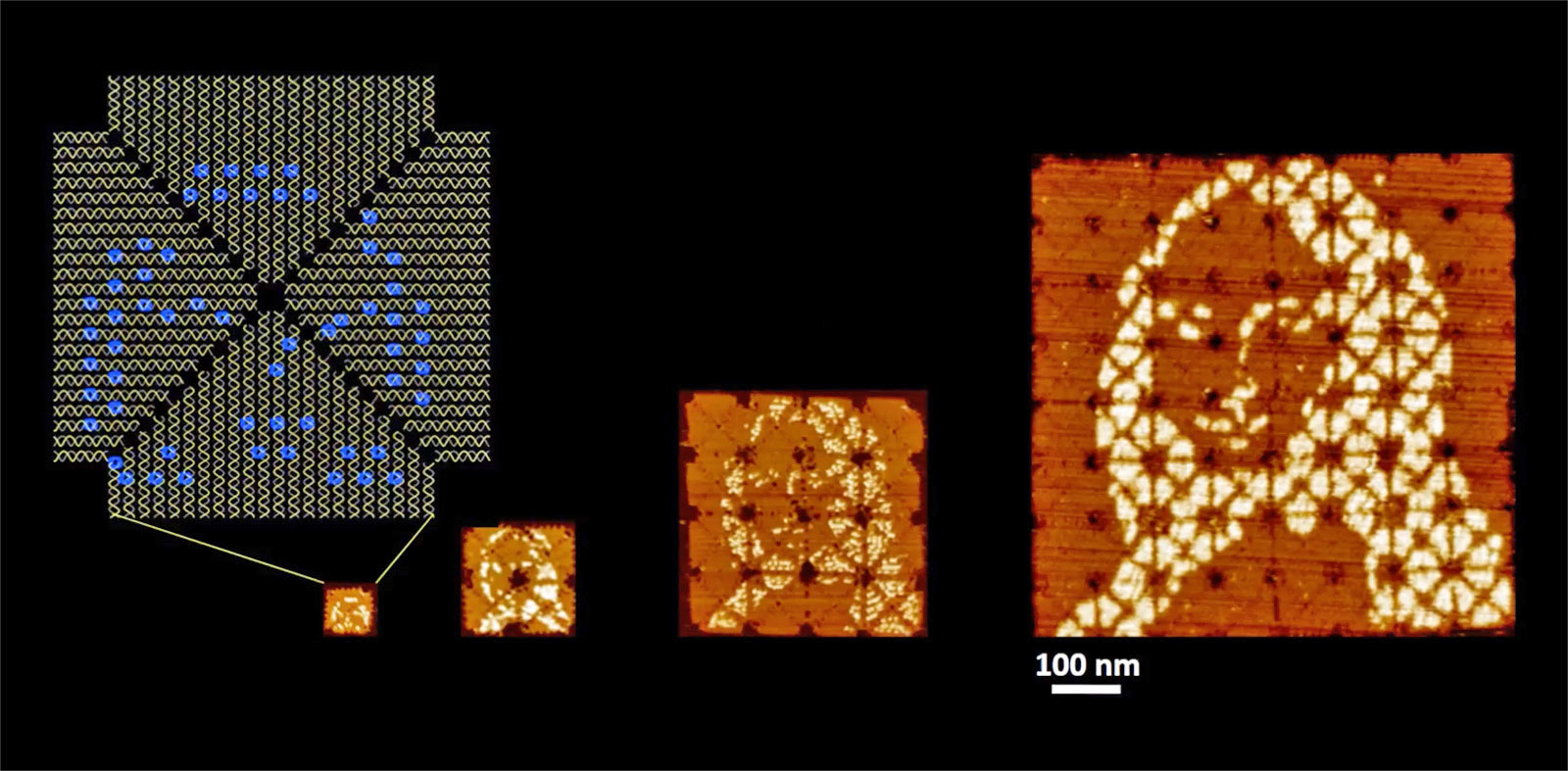
But now scientists were able to create the smallest picture in the world with the image of the very girl. This is done using separate DNA molecules. Known around the world smile (and smile whether?) In the picture does not exceed 100 nm in length. All this was accomplished thanks to the development of a new “method of origami,” which allows the folding of DNA molecules into complex structures.
The picture, obtained by scientists, is not complete. It consists of squares, each of which is composed of individual DNA strands. The sequence in the DNA strands is different, it is predetermined in advance. All this allows you to create fragments of "canvas", which create outlines. Then, increasing the scale of the canvas (2x2, 4x4, 8x8 - the final size), scientists have achieved that the image fits here completely.
Each element of the whole puzzle (64 in total) was created in one of 64 tubes. Scientists knew in which of them which element was assembled, therefore, when all the elements were ready, they had to be joined together, getting a single picture.
Of course, there was little to be done manually. Specialists used a combined system, a specialized liquid automatic, which is controlled by specific software. Automation greatly facilitates the extremely time-consuming process of folding the threads. Thanks to this, the project authors were able to create not only a copy of “Mona Lisa”, but also a “portrait” of the bacteria, in order to show the capabilities of the system.
The software analyzes the image downloaded by scientists, splits it into small squares of equal size, and then determines the DNA sequence required to create a specific pattern on each square. Well, then there is the assembly of patches grown in test tubes, as mentioned above.
“We can create a separate piece of the picture on each square, and then form a whole picture of the individual elements,” explains Grigory Tikhomirov, the project manager. “All this is complicated by the fact that we need hundreds of individual elements that are not only technically difficult to design, but also need to be synthesized, which is expensive. We decided to use a small number of elements and immediately place them in the right places. ”
And just this was achieved by creating specialized software that manages the "fluid" robot that collects the DNA together. All this is a very difficult technology, but scientists managed to do what was required.
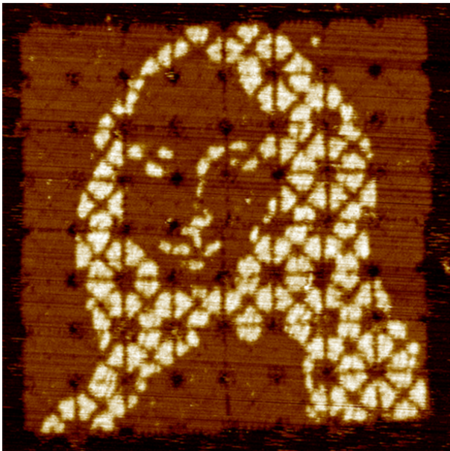 The picture is 64 times larger than the original origami-structure of DNA, developed by American Paul Rotemund in 2006. The principle of creating all the elements of a molecular puzzle is the same that was originally developed.
 “The hierarchical structure of our project allows us to use only a small number of building blocks, in our case these are DNA strands with a unique sequence, in order to create larger-scale structures. In theory, we can create drawings of any size, ”says Tikhomirov. The method used by specialists is relatively inexpensive, especially if we compare it with other existing methods of assembling DNA strands into specific structures.
In addition, it is worth noting that all this was created not for fun. The technology allows for the most accurate manipulation of objects from the microworld. As a result, scientists will be able to obtain extremely small microchips, create unusual specimens of organically materials, or simply test chemical and molecular interactions.
The picture itself may not be the smallest image in the world (this primacy belongs to “The Boy and His Atom” by IBM). But the technique itself, which allowed to create a picture, can be extremely useful.