New wormhole allows information to escape from black holes
- Transfer
Physicists have put forward the theory that a new type of “passable” black holes can resolve a complex paradox and save information that has fallen into black holes.
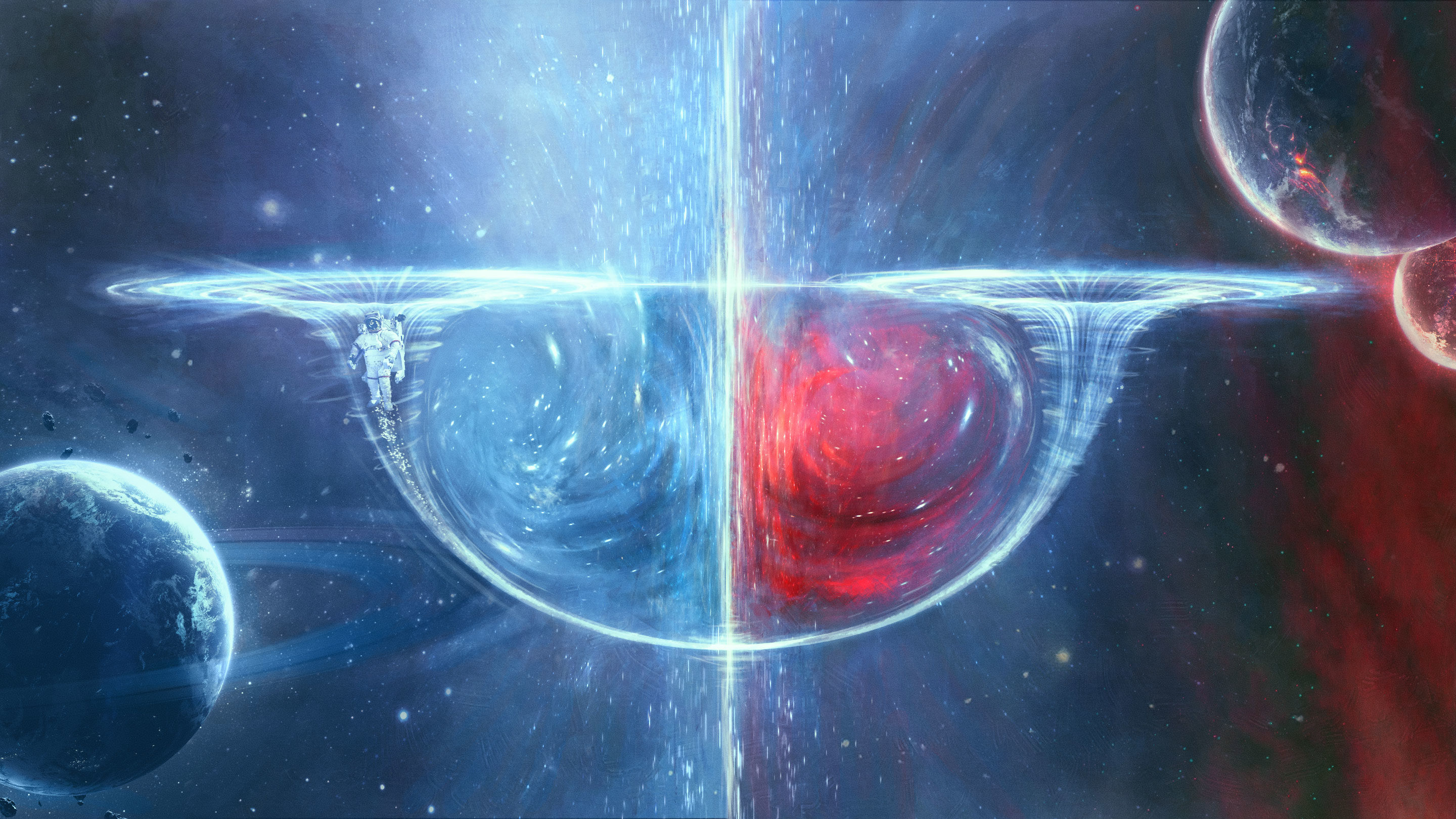
In 1985, when Karl Sagan wrote his novel “Contact,” he needed to quickly move his protagonist, Dr. Ellie Arroway From Earth to the Vega star. He made her fall into a black hole and came out a few light years away from her, but it was not clear to him whether such a plot makes sense. An astrophysicist at Cornell University and a famous TV host consulted with his friend Kip Thorne , an expert on black holes at the California Institute of Technology (he recently won the Nobel Prize ). Thorne knew that Arroway could not get to Vega with the help of a black hole, which is believed to catch and destroy everything that gets into it.. But he realized that she could use a hole of another type that does not contradict Einstein’s general theory of relativity: a tunnel, or a wormhole connecting remote places of space-time.
The simplest theoretical wormholes immediately collapse and disappear before anything can pass through them. But Thorn wondered if the “infinitely advanced” science fiction civilization could stabilize the wormhole long enough for something or someone to pass through it. He thought that such a civilization could lay out a tunnel with “exotic material” opposing the collapse. The material must have negative energy, repelling radiation and space-time. Sagan used this trick in Kontakt, attributing the invention of exotic material to an earlier, lost civilization, in order not to go into details. In the meantime, these very details captured Thorn, his students, and many other physicists who had spent years studying the passable black holes and their theoretical applications. They found
Today, decades later, new types of passable BH have appeared that do not require exotic material and have the potential to help physicists to unravel the complex BH paradox. It was this paradox that hampered the development of the early draft of “Contact” and led Thorn to reflect on passable black holes - namely, everything that falls in the black hole disappears without a trace. The complete erasure of information violates the rules of quantum mechanics and leads experts into such difficulty that in the past few years some have even begun to declare that the black hole does not have any viscera at all - space and time end up in strange ways on their horizons.
A flurry of discoveries began in 2016 from workwhich reported the first passable wormhole, which does not require the addition of exotic materials in order to remain open. According to Ping Gao [Ping Gao] and Daniel Dzhafferisu [Daniel Jafferis] of Harvard University and the Aaron Wall[Aron Wall] from Stanford, the repulsive negative energy in the wormhole's womb can be created outside by a special quantum connection between a pair of BHs that form two entrances to the wormhole. If you correctly connect two BHs, then something thrown at one of them quickly flies through the wormhole, and after certain events in the external universe, jumps out of the second. Interestingly, Gao, Jaffers and Wall noted that their scenario is mathematically equivalent to quantum teleportation - this is the key to quantum cryptography, and it has already been demonstrated in the laboratory.
John Presquil[John Preskill], an expert on BH and quantum gravity from Caltech, says that new passable wormholes were a surprise and have consequences for the information paradox and BH insides. “What I like the most,” he says, “is that the observer can enter the BH, and then run away and tell what he saw.” This suggests the existence of BH internals and that everything that gets into them should go back.
Mysterious equation
Work on the new wormhole began in 2013, when Jaffers attended an interesting report at the string conference in South Korea. The speaker, Juan Maldacena , a professor of physics from the Institute of Advanced Studies in Princeton, concluded on the basis of various circumstantial evidence and reasoning that ER = EPR . That is, the wormholes between remote points of space-time, the simplest of which are called Einstein-Rosen bridges, or ER, are equivalent (though not in the most obvious way) to entangled quantum particles, also known as Einstein-Rosen-Podolsky pairs, EPR. ER = EPR hypothesis put forward by Maldacena and Leonard Susskindfrom Stanford, is trying to solve the modern version of the infamous paradox of black hole information by associating TOT-controlled space-time geometry with instantaneous quantum connections between distance-separated particles, which Einstein called "frightening long-range action."
The paradox has been unclearly looming away since 1974, when the British physicist Stephen Hawking determined that BH evaporate — slowly emit heat in the form of particles, known as “Hawking radiation”. Hawking has calculated that this heat is completely random; it does not contain information about the contents of the BH. And when the BH ceases to exist, the same happens with the recording of the Universe about everything that got into the BH. But this violates the principle of unitarity, the basis of quantum theory, which states that when particles interact, information about them is never lost, only mixed up - so that if you turn the arrow of the time of the quantum evolution of the Universe backwards, you will see how things reappear, recreating the past.

Daniel Jaffers, Associate Professor of Physics at Harvard University
Almost everyone believes in unitarity, therefore the information is simply obliged to run away from BH - but how? Over the past five years, some theorists, in particular, Joseph Polchinsky from the University of California at Santa Barbara, have argued that BHs are empty shells without any filling, and Ellie Arroway, hitting the BH event horizon, would hit the firewall and be radiated back.
Many theorists believe in the existence of BH interiors (and smoother transitions through their horizon), but in order to understand them, they need to deal with the fate of the information that goes inside. It is necessary to build a working quantum theory of gravity, a long-sought association of quantum physics and a description of spacetime, most acutely manifested inside the BH, where extreme gravity works on quantum scales.
Quantum gravity led Maldacena, followed by Jafferis, to the idea of ER = EPR and wormholes. The supposed relationship between tunnels in space-time and quantum entanglement, described by the hypothesis, coincided with the recently popular idea that space is stitched with quantum entanglement. Apparently, wormholes have a special role in stitching space-time and in escaping information from BH - but how can this work? When Jaffers heard Maldacena’s report on his mysterious equation and his arguments, he knew that the standard ER wormhole is unstable and impassable. But he wondered what could mean the duality of the Maldacena equation for a passable wormhole - one with which Thorn and the others played a few decades ago. Three years after the report in South Korea, Jaffers with his colleagues Gao and Wall presented their answer. Their work extends the idea of ER = EPR, equating not a standard wormhole and a pair of entangled particles, but passable wormhole and quantum teleportation:discovered in 1993 a law allowing the quantum system to disappear and reappear unscathed elsewhere.
Maldacena read the work of Gao, Jaffers and Walla: “It seemed to me that this is a very good idea, one of those that seems obvious when you learn about it.” Maldacena and his assistants, Douglas Stanford and Gen-Bin Young immediately began to explore the newly discovered implications of this idea for the BH paradox; their new work appeared in April. Susskind and Yin Zhao from Stanford after them released workabout teleporting through the wormhole in July. Wormholes “paint an interesting geometric picture of the teleportation process,” said Maldacena. “The message moves through the wormhole.”
What happens when you fall into a black hole
Diving into the wormhole
In his work Diving into Wormhole Passages , published in the magazine Fortschritte der Physik, Maldacena, Stanford and Young, consider a new type of wormhole connecting two black holes: the parent BH and the daughter BH formed from half of the Hawking radiation emitted by the parent in the evaporation process. Two systems are confused to the maximum. Then the fate of information of an older BH is clear: it penetrates the wormhole into the daughter BH.
During an interview in his quiet office at the Maldacena Institute for Advanced Study, a taciturn American of Argentine descent, who had several influential ideas behind him, described his radical reflections. To the right of the chalk-stained blackboard, Maldacena drew a not very intelligible image of two black holes joined by a wormhole that was being passed. On the left, he sketched a quantum teleportation experiment performed by famous fictional experimenters Alice and Bob, who possess quantum-entangled particles a and b, respectively. Suppose Alice wants to teleport the qubit q to Bob. It prepares the combined state of q and a, measures it (reducing everything to a pair of classical bits, 1 and 0), and sends the measurement result to Bob. He can then use it as a key to work on b in order to recreate the state q.
Maldacena turned to the right side of the board. “Operations can be performed with a pair of BHs, equivalent to what I told you about quantum teleportation. And in this picture the message actually goes through the wormhole. ”
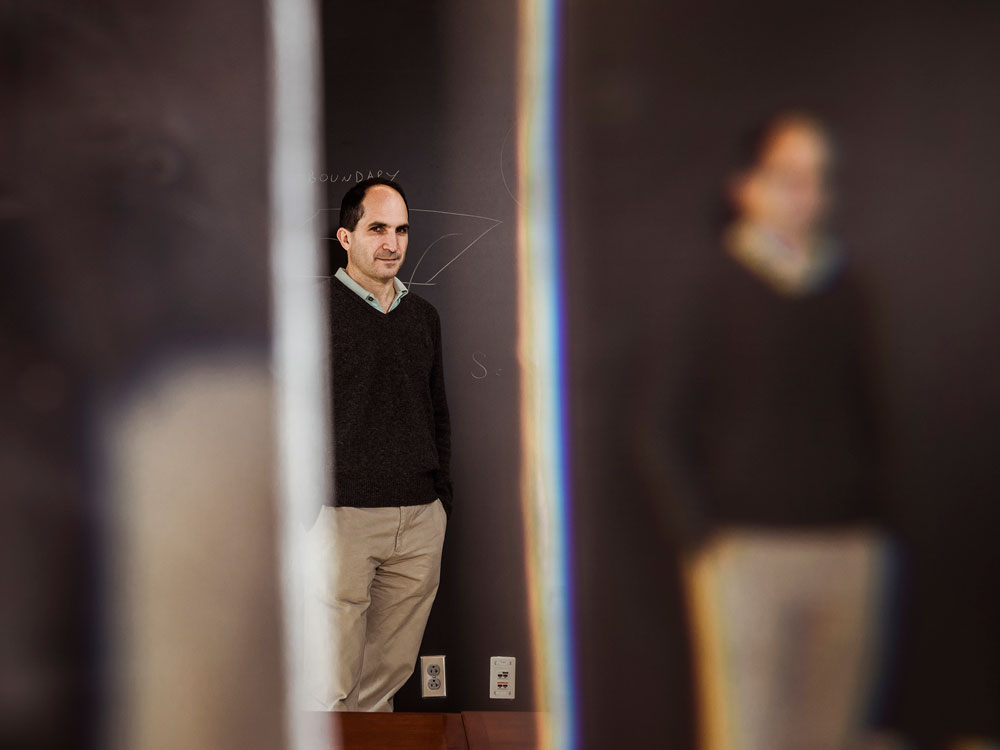
Juan Maldacena
Suppose Alice throws a qubit q in BH A. She then measures Hawking's radiation particle and sends the measurement result through the outer part of the universe to Bob, who can use this knowledge to work on b, Hawking radiation particle emanating from BH B. Bob’s work will recreate q , which seems to have jumped out of hole B, and ideally coincides with what fell into A. That is why some physicists are so excited about this: the wormhole Gao, Jaffers and Wall allows you to recreate information from the BH. In their work, they placed their wormhole in a negatively curved space-time, which often serves as a useful, albeit unrealistic, field for experiments in the theory of quantum gravity. However, the idea of a wormhole extends to the real world, provided that two BHs are connected in the right way: “They must be causally related, and then the nature of the interactions we described will be the simplest case that you can imagine,” explains Jafferis. If you allow Hawking radiation from one BH to fall into the other, then the two BHs become entangled, and quantum information falling into one of them comes from the other.
The quantum teleportation format prohibits the use of passable wormholes as a time machine. All that passes through the wormhole must wait until Alice’s message reaches Bob in the outer Universe until it can get out of Bob’s BH — so the wormhole does not provide superluminal speed that could be used for time travel. Apparently, passable wormholes can exist in nature, as long as they do not provide speed advantages. “Passable wormholes are like a bank loan,” Gao, Jaffers and Wall write in their work. “You can get it only when you are rich enough so that you do not need it.”
Naive octopus
Although passable black holes will not revolutionize space travel, Presquill argues that the new discovery gives a “promising resolution” to the black hole firewall issue, suggesting that there is no firewall on their horizon. Preskill said that the discovery saves the “complementarity of black holes”, meaning that the interior and the outer part of the BH are not two different systems, but serve as two different, but complementary ways to consider the same system. If complementarity is preserved, as many assume, then when going through the horizon of BH events from one part of the Universe to another, Elli Arroway from “Contact” would not feel anything strange. Apparently, under certain conditions, it could even slip through the wormhole of Gao-Jafferis-Walla.
The wormhole also protects unitarity - the principle of the absence of information loss - at least in the case of those intricate BHs who are currently studying. Everything that falls into one BH comes from the other in the form of Hawking radiation, as Preskill says, which then "can be considered as a very strongly encrypted version of the BH internals."
Summing up the discovery to a logical conclusion, Preskill believes that it should be possible (at least for an infinitely advanced civilization "to influence the insides of one of these BHs by manipulating its radiation. This" sounds crazy, "as he wrote in one of the letters, but "It may make sense if we recall that radiation entangled with a BH - EPR - is connected with the insides of the BH wormholes - ER. Then radiation manipulations can send a message that can be read inside the BH! But we have a lot of work to do before as we can m detailed description of this picture. "
On the way to the generalization of new open wormholes to describe the fate of the whole of quantum information and the value of the equation ER = EPR is a lot of obstacles.
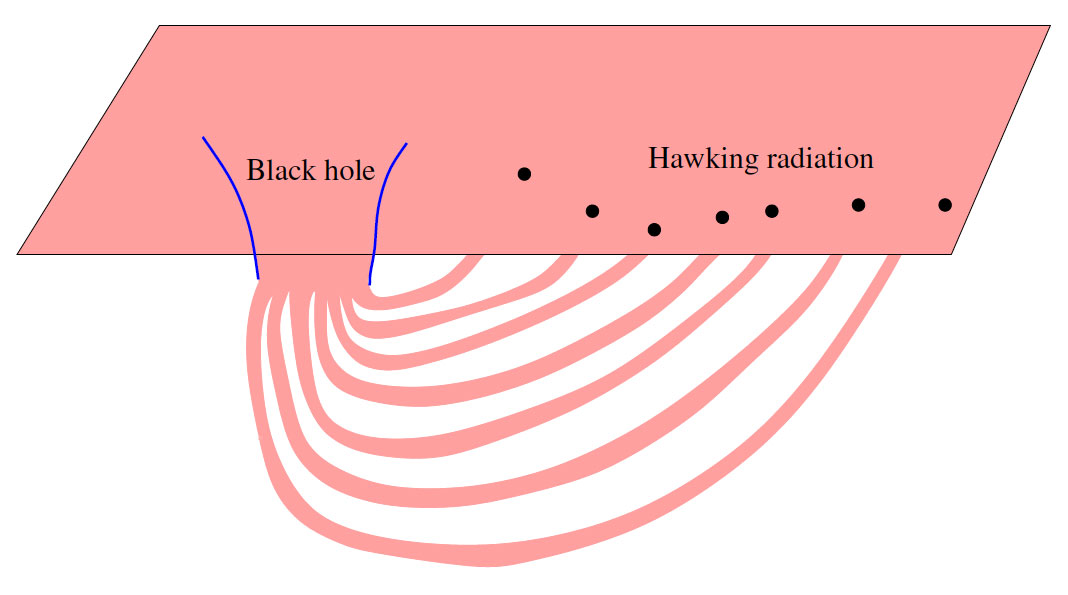
Outline of" octopus ", explains the idea ER = EPR
In the work of Maldacena and Susskind, proving that ER = EPR, there is a sketch, nicknamed "octopus": BH with tentacle-like wormholes leading to distant Hawking particles emitted from it. The author explains that the sketch illustrates “the intricacy between the BH and Hawking radiation. We believe that this entanglement leads to the internal geometry of the BH ”.
But according to Matt Wisser, a mathematician and a UTO expert from Queen Victoria University in Wellington, who has studied wormholes since the 1990s, does not have to be taken as an octopus sketch literally. Wormholes formed up to individual Hawking particles will be so thin that they will not crawl through the qubits. “A passable wormhole is transparent only for wave packets smaller than its radius in size,” explains Visser. “Large wave packets will simply bounce off small wormholes, and will not cross them to the other side.”
Stanford, co-author of the recent work of Maldacena and Young, acknowledges that this may be a problem in the simplest interpretation of the ER = EPR idea, in which every Hawking particle has its own wormhole tentacle. However, a more abstract interpretation of the idea, which he and his colleagues were considering, does not suffer from this shortcoming. "We think that to restore information from Hawking radiation using passable wormholes, it is necessary to collect Hawking radiation in one place and work with it in a rather complicated way." Such a collective dimension gives information about particles that had fallen into the BH earlier; as he says, he has a “large passable wormhole made up of small useless tentacles. Then the information is transmitted through this large wormhole. ” Maldacena added that, to put it simply, a new theory of quantum gravity may appear, generalized idea of geometry, in which ER equals EPR. “We think that quantum gravity must obey this principle,” he says. “We see it more as a guide for the theory.”
In the 1994 science book " Black Holes and the Folds of Time, " Kip Thorn admires the style of reasoning used in wormhole research. “No thought experiments give such a load on the laws of physics as those that appeared because of the telephone call of Karl Sagan,” he writes, “thought experiments asking the question:“ What does the infinitely advanced civilization, in terms of the laws of physics, and what can not? "