February 17, 2010 at 01:03
Genetic Code 2.0
- Transfer
A new approach to the use of genetic material has been discovered, which will allow the creation of proteins with properties unprecedented in the natural environment. A discovery may someday lead to the creation of a new or “improved” life form that incorporates these new materials.
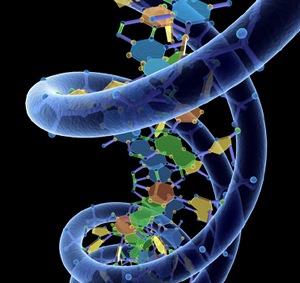
In all existing life forms, the four “letters” of the genetic code, called nucleotides , are read in triplets, so that three nucleotides encode an amino acid.
But that was before ... Jason Chin and his colleagues at Cambridge University redesigned cellular mechanisms so that they read the genetic code with quadruplets (in other words, 4 ).
In the genetic code that life has used to this day, there are 64 possible combinations of triplets of 4 nucleotide letters. These genetic "words" are called codons. Each codon either encodes an amino acid or tells the cell to stop the production of the protein chain. Now, Chin’s team has created 256 empty four-letter codons that can be “assigned” to amino acids that do not even exist. ( Note by translator: it should be understood that nucleotides encode amino acids not because they bind chemically, but because the ribosome, like a compiler, “knows” all 64 codes and can create an amino acid that matches the code. Therefore, the new 256 combinations are “empty” The normal ribosome does not know what to do with these codes. They must be "assigned" )
To achieve this result, the team had to rebuild several cellular mechanisms for the production of proteins. But they did not stop at getting a working system. To prove that the final genetic code works, they “assigned” quadriplet codons to two “unnatural” amino acids and included them in a real protein chain.
According to Chin, "This is the beginning of a parallel genetic code."
However, more interestingly, these two amino acids can react with each other, forming different types of chemical bonds, including those that usually connect proteins to form their three-dimensional structure.

The usual type of bonds — disulfide bonds — can be broken by changing temperature or acidity, as a result of which proteins lose their three-dimensional shape. For example, a chicken egg changes its texture and color during cooking precisely because of this process : albumin in a protein ( egg protein ) loses its three-dimensional structure and its physical characteristics change.
But new amino acids create stronger bonds and therefore the proteins formed from them can work in a much wider range of temperatures and environments, which, for example, can help create drugs that will not break down in inappropriate places in the gastrointestinal tract.
“This is a major breakthrough that opens up new theoretical horizons in synthetic biology,” said Craig Venter, one of the discoverers, who himself leads the Rockville Institute and is currently working on creating a synthetic organism from scratch.
In all existing life forms, the four “letters” of the genetic code, called nucleotides , are read in triplets, so that three nucleotides encode an amino acid.
But that was before ... Jason Chin and his colleagues at Cambridge University redesigned cellular mechanisms so that they read the genetic code with quadruplets (in other words, 4 ).
In the genetic code that life has used to this day, there are 64 possible combinations of triplets of 4 nucleotide letters. These genetic "words" are called codons. Each codon either encodes an amino acid or tells the cell to stop the production of the protein chain. Now, Chin’s team has created 256 empty four-letter codons that can be “assigned” to amino acids that do not even exist. ( Note by translator: it should be understood that nucleotides encode amino acids not because they bind chemically, but because the ribosome, like a compiler, “knows” all 64 codes and can create an amino acid that matches the code. Therefore, the new 256 combinations are “empty” The normal ribosome does not know what to do with these codes. They must be "assigned" )
Fundamental redesign
To achieve this result, the team had to rebuild several cellular mechanisms for the production of proteins. But they did not stop at getting a working system. To prove that the final genetic code works, they “assigned” quadriplet codons to two “unnatural” amino acids and included them in a real protein chain.
According to Chin, "This is the beginning of a parallel genetic code."
Strong bond
However, more interestingly, these two amino acids can react with each other, forming different types of chemical bonds, including those that usually connect proteins to form their three-dimensional structure.
The usual type of bonds — disulfide bonds — can be broken by changing temperature or acidity, as a result of which proteins lose their three-dimensional shape. For example, a chicken egg changes its texture and color during cooking precisely because of this process : albumin in a protein ( egg protein ) loses its three-dimensional structure and its physical characteristics change.
But new amino acids create stronger bonds and therefore the proteins formed from them can work in a much wider range of temperatures and environments, which, for example, can help create drugs that will not break down in inappropriate places in the gastrointestinal tract.
“This is a major breakthrough that opens up new theoretical horizons in synthetic biology,” said Craig Venter, one of the discoverers, who himself leads the Rockville Institute and is currently working on creating a synthetic organism from scratch.