January 18, 2010 at 13:43
Dismantling: Old music center
 It's amazing how preferences change over time. 15 years ago I wanted to buy a music center more than a new computer. I did not even realize that a set of individual components is much better. Not! It was a dream of a harvester, with numerous bulbs and baubles, and so that it was possible to rewrite CDs to a cassette. The fashion for such units gradually came to naught, homely theaters came to replace the lurid handsome men, and indeed it became somehow simpler with sound reproducing devices. Or is there more money? In any case, the purchase of an audio system is no longer a landmark event. Well, I bought and bought, which is already there.
And yet, when I saw my old Sony music center, visiting friends, I couldn’t just pass by. The unit that changed the second ten years was the very dream of my youth. It turned out that the piece of iron has been idle for several years, because when it is turned on, it makes a terrible rattle. I must say that I like to disassemble the glands even more than to use them. Therefore, having received the approval from the owners, he took up a screwdriver, setting himself the task of maximum - to repair, the task of minimum - to see how it worked and with honor to send the old man to a landfill.
UPD Moved to the "Old Iron". At least a couple of old devices are ready to become a victim of a screwdriver :)
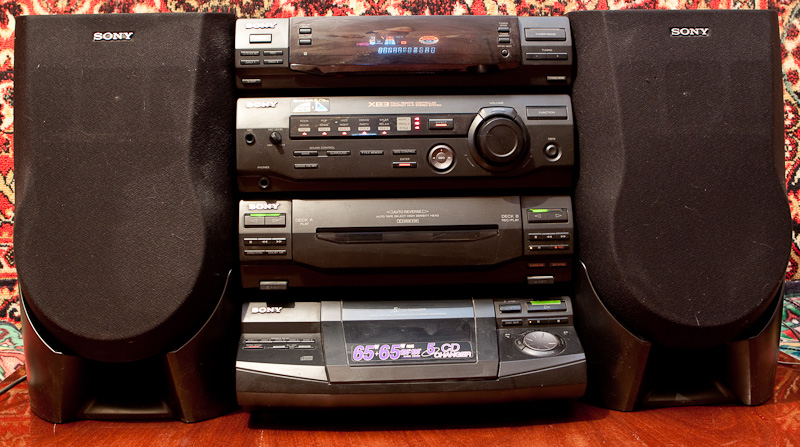
Before the showdown - a photo for memory, but it is not known how it will go. Against the authentic background of his nap, the Sony HCD-XB3 music center is presented. Surprisingly, this device is so outdated in just a dozen years. Cassettes - it’s understandable, the last century, but CDs have ceased to be relevant. Than to charge the carousel available on this unit for 5 CDs, it is easier to connect a laptop or MP3 player to the line input. On a very useful site dedicated to technology and its repair monitor.net.ru , a service manual for this miracle was found with detailed disassembly instructions. Did I begin to study it before starting the repair? No, as that would be too boring! But in a couple of difficult moments, the instruction helped me a lot.
The characteristics of the device are as follows:
Outputpower 2x65 Watt RMS
Two cassette decks with auto-reverse and electronic control, frequency range 60-13000 Hz for standard Type I tape
CD changer for five discs , frequency range 2-20000 Hz, signal-to-noise ratio> 90dB FM / VHF
radio receiver (65 -74, 87.5-108 MHz), DV (153-279 kHz), CB (531-1602 kHz)
Microphone jack and karaoke function
Line in and out for the vinyl player, there is a built-in phono corrector (thanks standov )
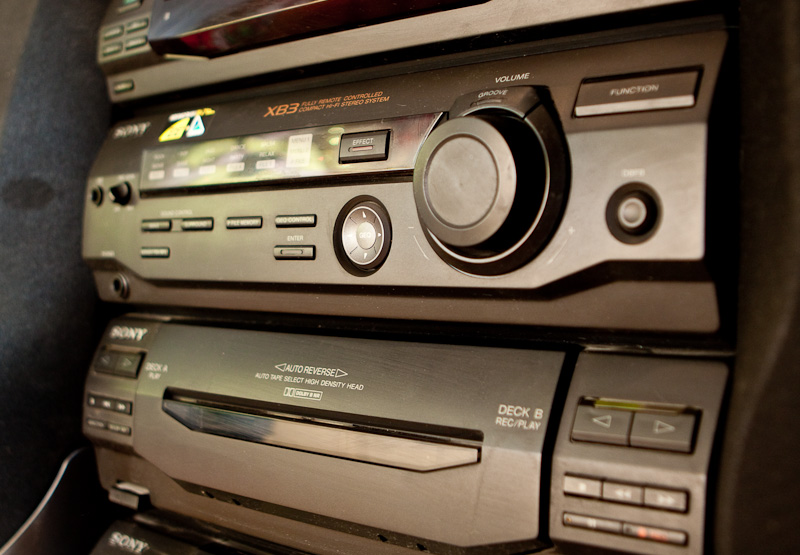
In the 90s, manufacturers of various equipment (not just music centers) underwent one major change: instead of developing the devices efficiently, they began to hang them with simple “marketing” features, actively advertising them. The hardware at the same time ceased to differ even from different manufacturers. As it becomes clear from the service manual, the cassette deck, CD-player and amplifier of this model are almost the same in almost a dozen similar music centers to the last screw. In the Sony XB3, such useless add-ons are also full. Various pre-installed equalizers, a separate bass enhancement system and a large “Groove” button that makes the sound even more wooden, karaoke and a couple of DJ lotions, such as the ability to loop a specific piece of a song directly during playback.
Another fashionable feature of the music center is a solid cover that covers two cassette decks at once. The solution is unusual, but convenient in that you can at any time, without turning off the playback, open the lid and see how much tape is left to the end.

Stick a huge blame with an indication of power - this is sacred! It’s good that the watts are not Chinese (they produce 1000W).

I am starting to disassemble. The top and side covers are combined into one element, so it does not take much time. From the photo you can estimate how much dust has accumulated inside for many years. From the inside, the music center is presented in the form of several boards. The panel in the photo on the right is responsible for control and the LCD (UPD. Never an LCD! As standov says , it is a vacuum luminescent). In the background, there is a preamplifier board with a cassette deck and a CD player connected to it. A separate module with two linear inputs is attached to the top of the board. At the bottom, a power amplifier is screwed to a large radiator, and in the foreground the power supply is visible.

Close-up noise filter Dolby B, a chip manufactured by Hitachi.
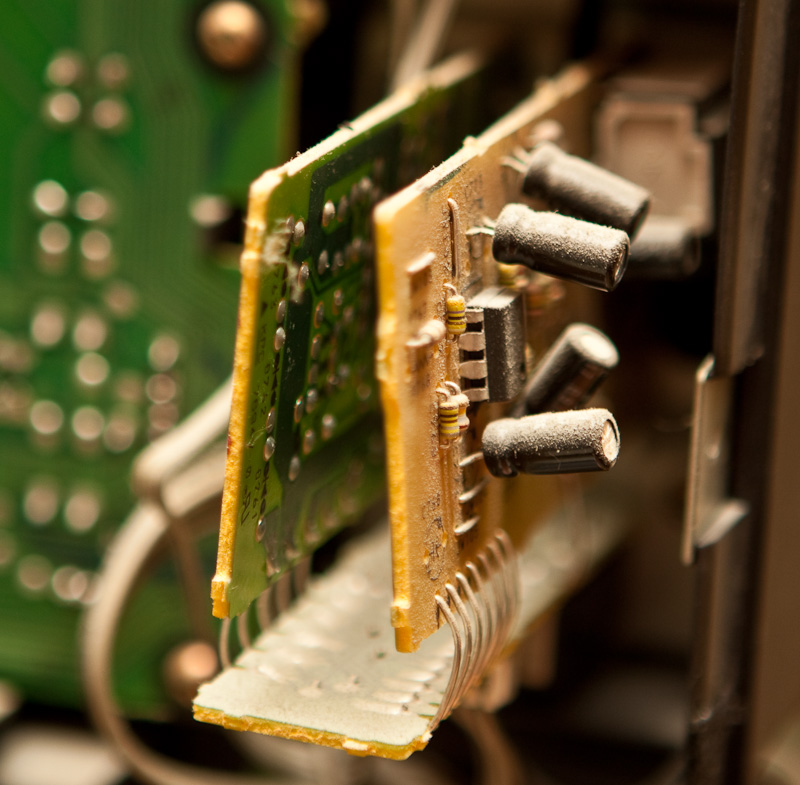
Unusually looking karaoke system board (on the other hand - a microphone jack and level control).
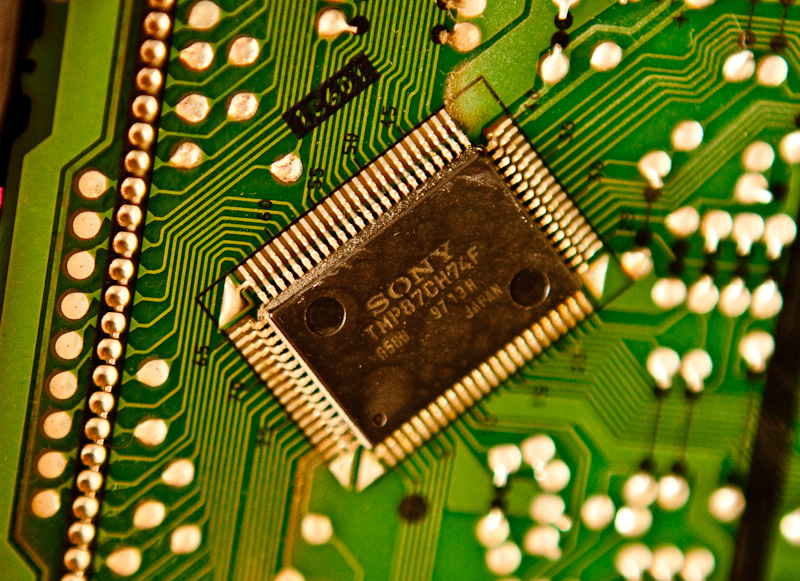
The microcircuit with the Sony logo, although the number on the Internet is an 8-bit Toshiba microcontroller .
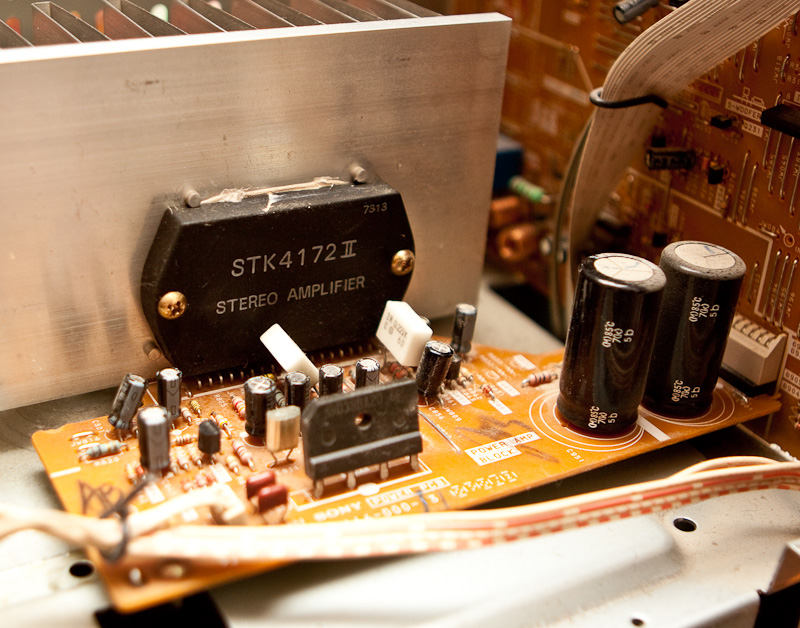
The most interesting part of the music center is the power amplifier, based on the STK4172II element manufactured by Sanyo. Judging by the datasheet, the amplifier provides an output power in the range of 6-50 watts.
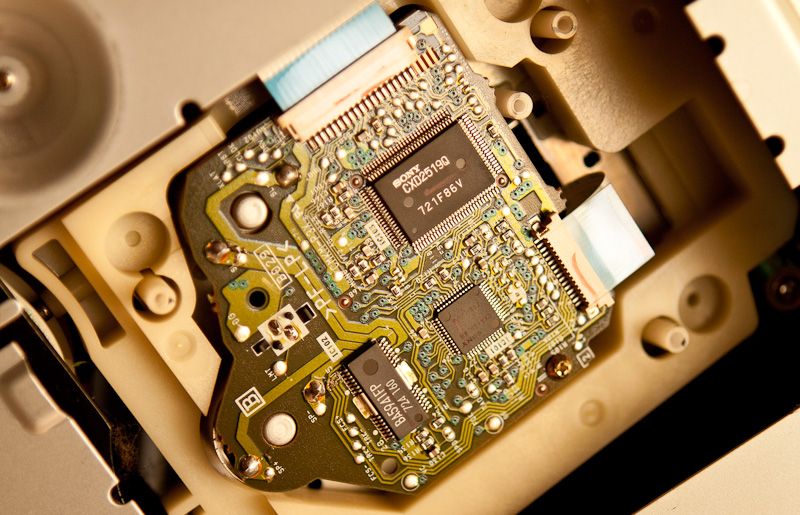
An unusual board that controls a CD player. It is hidden under a special hatch on the bottom of the music center. The CXD2519Q is a digital signal processor.
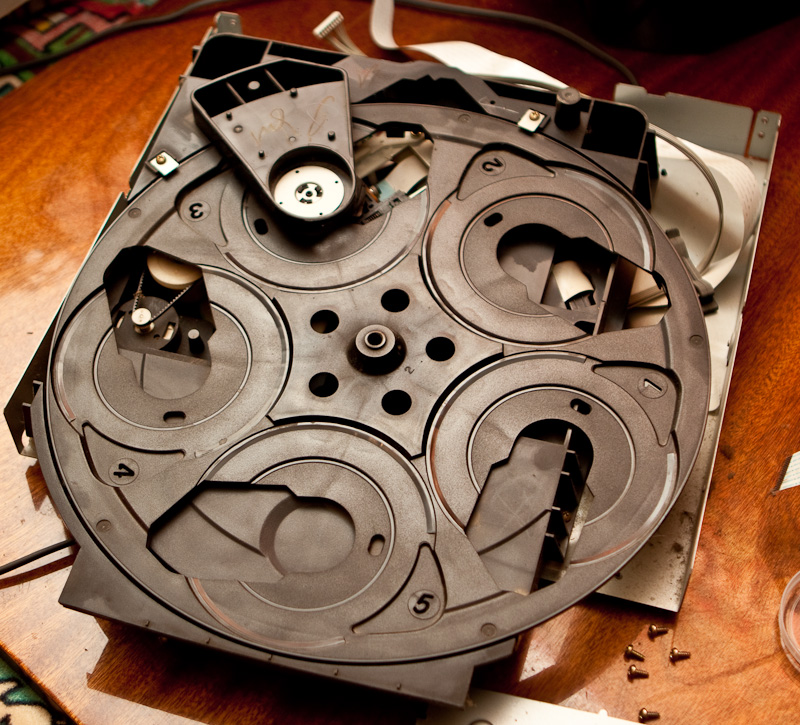
To disassemble the music center was completely simple enough. It is only necessary to disable several flexible cables (they are all of different sizes - you will not mix it up) and unscrew a dozen screws. This is what the “carousel" looks like - a separate module of the CD changer.
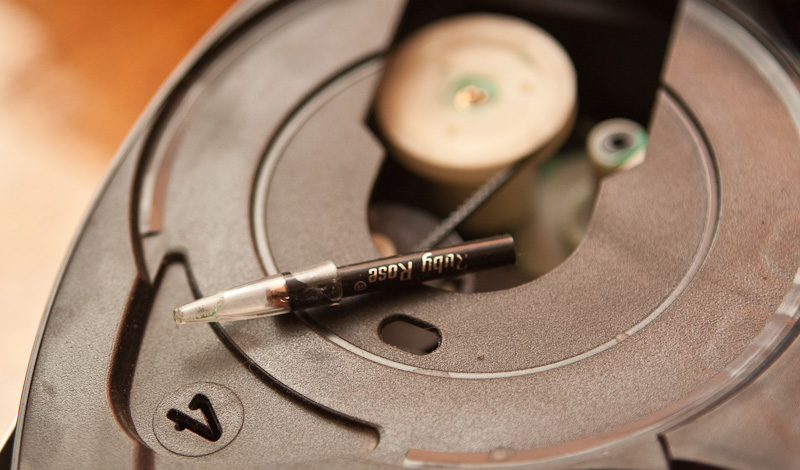
The first (but not the only, as it turned out later) reason for the terrible sounds that the center made when turned on was immediately discovered. A small pencil stuck between the gears rotating the changer disk.
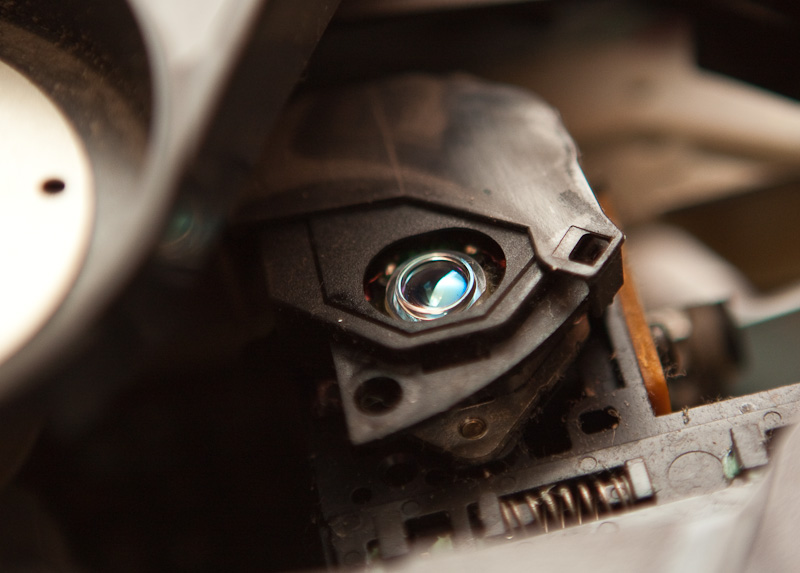
The lens in the read head of the CD player. Just in case, rubbed it.
I immediately, putting everything together on a live thread, tried to play a CD (which, incidentally, also lay in the music center for at least three years). Happened! The joy was somewhat overshadowed by the fact that the rattle did not completely disappear, and now it was heard only from the cassette deck.
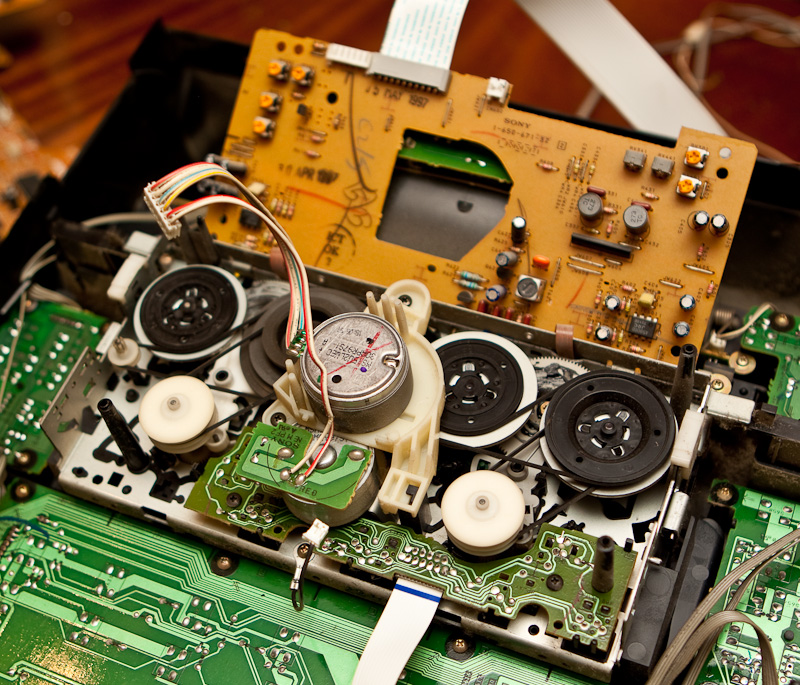
Removing the cartridge module was the only task for which I had to read the service manual - otherwise I would definitely break something. In the photo there is a cassette deck with the board removed, to which there are cables from magnetic heads. Not the highest quality design: both decks are controlled by a single motor (in the center). Another auxiliary motor is responsible for autoreverse, and, as it turned out later, the problem was in it.
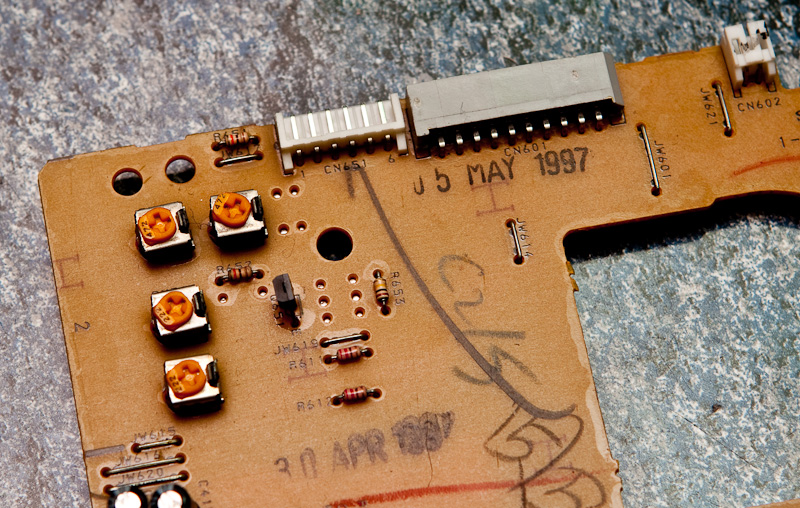
Thanks to the stamp on the control board of the cassette deck, it was possible to determine the year of release of the music center - 1997. 12 years old, the same age as my old IBM ThinkPad .

Swivel magnetic head and rollers. Around dust, dirt and rust. About two hours I tried to establish a stalled mechanism. As it turned out, autoreverse caused all the problems. Apparently, due to the loose fitting “fashionable” cover of the cassette deck, a huge amount of dust accumulated inside. The mechanism of rotation of the head and its "supply" to the magnetic tape gradually clogged, and it became increasingly difficult to turn it with the help of plastic gears. As a result, the smallest gear on the auxiliary engine (it just starts the auto reverse mechanism) cracked and flew off the mount. I put the gear back in place and, manually rotating the mechanism, “developed” it. But this is clearly not for long: sooner or later, the gear will fly off again, and the cassette deck will not work. Considering how often I listen to tapes (once a year it still happens),
Reassembling the music center did not take much time and, surprisingly, there was not a single extra screw left! The music center no longer emits a terrifying rattle, and can fulfill the honorable duties of an amplifier for a laptop and a radio alarm clock. And I got a lot of pleasure, delving into dusty mechanics, and imagining how much joy such a piece of iron would bring me if it came to me new, in 1997.
Of course, this is not the most remarkable music center. It is not too high-quality, it has few really good technical solutions, too many light bulbs and meaningless functions. The speakers, although large, are made of thin chipboard, and at a high volume they are a little “chatter”. Trying to simultaneously pull two rubber straps onto one engine, I thought about how much easier it was to live with information carriers devoid of moving elements. Modern MP3-players are not afraid of dust, they do not need to be cleaned with cotton wool with alcohol, there is no need to adjust the position of the heads. I think b aboutmost of the nostalgia for cassettes or vinyl (I'm sick of this too) is due to the fact that it was not just listening to music, it was a process! And now, click on the button and that’s it? Not interested. However, I’m still happy about progress, and for nostalgia I will continue to continue to repair (or break) such old devices.