Interview with Richard Dawkins. About the unloved meme, martyrs of atheism, correct theology and conversation with God
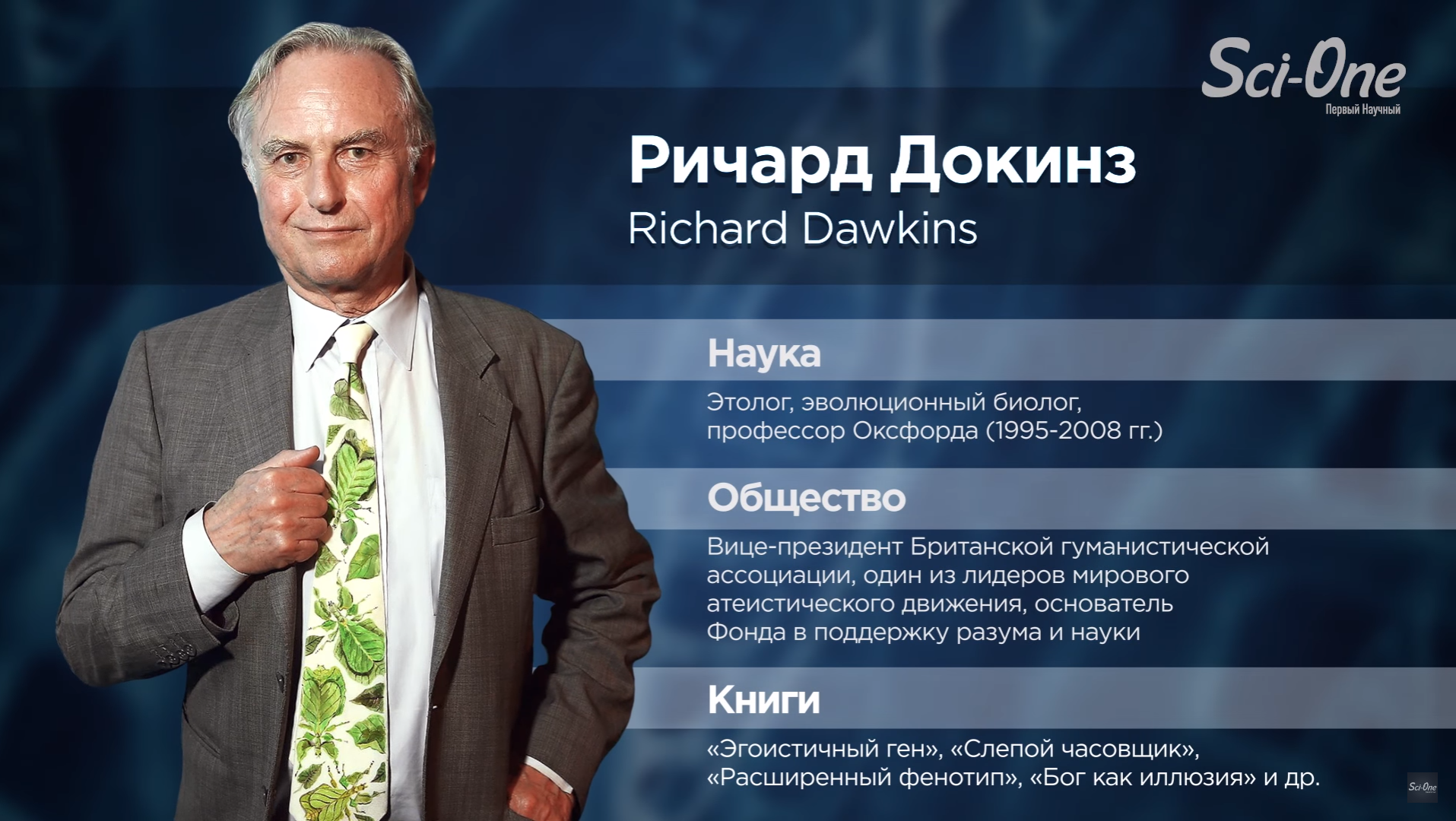
The June Geek Picnic Festival in St. Petersburg was visited by English evolutionary biologist, ethologist, popularizer of science Richard Dawkins - the founder of the Foundation for the Support of Mind and Science, one of the leaders of the world atheist movement, vice president of the British Humanist Association.
The Sci-One and Vert Dider teams could not get past such an event and interviewed this outstanding man! So, we present to you a version of the interview adapted for reading (and the video version is here ). Welcome under cat.
Vert Dider: Hello, Richard. If you don't mind, we will start with a question that worries many of our subscribers, and us too.
As you know, in the USSR, atheism was a generally accepted ideology; there were no religions officially. But after the collapse of the Soviet Union, and especially in the 90s, people began to actively believe in wizards, psychics ... What they did not believe in only then. And it is a bit strange that after a long period of official atheism, the pendulum swung back toward religion, mysticism, and so on. As an evolutionary biologist, can you guess why this happened? How did society turn from atheistic to religious and prone to different beliefs?
Richard Dawkins:The first thing that comes to mind is the response to an attempt by the state to implant atheism. It is logical that people would try to deal with attempts to indicate what you can believe and what not. I do not understand this, in my opinion there is no reason to believe religions at all, and such situations upset me. It seems to be the same in China. I do not know how else it can be explained, except as a response to the existing regime.
VD: Due to too much pressure, did everything roll back?
R. Dawkins: I suppose so.
VD: Many subscribers are asking for your advice. Perhaps you are familiar with the situation in Russia - religion has gained more power and popularity, laws have appeared, for example, “On the Protection of Believers' Feelings”, and so on. And many people ask what to do if they live in a religious environment, say, in a Muslim country, in a religious family, and no one shares their views and beliefs? They are, in fact, alone. What should they do? Trying to escape to another country? To another society? Should you try to defend their views or is it better not to risk your life and sit quietly for yourself?
R. Dawkins:I do not know how appropriate it is to give advice, I am not familiar with the situation, but I understand perfectly well that people who do not share the religious views of their surroundings find themselves in a very tragic situation. This is happening in America and in Muslim countries. In their place, I would argue. I would not run away, I would directly tell religious relatives that their views are foolish. Or let them explain, tell you why they believe. "Do you have a reason for faith or not?" “This is stupid!” I would argue. Of course, this is not for everyone. And it’s very hard if, as you said, a person is rejected, persecuted in his own family.
VD: You are a person with a wealth of experience in disputes on similar topics, in attempts to convey to people that their faith is unfounded. And how successful are attempts to conduct a reasonable discussion with believers?
R. Dawkins: I think it’s almost useless to those who are completely blinded by faith. But I think that many people have simply not thought about it enough. They never asked such questions. And I would try to reach such people.
VD: Recently we have a new law, I have already mentioned it - “On the protection of the feelings of believers”. In fact, you can even get to prison for some rude statement, for a caricature or for a post on a social network. In general, if there is a believer who is touched, you can be sued and you will have problems. Can the fact of the existence of atheism be considered an insult to the feelings of believers?
R. Dawkins: Will I be sent to prison if I say that this is an incredibly stupid and idiotic law?
VD: Let's see ... most likely not.
R. Dawkins: Insulting people is one thing. Insulting beliefs is another. Faith has no feelings, it just has it. The law under which you can go to jail for insulting someone's faith is absolute nonsense and ridiculous.
VD: On the ridicule question. Recently, theology, the “science” of religion, was made the official science, specialty. Now you can get a degree in philosophy, but the specialty "Theology" and the first dissertation have already been defended. We used methods like “personal experience”, “spiritual experience”, “personal experience of faith” and so on. As a result, the work was accepted.
Do you think it is possible to say that it is dangerous to recognize theology as a science at the official level?
R. Dawkins:If you look at the department of theology at some university, it turns out that people there are engaged in worthy academic research. For example, they translate ancient documents, restore manuscripts, compare different versions of the book of Isaiah , for example, study the history of the bible and archeology. This is all a wonderful, decent academic work. Theology ceases to be a science when it goes into the study of doctrines such as transubstantia (Transformation of substance. - Note. Ed. ), The sacraments of the holy trinity, and so on. Such topics for study are certainly not worthy of academic discipline and degrees.
VD: But the fact that theology is a science in many respected universities, like in Cambridge ...
R. Dawkins:As I said, if theology involves a scientific approach, the study of documents, biblical history, and so on - this is a worthy subject.
VD: In that case, you need to follow this.
R. Dawkins: Well, of course. I repeat, the study of the sacraments, the mysteries of the trinity, the mysteries of the transubstantiation is nonsense, and absolutely not a subject for the university.
VD: Another interesting question. It is known that many people, fanatics, are ready to sacrifice their lives, protecting and spreading their faith. Do you think a situation is possible when an atheist will be ready to risk his life, to endure punishment by spreading his atheistic ideas? And what about you? You can be considered an “icon”, although this is hardly the right word ... More precisely, one of the leaders of atheism. Are you ready to suffer, risk your life?
R. Dawkins: No It would be irrational.
VD: But some people do that. You have probably heard of cases when, for example, in Muslim countries people were killed for their beliefs.
R. Dawkins: They showed incredible courage, but I am shocked that they are at risk and that their lives are in danger. My organization in the United States, the Richard Dawkins Foundation Investigation Center , is just trying to help people, for example, in Bangladesh, whose lives are at risk only because they use free speech and, often, quite gently. And every time I am shocked that religion has decided to reserve the right to kill people simply because they hold a different point of view.
VD: Great, now let's move on to a more interesting and fun - to science. You have written many scientific articles and scientific books. Is there anything that you would like to change in what you have already written? In your books that have already been published.
R. Dawkins: I would like to answer this question in the affirmative, but I can hardly. In a sense, scientists make a name for themselves by changing their point of view, unlike politicians, but I have not changed it. For example, the main idea of the “ Egoistic Gene ” has not lost its relevance today, and the latest wonderful discoveries in genomics have not reduced its significance.
VD: But there are two or three editions of the “Selfish Gene”. He is reissued.
R. Dawkins:Yes, there are two major publications. The original one was in 1976 and updated in 1989, which was most likely completed, there are almost no differences from the original, just added two chapters and significantly expanded the notes after the book. So this is only an addition to the original, no special changes.
VD: Do you have any ideas for new books? Anything over which you have long wanted to work, but it was not possible?
R. Dawkins: Well, quite recently, the book Science in the Soul was published in the UK - a collection of my works and articles already published (I hope it will be translated into Russian), and while I'm busy promoting this book. I have no specific plans, but there are several possible options that I ponder.
In the title of the book there is the word “soul”, which is a bit provocative, because “soul” is rather something religious. Here we are more likely talking about the romance of science, following the example of Carl Sagan , talking about the poetry of science.
VD: Sounds beautiful.
In Russia, your first book, The Selfish Gene, is now on the list of recommended literature in the university course on evolutionary biology. But the subsequent books fell, rather, into the category of popular science literature. Why do you think so?
R. Dawkins: In fact, they have one target audience. But I fully understand why the “Selfish Gene” was included in the program of the university - it explains the central doctrine of neo-Darwinism from new points of view., gene-based evolutionary theory. Other books, such as The Blind Watchmaker , are more aimed at ordinary people, without affecting what the student who is studying biology needs to know.
VD: One of the big contributions of the Selfish Gene to culture and the world was the theory of memes . One of the most popular questions from our subscribers: what is your favorite meme?
R. Dawkins:Meme is all that goes from brain to brain. I do not think that the word "favorite" is generally appropriate here. I find it difficult to answer this question. This is just a theory about how culture can be viewed from the point of view of Darwinism. And “beloved” here can mean the most vivid example of a self-replicating meme, and it is not at all necessary that it will be pleasant to me. For example, it may be a religion. This is a very successful meme, but I despise religion, so I can't call it a favorite meme.
VD: Can science be considered a meme?
R. Dawkins: Anything that spreads - can. Any successful idea that can spread widely can be considered a meme, but I do not think this terminology will be useful.
VD: Your concept of meme theory itself has remained the same since you came up with it? Has anything changed?
R. Dawkins: For the most part stayed. The fact is that Denn Dennett , and Susan Blackmore , seized upon the idea of memes and found a much larger application for her than I had intended. For me, it was just a way to explain that the Darwinian idea of self-replication and survival also applies to culture. Dennett and Blackmore began to explain directly ... Dennett - the human mind, the human consciousness, and Susan Blackmore - the growth of the human brain.
VD: And she also has a theory of T-memes, Techno-memes ...
R. Dawkins: Yes, but I don't know why she needs a new word. For me, it's just memes.
VD: Как вам кажется, замедляют ли этические вопросы научный прогресс? Например, клонирование, эксперименты над людьми, над человеческими эмбрионами, которые запрещены во многих странах, не тормозит ли это прогресс?
R. Dawkins:In fact, I do not react so sharply to this, like many others. I don’t have some kind of disgust, I don’t consider it a “game of god.” I believe that ethics is appropriate when there is suffering. Cloning, for example, if no one suffers from this, does not cause me to protest. For example, the world's first cloned child, the first cloned person, will probably suffer because of the constant attention of the newspapers, and it is very unpleasant to live. This is the ethical side, because of which I would be worried, but in no way because we allegedly overstep the limits of what is permitted or something else. I am interested in science, I would like to see it from a scientific point of view, but I very much sympathize with the life that is ahead of the first cloned person.
VD: What about the genetic experiments that are currently being conducted on other animals? Say, mice are often used in experiences that cause suffering.
R. Dawkins: It bothers me, it’s just worth worrying about - that mice are suffering. But many are not experiencing because of the suffering of mice, but because of, for example, the blurring of the line between people and animals. And this is not a reason for worry.
VD: Do you expect any fundamental discoveries in evolutionary biology?
R. Dawkins:I think that due to the fact that genetics is increasingly moving into the digital sphere and information technology, in fact, we can expect a large number of exciting discoveries from molecular genetics. It is becoming easier and cheaper to sequence the DNA of an animal of any kind, and this brings us closer to creating the full tree of life, the family tree of all living things. Progress is fast and great.
VD: What question about evolutionary biology or genetics would you most like to receive an answer to? Complete the tree of life or something else?
R. Dawkins:Well, it will happen anyway. Much more mysterious for me is the human consciousness - how the brain and its physiology give rise to those subjective sensations that are familiar to each of us. This is a big question. Another one is the origin of life, I would like to know how life originated.
VD: One of the questions that many people want to find the answer to is the question of immortality. Many want to become immortal - no death - a great life! But we know from the example of other essentially immortal species, say, “ immortal jellyfish ” and other simple animals, that immortality is not so simple and it is not always so wonderful. Would you like people to be immortal?
R. Dawkins: But then everyone will have to stop multiplying, otherwise people will become too many.
VD: Colonization of other planets?
R. Dawkins: This is a temporary solution. Let's say we will create a colony on Mars, it is quite likely, but we will fill it up quite quickly.
VD: And if for a second you forget about the technical side of immortality (overpopulation and so on)? The very idea of immortality for a man ... Do you think it is worth exploring? Should we strive for this?
R. Dawkins: Well, I would not refuse to live a hundred and fifty years. And then, I think that's enough for me.
VD: Some personal questions. You said a hundred and fifty years. What about death itself? Do you often think about her?
R. Dawkins:I think that in death we fear eternity. That thought of something that will go on and on. And, in my opinion, it is better to spend eternity under general anesthesia, which will happen.
VD: So you’ve already planned? Once, during your conversation, when you were on stage with Neil Degrass Tyson on the question of what happens after death, Neal said he wanted to be buried, then all the nutrients would return to the plants. We asked Lawrence Krauss about this - he would choose cremation, provided that all carbon dioxide is processed. What about you?
R. Dawkins: Then I recall the words of my wonderful friend, William Hamilton. He wanted to be laid in the jungles of Brazil, surrounded by a fence to protect him from various scavengers. Then the grave digger will take it underground. And the next year, the larvae, nourished by its flesh, will turn into beetles, get out and the blue cloud will rise up, scattering through the forest canopy. And he will gain immortality in this iridescent blue cloud. Unfortunately, this did not happen ...
VD: For yourself, would you like something similar?
R. Dawkins: I didn’t really think about it.
VD: Death is a very difficult topic for some. For example, for children. How can death be explained to children (especially if someone close is dead)? In such situations, people turn to religion and fairy tales about the afterlife, a better world and so on. How to explain something like a child without resorting to fairy tales about the afterlife?
R. Dawkins: I don’t have a universal solution, but I don’t like to lie or somehow deceive children. I think it’s worth telling the truth anyway, and you can, for example, say: “Your grandmother has died, but she no longer suffers - she has found peace.” I think my analogy with general anesthesia is appropriate here.
VD: Is there anything in your life that you regret? And if so, what do you regret the most?
R. Dawkins:I don’t know if I can answer for myself, but an amusing quote from the English poet John Betchemen comes to mind - when he was already eighty-ninety years old, he was asked the same question: “John, have you lived a long, long life, do you regret about someday? ”and he replied:“ Sex would be more! ”
VD: I suggest a small thought experiment: you met a god / jinn / someone who can fulfill desires. You have one desire and you can change something right here and now. What would you make?
R. Dawkins:It is likely that everyone around the world would build their lives and beliefs, based on evidence, abandon superstitions in any form, including religion. They strived to do good, lived according to their conscience, rejoice in life and make the world better before death than when they came to it.
VD: Do you remember your first love? The first time you fell in love is the feeling of butterflies in the stomach ... Many people oppose this feeling of love, falling in love and rationality. Did you have a desire to change, to sacrifice rationality for this wonderful feeling of love?
R. Dawkins:As a biologist, I can rationally understand what “love” is and understand it from this point of view. But this does not detract from the feeling of passion that I can feel as a person. After all, I am a person (even though I understand where “love” comes from and this deepest passion) - I enjoy it.
VD: What is “happiness” in your understanding? When do you personally feel happy?
R. Dawkins: I once participated in one talk show on the BBC, where we were asked similar questions. And it was awful. We were just asked “What is happiness?” And one of the invited guests, the poet, said: “Happiness is a mountain stream flying down the slope between the stones ...”. And I do not do this.
VD: But ... Well, after all, even from a biology point of view, there is a feeling that people call "happiness." And in your case, when are you well? What launches the reward system in your brain?
R. Dawkins: Probably something similar to what John Betjemen then answered.
VD: One famous scientist, physicist, Sergey Kapitsa was the host of a talk show where he invited various scientists and in the end he always asked them to make a prediction several years ahead - they pulled out a piece of paper with the number of years and made a prediction. Can you make a prediction for the future - how do you see our life as a whole species on this planet (or not only on this one) in, say, fifty years? Or twenty?
R. Dawkins:Well, fifty and twenty years is too short a time to ask an evolutionist. This is the scale of history, not evolution. Here I can answer, not as a scientist, but as a citizen observing the world. I think computer evolution, Moore's law, the rapid doubling of computing power is likely to continue, and the role of computing electronics in our lives will continue to grow. Someone this scares because of the possibility of the emergence of more and more complex artificial intelligence. We will see how computers take away not only physical labor, but also the work of doctors, lawyers, and so on. A lot of things will happen in this direction. Virtual reality, when you see not what is in front of you, but a world created by a computer, changing depending on your actions. And if the virtual reality becomes so qualitative that it will be impossible to distinguish it from the reality, people will be able to simply go to that world, becoming such ideal “clowns” who do not go anywhere and live in a fantasy world created by computer. We go to the territory of science fiction. Colonization of the planets looks like a likely event. More ambitious people talk about landscaping Mars about histerraforming . This is a bold project. Life under a large dome, “in greenhouses” scattered around the planet, seems to be more realistic.
VD: So in this respect you are optimistic about the future?
R. Dawkins: Well, I can't be sure. Some of my colleagues, such as royal astronomer Martin Rees, believe that our chances of surviving the twenty-first century are 50%. There are other pessimists.
VD: Do you have any predictions about evolutionary change?
R. Dawkins:Not sure about that. Now it is difficult to identify the factors of evolutionary pressure that affect us. In ancient times, say, a million years ago, selection pressure was provided by hunger, disease, lions that ate us, poisonous snakes, falls from trees and other things. Today, selection pressure, if it exists, is constantly changing along with human culture. And it’s not even clear if there is constant pressure in any one direction.
VD: Is it possible that we will leave natural selection, when the forces of nature decide who will live and who will not, towards cultural selection, in which they will fight for the idea?
R. Dawkins:Maybe. In part, this is the essence of meme theory - selection can move from genes to memes. And this is already happening - the changes that we will see will be cultural rather than genetic.
VD: And what can we do, ordinary people scattered in distant cities, who have no special opportunities, but are very willing to spread the meme of science and critical thinking. What we can do?
R. Dawkins: Well, computers are getting cheaper, I think computers will become widely available even in poor countries and this will allow people to get an education and enjoy the fruits of civilization.
VD: One more thing, finally. Representatives of the two channels gathered here, and together we have about half a million subscribers keen on science ... What would you like to tell them?
R. Dawkins:The only reason to believe in anything is evidence. Do not trust those who are trying to convince you that faith, revelation, authority, or scripture can tell you at least something valuable. Evidence is the only reason to believe in anything.
We remind you that this was a transcript of a video interview with Richard Dawkins.
Just in case, we attach the video itself:
May science be with you.