Flaming motor of Saturn-5
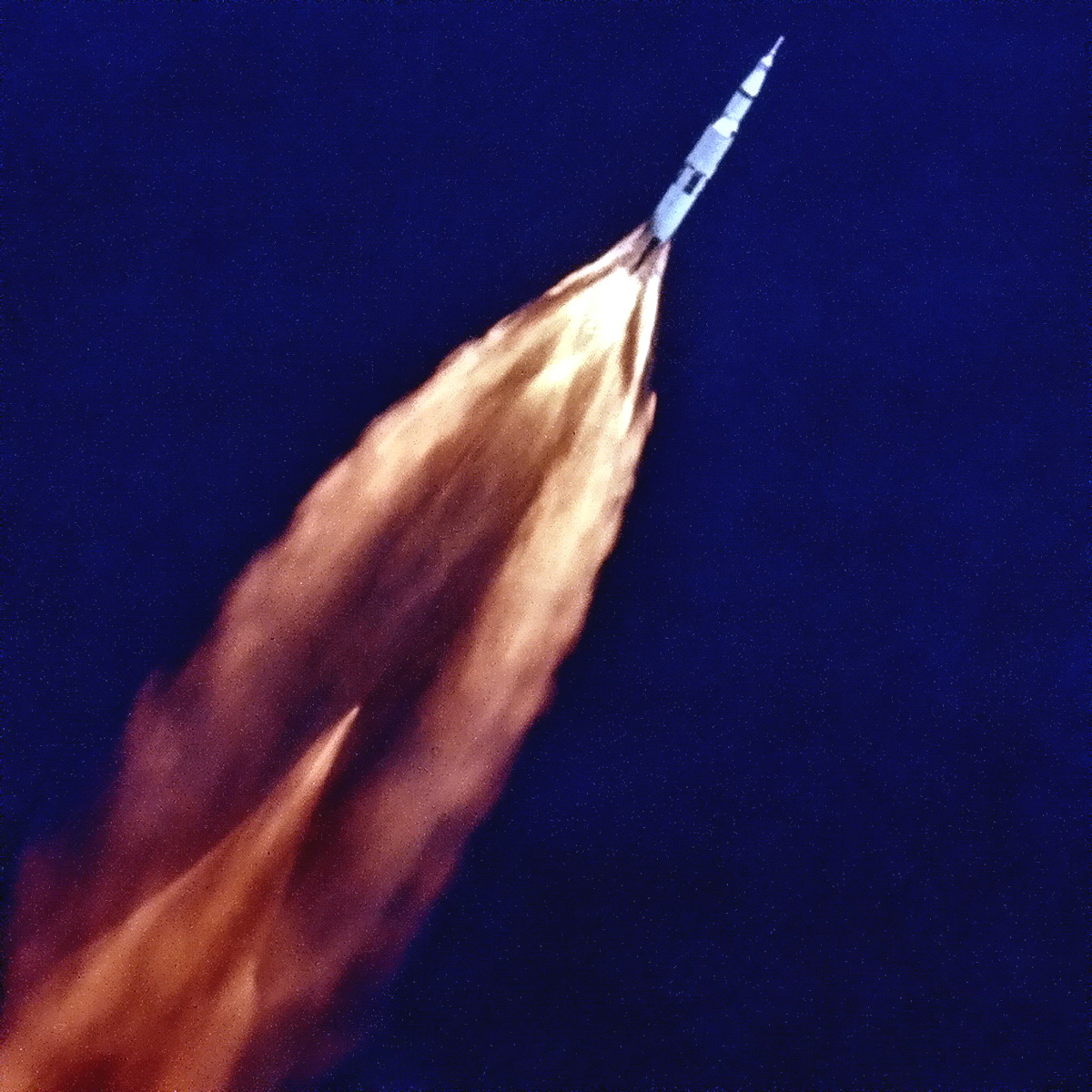
So on July 16, 1969 at 13:32 GMT (UTC), “a small step for one person” began. A rocket with an initial mass of 2 725 tons was raised to an altitude of 67 km and five engines of the 1st stage F-1 were dispersed to 2.75 km / s with a 690-ton thrust at the ground level. It is still the most powerful motor in history, because The Soviet RD-170 with a 740-ton load is a four-rocket engine in one “team”. Mass insanity in denial of lunar flights, among other things, is expressed in attempts to challenge the existence of an F-1 or reduce its performance.
One of these studies, if you can call it a stretch of facts on fantasy, belongs to Gennady Ivchenkov with his article "Assessment of F-1 characteristics, based on the analysis of heat transfer and the strength of the tubular cooling jacket" www.manonmoon.ru/articles/st65.pdf . Being a Ph.D., who studied rocket engines when he was a student and a graduate student at MVTU, he wrote a seemingly serious work, with the aim of proving that the main engine of Saturn-5 could not develop traction above 500 tons. From this it would follow that Apollos 8,10,11,12,13,14,15,16,17 did not fly to the Moon, and the human foot did not step on its dusty surface. But this attempt to pull reality behind the ears to the desired conclusion, like all the other fruits of lunar paranoia, was unsuccessful. Below is the article www.manonmoon.ru/articles/st65.pdfsubjected to critical analysis and wherever nothing else is explicitly said, it will only be about her.
On page 1, the author demonstrates his prejudice, which sets the tone for the publication. " The Americans themselves were the first to raise this question almost immediately after the Apollo flights. Over the following years, a large number of direct and indirect evidence came to light that at least some of these flights were really staged ." The author makes it clear to the reader that "the Americans themselves" were serious specialists. On the founding fathers of the sect lunobortsy - Keising and Rene can be found in the article geektimes.ru/post/285236 . These “Americans themselves” were not specialists that were not entirely serious, but none at all!
Against the background of other “whistleblowers”, including Dr.Sc. A.I. Popov (he paid attention in the article geektimes.ru/post/274384 ), Gennady Ivchenkov looks preferable. However, his expert aplomb is not confirmed on closer examination. Like all Lunoborians, the author builds objections on his own mistakes and facts that are incomprehensible to him - Ivchenkov. As usual, this pseudo-scientific messivo is imbued with anti-Americanism and seasoned with journalistic sarcasm.
On page 2, the author writes. “ Now a kind of“ critical mass ”of evidence has accumulated, including the same photos and film materials, astronaut stories, allegedly moon stones, surprising researchers, and inconsistencies (and apparent nonsense) in the designs of“ Saturn-5 ”, its engines, ship“ Apollo "and landing module"In fact, the Web has accumulated a huge array of quasi-scientific fabrications that millions of profane people take as solid evidence that" Americans did not fly to the moon.
"" In particular, who guessed to design the Apollo service module from sectors (like orange slices) and make in the service compartment a large (50 degrees around the circumference) longitudinal reserve compartment, which must be loaded with ballast (?? !!) to balance the center of gravity? "The author is outraged by the fact that he - Ivchenkov, who has never been involved in designing space and other machines, does not understand the technical solutions inherent in Apollo? Three interrogative and two exclamation marks reinforce this ridiculous pathos.
And further."Who guessed to put there an overweight engine of AJ-10-137, 11 tons in size and weight, when the Americans themselves write that it was twice as large as necessary, while the more suitable engine was (AJ-10, 5) tons) and weighed 200 kg less? Rocket engines with their problems are only part of the question . "
According to data from epizodsspace.airbase.ru/bibl/raketostr3/obl.html, AJ-10-137 thrust was slightly less - 9.76 tons, and some sources give 9.3 tons. Following Wikipedia, the author claims that the thrust was twice as much as is needed to enter the circumlunar orbit. Obviously, for a ship with an initial mass of more than 43 tons, an extra 200 kg of the weight of the LRE is not a problem. Approximately such a mass had a lunobul that Apollos 15, 16 and 17 carried with them. Even if this excessive thrust was not needed, this fact does not serve as a basis for declaring that " Rocket engines with their problems are only part of the question . " As will be shown later, these problems are in the author’s head!
In the English-language Wikipedia, which is referred to by the “LRE Expert” (p. 3) en.wikipedia.org/wiki/Apollo_Command/Service_ModuleThis explanation is given. The initial profile of the mission assumed the landing of the entire Apollo spacecraft on the moon, so the engine was designed with a greater burden. At the time when the profile was changed, work on AJ-10-137 was already boiling, and the graphics of the lunar program were very hard. But I think that the engine with a margin of thrust was deliberately placed on the Apollo, because reliability was the main priority, not optimization. As is the case with moonbeats, Ivchenkov clings to trifles, trying to inflate fundamental problems from them.
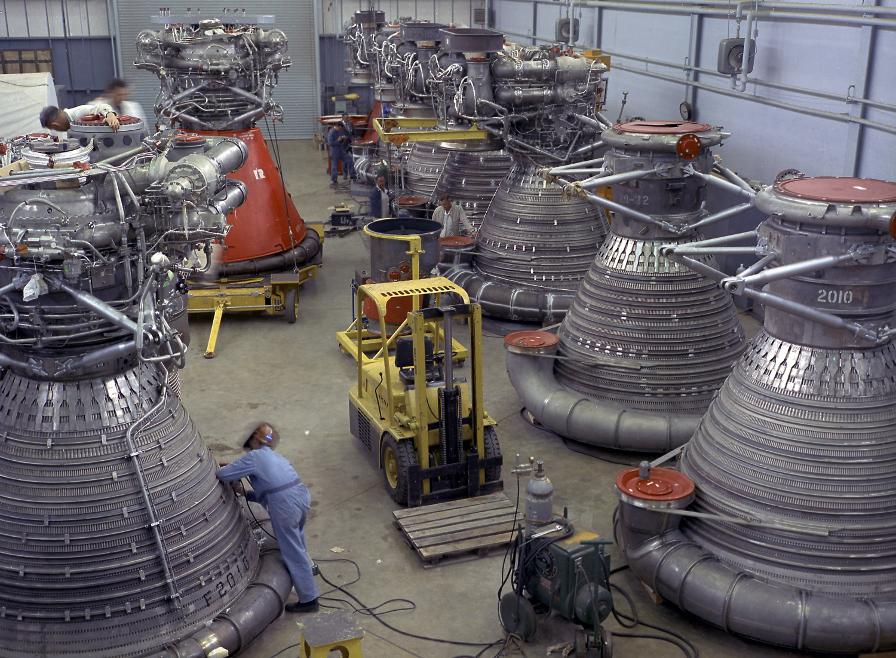
Engines F-1, which "was not" (without nozzle attachments, which were mounted on the finished rocket).
Next on page 3, he claims. "In particular, the “tubular-jet” combustion chamber (hereinafter referred to as the CS) could not in principle provide the declared pressure and thrust of the F-1 engines. This is shown in detail in the work of A. Veliurov . "The following will be shown completely differently. Namely, that Ivchenkov’s arguments do not withstand criticism. You can read apollofacts.wikidot.com/hoax : people-velyurov about this virtual moonbreaker. A look at the article free-inform.narod.ru/pepelaz/pepelaz-1.htm . Here is an exemplary fragment from this slapstick.
"But the second flight July 5, 1966. was orbital! Americans write that the purpose of the AS-203 mission was to study the "behavior of liquid hydrogen in zero gravity." And despite the usual trivialities, the flight was successful ... But the Yearbook of the Great Soviet Encyclopedia (TSB) (3) for 1967 describes the results as follows:
“The last stage (S-4B rocket) of the experimental launch vehicle Saturn IB SA- 203 is put into orbit with fuel not fully consumed. The main tasks of the launch are the study of the behavior of liquid hydrogen in a state of weightlessness and the testing of a system that ensures the repetition of the main engine of the stage. After carrying out the planned experiments in the system for removing hydrogen vapor from the tank, the valves were closed, and as a result of an increase in pressure, the stage EXPLODED at the seventh orbit . ”
"In this case, the level of SA-203 shattered into 37 fragments! (2) You can congratulate NASA on the successful execution of the flight program, almost like it was sung in a famous song: with the exception of nothing, your house with the stable burned together when the entire estate burned ... But otherwise the beautiful marquise, everything is fine, everything is fine ! ".
The annual book of the Great Soviet Encyclopedia for 1967 really did write istmat.info/files/uploads/22100/17_str_496-540_nauka_i_tehnika_chast1.pdf. But if you read it in the original, without Velururov’s comments and hysterically screaming selections in color and size, it becomes clear that there was in fact no accident. Step blew deliberately! Perhaps for reasons of secrecy so that she somehow did not go to the Russians. Who and how counted the fragments? On this rhetorical question, we will part with Velura, returning to Ivchenkov on page 3.
"In addition, according to the data on the Saturn-5 rocket in the American "advertisements", its first stage is the best first stage "for all times and peoples." It has 5 of the most reliable and powerful F-1 engines in the world and, moreover, its weight perfection (the ratio of the weight of the filled stage to the weight of the empty stage) is the best and unsurpassed so far! It (again, according to the American "advertisements") is already 17.5! While this value at the 1 st level H-1 was equal to 14.4, at the Proton - 15, at the 2 nd stage of the Union - 15.2, at the Atlas II - 16, at the Shuttle (if we add to the weight tank weight of engines and engine compartment) - 17 (for the latest version). "
And actually, what is the so-called “LRE expert” so surprised? The fact that the ratio of the weight of the filled 1st stage of Saturn-5 to empty weight is the highest naturally follows from the fact that this rocket was and remains the largest ever flown. The mass of the thin-walled shell, which is a rocket, is proportional to the square, and the mass of the fuel is proportional to the cube of its linear size. Therefore, their ratio grows with increasing size. Of course, this judgment should not be taken literally, because In reality, there are many other factors. But in general, it explains the feature of Saturn-5, to which Ivchenkov clung.
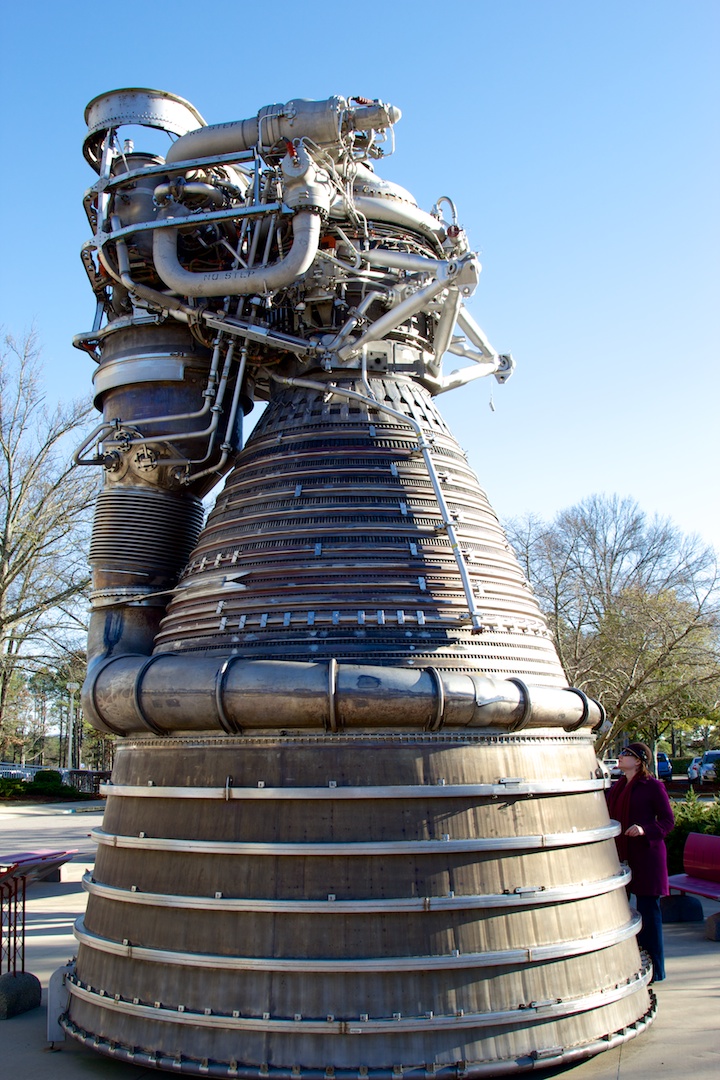
The main engine of Saturn-5 (with nozzle attachment)
The internal surfaces of the combustion chamber and the F-1 nozzles were made of longitudinal tubes through which 70% of the kerosene flowed before being fed into the nozzle head, thus providing cooling. In the picture the tubes are clearly visible - they are directed from the top down. The nozzle nozzle (ends a little higher than the girl) is cooled by the flow of gases from the exhaust of the turbine of the fuel drive with a temperature of about 920 K, which is much lower than the temperature in the combustion chamber (about 3 500 K). The line of supply of exhaust gas looks in the photo like a thick sleeve, covering the nozzle nozzles. The cooling tubes were made of heat-resistant nickel alloy Inconel X-750. The main content of www.manonmoon.ru/articles/st65.pdf is an attempt to prove that the tubes of this alloy could not work under pressure in the F-1 chamber (70 atm).
It is worth noting that some sources indicate less pressure, for example, 63 - 65 atm epizodsspace.airbase.ru/bibl/raketostr3/1-1.html . There is also given a temperature of 3,273 K, which is somewhat lower than what Ivchenkov uses. Given that he “balances on the edge,” these differences are significant. But we will use the author’s data, since they do not interfere with proving the failure of his fantasies.
The author compares the F-1 with the H-1, which was a reduced copy, but with the cooling pipes made of 347 stainless steel. Comparing the properties of these materials and the characteristics of the Ivchenkov motors, it seems to him, he proved that F-1 could not have a thrust above 500 m. On page 13 he writes. " Problems with alloys like Inconel X-750 were described in detail and highly professional S. Pokrovsky". Pokrovsky is the authoritative among the Lunoborians, the late conspiracy theorist who wrote the article www.manonmoon.ru/addon/22/inkonel.doc .
What it says about the Inconel X-750 alloy looks very solid at first glance point of view of solid state physics and metallurgy. But on page 2 of his article, Pokrovsky writes, “ It so happened that the author of this work is a laser scientist, who in his laboratory practice had for current needs to practically evaluate the absorption capacity of metals at a wavelength of 1 μm, approximately spectral the maximum emission of gases in the combustion chamber F-1. "Thus, he was not a specialist in these areas. Pokrovsky focused on the fact that he was close - on the interaction of tubes of X-750 and solder with the radiation of hot gas.
On page 1 of his article, he writes. "The F-1 engine was built according to the traditional scheme of that time with a cooled combustion chamber made of welded pipes. This solution was like a simple scaling of a rather worked out scheme. That's right, but then begins illiterate nonsense. “But not everything in it allowed simple scaling. The growth of the size of the combustion chamber in the first approximation is proportional to the cube of linear dimensions, - leads to the same increase in the volume of hot radiating gases. The surface area that receives the radiation grows as a square of linear dimensions. Thus, the specific flux of radiant energy to the surface of the chamber wall increases with increasing size . ”
The radiation power of a black body is determined by its surface area and temperature, but not by volume. Therefore, the radiation on the walls of the chamber does not occur from the entire volume of the gas, but only from the outer surface of the gas bunch. Inside, reradiation takes place - atoms absorb and emit photons with equal probabilities, which corresponds to thermodynamic (quasi) equilibrium. According to the Stefan-Boltzmann law, with an increase in the dimensions of the combustion chamber, the radiation flux density will not change, being proportional to the 4th degree of temperature. If the temperature in F-1 was the same as in H-1, then the flux of radiant energy to the chamber walls was of the same density.
At this point, the laser specialist demonstrated not only the expert’s aplomb, but also the ignorance of the radiation thermodynamics. Which led him to a blunder on page 4. "The power density in a pulse of a scale of 10 ^ 4 W / cm2 is close to the power density in the F-1 engine. And when you start? And at launch, the scale of radiant fluxes to the surface instantly increases to a level of 10 ^ 4 - 10 ^ 5 W / cm2. These are typical scales of laser exposure . "
It is stated here that the radiation flux density from the surface of a gas bunch to the walls of the combustion chamber exceeds
 . But at a temperature of 3 500 K, the intensity of blackbody radiation is
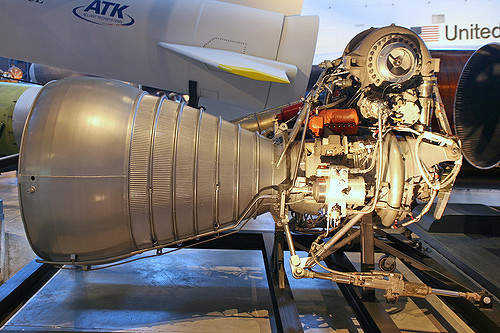
Engine H-1, the younger brother of the F-1
From p. 4 to p. 32, the author discusses the design of the F-1 engine and compares it with others, but the proof of impossibility postpones “for later”, limited to evaluative, categorical judgments.
On pp. 12-15, Ivchenkov argues that the cooling tubes of Inconel X-750 alloy were annealed, as a result of which they acquired a limit of elasticity of 2,400 kg / sq.cm (
 MPa). In essence, these are only plausible conjectures. The only argument that can be considered evidence presented on page 15. “ The fact that the tube material was subjected to annealing, rather than thermal hardening, is fully confirmed by F-1 images“ from the bottom of the sea ”(Fig. 2 and 3), which show that the pipes are bent (that is, the material is plastic.) If they were subjected to thermal hardening, they would not bend, but break (try to bend the spring). "But in Fig. 3 tubes are not at all, and in fig. 2 they look rather broken than bent. In my opinion, the hypothesis that "the material of the tubes was subjected to annealing, and not thermal hardening", this photo is not confirmed. Moreover, the F-1 is clearly not imprinted on it! But even if it is true that the elastic limit was 240 MPa, then in this case the author's arguments are based on arbitrary assumptions (see below).
 On page 15, Ivchenkov writes. " In addition, the features of the Inconel X-750 can cause problems with short-term heating under pressure (in particular, with F-1 operation.) At the same time, crystallization begins on the firing surface of the tube with some hardening and increase in hardness and, accordingly, brittleness, while internal No layers of the fire wall and the other wall are exposed to this. The pressure in the tubes increases and plastic deformation occurs, cracks may appear on the brittle surface . "
But how does the author know that these problems may arise with the F-1? Assume that the part of the tube that is in contact with the hot gas becomes more solid and brittle. In the absence of deformations, this will not manifest itself at all, but where will the deformations come from? The pressure of 70 atm is 2 orders of magnitude less than the elastic limit. Ivchenkov writes as about the fact that plastic deformation is underway, although in reality this is only an assumption. Apparently, he believes that uneven adjustment of the crystal structure of the alloy will cause tube bending. Given that the author is not an expert in solid state physics and metallurgy, there is no reason to trust these fantasies.
It is also worth paying attention to the word "may." They can - this does not mean that they will appear, given the brevity of the life cycle of the F-1 (less than 3 minutes). Moreover, on page 13, the author claims the exact opposite. "The increase in yield strength at 1200-1300 F is explained by the onset of crystallization during the operation of the alloy at these temperatures. This does not occur under short-term exposure to such temperatures (during short-term heating, for example, during F-1 168 sec), since the process of complete restructuring of the alloy goes slowly and takes hours . " Gennady Ivchenkov contradicts himself, as often happens with Moonbreakers.
Further on p. 15, the author once again formulates his fantasies, giving them the form of a firmly established fact. "It turns out that the Inconel X-750 is a problem material, in particular, due to the possibility of uncontrolled restructuring during operation . "Taking from the arsenal of conspiracy theorists: after speculating about what they think could have taken place, end with the categorical conclusion that that it was so in reality))

The remains of the engine, which Ivchenkov calls F-1 (compare with the photo where the girl is)
On page 16 Ivchenkov writes about another, in his opinion, the fatal problem of the F-1 engine. " Besides , when developing the H-1 engine, additional problems arose with the interaction of nickel alloys with kerosene RP-1". Then he quotes a fragment in English from the NASA archive, where it is said that experts suspected the possibility of a chemical reaction between sulfur in kerosene and Inconel X-750 alloy, which could lead to embrittlement of the tubes. To eliminate this alleged problem the newly created H-1 they are made of alloy 347. Judging by the fact that the word "correction» (fix) is quoted, this was done as a precaution, not because the reaction observed real consequences c kerosene PR-1.
in - apparently later it turned out that these are dangerous I exaggerated and Inconel X-750 was used in the F-1. But the author confidently writes that serious problems were moved to the "correction" of the H-1 to F-1 engine (p. 16). "The question arises, what about the nickel alloy tubes in F-1? After all, the kerosene RP-1 is the same, the Inconel X750 alloy is high in nickel (70%), and the temperature and pressure of the F-1 is higher than that of H-1 . "They don’t want to look for questions from the moon masters therefore, they prefer those that respond to their “disclosures.” And meanwhile, besides the reaction of fusing nickel with sulfur
 occurring at a temperature of about 1200 K, the oxidation reaction
  at 900 - 1100 K removes sulfur from the metal. Is it because Rocketdyne returned to the alloy Inconel X-750, developing the F-1?
 But Ivchenkov doesn’t bother himself with questions, for he "knows" the exact answers! The last paragraph on page 16. " This factor, together with the uncontrolled crystallization of heat-resistant nickel alloys of the type Inconel, raises the question of the possibility of using nickel alloys for fire walls of the CS operating on kerosene. The conclusion here is unequivocal - nickel alloys cannot (and could not) be the material of the cooling tubes at the stated for F-1 characteristics . " So, at first, " poses the question" and immediately " The conclusion is unequivocal ")) But, as shown above, it is far from unequivocal, but rather attracted to the myth of the moon scam.
On page 18, the author declares. " The walls of the cooling jacket tubes have a thickness in fractions of a millimeter, for example, the wall thickness of the H-1 tubes is 0.25 mm. The literature indicates the thickness of the F-1 tubes at 0.457 mm, the reliability of which is in serious doubt, since this wall thickness is completely does not pass on the requirements for cooling (this will be shown later). "In assessing the wall thickness of the tubes Ivchenkov relied on his fantasies (see below).
On pp. 21-22, the author considers cooling pipes, trying to find a contradiction in this as well. "Thus, in the case of a single layer, the number of tubes after bifurcation (the nozzle from the 1/3 to 1/10 expansion ratio) should be equal to 356. Now look at the photo of the F-1 nozzle on the seabed (Fig. 2), made by the Jeff expedition Bezos. In the photo you can count 178 tubes located below the 1/3 section (viewed up to the 1/8 section, then the tubes are creased and bent). And how many tubes really are and what is their real diameter? At the same time, the NASA (Rocketdyne) images can clearly count 178 tubes stacked in one layer and forking 356 below the 1/36 " section .
The snapshot of Jeff Bezos in question can be seen above (remains at the bottom of the sea). I personally could not count more than 60 tubes on the nozzle debris. In addition, the lower part of this wreck is completely different from the F-1. The number of transverse (broken) rings clearly does not exceed 9. The picture with the girl shows that there were many more such rings. How do you even know that this photo shows the remains of the F-1? The Jeff Bezos Expedition found the wreckage of various missile engines, working on that part of the ocean over which their routes passed after takeoff from Cape Canaveral. Most likely the photo shows a fragment of the H-1, which was put on the first models of Saturn as boosters. But lunoborts choose from possible explanations only those that fit into their picture of the world. The world in which the Americans did not fly to the moon and in space, it seems, was not at all))
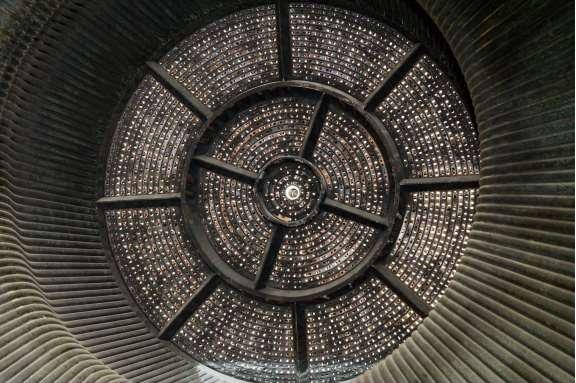
Inside the F-1 combustion chamber, cooling tubes and nozzles are visible.
Further down to page 27, Ivchenkov praises the Soviet technology of rocket engines based on the double wall of the combustion chamber that forms the cooling jacket. At the same time, he criticizes the approach chosen by the Americans in lunar rockets - a chamber made up of cooling tubes. It is possible that all this is true ... with one exception. American technology has provided less weight for the combustion chamber and nozzle, which is of fundamental importance for huge engines. The USSR failed to create anything similar to the F-1 in size, trying to harness dozens of relatively small LREs into its rocket. The result is well known - our country lost the lunar race.
These comparisons end with another portion of fantasies (p. 27). "All this suggests that the development of engines in the USSR and the United States went in different ways. At the same time, practice has shown that “American technology” is flawed, dead-end, not allowing to obtain satisfactory engine performance, such as pressure in the chamber (no more than 50 atm) and, accordingly, specific impulse . ”What practice has shown? Apollo flights to the moon? Who established that the pressure in the F-1 chamber was no more than 50 atm? Velours and his follower Ivchenkov? Below we will discuss how he estimated this pressure, and yet another jet of bile with a lie ("fuel and oxidizer" ) on page 27.
"The nozzle head made by “American technology” has jet nozzles and resembles a washboard with holes (or a flat board with holes made at an angle - see fig.11). Practice has shown the flaws of this technology, which does not provide satisfactory atomization and mixing of components. The fact of the use of jet nozzles by Americans, in fact, is strange, because on the engine of the V-2 known to them there were all types of nozzles, and they chose the worst ones, the advantage of which is only lower hydroresistance . "
Slightly modifying the question asked above: did the practice of nine manned flights to the Moon and the launch of the entire Skylab station show the “deficiency” of this technology? Although, of course, there was no Skylab either, there is no way to fool the vigilant moonbearers)) As for the lower resistance of the “defective” F-1 nozzles, this was of fundamental importance for him, considering the cooling system and the enormous fuel consumption. Looking ahead, we note that the problem with the increased thermal load on the tubes in the F-1 engine as compared to H-1, which, according to Ivchenkov, could only be solved by thinning the walls to an unacceptable strength of 0.2 mm, was solved precisely by accelerated circulation kerosene in the cooling system. With a different type of nozzle, it probably wouldn't have worked.

Skylab orbital station from the inside ... which was not there either
On page 33, the author proceeds to estimating the heat load on the cooling tubes. He takes as a basis the empirical formula from heat engineering, describing the heat exchange between the gas flow and the pipe wall, and uses for comparison the heat transfer coefficients
 and
and  between the hot gas and the walls of the combustion chamber for engines F-1 and H-1, respectively, so that: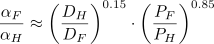
where
 - pressure in the combustion chamber and
  - its diameter. From here the author gets that attitude
 is in the range of 1.22 - 1.29. As is always the case with “revelations”, this attitude is overstated. If we take the pressure in the chamber F-1 65 atm and assume that
 it will work out
  . Given that the formula (*) is empirical, and the combustion chamber is not a pipe, the difference in heat transfer coefficients seems to be close to the methodical error of the calculations. As usual, moonbats balance on the edge, trying to pull numerical data on speculation.
 But suppose the estimate
 which operates in the future Ivchenkov, true. Let be
 - gas temperature in the combustion chamber (3 500 K),
  - the temperature of the surface of the wall of the tube in contact with this gas,
  - the temperature of the wall surface in contact with the cooler (kerosene),
  and
and  - heat flux densities (W / m2) from the gas into the wall of the tube and through the wall into the cooler. Then
 and
and  (**)
(**) where
 - coefficient of thermal conductivity and
  - wall thickness. The author believes that
 K. With the same difference
  magnitude for the F-1 engine it will be 1.22 times more than for the H-1. On page 34, a false conclusion is made here that to keep the heat flux unchanged it would be enough to increase from 1000 K to 1220 K. From (**) it follows that due to this would decrease not by 1.22, but only 1.1 times.
 To preserve the “throughput” of the tube wall,
unchanged (1000 K), the author proposes to reduce the wall thickness 1.22 times. But what happens ifwill not decrease, but increase from 0.254 mm in the H-1 engine to 0.457 mm in the F-1? The last value of Ivchenkov was declared a figment of fantasy by Technical Writers, but it is precisely this that indicates NASA for F-1. In this casedecrease by 1.8 times. However, we assumed that the flowincreased 1.22 times. In this mode, of course, the cooling system could not work. It is easy to verify that the heat flows from the gas to the wall and through the wall to the cooler will be dynamically balanced (i.e.
 ), if a
  K and
K and  K. This might be the F-1 mode of operation under the assumption if the H-1 engine worked in K and
  K. In this case, the kerosene temperature is above the freezing point. The reduced temperature of the cooler in F-1 could be ensured due to the higher rate of its pumping through the tubes. A temperature of 1,300 K was probably acceptable for an Inconel X-750 alloy with a melting point of about 1,700 K, given the short duration of engine operation (~ 165 sec). As well as the fact that only the firing surface of the wall would be heated to 1,450 K, and inside it the temperature would drop to 300 K on a cold surface (the author takes K, as seen on page 35, where it gets
  TO).
TO). It is easy to come up with even more realistic modes for cooling systems F-1 and H-1 with the same assumption of heat transfer coefficients. For example, for F-1, let
 K and
K and  K, and for H-1 let K and
  K. The temperature of the fire wall of 1 145 K for a tube from Inconel X-750 operating for less than 3 minutes is clearly not a big problem. The temperature difference between the coolers is only 85 K. Sincethey are average over the cooling system, these temperatures and should not have "room" values near 300 K, which were supposed to be higher. It is also worth noting that at temperatures above 1,000 K, the thermal conductivity of the Inconel X-750 alloy is slightly higher than that of steel 347. Although the difference is small, 1.1 - 1.2 times, this further strengthens the position of the F-1 engine in the “competition” with H- one.
The first stage of Saturn-5. Nozzle nozzles removed
Prior to page 47 Ivchenkov musolith the subject of supposedly too thin walls, as if reveling in his own “discovery”. On page 47. "Such calculations (of course, more detailed, including computer simulations) were probably carried out by the Americans in the design process and obtained quite real operating pressure of 46–50 atm and engine thrust of about 450 tons. How did they continue to force the F-1 to 70 atm and 690 tons and what came out of it is the big secret of Rocketdine (Rocketdyne) . "How does all this know Ivchenkov? A rhetorical question - he selflessly fantasizes)))
on page 48 "The difference in the design of engines pulled from the bottom of the sea by Jeff Bezos from those presented in the sources listed in the article from NASA " is highlighted in bold. It has already been said that the picture that the author means (the engine on the seabed) is almost impressed by H -one.
On pages 49 - 53, the author tries to find fault with the exhaust gas supply system in the nozzle nozzles. He did not seem to invent anything serious. Proves that the Soviet LPRE were the best, and the Americans generally had no good ideas. Who would argue with that? Russia is the birthplace of elephants.
On pages 56 - 58 Ivchenkov writes nonsense that the F-1 engine burned in flight (photo at the beginning of the article). But if it was on fire, because the kerosene cooling tubes burned out somewhere, then why is it so symmetrical?
Such a dramatic expansion of the torch was obviously connected with a drop in the pressure of the atmosphere when the rocket was raised. The external pressure decreased, therefore, the fiery clot flying out of the nozzle expanded radially. The eerie ejection of the flame above the level of the nozzles is explained by the rise of a part of the hot gases into the empty space of the engine compartment. This should not be surprising, since at the intersection of torches from different engines (there were 5 of them altogether) flame particles inevitably appear, having an impulse along the rocket movement. They also burst into the voids of the motor compartment, then leaving it through the holes in the rocket body (in the photo above you can see 4 longitudinal slots below the letter A). In a dense atmosphere, this did not occur, since such particles of flame were rapidly decelerated by air. And in the stratosphere, part of the torch, in simpler words, sucked into the empty space of the engine compartment. And Saturn 5 revealed a fiery flower in all its glory!
It was a terrific rocket, the fruit of the technical genius of Wern Von Braun, as well as the tremendous work of German and American engineers. But do not forget about the company Rocketdyne, created the engine F-1, which delivered a man to the moon.