May 8, 2008 at 23:02
Wandex or Nine Things You Didn't Know About Search Engines
- Transfer
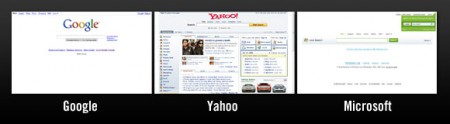
In the picture: Big Three. Or…?
We take search engines for granted. They exist because they must exist. Without them, finding the information we need and adequate among many millions of web pages would be an almost impossible task.
Here are nine likely unknown facts about search engines.
1. Invented in 1936?
The idea that later led to the invention of hypertext, and the discussion about the need to develop a system for quickly extracting data from thus stored information (the equivalent of today's search engines) were published in 1945 by the American engineer and science administrator Vannevar Bush. His essay " How We Could Think"was probably written back in 1936. The concept of a memory expander device that he introduced contained original ideas that eventually came to life on the Internet.
2. Magic automatic text extractor
The first real search engine was created in the 1960s by Gerard Gerard Salton, he and his team at Cornell University developed the SMART information retrieval system . SMART is the abbreviation for Salton's Magic Automatic Retriever of Text, that is, “Salton's Magic Automatic Text Retriever.” Jer ard Salton is considered the father of modern search technology
3. First on the Internet
The first search engine on the Internet was called Archie. It was designed to index FTP archives. The name Archie is simply Archive without the letter “v”.
4. The first web search
The first search engine for websites was called Wandex :) :) :) (smiles from the translator). It was released in 1993 and used an index created by the first World Wide Web Wanderer indexer , which was written in Perl by Matthew Gray of the Massachusetts Institute of Technology. Matthew Gray now works for Google.
5. Which especially had nothing to do.
In December 1993, there were 623 websites on the Internet , so the first search engines had less work than today with more than 162 million websites.
6. First full-text search
The first search engine to index entire pages was WebCrawler . Launched in 1994, WebCrawler was the first system to offer full-text search, similar to today's search engines. Prior to this, search engines indexed only page headings and information from meta tags. Today WebCrawler has become a metasearch engine integrating information from Google, Yahoo, Live and other search engines.
7. ProtoGugl
Larry Page and Sergey Brin started working on the technology later evolved into Google, in 1996. The original name of the project is BackRub .
8. Yahoo and Microsoft - Belated Entry into the Game
Yahoo and Microsoft did not have their own search technologies until 2004. Yahoo Search used data from AltaVista and Inktomi, and even Google for some time. MSN Search (now Live Search) followed a similar path, although it did not resort to Google services. Microsoft launched its own search technology only in 2005 (a beta version appeared in 2004).
9. The Big Three - not quite what
Google, Yahoo and Microsoft usually call the Big Three, but that’s incorrect, if you rely on the total number of searches around the world . The Chinese search engine Baidu is ahead of Microsoft Live Search in terms of the number of search queries ... Thus, the big three are Google, Yahoo and Baidu.