New line of hybrid IP PBX Grandstream UCM6200
In the summer of 2013, Grandstream launched the UCM6100 series of SIP-enabled telephone exchanges. Now, three years later, Grandstream announces the update of its IP PBX line. Looking ahead, we note that the stations from the new lineup, called the UCM6200, are only slightly different from their predecessors. Nevertheless, this update provides us with an excellent opportunity to acquaint readers who have no experience with the Grandstream IP PBX, with these rather interesting devices.
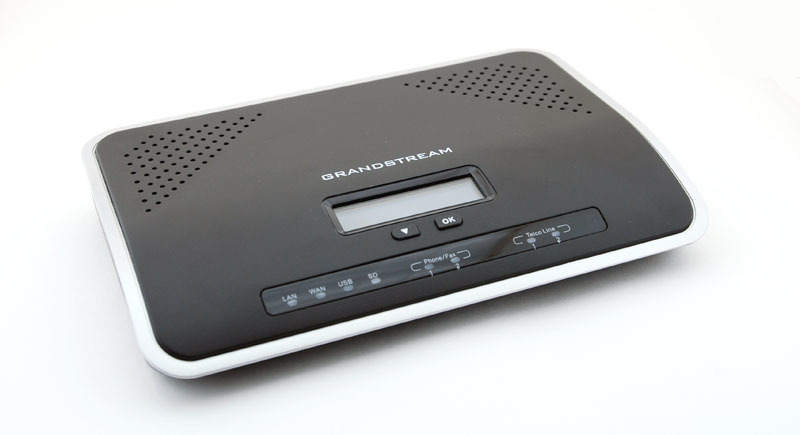
All IP-PBX Grandstream new series are classified as hybrid - that is, in addition to supporting VoIP-protocols, they also have ports for connecting traditional telephones (FXS) and city lines (FXO). Unlike some other manufacturers, such as Yeastar and Zycoo, for example, Grandstream does not use a modular architecture in their stations, when the necessary ports are dialed using special cards. Instead, they are already pre-installed at the discretion of the manufacturer - all models of the series have two FXS ports, and the number of FXO ports corresponds to the last digit in the model name. At Grandstream UCM6202 two of them, in UCM6204 - four, in UCM6208 - respectively, the eight.
Rejection of the modular structure is a double-edged sword. On the one hand, the manufacturer limits the buyer in the choice, and on the other hand, offers him a ready and cheaper solution by simplifying the design. For example, the Yeastar S20 with a set of ports similar to the UCM6202 will cost a third more. At the same time, the manufacturer has additional responsibility associated with the choice of the right combinations of analog ports that suit the largest number of potential buyers.
Here Grandstream comes quite radically (but modernly) offering to completely abandon the use of traditional telephones, and replacing them with IP-phones. And the two FXS ports that the manufacturer leaves can be used, for example, to connect faxes. But the telephone numbers served by analog lines, it is not so easy to translate into VoIP, so the choice of the number of FXO-ports is wider.
Under the spoiler is a comparative plate of the main technical characteristics of the stations of the old and the new lines. As you can see, any significant changes affected only the most senior model UCM6208 - they added a second network port to it and increased performance. The average model UCM6204 compared to the previous one has learned only to work as a router. The youngest model UCM6202 has not affected any changes at all. The last thing worth noting is the absence of a new line of station with 16 FXO ports - in the old model range the station UCM6116 was.
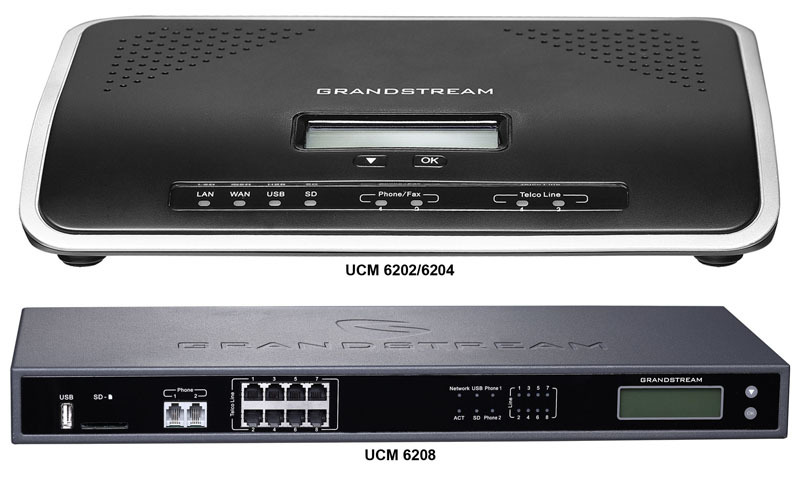
Grandstream stations are made in two different packages: the low-end models UCM6202 and UCM6204 in the desktop version, the older model UCM6208 - in the rack. Both housings are equipped with small graphic displays, which in some cases can somewhat simplify device administration. You can display all the most basic information about the device — date, time, hardware and software versions, current IP address, web interface access port, event log entries, and others. Also, it can be used to make some simple settings - choose the way to connect to the network, enable / disable SSH, control the screen, LEDs and fans. To control the on-screen menu, there are two buttons - scrolling and OK.
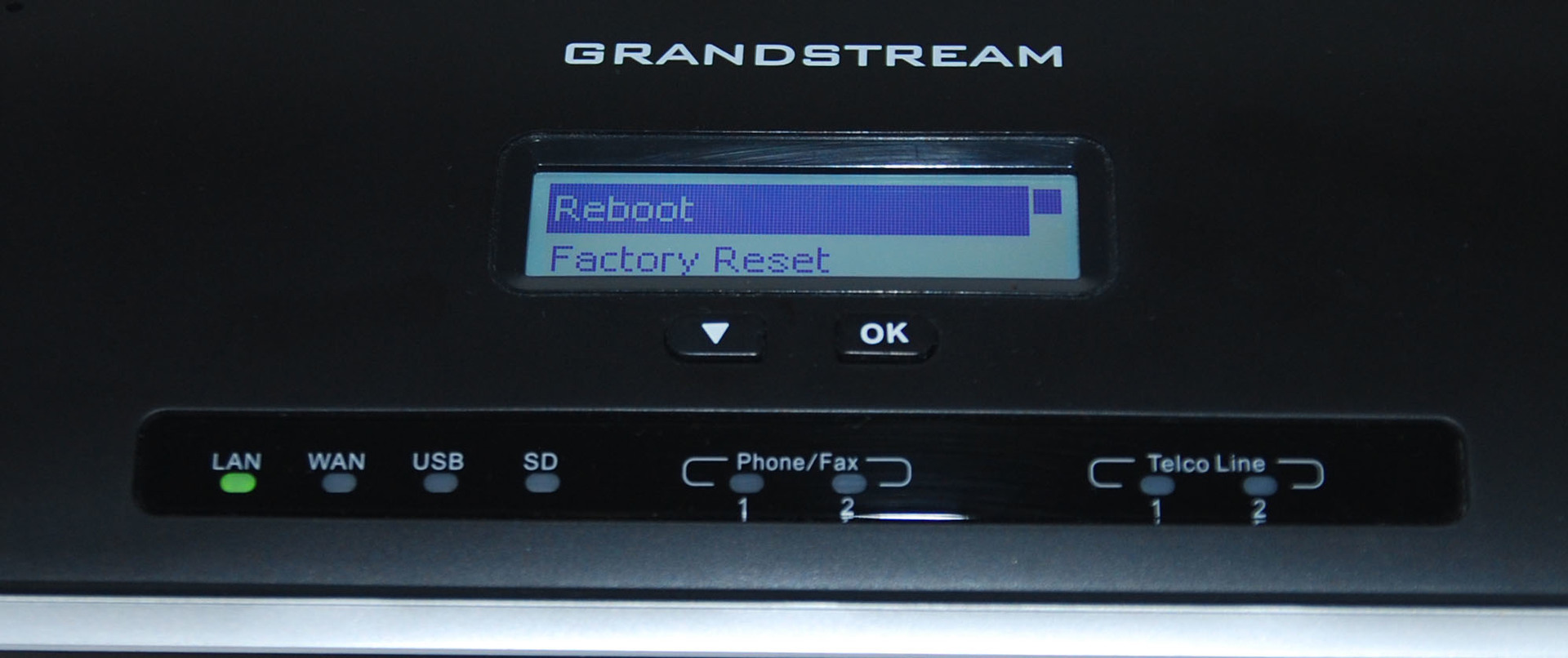
Next to the screen are LEDs to monitor the status of all device ports - LAN, WAN, SD, USB, FXS and FXO. The ports themselves are located on the back of the UCM6202 and UCM6204, and on the front of the UCM6208. About network ports it should be noted that they are gigabit - in 2016 this is, of course, not a sensation, but not all IP PBXs can boast of this. USB and SD ports are used for storing recorded conversations, conference meetings, voice mail messages on external media.

The built-in storage at the UCM6200 stations is also quite decent - 4 gigabytes. For comfortable work of all components, station enclosures are equipped with a small fan and a thermal sensor. As for the power of IP-PBX, it can be carried out using the bundled 12-volt power supply unit, or via PoE. Power over Ethernet support is an unusual feature for this class of devices, but its presence is a definite plus.

As already mentioned, there are few hardware changes in the new UCM6200 series compared to the UCM6100. If we talk about the software part - they are not at all. Firmware available for the new series, can be installed on older IP-PBX. All modern electronics manufacturers should take an example from Grandstream. In addition to jokes, this decision may be due to another reason - they are not looking for good from the good. For example, the Web interface, in which all the stations are configured, turned out to be extremely successful for Grandstream, there is no sense in changing it. Everything is in place, everything is quite logical, and Russification is done on a decent level.

Let's go through the most interesting features of IP-PBX Grandstream and start with the auto-tuning feature of the ZeroConfig subscriber devices. Immediately make a reservation, this function works only with Grandstream subscriber devices (IP phones, SIP adapters, VoIP gateways). On the one hand, this is bad, since the manufacturer limits us in choosing and forces us to buy our own devices. On the other hand, due to this limitation, the ZeroConfig function turned out to be very powerful - you can remotely configure almost all parameters of almost any Grandstream subscriber device.

It all works quite simply - there are global policies, and there are policies with reference to the model. In global policies, for example, you can specify settings for all devices on a network — time and date, time zone, language, dialplan, network settings, and others. In the model policies, you can select the wallpaper for each specific phone model, configure shortcut keys and soft keys.
You can also use the Autodiscover function and manually edit the necessary parameters for a specific subscriber device.

For the most lazy, you can enable automatic account assignment and specify the range of numbers issued. When you first turn on the IP phone sends a SIP SUBSCRIBE broadcast request to the network, and in response, the telephone exchange issues it with the settings of the first free account from the range specified by the administrator. Also, the station can offer the phone not one, but several accounts, from which the subscriber can choose the one he likes on the IP phone screen. In this way, you can set up even a fairly large number of IP phones extremely quickly.
Not every IP PBX, especially entry level (like the UCM6202), supports the recording of all calls. In the case of Grandstream there are no restrictions - you can write all the conversations, recording is included with reference to a specific account. The on-demand recording function, when the conversation starts to be recorded after the subscriber has entered a specific key combination, is also present.
The function of listening to the conversation in real time is not very successfully implemented. This feature is enabled for the entire system as a whole, that is, everyone can listen to everyone. Taking into account the fact that various modes are supported, including absolutely imperceptible for listening, it would be extremely unwise to use this option in some cases.
Like all modern IP PBXs, the UCM6200 supports the function of organizing conferences. The UCM6202 and UCM6204 models support the organization of up to three conferences with the total number of participants up to 25, the UCM6208 model up to 6 meetings per 32 subscribers in total. However, of particular interest here is the function of holding meetings on a schedule. Date, time, meeting duration, list of participants are set, conference room is selected, repeatability is set up.

A certain time before the meeting, the conference room is automatically cleared, and at a specified time, the station calls all participants. Thus, to participate in a conference meeting, subscribers simply pick up the phone. By the way, Grandstream UCM6200 support Google OAuth 2.0 authentication, so the calendar of the system can be synchronized with the Google calendar.
Quite interestingly implemented outbound call routing in IP-PBX Grandstream UCM6200. Firstly, each extension is assigned an access level — internal (lowest), local, national, and international (highest). On the basis of these levels, you can build the rules for outgoing calls, for example, allowing only certain groups of subscribers to use certain trunks and directions.
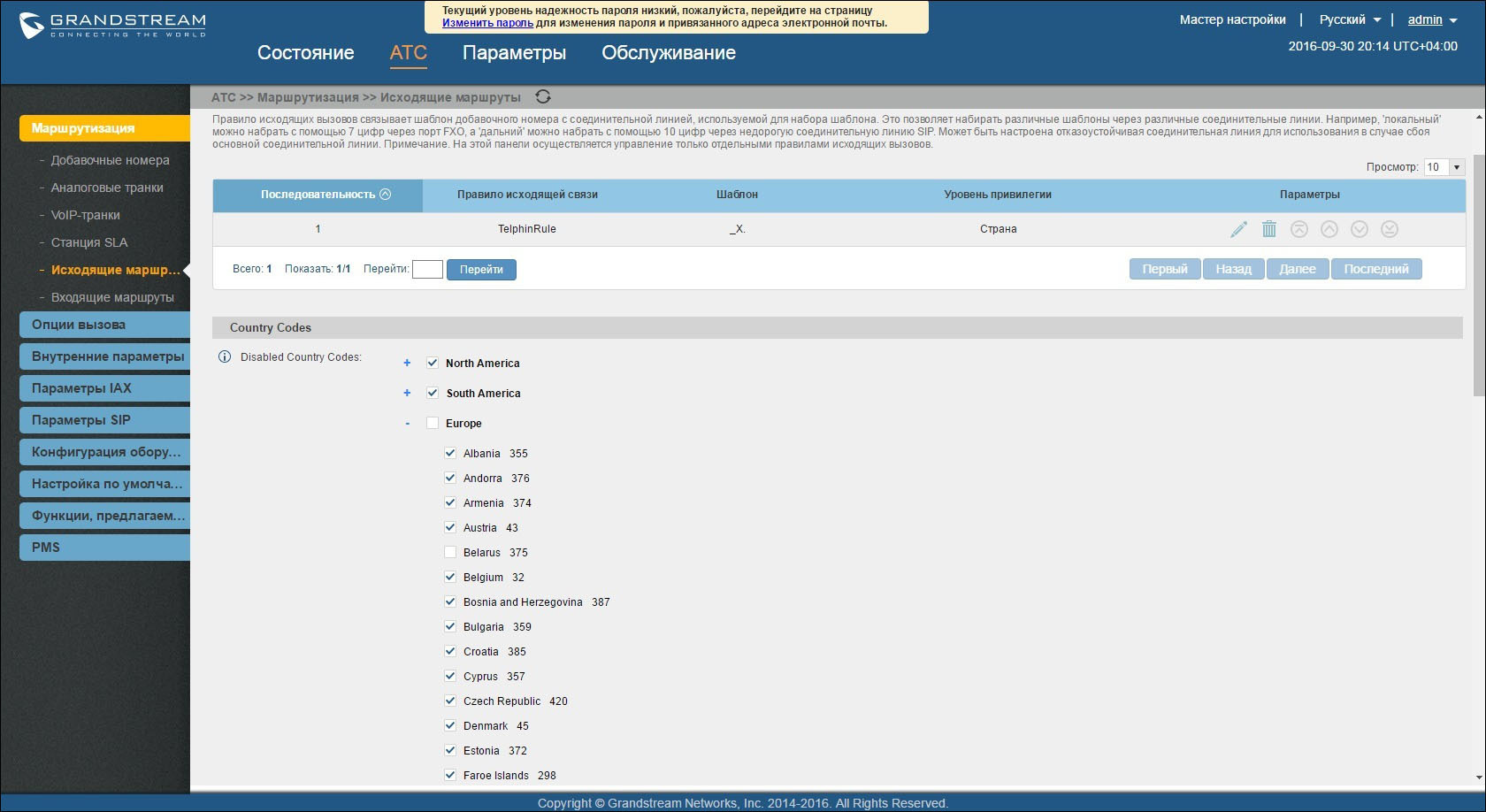
Secondly, there is a rather curious global setting - the list of prohibited countries with a breakdown by continent. It is enough to just mark the necessary countries (or rather, it is better to mark all countries, and to remove the mark only from the necessary ones) and a call in these areas will be banned to all users.
Since the PBX of the UCM6200 series is built on the basis of the Asterisk software PBX, the manufacturer didn’t consider it superfluous to add the possibility of using the IAX protocol, which allowed to create trunks and accounts working under this protocol.
The main advantage of the IAX protocol is that the signaling information and voice packets are transmitted within one network connection (even several conversations at the same time) - this greatly simplifies combining PBXs behind NAT - problems with one-way audibility due to incorrect firewall settings disappear. As well as increased security when opening network ports to the Internet.
The software of telephone exchanges of the UCM6200 series uses Asterisk 13 version as a software PBX. It is from this version that the PJ SIP driver has been added to this product, which allows you to register several SIP devices on one account. This can be quite convenient when a subscriber uses several devices at the same time (for example, a fixed IP phone and a DECT IP phone or a SIP client installed on a smartphone).
The number of simultaneous connections is configured for each account individually, in its settings. Accordingly, this feature is available only for SIP accounts.

Another function similar in its meaning is the ability to simultaneously send a call to a second number, such as a mobile, that comes to the subscriber’s phone. Quite a convenient option for employees who are often at meetings, conferences and other events held outside the office.
Updating the line of IP-PBX Grandstream leaves a double impression. On the one hand, this is not an update at all - both hardware and functional characteristics, in fact, remain the same. On the other hand, the release of devices as a new model line indicates that the life cycle of telephone exchanges will be extended for at least several years. And this can not but rejoice, since the Grandstream IP-PBX turned out really successful, both in terms of functionality and in terms of ease of configuration and management.
As for the price, there is currently no official data. But, something prompts that in comparison with the previous models the price should not change. Today, the UCM6102 retails for $ 316, the UCM6104 for $ 406, and the UCM6108 for $ 690.
All IP-PBX Grandstream new series are classified as hybrid - that is, in addition to supporting VoIP-protocols, they also have ports for connecting traditional telephones (FXS) and city lines (FXO). Unlike some other manufacturers, such as Yeastar and Zycoo, for example, Grandstream does not use a modular architecture in their stations, when the necessary ports are dialed using special cards. Instead, they are already pre-installed at the discretion of the manufacturer - all models of the series have two FXS ports, and the number of FXO ports corresponds to the last digit in the model name. At Grandstream UCM6202 two of them, in UCM6204 - four, in UCM6208 - respectively, the eight.
Rejection of the modular structure is a double-edged sword. On the one hand, the manufacturer limits the buyer in the choice, and on the other hand, offers him a ready and cheaper solution by simplifying the design. For example, the Yeastar S20 with a set of ports similar to the UCM6202 will cost a third more. At the same time, the manufacturer has additional responsibility associated with the choice of the right combinations of analog ports that suit the largest number of potential buyers.
Here Grandstream comes quite radically (but modernly) offering to completely abandon the use of traditional telephones, and replacing them with IP-phones. And the two FXS ports that the manufacturer leaves can be used, for example, to connect faxes. But the telephone numbers served by analog lines, it is not so easy to translate into VoIP, so the choice of the number of FXO-ports is wider.
Under the spoiler is a comparative plate of the main technical characteristics of the stations of the old and the new lines. As you can see, any significant changes affected only the most senior model UCM6208 - they added a second network port to it and increased performance. The average model UCM6204 compared to the previous one has learned only to work as a router. The youngest model UCM6202 has not affected any changes at all. The last thing worth noting is the absence of a new line of station with 16 FXO ports - in the old model range the station UCM6116 was.
Comparative characteristics of IP-PBX Grandstream UCM6100 and UCM6200
| Characteristic | 6102/6202 | 6104/6204 | 6108/6208 |
|---|---|---|---|
| Number of fxo ports | 2 | four | eight |
| Number of fxs ports | 2 | 2 | 2 |
| Gigabit Ethernet ports | 2 | 2 | 12 |
| USB / SD ports | there is | there is | there is |
| PoE support | there is | there is | there is |
| Max. number of SIP devices | 500 | 500 | 500/800 |
| Макс. кол-во одновременных разговоров | 30 | 45 | 60 / 100 |
| Макс. кол-во конференц-комнат | 3 | 3 | 6 |
| Макс. кол-во участников конференц-комнат | 25 | 25 | 32 |
| Режимы работы сетевых интерфейсов | Коммутатор, две сети, маршрутизатор | Коммутатор, две сети / Коммутатор, две сети, маршрутизатор | Коммутатор / Коммутатор, две сети, маршрутизатор |
| Встроенный DHCP сервер | Есть | Нет / Есть | Нет / Есть |
| Версия Asterisk | 13 | 13 | 13 |
Appearance

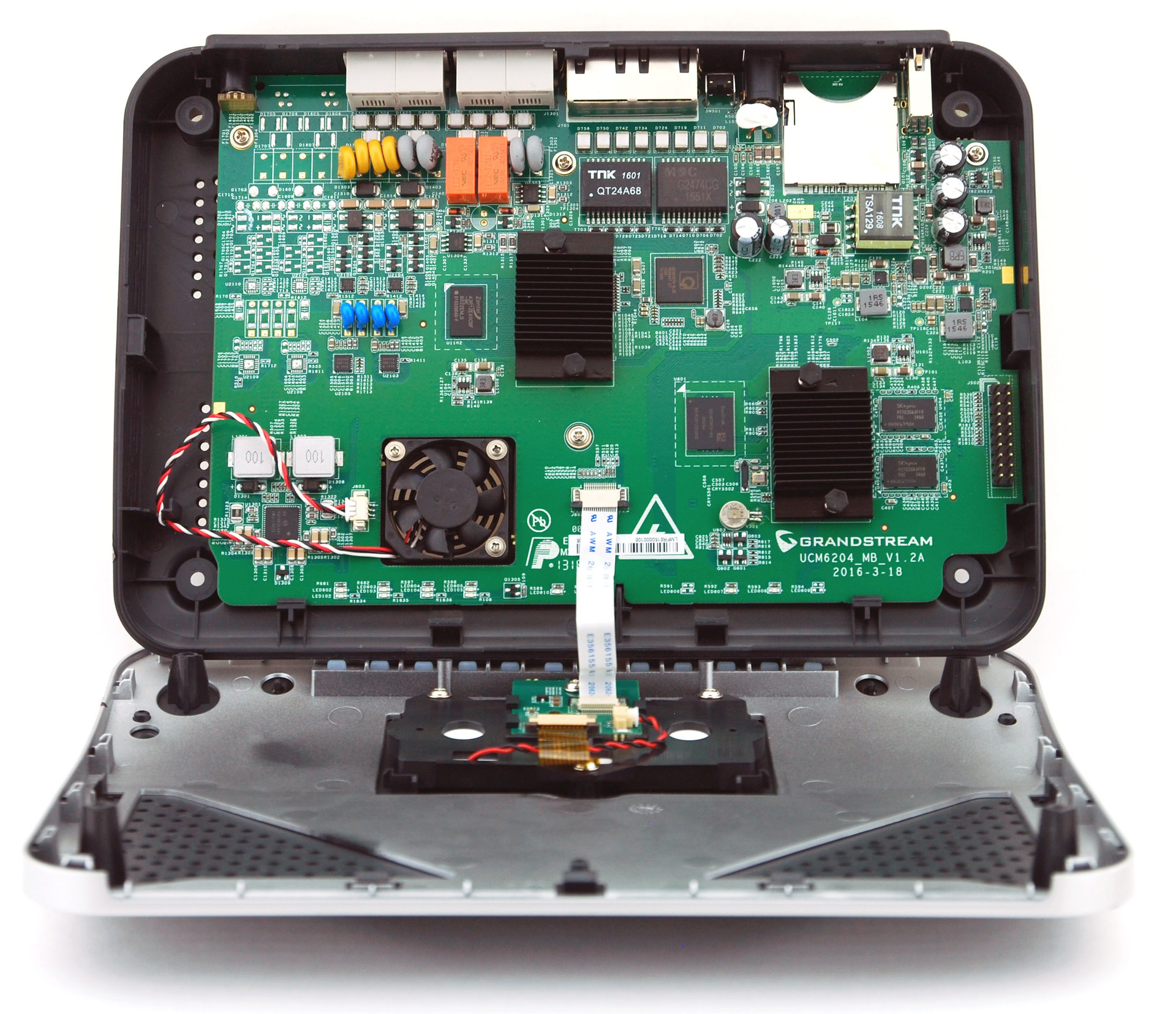
Grandstream stations are made in two different packages: the low-end models UCM6202 and UCM6204 in the desktop version, the older model UCM6208 - in the rack. Both housings are equipped with small graphic displays, which in some cases can somewhat simplify device administration. You can display all the most basic information about the device — date, time, hardware and software versions, current IP address, web interface access port, event log entries, and others. Also, it can be used to make some simple settings - choose the way to connect to the network, enable / disable SSH, control the screen, LEDs and fans. To control the on-screen menu, there are two buttons - scrolling and OK.
Next to the screen are LEDs to monitor the status of all device ports - LAN, WAN, SD, USB, FXS and FXO. The ports themselves are located on the back of the UCM6202 and UCM6204, and on the front of the UCM6208. About network ports it should be noted that they are gigabit - in 2016 this is, of course, not a sensation, but not all IP PBXs can boast of this. USB and SD ports are used for storing recorded conversations, conference meetings, voice mail messages on external media.
The built-in storage at the UCM6200 stations is also quite decent - 4 gigabytes. For comfortable work of all components, station enclosures are equipped with a small fan and a thermal sensor. As for the power of IP-PBX, it can be carried out using the bundled 12-volt power supply unit, or via PoE. Power over Ethernet support is an unusual feature for this class of devices, but its presence is a definite plus.
Interface
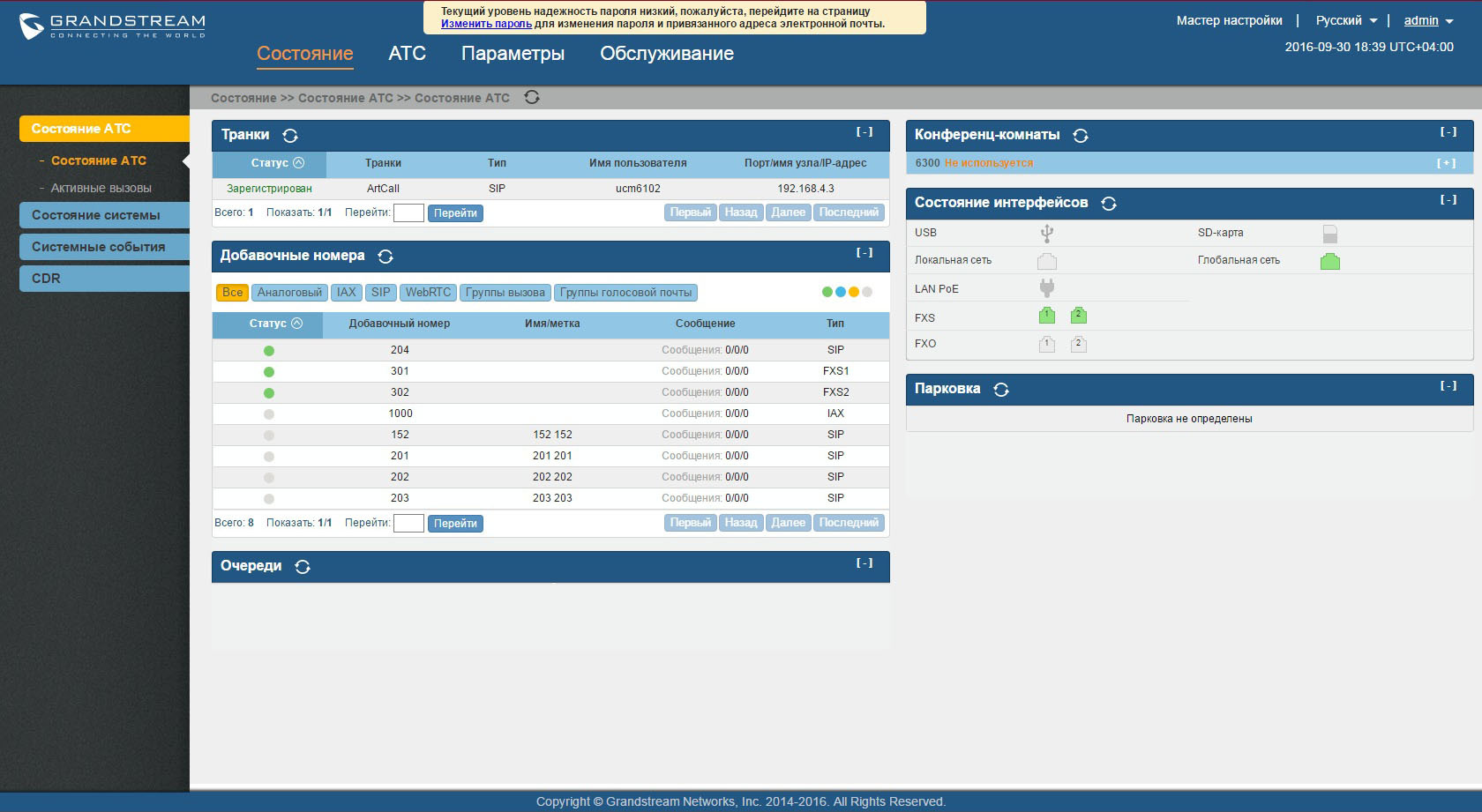
As already mentioned, there are few hardware changes in the new UCM6200 series compared to the UCM6100. If we talk about the software part - they are not at all. Firmware available for the new series, can be installed on older IP-PBX. All modern electronics manufacturers should take an example from Grandstream. In addition to jokes, this decision may be due to another reason - they are not looking for good from the good. For example, the Web interface, in which all the stations are configured, turned out to be extremely successful for Grandstream, there is no sense in changing it. Everything is in place, everything is quite logical, and Russification is done on a decent level.
Automatic tuning of Grandstream phones
Let's go through the most interesting features of IP-PBX Grandstream and start with the auto-tuning feature of the ZeroConfig subscriber devices. Immediately make a reservation, this function works only with Grandstream subscriber devices (IP phones, SIP adapters, VoIP gateways). On the one hand, this is bad, since the manufacturer limits us in choosing and forces us to buy our own devices. On the other hand, due to this limitation, the ZeroConfig function turned out to be very powerful - you can remotely configure almost all parameters of almost any Grandstream subscriber device.
It all works quite simply - there are global policies, and there are policies with reference to the model. In global policies, for example, you can specify settings for all devices on a network — time and date, time zone, language, dialplan, network settings, and others. In the model policies, you can select the wallpaper for each specific phone model, configure shortcut keys and soft keys.
You can also use the Autodiscover function and manually edit the necessary parameters for a specific subscriber device.
For the most lazy, you can enable automatic account assignment and specify the range of numbers issued. When you first turn on the IP phone sends a SIP SUBSCRIBE broadcast request to the network, and in response, the telephone exchange issues it with the settings of the first free account from the range specified by the administrator. Also, the station can offer the phone not one, but several accounts, from which the subscriber can choose the one he likes on the IP phone screen. In this way, you can set up even a fairly large number of IP phones extremely quickly.
Recording and listening to conversations
Not every IP PBX, especially entry level (like the UCM6202), supports the recording of all calls. In the case of Grandstream there are no restrictions - you can write all the conversations, recording is included with reference to a specific account. The on-demand recording function, when the conversation starts to be recorded after the subscriber has entered a specific key combination, is also present.
The function of listening to the conversation in real time is not very successfully implemented. This feature is enabled for the entire system as a whole, that is, everyone can listen to everyone. Taking into account the fact that various modes are supported, including absolutely imperceptible for listening, it would be extremely unwise to use this option in some cases.
Conference meeting
Like all modern IP PBXs, the UCM6200 supports the function of organizing conferences. The UCM6202 and UCM6204 models support the organization of up to three conferences with the total number of participants up to 25, the UCM6208 model up to 6 meetings per 32 subscribers in total. However, of particular interest here is the function of holding meetings on a schedule. Date, time, meeting duration, list of participants are set, conference room is selected, repeatability is set up.
A certain time before the meeting, the conference room is automatically cleared, and at a specified time, the station calls all participants. Thus, to participate in a conference meeting, subscribers simply pick up the phone. By the way, Grandstream UCM6200 support Google OAuth 2.0 authentication, so the calendar of the system can be synchronized with the Google calendar.
Call Routing
Quite interestingly implemented outbound call routing in IP-PBX Grandstream UCM6200. Firstly, each extension is assigned an access level — internal (lowest), local, national, and international (highest). On the basis of these levels, you can build the rules for outgoing calls, for example, allowing only certain groups of subscribers to use certain trunks and directions.
Secondly, there is a rather curious global setting - the list of prohibited countries with a breakdown by continent. It is enough to just mark the necessary countries (or rather, it is better to mark all countries, and to remove the mark only from the necessary ones) and a call in these areas will be banned to all users.
IAX protocol support
Since the PBX of the UCM6200 series is built on the basis of the Asterisk software PBX, the manufacturer didn’t consider it superfluous to add the possibility of using the IAX protocol, which allowed to create trunks and accounts working under this protocol.
The main advantage of the IAX protocol is that the signaling information and voice packets are transmitted within one network connection (even several conversations at the same time) - this greatly simplifies combining PBXs behind NAT - problems with one-way audibility due to incorrect firewall settings disappear. As well as increased security when opening network ports to the Internet.
Simultaneous registration of multiple devices on one account
The software of telephone exchanges of the UCM6200 series uses Asterisk 13 version as a software PBX. It is from this version that the PJ SIP driver has been added to this product, which allows you to register several SIP devices on one account. This can be quite convenient when a subscriber uses several devices at the same time (for example, a fixed IP phone and a DECT IP phone or a SIP client installed on a smartphone).
The number of simultaneous connections is configured for each account individually, in its settings. Accordingly, this feature is available only for SIP accounts.
Another function similar in its meaning is the ability to simultaneously send a call to a second number, such as a mobile, that comes to the subscriber’s phone. Quite a convenient option for employees who are often at meetings, conferences and other events held outside the office.
Conclusion
Updating the line of IP-PBX Grandstream leaves a double impression. On the one hand, this is not an update at all - both hardware and functional characteristics, in fact, remain the same. On the other hand, the release of devices as a new model line indicates that the life cycle of telephone exchanges will be extended for at least several years. And this can not but rejoice, since the Grandstream IP-PBX turned out really successful, both in terms of functionality and in terms of ease of configuration and management.
As for the price, there is currently no official data. But, something prompts that in comparison with the previous models the price should not change. Today, the UCM6102 retails for $ 316, the UCM6104 for $ 406, and the UCM6108 for $ 690.