Ramjet Engines: From Loren's Vision to Experimental Projects
In 1908, René Loren proposed a direct-reaction engine based on a piston internal combustion engine, where exhaust gases were routed to a nozzle instead of an exhaust pipe. This foreshadowed the idea of supplemental thrust without replacing the main propeller. By 1913, he had developed the concept of the ramjet engine (ramjet), demonstrating thrust in a wind tunnel with a burner inside a converging duct.
Concept and Early Experiments
Loren anticipated the limitations of propeller engines at high speeds: at a wing loading of 300 kg/m², propellers lose efficiency. His "air torpedo"—a 500 kg unmanned vehicle carrying 200 kg of explosives—evolved from a 1910 project. A ramjet operates solely on incoming airflow: air is compressed by the inlet diffuser, heated by the burner, and accelerated through the nozzle.
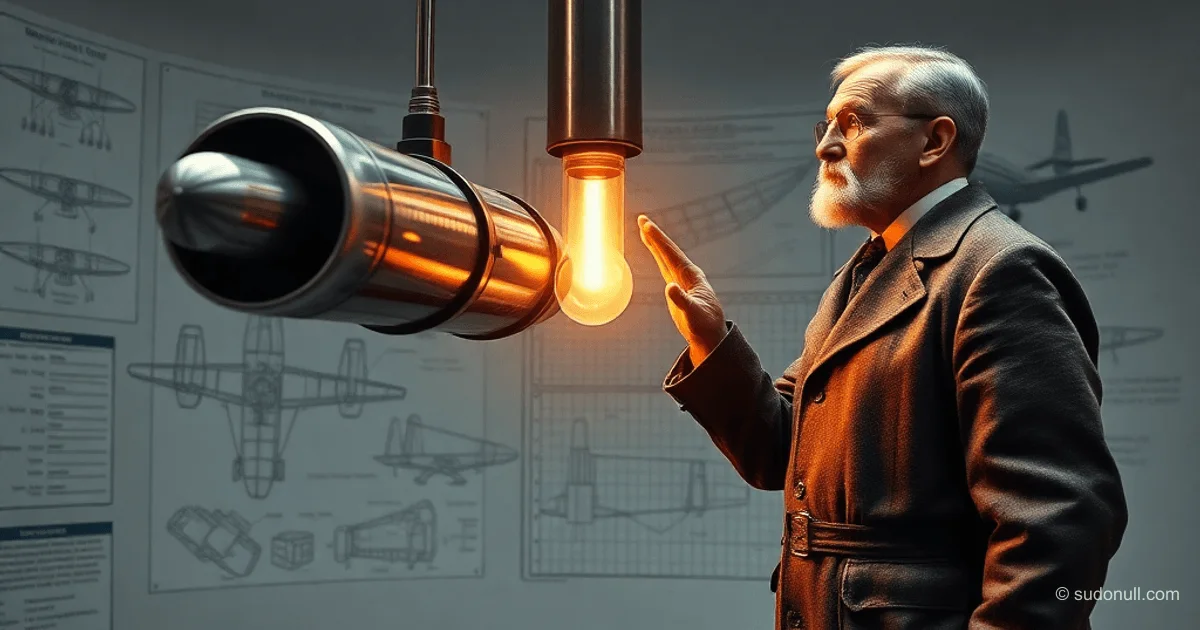
The "Loren tube" schematic was suspended in a wind tunnel on a lever with a dynamometer. Without combustion, the airflow pushed the setup backward; with the burner lit, thrust counteracted the force. This proved the jet principle without a turbine or external compressor drive.
Loren mounted the ramjet in the fuselage nose with minimal wings and tail, emphasizing simplicity: no moving parts meant higher reliability. The idea intrigued Robert Esnault-Pelterie but stayed theoretical.
Soviet Ramjet Developments
B.S. Stechkin studied Loren's theory, influencing GIRD. In 1933, the group ran flight tests: a ramjet in a 76-mm shell casing with phosphorus extended range by 1 km.
In 1939, Igor Merkulov created the DM-2 for the I-15bis: a pair of engines under the biplane's lower wing. Tested on I-153, Yak-7B, and LaGG-3. Pilots activated ramjets in combat for pursuit, with the piston engine as primary.
- I-15bis: First flight January 25, 1940; landing with burning engines summoned firefighters.
- LaGG-3: Bondaryuk's ramjet produced a flameout on the ground due to propwash vortices from another aircraft, nearly torching the hangar.
Considered for cruise use on BI and "302" with booster rocket engines.
German and American Projects
Germans called ramjets "Loren tubes." Alexander Lippisch integrated them into the P.13a flying wing: a low-aspect-ratio delta wing with a flat combustor and nozzle, fuel from compressed coal dust. The glider was wind tunnel tested: wing profile flopped, but ideas led to P-92 (rocket + cylindrical ramjet), then XF-92A with turbojet.
Eugen Sänger, post-Silbervogel, worked on ramjets. Mstislav Keldysh suggested them for flat-glide bombing from rocket-powered aircraft. Von Braun's A-6—a winged A4b (V-2 variant)—added ramjets under the tail.
Americans fitted them on P-51D Mustangs and P-80A Shooting Stars: Marquardt booster pods under wings for speed bursts.
Evolution and Limitations
Ramjets served as accelerators: simple, but speed-dependent (ignite at M=0.3–0.4). Fuels included kerosene, gasoline, or solid mixtures. Drawbacks: poor low-speed efficiency, overheating, combustion instability.
Projects traced the path from theory to practice:
- Thrust demos in static tests.
- Flight experiments on piston aircraft.
- Integration into cruise missiles and flying wings.
Though turbojets won out, ramjet principles underpin hypersonic systems.
Key Takeaways
- Loren invented the ramjet in 1913 as a supersonic propeller alternative.
- Soviet DM-2s flew on biplanes and LaGG-3s.
- Lippisch embedded them in delta wings with coal fuel for high speed.
- Limitation: needs incoming airflow, no static starts.
- Influenced missiles and interceptors pre-turbojet era.
— Editorial Team










No comments yet.