June 29, 2007 at 11:57
 First, damn it!
I recently got acquainted with one curious marketing report. Its essence is the analysis of the market share of MP3-players of one well-known brand. However, this is not the essence of curiosity. Along with ordinary players, the report included some types of cell phones, clearly claiming some kind of attention from music lovers.
This trend is quite interesting. Cell phones with MP3 ambitions, game consoles used as Bluray players, cameras, crowding out the old Sony Handycam from the shelves ...
The tale has come true
In general, of course, the idea of combining digital cameras and digital video cameras is correct. No, we are not talking about those hybrids that are now: not universal, capable of producing high-quality results either in the form of pictures, or - in the form of records. I mean a combine that makes normal competition for entry-level devices (at least) and completely replaces home budget cameras (costing up to 10-13 thousand). Once it was just a dream, but ...
... but in February 2007, Canon announced the PowerShot TX1 project. A video camera with a standard camera matrix, optical stabilization, a large range of focal lengths and flash cards as media. In the past, everything rested, by the way. According to experts, the appearance of normal hybrids is inevitable - as soon as the price of flash drives with a volume of more than eight gigabytes falls below the level acceptable for the mass user.
Now this price for Compact Flash has dropped to below $ 99. At the end of May, the PowerShot TX1 project turned into a product - the Canon PowerShot TX1 entry-level video camera and entered US stores for as low as $ 450.
Features PowerShot TX1:
Matrix
SCD 1 / 2.5 "7.1 megapixel
processor
DIGIC III with support for iSAPS technology Image
sizes
3072 x 2304, 3072 x 1728 (16: 9), 2592 x 1944, 2048 x 1536, 1600 x 1200, 640 x 480
Movie
1280 x 720 @ 30fps640 x 480 @ 30fps320 x 240 @ 60 / 30fps JPEG
file formats
Exif 2.2, DCF, DPOF, AVI Motion JPEG, WAVE
Optics
39-390mm (at 35mm equiv.), F3.5-5.6 optical image stabilization
Shooting modes
Auto, Manual, Portrait, Night Snapshot, Indoor, Foliage , Snow, Beach, Aquarium, Super macro, Color accent, Color swap, Stitch assist, Special scene, Movie
Shutter speeds
15 - 1/2500 Exposure
compensation
± 2EV in steps of 1/3 EV
Sensitivity
Auto, High ISO Auto, ISO 80-800
White balance
Auto, Daylight, Cloudy, Tungsten, Fluorescent, Fluorescent H, manual adjustment Auto
flash
, always on, always off, red-eye reduction, Flash exposure lock, slow sync SD, SDHC, MMC
memory
cards (MMCplus support)
Viewfinder
No
Crop screen
1.8-inch TFT, 115,000 dots USB 2.0 Hi-Speed
connections
, AV out (NTSC / PAL), component output for HDTV
Other
Histogram, 2- and 10-second delay
Super photos
We proceed directly to the tests. First, check TX1 as a camera. Like the latest Canon superzoom, the TX1 boasts that it is able to focus at a distance of 0 cm. Yes, yes, right at the point located on the outside of the lens. To do this, however, you need to use the Super macro shooting mode - an ordinary macro “fulfills” the distance from a meter (with a focal length of 390 mm) to 10 cm (with a focal length of 39 mm).
The TX1 autofocus system works quite satisfactorily for cameras of this class. With good lighting, its speed is high, and there are practically no errors. In Super macro mode and when shooting indoors, the system is sometimes forced to make several attempts to finally focus on the desired detail.
The overall quality of the TX1 shots was very pleasing. Before us is a typical camera of the upper entry-level sector with a resolution of 5-8 megapixels, without discounts on “hybridity”.
Megavideo
Having made sure that as a TX1 camera it is quite worthy of attention, we pass to tests on video shooting.
Technically, shooting on TX1 boasts a full range of necessary parameters: resolution - from compact 320 x 240 to fully satisfying the HDTV format of 1280 x 720, 30 frames per second - as a reasonable minimum (320x240 can be shot at 60 frames per second), stereo sound, the ability to change focal lengths during shooting.
The problems of TX1 as a video camera stem from the fact that Canon in this project used a standard recording encoding method for its cameras: Motion JPG. As we know, this wonderful format, although it responds to the AVI extension, but in fact, demonstrates such file volumes that are not typical for standard AVI under any conditions.
In order not to be unfounded, let’s give an example of a table of standard gigabyte card capacity for various shooting modes:
640 x 480 @ 30 fps - 7 min 49 sec
640 x 480 @ 30 fps, low quality - 14 min 20 sec
320 x 240 @ 60 fps - 10 min 5 sec
320 x 240 @ 30 fps - 19 min 07 sec
1280 x 720 @ 30 fps - 3 min 30 sec
1280 x 720 @ 30 fps low quality - 6 min 44 sec
By the way, the TX recording file size is also limited: it is 4 gigabytes.
The recording quality of TX1 is on the standard DV format for modern home video cameras - so the new unit is quite capable of competing with this parameter. By the way! DV cameras for “at home, for the family” are produced not only by Canon's competitors, but also by the company itself. Maybe that’s why her leadership decided not to give such a powerful weapon as the MPEG-4 compression to the TX1’s hands.

Macedonian!
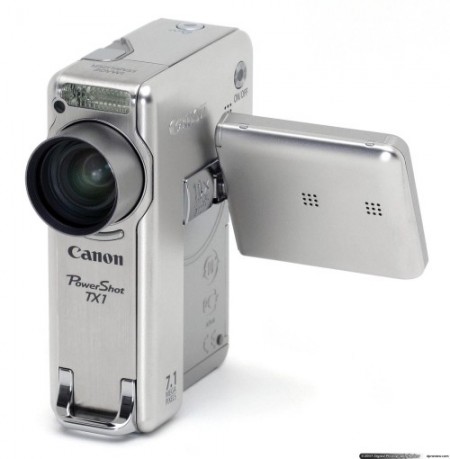
The design of the Canon PowerShot TX1 can be attributed to ultra-compact cameras. This is not surprising, because the progenitor of the project is the Ixus series. Structurally, the video camera was made very cool: the size of a little more than a pack of cigarettes, a pleasant weight (for such sizes), silver. In the decoration of the body used both plastic and metal inserts. The lens is fully retracted into the body, the rotary screen rotates 270 degrees around its longitudinal axis.
Miracles begin at the moment when you pick up the camera and try to take something off. I must say, the engineers acted quite wisely, spreading the functions of the photo and video into different buttons: on the upper end (photo) and on the side opposite the lens (video).
Designers speculated that grabbing her right hand in the manner of a pistol grip would be natural for the TX1. In life, this is not very convenient. Firstly, the light weight of the camera strains the muscles of one arm too much. Secondly, although the controls are reasonably well thought out, some operations take too much time. Perhaps out of habit.
Finally, thirdly: in order to take a vertical photo (for example, a full-length portrait), TX1 has to be directed to the subject ... in short, in a movie this is called “shoot in Macedonian”. As you know, it’s very, very difficult not to fill up the horizon, “shooting” in Macedonian style ... The
step has been taken!
Canon PowerShot TX1 is the first device in history, after testing which it is impossible to say which of the functions (photo or video) it has the main. Basic both.
As for the quality. If you consider that the Canon PowerShot TX1 is the cheapest HDTV-camcorder on the market, we have practically no complaints about the quality. Yes, the size of the output file makes you look for the most capacious cards, carrying them with you almost handfuls. Yes, the lightness of the body provokes a “stir” during the change of focal length - and the stabilization system is powerless here. But: pure quality, the picture without taking into account technical factors at TX1 is good.
Good and photos taken by Canon PowerShot TX1. At least in comparison with other competitors with similar capabilities (7 megapixels, 39-390 mm focal length), the brainchild of Canon looks extremely convincing. Excellent picture clarity, slight aberration, tolerable dynamic range. Like all compacts, PowerShot TX1 loves nature and sunny weather, reacting extremely painfully to lack of lighting: high ISOs are noisy, and autofocus becomes extremely leisurely.
Problems PowerShot TX1 do not relate to the technical side, but to the design. The vertical grip and the location of the buttons do not allow the user to make the necessary parameter changes quickly and quietly for the recording results. Of course, it was worth the engineers boasting that in such a miniature size they embodied so many useful options. Nevertheless, using TX1 is inconvenient. It would be interesting, but inconvenient.
Therefore, the current model, although it is a major step towards combining cameras and cameras, in fact, can be considered nothing more than an interesting toy for enthusiasts. And the mass buyer should wait for the Canon PowerShot TX2.
(review based on material from DPreview.com)
This trend is quite interesting. Cell phones with MP3 ambitions, game consoles used as Bluray players, cameras, crowding out the old Sony Handycam from the shelves ...
The tale has come true
In general, of course, the idea of combining digital cameras and digital video cameras is correct. No, we are not talking about those hybrids that are now: not universal, capable of producing high-quality results either in the form of pictures, or - in the form of records. I mean a combine that makes normal competition for entry-level devices (at least) and completely replaces home budget cameras (costing up to 10-13 thousand). Once it was just a dream, but ...
... but in February 2007, Canon announced the PowerShot TX1 project. A video camera with a standard camera matrix, optical stabilization, a large range of focal lengths and flash cards as media. In the past, everything rested, by the way. According to experts, the appearance of normal hybrids is inevitable - as soon as the price of flash drives with a volume of more than eight gigabytes falls below the level acceptable for the mass user.
Now this price for Compact Flash has dropped to below $ 99. At the end of May, the PowerShot TX1 project turned into a product - the Canon PowerShot TX1 entry-level video camera and entered US stores for as low as $ 450.
Features PowerShot TX1:
Matrix
SCD 1 / 2.5 "7.1 megapixel
processor
DIGIC III with support for iSAPS technology Image
sizes
3072 x 2304, 3072 x 1728 (16: 9), 2592 x 1944, 2048 x 1536, 1600 x 1200, 640 x 480
Movie
1280 x 720 @ 30fps640 x 480 @ 30fps320 x 240 @ 60 / 30fps JPEG
file formats
Exif 2.2, DCF, DPOF, AVI Motion JPEG, WAVE
Optics
39-390mm (at 35mm equiv.), F3.5-5.6 optical image stabilization
Shooting modes
Auto, Manual, Portrait, Night Snapshot, Indoor, Foliage , Snow, Beach, Aquarium, Super macro, Color accent, Color swap, Stitch assist, Special scene, Movie
Shutter speeds
15 - 1/2500 Exposure
compensation
± 2EV in steps of 1/3 EV
Sensitivity
Auto, High ISO Auto, ISO 80-800
White balance
Auto, Daylight, Cloudy, Tungsten, Fluorescent, Fluorescent H, manual adjustment Auto
flash
, always on, always off, red-eye reduction, Flash exposure lock, slow sync SD, SDHC, MMC
memory
cards (MMCplus support)
Viewfinder
No
Crop screen
1.8-inch TFT, 115,000 dots USB 2.0 Hi-Speed
connections
, AV out (NTSC / PAL), component output for HDTV
Other
Histogram, 2- and 10-second delay
Super photos
We proceed directly to the tests. First, check TX1 as a camera. Like the latest Canon superzoom, the TX1 boasts that it is able to focus at a distance of 0 cm. Yes, yes, right at the point located on the outside of the lens. To do this, however, you need to use the Super macro shooting mode - an ordinary macro “fulfills” the distance from a meter (with a focal length of 390 mm) to 10 cm (with a focal length of 39 mm).
The TX1 autofocus system works quite satisfactorily for cameras of this class. With good lighting, its speed is high, and there are practically no errors. In Super macro mode and when shooting indoors, the system is sometimes forced to make several attempts to finally focus on the desired detail.
The overall quality of the TX1 shots was very pleasing. Before us is a typical camera of the upper entry-level sector with a resolution of 5-8 megapixels, without discounts on “hybridity”.
Megavideo
Having made sure that as a TX1 camera it is quite worthy of attention, we pass to tests on video shooting.
Technically, shooting on TX1 boasts a full range of necessary parameters: resolution - from compact 320 x 240 to fully satisfying the HDTV format of 1280 x 720, 30 frames per second - as a reasonable minimum (320x240 can be shot at 60 frames per second), stereo sound, the ability to change focal lengths during shooting.
The problems of TX1 as a video camera stem from the fact that Canon in this project used a standard recording encoding method for its cameras: Motion JPG. As we know, this wonderful format, although it responds to the AVI extension, but in fact, demonstrates such file volumes that are not typical for standard AVI under any conditions.
In order not to be unfounded, let’s give an example of a table of standard gigabyte card capacity for various shooting modes:
640 x 480 @ 30 fps - 7 min 49 sec
640 x 480 @ 30 fps, low quality - 14 min 20 sec
320 x 240 @ 60 fps - 10 min 5 sec
320 x 240 @ 30 fps - 19 min 07 sec
1280 x 720 @ 30 fps - 3 min 30 sec
1280 x 720 @ 30 fps low quality - 6 min 44 sec
By the way, the TX recording file size is also limited: it is 4 gigabytes.
The recording quality of TX1 is on the standard DV format for modern home video cameras - so the new unit is quite capable of competing with this parameter. By the way! DV cameras for “at home, for the family” are produced not only by Canon's competitors, but also by the company itself. Maybe that’s why her leadership decided not to give such a powerful weapon as the MPEG-4 compression to the TX1’s hands.
Macedonian!
The design of the Canon PowerShot TX1 can be attributed to ultra-compact cameras. This is not surprising, because the progenitor of the project is the Ixus series. Structurally, the video camera was made very cool: the size of a little more than a pack of cigarettes, a pleasant weight (for such sizes), silver. In the decoration of the body used both plastic and metal inserts. The lens is fully retracted into the body, the rotary screen rotates 270 degrees around its longitudinal axis.
Miracles begin at the moment when you pick up the camera and try to take something off. I must say, the engineers acted quite wisely, spreading the functions of the photo and video into different buttons: on the upper end (photo) and on the side opposite the lens (video).
Designers speculated that grabbing her right hand in the manner of a pistol grip would be natural for the TX1. In life, this is not very convenient. Firstly, the light weight of the camera strains the muscles of one arm too much. Secondly, although the controls are reasonably well thought out, some operations take too much time. Perhaps out of habit.
Finally, thirdly: in order to take a vertical photo (for example, a full-length portrait), TX1 has to be directed to the subject ... in short, in a movie this is called “shoot in Macedonian”. As you know, it’s very, very difficult not to fill up the horizon, “shooting” in Macedonian style ... The
step has been taken!
Canon PowerShot TX1 is the first device in history, after testing which it is impossible to say which of the functions (photo or video) it has the main. Basic both.
As for the quality. If you consider that the Canon PowerShot TX1 is the cheapest HDTV-camcorder on the market, we have practically no complaints about the quality. Yes, the size of the output file makes you look for the most capacious cards, carrying them with you almost handfuls. Yes, the lightness of the body provokes a “stir” during the change of focal length - and the stabilization system is powerless here. But: pure quality, the picture without taking into account technical factors at TX1 is good.
Good and photos taken by Canon PowerShot TX1. At least in comparison with other competitors with similar capabilities (7 megapixels, 39-390 mm focal length), the brainchild of Canon looks extremely convincing. Excellent picture clarity, slight aberration, tolerable dynamic range. Like all compacts, PowerShot TX1 loves nature and sunny weather, reacting extremely painfully to lack of lighting: high ISOs are noisy, and autofocus becomes extremely leisurely.
Problems PowerShot TX1 do not relate to the technical side, but to the design. The vertical grip and the location of the buttons do not allow the user to make the necessary parameter changes quickly and quietly for the recording results. Of course, it was worth the engineers boasting that in such a miniature size they embodied so many useful options. Nevertheless, using TX1 is inconvenient. It would be interesting, but inconvenient.
Therefore, the current model, although it is a major step towards combining cameras and cameras, in fact, can be considered nothing more than an interesting toy for enthusiasts. And the mass buyer should wait for the Canon PowerShot TX2.
(review based on material from DPreview.com)