The rule of five seconds still does not work
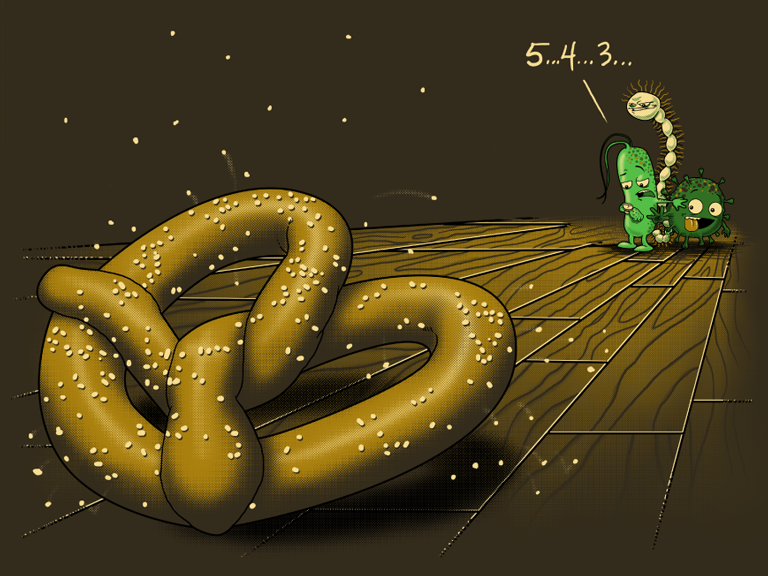
The saying “Quickly raised by a fallen man is not considered” in one form or another is known to all. We are talking about the so-called " rule of five seconds ." Some people believe that if a product fell on the floor, then if it is lifted within five seconds, this product remains usable. It is alleged that harmful microorganisms simply do not have time to move to food.
In 2003, Gillian Clark, an intern at the University of Illinois, decided to check whether this was true or not. Under the supervision of her supervisor, Clark conducted a rather large-scale scientific study. An intern took samples from the floors on campus. Were examined laboratory, hostel, cafeteria.
After the samples were examined under a microscope, it turned out that there was simply no significant amount of bacteria in the starting material. Therefore, it was concluded that a dry and relatively clean floor is a marginal source of harmful bacteria.
Clark conducted the second part of the experiment, placing the culture of Escherichia coli on smooth and rough tiles for flooring. On the same samples were placed pieces of food. After studying the food samples, it turned out that E. coli is present in significant amounts. In other words, Clark showed that the “five-second rule” does not work. Time did not play a special role - bacteria in quantities sufficient for human disease appeared on food within a second or two after a fall.
Interestingly, in the course of her research, the intern also conducted a survey, the results of which showed that 70% of women and 56% of men know about the “rule”. Many respondents are guided by this rule almost all their life when deciding how to deal with food falling on the floor.
A little bit later, the “Destroyers of Legends” conducted a series of experiments as part of the work on the “rule of five seconds”. The results of these experiments confirmed the results obtained by Clark.
All this, of course, is interesting, but the problem in the experiments mentioned above is that they were conducted not by professional scientists, but by amateurs.
Now scientists from Rutgersky University decided to take up the matter. Rutgers University- US State Research University, the largest institution of higher education in New Jersey. The research was led by Donald Schaffner, a professor of nutrition. The results are already published in the authoritative edition of Applied and Environmental Microbiology.

“The popular statement, dubbed the“ five-second rule, ”which says that a product quickly picked up from the floor does not harm health, does not correspond to the real state of affairs,” Schaffner said. The scientist says that he and the team decided to seriously address this issue, not considering the problem far-fetched or stupid. "We decided to use a serious scientific arsenal," - says the head of the study.
In the course of their work, scientists checkedFour types of surfaces, including stainless steel, ceramic coating, wood and carpets. Products such as watermelon, bread, a butter sandwich, and chewing candy were alternately placed on these surfaces. These products were left on the surface at different times. These are 1, 5, 30 and 300 seconds. Before putting the product on any of the surfaces, the specialists placed a culture of Enterobacter aerogenes on such a surface. This is a close relative of Salmonella. Before you put the product, scientists waited until the test surface is dry. A total of 128 situations were tested with the “fall” of a particular product on a certain surface. Each situation was tested 20 times. The total number of measurements taken by scientists - 2560.
As it turned out, most of the bacteria after the "fall" were on a piece of watermelon. Chewing candy received the lowest level of infection with a bacterium. True, nobody chewed the candy itself, it was put on the surface in its original form, without a wrapper. “The transition of bacteria from the surface to the surface is the fastest in a wet environment,” says Schaffner. “The bacteria have no legs, but they can move through the liquid. And the most bacteria get food products with high water content ... Of course, the most bacteria are on the samples that have lain on the contaminated surface the longest. "
An interesting result was shown by the test of infection of the food product on the carpet. As it turned out, the carpet - the safest of all the types of surface, despite our attitude to carpets. "The structure of the surface and food product plays an important role in the process of bacteria transition from one surface to another," says Schaffner.
In general, the study showed that the “five-second rule” does not work in most cases. Some types of surfaces and products are unfavorable for the transition of bacteria in the fall of the product. But 5 seconds has nothing to do with it.
The “five seconds rule” is a significant simplification of what actually happens when bacteria migrates from the surface to food. Bacteria can contaminate food almost instantly, "the study participants said.
Presumably, if an ice-cream or a buttered brood fell on the floor (butter down, as usual), then nothing can be done - it is undesirable to pick it all up if you do not want to get infected with E. coli or other bacteria. Sticky and wet foods are something that shouldn't be picked. But something like cookies, regular bread, dry sausage, etc. you can pick up. But again, not all types of surfaces are safe. Picking up fallen food is like a lottery. You never know if you will get sick or everything will be fine. The prize, of course, is questionable.