How to transfer energy through a single wire
There are a lot of discussions on the topic of energy transmission through a single wire on the Internet. Usually, for such a transfer of energy, grounding is implied, although in reality it is not the best way to transfer energy. It is best to transfer energy through the wire using the circuit shown below.
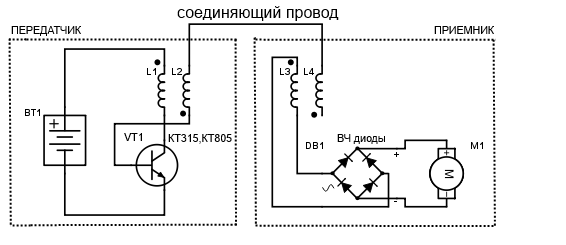
The connecting wire can be used very thin, in my experiments the wire was 0.08 mm in diameter. With well-chosen parameters of the coils, the transistor can be used without additional resistors, as shown in the diagram. For kt315, such an inclusion works at about 9 volts, for kt805, such an inclusion can be operable at 12 volts. It is important to observe the correct connection of the coils in the transmitting part of the circuit, otherwise it will not work. L2 coil is usually wound with a large number of turns of wire with a diameter of 0.2 - 0.5 mm. Coils L2 - L4 must be the same!It is easy to check the performance of the circuit; it is enough to pick up the LED for one of its legs and bring it to the contact of the L2 coil. It should start to glow. The rectifier diodes on the receiving part of the circuit must be high-frequency. It is also better to put a smoothing capacitor at the output of the rectifier.
Video with the work of this scheme
You may notice that the inclusion scheme on the video differs from the scheme in the article. In the video base of the transistor is connected to a resistive divider, consisting of 27 and 240 ohms. The rest works the same. A 12 volt battery is not necessary to install a powerful one, the power consumption from the circuit is small and a krone battery is enough for the experiments if the device is made small according to the scheme in this article. Tapered coils do not need to be wound, they were used in the video, as there was simply no other at hand.
Difference from other schemes
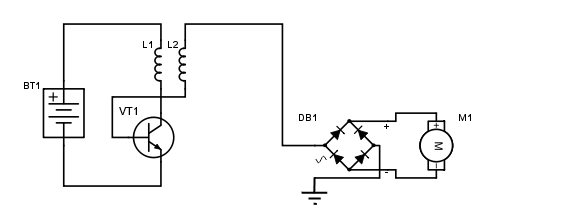
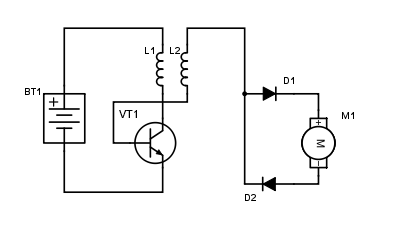
The two schemes presented above, without grounding, will work the worse, the longer the connecting wire. Moreover, it is very noticeable within 3 meters. When a massive conductive object is connected to the receiving part, the energy intake improves, but it still remains worse than in the very first scheme of this article. For the first circuit, the energy reception efficiency is not so much dependent on the length of the connecting wire and does not require the presence of a massive conductive object as ground.
Experience with a light bulb
If the output of the coil L2 is connected to a light bulb with a filament, and the second wire of the bulb is made long enough, the filament will be lit. However, it will not burn evenly, but with a gradual attenuation.
Experience with a coil around a wire
If you make a coil and pass a wire that transmits energy to a receiver through it, an EMF appears on the coil, as if an alternating magnetic field is directed along the conductor, and not around it.
The connecting wire can be used very thin, in my experiments the wire was 0.08 mm in diameter. With well-chosen parameters of the coils, the transistor can be used without additional resistors, as shown in the diagram. For kt315, such an inclusion works at about 9 volts, for kt805, such an inclusion can be operable at 12 volts. It is important to observe the correct connection of the coils in the transmitting part of the circuit, otherwise it will not work. L2 coil is usually wound with a large number of turns of wire with a diameter of 0.2 - 0.5 mm. Coils L2 - L4 must be the same!It is easy to check the performance of the circuit; it is enough to pick up the LED for one of its legs and bring it to the contact of the L2 coil. It should start to glow. The rectifier diodes on the receiving part of the circuit must be high-frequency. It is also better to put a smoothing capacitor at the output of the rectifier.
Video with the work of this scheme
You may notice that the inclusion scheme on the video differs from the scheme in the article. In the video base of the transistor is connected to a resistive divider, consisting of 27 and 240 ohms. The rest works the same. A 12 volt battery is not necessary to install a powerful one, the power consumption from the circuit is small and a krone battery is enough for the experiments if the device is made small according to the scheme in this article. Tapered coils do not need to be wound, they were used in the video, as there was simply no other at hand.
Difference from other schemes
The two schemes presented above, without grounding, will work the worse, the longer the connecting wire. Moreover, it is very noticeable within 3 meters. When a massive conductive object is connected to the receiving part, the energy intake improves, but it still remains worse than in the very first scheme of this article. For the first circuit, the energy reception efficiency is not so much dependent on the length of the connecting wire and does not require the presence of a massive conductive object as ground.
Some experiences
Experience with a light bulb
If the output of the coil L2 is connected to a light bulb with a filament, and the second wire of the bulb is made long enough, the filament will be lit. However, it will not burn evenly, but with a gradual attenuation.
Experience with a coil around a wire
If you make a coil and pass a wire that transmits energy to a receiver through it, an EMF appears on the coil, as if an alternating magnetic field is directed along the conductor, and not around it.