Computer facilities of the CMEA countries. Part one. GDR
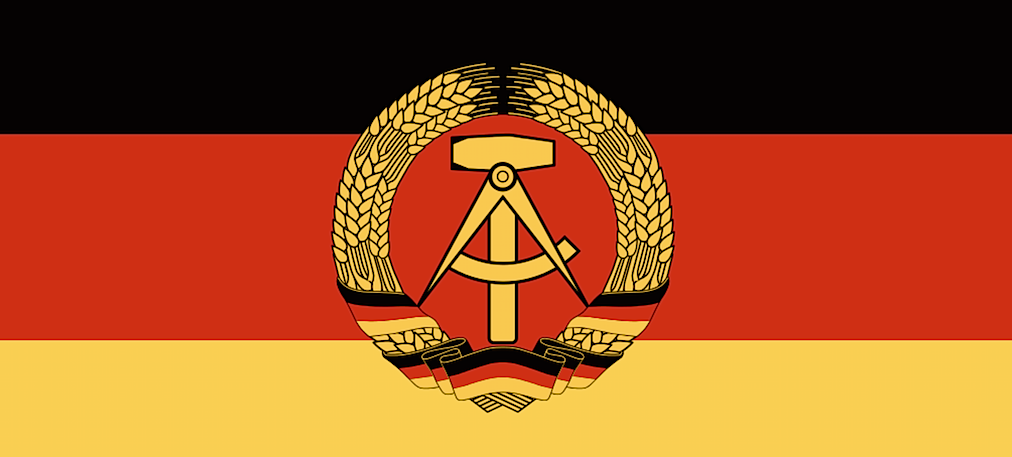
On January 5, 1949, the Council for Mutual Economic Assistance (CMEA) was created. The countries of the socialist Europe became members of the Commonwealth: the Soviet Union, Romania, Bulgaria, Poland, Czechoslovakia and Hungary, and later joined Albania, the “democratic” part of Germany (German Democratic Republic). The Commonwealth was focused on "worldwide support for scientific and cultural development," against the backdrop of "accelerating scientific and technological progress."
The main reason for the creation of the CMEA was the devastation that subsequently arose from World War II. Huge losses were incurred not only human, but also economic, industry, residential spectrum, infrastructure required immediate recovery.
Ardent propaganda of science, focus on education and participation in scientific work was welcomed by society and was perceived as "creative self-realization of the individual and a form of social contribution." The economic and scientific interaction of countries has borne fruit, although it was a unique project that was based on the relations of the peoples of different countries. The exchange of students between all socialist countries was practiced; thanks to the “iron curtain”, the concept of “competition” between the eastern and western markets did not exist.
Let us recall only the development of a single series of computers of the EU, on the development of which 300 thousand people worked - engineers, technicians, scientists, developers.
It is obvious to divide the participating countries into three groups according to their relation to the development of computer technology in the early 60s: with substantial scientific experience and advanced production (USSR), with a developed scientific basis, but without own production (GDR, Czechoslovakia, Hungary, Poland), and those countries that did not have a developed scientific basis or electronic industry (Bulgaria, Vietnam, Cuba, Mongolia, Romania).
It is interesting to follow the development of the scientific and technical base of the CMEA countries, considering some of them separately.
GDR

East of Germany after World War II was almost in ruin. The scientific potential of Germany was great and one should not forget about it, such famous personalities as Konrad Zuse, his first programmable computers in the world of the Z series, the first high-level programming language Plankalkül (Plankalkül) in the world. Before the outbreak of hostilities in the country, various studies on semiconductors were conducted, and the electronics industry was developing. In 1946, the Academy of Sciences of the GDR began its work, in 1991 it already had 58 institutes and more than 20 thousand employees. It was originally called the Berlin Academy of Sciences and was founded back in 1700, but during the years of the Nazi rule, many eminent scientists were forced to leave the Academy.
The engineering base for the creation of electronic computers was laid in Germany during the Second World War, the prototypes of modern computers were used for encryption. About the encryption case of Germany was one of my previous publications .

In 1963, after the VI Congress, a new reform process began, which was aimed at raising the economy, culture and education of young people, developing electronic data processing. The creation of the computer began, so the Robotron R-300 appeared. Many enterprises worked on the production of the machine.
VEB Kombinat Robotron
These were the best computers of the GDR. Western experts appreciated the quality of the machines produced by this company. Robotron A 5120 (BC 5120), Robotron K 5221, Robotron KC 85 and KC 87 (home computer series), Robotron K 8915, Robotron 1715, Robotron EU 1834 ... and many others.

Old and new logo
The beginning of the development of the field of computing technology of the GDR is closely associated with the name Robotron. Rolf Kutchbach from Chemnitz is considered the father of computing in the GDR. He recalls one small dream of engineers and technicians. In 50 years, standing at the origins of the foundation in the GDR of the discipline of computer science, the machine with a speed of 5 thousand computing operations per second was the ultimate dream of these pioneers.

Rolf Kutchbach
As in the USSR, in the GDR, cybernetics was originally from the field of science condemned by socialism. As soon as they did not call it: both pseudoscience and the ideological weapon of imperialism. Meanwhile, the ideological struggle in the international market successfully and freely developed the American company IBM, releasing its first computers.
Combine for the production of electronic computers ELERMA (1958), which was Chemnitz (at that time renamed by the government of the GDR on Karl-Marx-Stadt) became the predecessor of the production association with the name Robotron. The name Robotron originated by combining the names of Roboter and Elektronik into one word. Manufactured products began to bear the same name. So, after the above-mentioned congress, in 1963 the practical implementation of the project for the creation and development of computers began, the work was carried out at different enterprises in different parts of the country: the Institute of Electronics in Dresden developed a memory device on ferrite rods and a control system on a magnetic tape The Karl Zeiss plant in Jena manufactured a tape memory device; in the Sommerd office equipment factory, a printing device, The VEB ORWO plant manufactured ferrite rods, and the Dresden Data Processing Institute supplied the DFE-550 data transmission units. It was expedient to unite the participants into one, controlled from above, “system”. Such a system was the cooperative association Robotron 300, starting in 1970 with headquarters in Dresden, with more than 25 enterprises. In April 1969, Robotron and Zentronik were established. In early 1978, the Zentronik plant ceased to exist and its enterprises merged into the Robotron. In April 1969, Robotron and Zentronik were established. In early 1978, the Zentronik plant ceased to exist and its enterprises merged into the Robotron. In April 1969, Robotron and Zentronik were established. In early 1978, the Zentronik plant ceased to exist and its enterprises merged into the Robotron.
Here are some of the Robotron businesses:
Robotron in Dresden
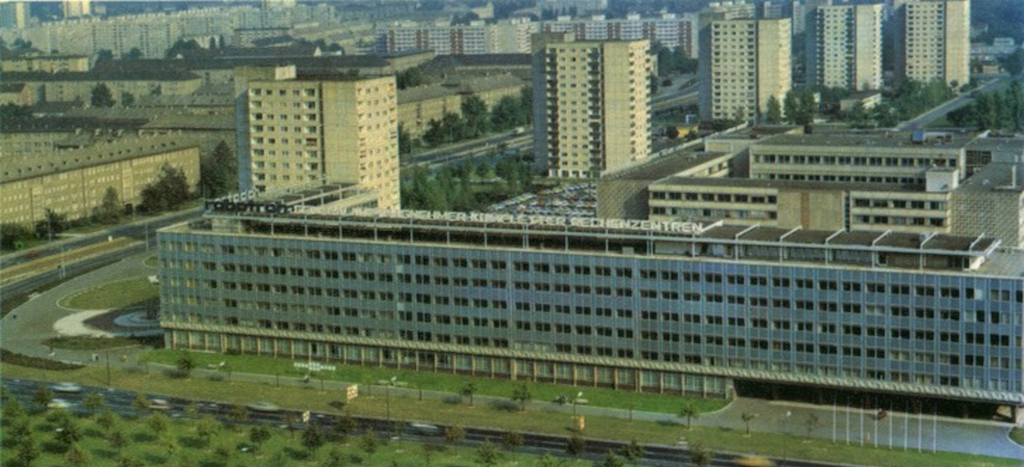
Accounting and counting machinery factory in Chemnitz


He was one of the largest manufacturers of computers in the GDR. Accounting machines of 170 class, office (institutional) computers A5120, A5130, K8924 (EC1834) were produced here. Also here they were engaged in the production of computing elements, for example, disk drives, as well as magnetic cards.
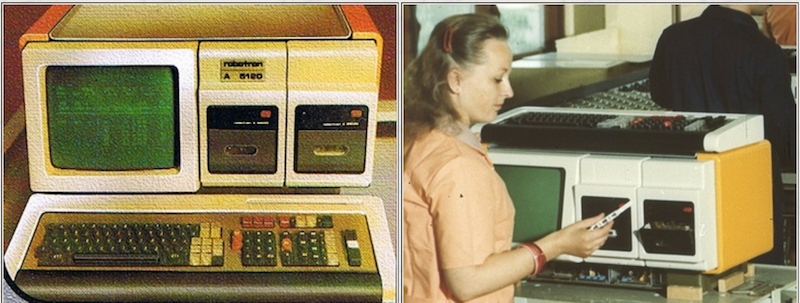
Robotron A5120 K1520
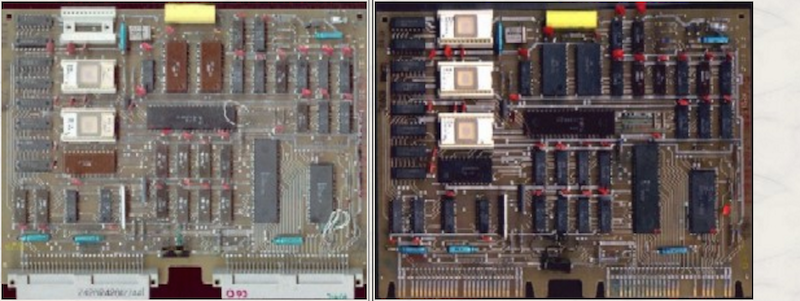
Boards
Computer Robotron A5120 was the predecessor of office (institutional) computers. Among its advantages: flexible configuration changes, compactness, ease of maintenance. It was developed primarily for office work, but was also used for software development, as a measurement and control center, as a terminal, for data conversion. He worked on the U880 processor with a frequency of 2.5 MHz, the memory size is usually 64Kb, it worked with a monochrome display. The A5120 first worked under the control of the BCU880, later the OS was replaced with the SIOS1526.
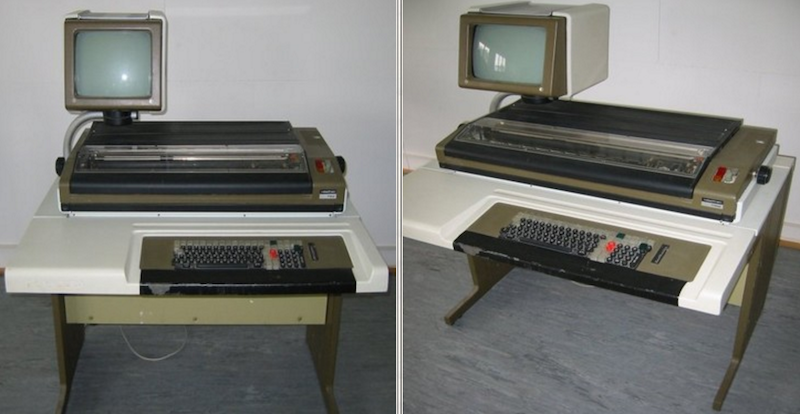
Robotron A5130

Robotron A5130

Drive MF6400
Software Robotron A5130. Supported operating systems: SIOS1526 - this was the original operating system for the A5130. Since this operating system was incompatible with international operating systems, it was used to work in banks, post offices, railway ticket offices. UDOS1526 - the second UDOS operating system was developed. It was intended primarily for programming, but was never properly used. SCP1526 (1984) is the most widely used OP for the A5130. CP / A, DAC, MICRODOS 1526, CP / Z. A5130 is known as EC8577.
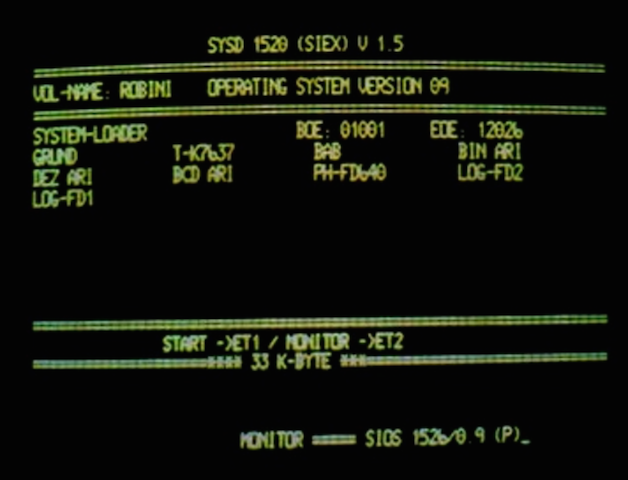
SIOS1526
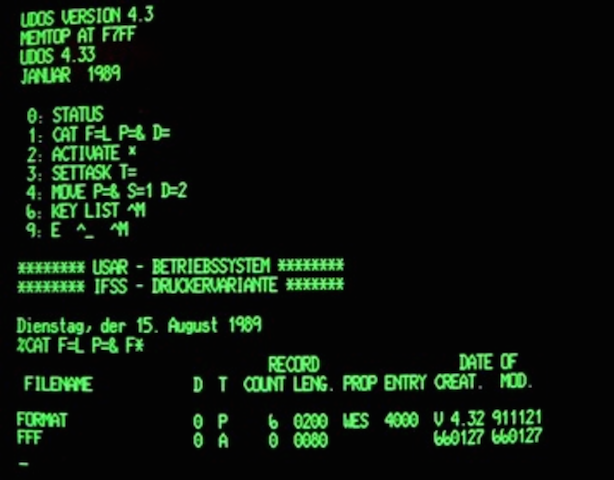
UDOS1526

SCP1526
Historically, an enterprise has emerged through the merger of Astra-Werke and Wanderer Werke.

Accounting machines 170 class

170 class accounting machines
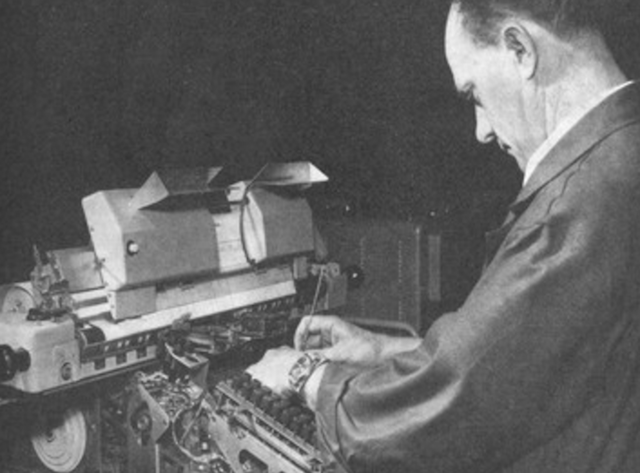
Manufacture of buchmash

Magnetic cards

Manufacture and inspection of disk drives

Manufacture of disk drives
The Ernst Telman office computer factory in Semmerd (BWS)

The plant was one of the largest manufacturers of computer equipment in the GDR. Here they were engaged in the manufacture of personal computers, printers, calculators, accounting and counting-invoice machines, cash registers, devices for working with punch cards. Well-known manufacturer of printing devices, the largest manufacturer in Europe.
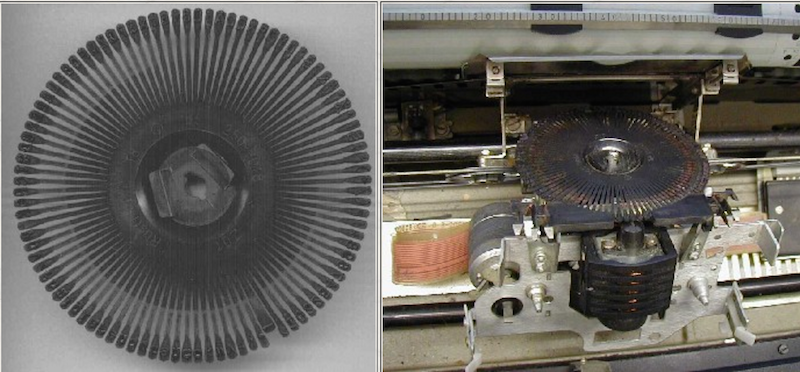
Printer series SD1152

Graphic printed on the printer SD1152
Printer SD1152 is also known as SD1. Used in computers A5110 and A5130.
The SD1154 printer was produced from 1976 to 1987. It was popular, 40420 copies of this printer were released.
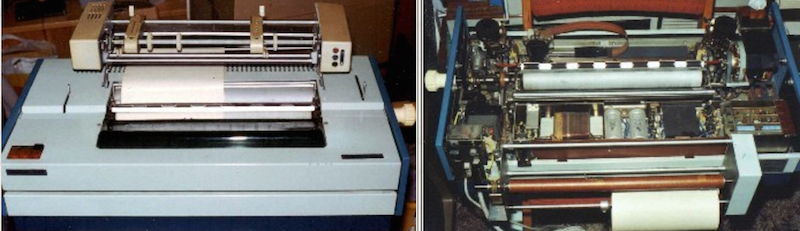
Printer SD1154

In 1982, the device cost 10289 marks. Currently only 5 copies of the SD1154 have been preserved, one of which, fortunately, is in good working condition.
As for computer production, this plant produced Robotron A5110, Robotron 1715 (PC1715), Robotron EC1834, Robotron EC1835.
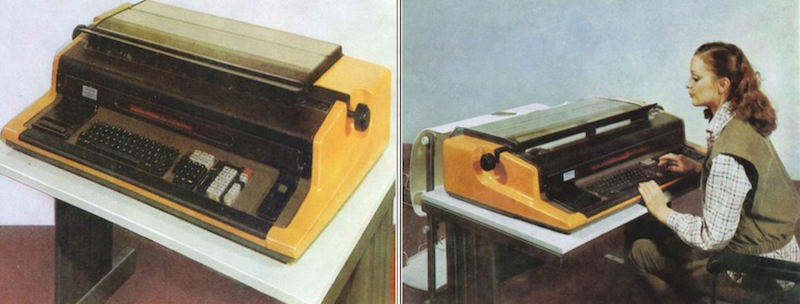
Computer Robotron A5110

Computer Robotron A5110
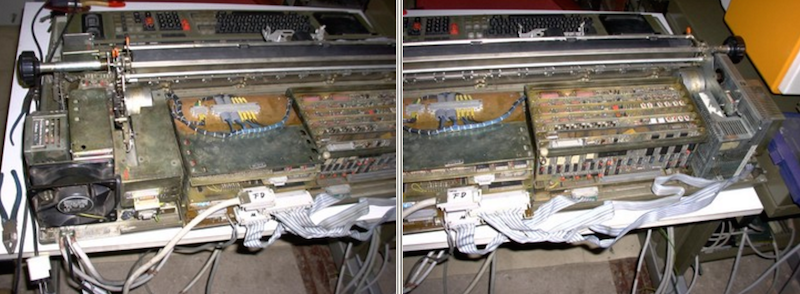
Computer Robotron A5110
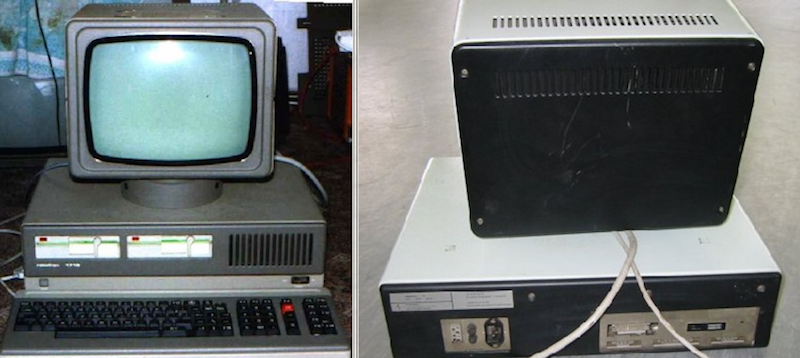
Robotron 1715 (PC1715)
Robotron 1715 (PC1715) - body dimensions 500 x 130 x 400 mm, weight was 13 kg. The car was relatively inexpensive, and therefore popular, they were made in a large volume, known as CM1904. The cost of a computer in 1986 was 19 thousand marks, in 1988 - just over 15 thousand. In 1987 he released an improved version of the PC1715W, today he is a welcome specimen for collectors.

PC1715W
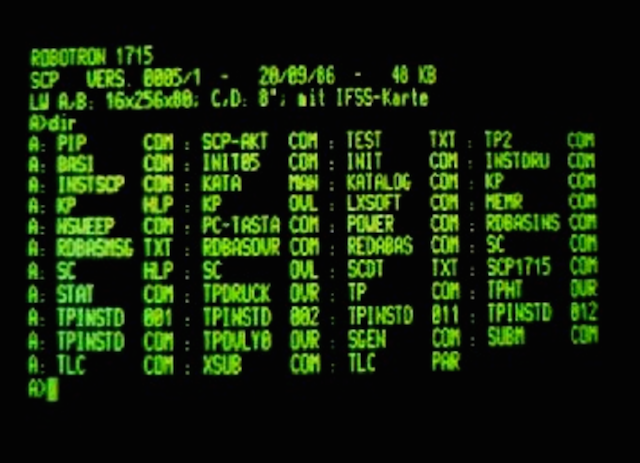
OS SCP1715

Office Computer Robotron EC1834
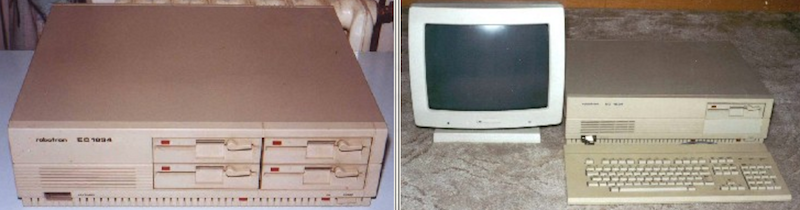
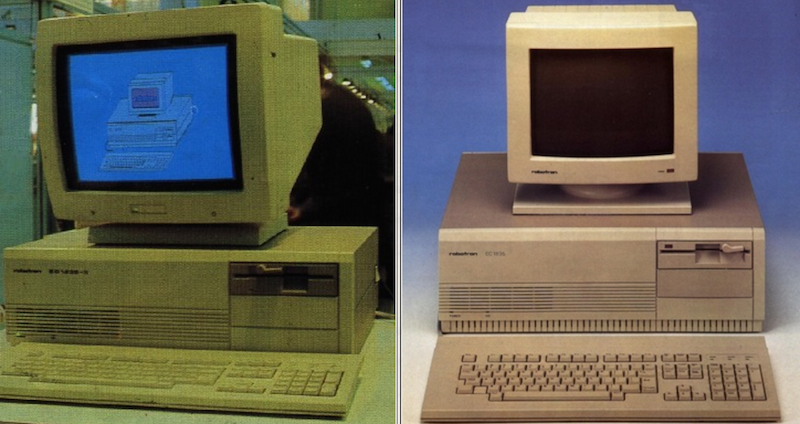
Robotron EC1835

Robotron EC1835-Turbo
In addition to such computing equipment, BWS produced cameras (Weltax, Exa und Perfecta), camera cables, photo tripods, drawing kits, scooters, bicycles, bicycle trailers, washing machines, vacuum pumps and stuff.
VEB Robotron-Elektronik in Dresden
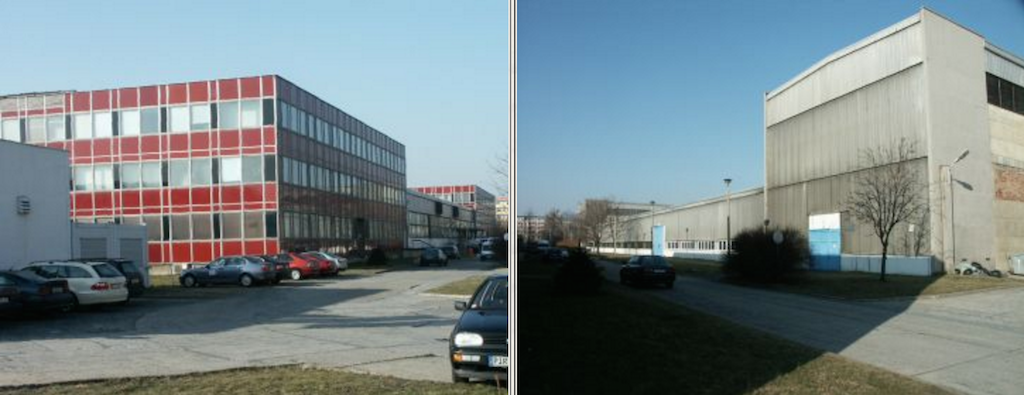
VEB Robotron-Elektronik in Dresden was one of the largest manufacturers of computer equipment in the GDR. Here were made such machines as office computers A7100 and A7150, terminal K8918, large computers R21, EC1040, EC1055, EC1056, EC1057, as well as computers A6401, A6402, A6491, A6492, K1820, K1840 and K1845. In 1990, the company was disbanded, transferred to private ownership.
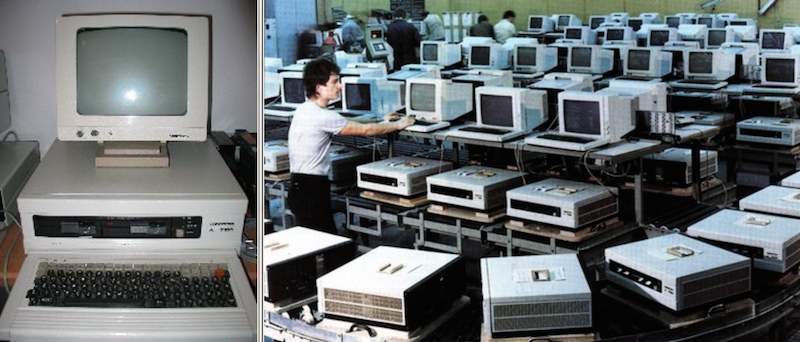
Computers A7100
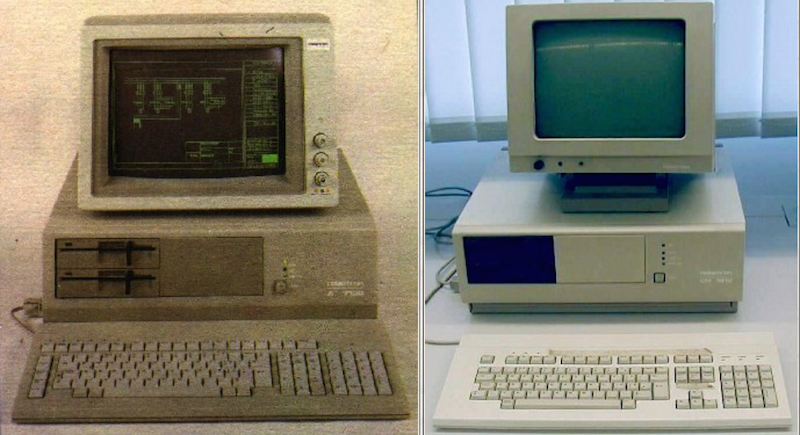
Robotron A7150 (SM1910, CM1910)
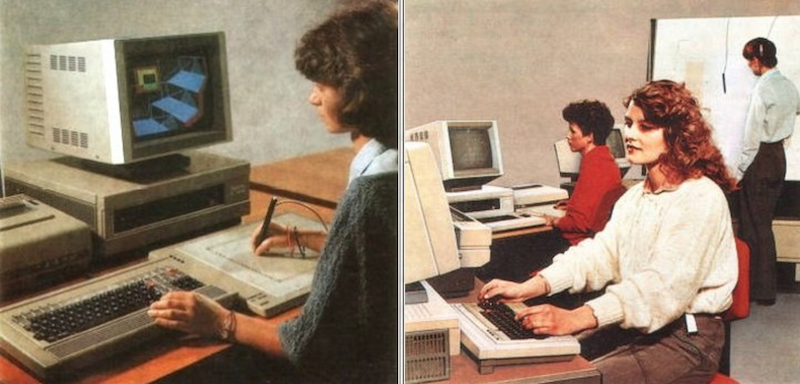
Working behind the graphic terminal K8918
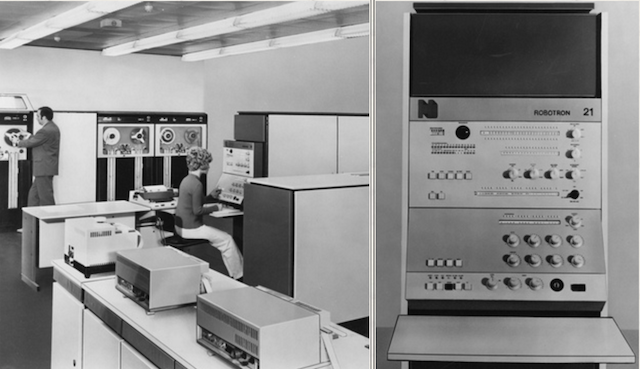
Large computer R21
The R21 computer was developed in 1971-1972 as an interim solution between the R300 and EC1040 mainframes, it was one of the first computers in the ESER / EU system. R21 was produced in the amount of 70 pieces. The speed is 50,000 operations per second (although in other sources the figure is 25,000 operations per second). The cost of a computer system is 3 million German marks. Today, R21 is considered "extinct."
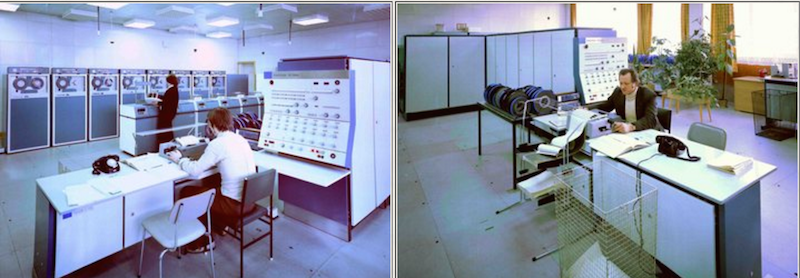
EC1040 1973, 380

EC1056 pieces were released , 1984 unfortunately there is no documentation on this

EC1057 computer .
The speed of the EC1057 machine was 1 million operations per second. The programming languages used were Assembler, REXX, FORTRAN, PASCAL and PL / 1.

Microcomputer A6401

K1840
K1840 - this 32-bit computing machine was introduced at the Leipzig Spring Exhibition in 1988. A small number of cars were produced. The product was well advertised, although in fact it was almost an exact copy of the American Digital VAX 11/780 computer. With a processing power of 1.1 million operations per second, the K1840 (EC1057) ranked second in speed among GDR machines. Approximately it weighed 1.2 tons, the cost of such a system was equal to several millions of marks.

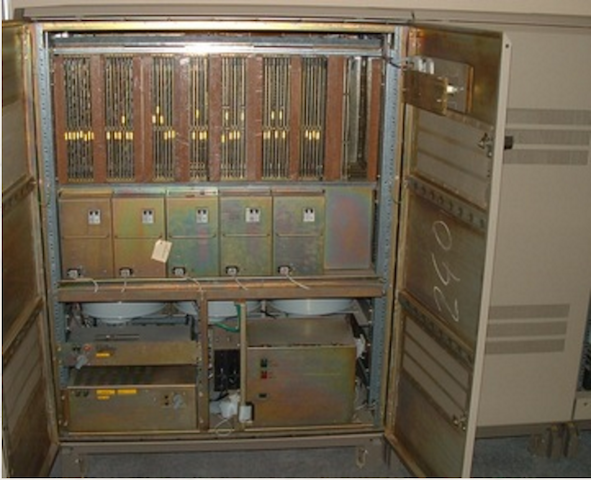
K1840 processor cabinet
VEB RAFENA. Robotron-Elektronik plant in Radeberg

The city of Radeberg near Dresden was of great importance for the German military industry. The company produced radios, portable televisions. The mainframe R300, UVM PR2000, PR2100, minicomputer R4000, R4100, R4200 and R4201 were also produced here.

R300, 1966

R300, 1966

UVM PR2100

R4000
Production of the R4000 was originally started in 1972 -1973 in Dresden, and starting from 1975, moved to Radenberg. The R4000 was a cabinet (cabinets, panels and plug-in units manufactured according to the standards of the EU series), which housed the processor, memory, interface cards, as well as the power supply. Any additional peripheral connected externally. A computer with a 16 bit processor. The R4000 did not have its own screen and keyboard, the PBT4000 terminal was used.
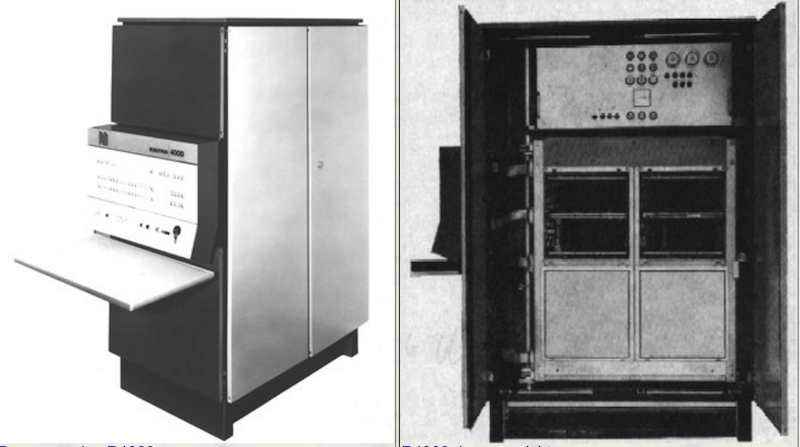
Processor R4000

PBT4000 The
price of the computer system R4000 is about 2.5 million marks. To date, one copy of which is known is preserved.
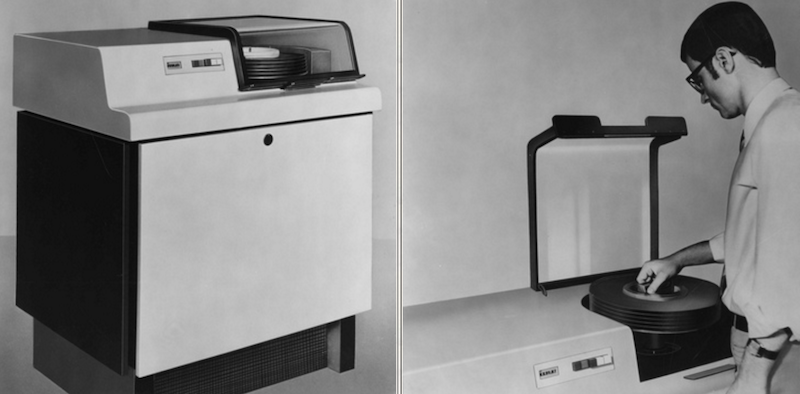
removable drive EC5055, weighing 190 kg
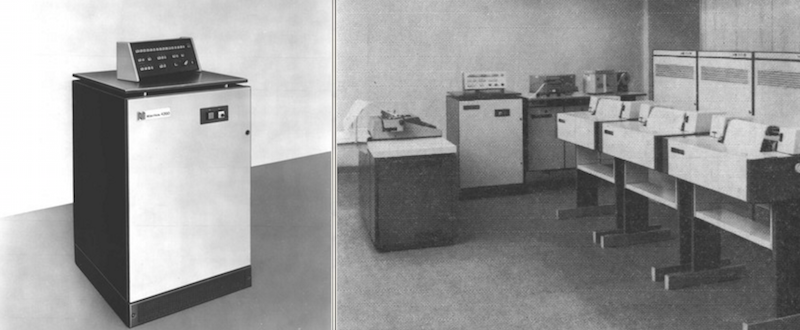
Computing Processor R4200 computer, computer center

computer R4200
Price R4200 system at that time was about 1.8 million marks, has remained one of the R4200 copies.
Robotron-Elektronik in Rize
At this production facility (abbreviated as “RER”), only two computers were produced: the microcomputer ZE1 and the home computer Z1013.
ZE1 was the first computational microsystem developed in the GDR, a microcomputer, the development and production of which was made possible by the release of the U808 microprocessor. From 1978 to 1987, approximately 100,000 copies of this system were released in Rize.

U808 microprocessor, was compatible with Intel i8008
With the development of microelectronics, developers were given the task of decentralizing the use of computers in connection with their miniaturization. Based on the 8-bit U808 CPU, the ZE1 microcomputer and the K1510 microcomputer system were released, and later on the U880, the K1520. The U880 processor, the prototype of which was the Zilog 80, was the main standard feature of the A-5100 office computer, later the PC-1715.

Plug-in module for ZE1 boards
A feature of the ZE1 system is the presence of a DMA channel for direct memory access from peripheral devices, bypassing the processor. The number of released ZE1, unfortunately, is not so great, possibly due to the release of a competitor - the K1510 system (later K1520). Today, however, there are still a few ZE1 machines, most of which do not function.

Computer Z1013

Operating system “Monitor Version 2.02”
For Z1013, the following programming languages were used - BASIC or FORTH.
Robotron-Elektronik Computing Enterprise in Bad Liebenverde

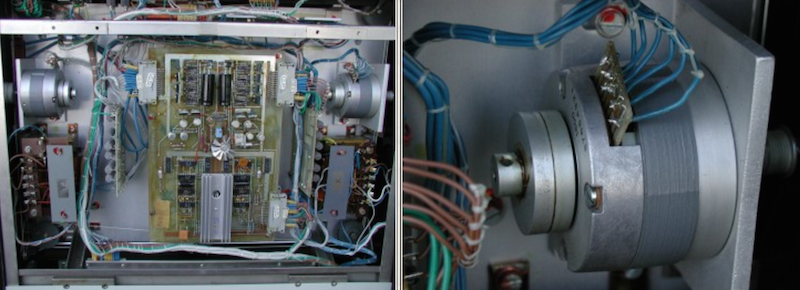
Plotter (computer peripheral graphics device) K6418

Plotter K6418
VEB Robotron-Elektronik in Zella-Mehlis

The company is known for developing the most "ancient" and universal computing technologies in the GDR.

daro 1210-0332
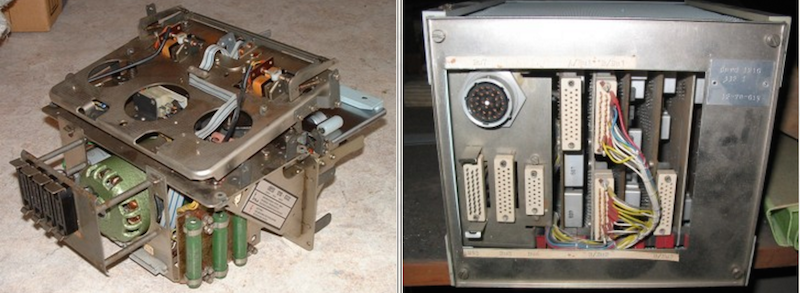
daro 1210-0332

Reader with punched tape 1210

Cassette tape drive mechanism K5200
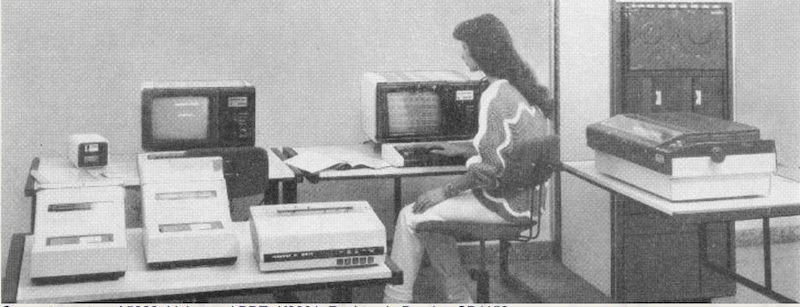
Robotron A5222

Robotron A5230
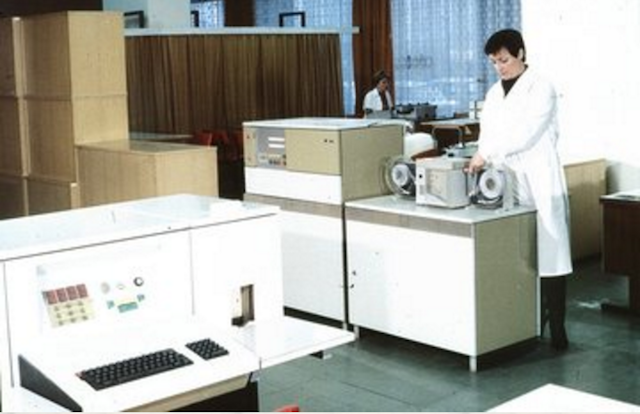
System HADES
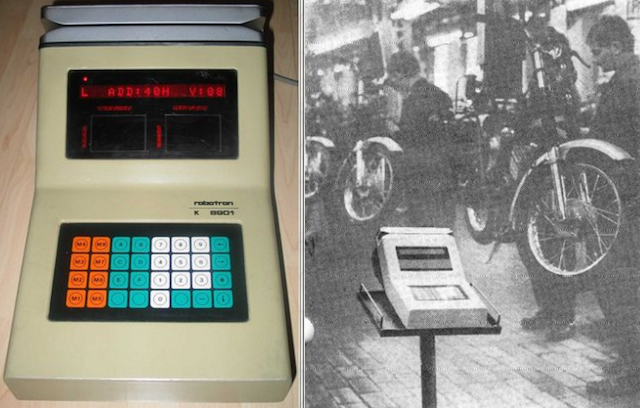
Terminal K8901

K8902

K8902
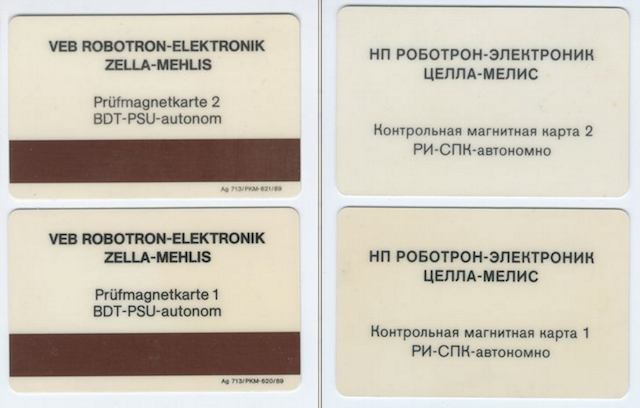
These are just some of the enterprises that have entered Robotron software. The machines of the popular single series ESER / EC were produced starting from 1973, thanks to which the total performance of German computers began to grow rapidly. Much attention was also paid to the computer control for production processes. The skill level of the staff was excellent. By the beginning of the 70s, the GDR was the most active participant in the EU EC project. The EU-1040 computer was produced in large quantities and exported to seven countries, in 1976 the EU-2640 central processor and the EU-5017 accumulators were awarded the Quality Mark.
For writing the article were used:
source 1
source 2
source 3
source 4