Backup, Part 5: Testing Bacula and Veeam Backup for Linux
This article will discuss various "large" backup software tools, including commercial ones. Candidate list: Veeam Agent for Linux, Bacula.
Work with the file system will be checked so that it is convenient to compare with previous candidates.
Expected results
Since both candidates are universal ready-made solutions, the most important result will be the predictability of work, namely, the same working time when processing the same data volume, as well as the same load.
Overview of Veeam Agent for Linux
This backup program works with block devices, for which it has a module for the Linux kernel, which ensures the integrity of the backup by tracking changed data blocks. A more detailed description is here .
The process of creating a file backup works on the basis of the same kernel module: a block device snapshot is created, which is mounted in a temporary directory, after which data is synchronized file by file from the nugget to another local directory, or deleted via the smb or nfs protocol, where several files are created in proprietary format.
The process of creating a file backup did not work out. Approximately 15-16% of the execution speed dropped to 600 kb / s and lower, with 50% cpu usage, which potentially led to 6-7 hours of the backup process, so the process was stopped.
An application for Veeam technical support was created, the staff of which proposed using block mode as a solution.
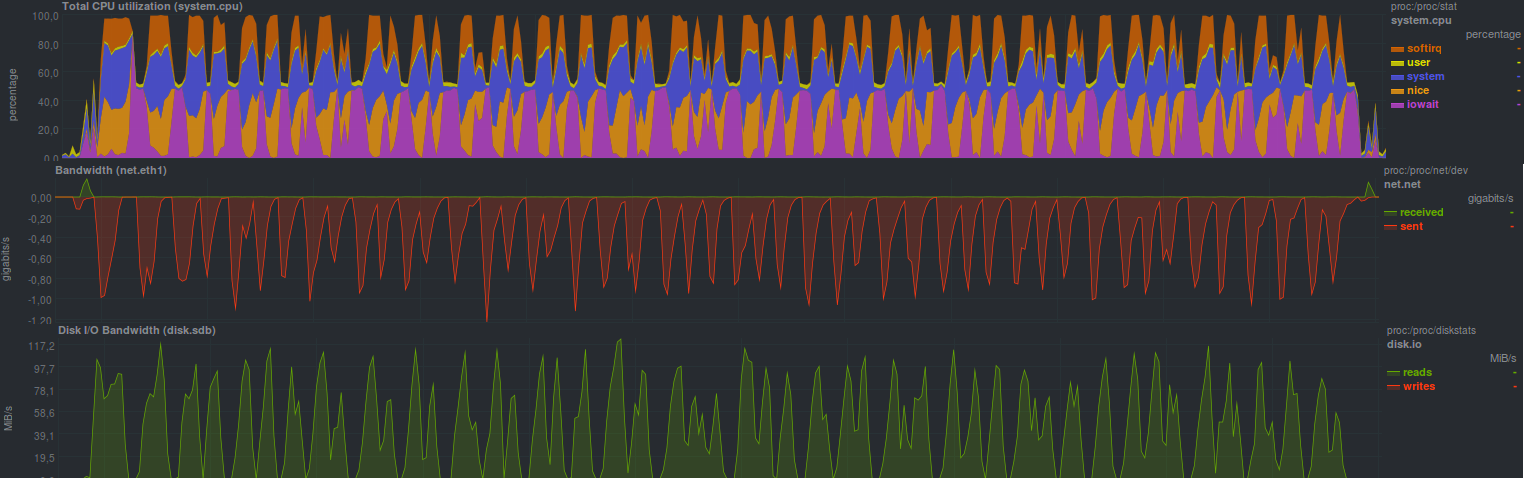
The runtime of the program in this mode is 6 minutes per 20 GB of data.
On the whole, quite good impressions of the program work, but in the general review it will not be taken into account due to the very large slowness of the file mode of operation.
Review Bacula
Bacula - client-server software for creating backups, logically consists of several parts, each of which performs its own part of work. There is Director, which is used for management, FileDaemon is the service responsible for backups, StorageDaemon is the backup storage service, Console is the interface to Director (there are TUI, GUI, Web options). This complex is also included in the review because, despite the significantly large entry threshold, it is a fairly popular means of organizing backups.
In this mode, Bacula proved to be quite predictable, performing a backup in an average of 10 minutes,
the load profile was as follows:
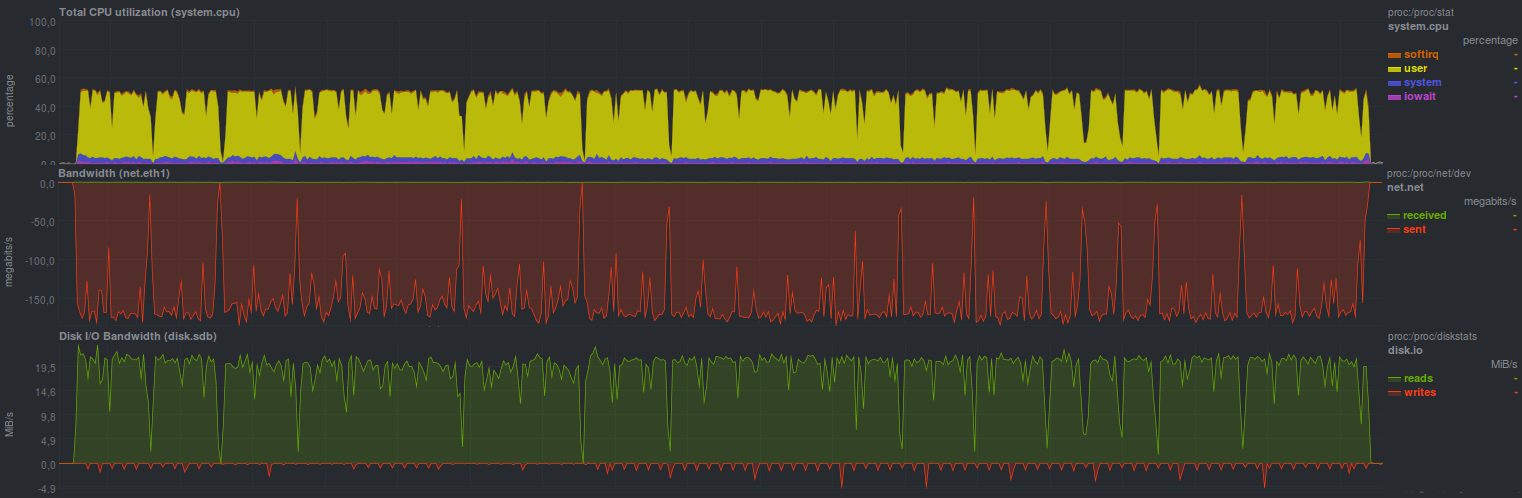
The size of the backups was approximately 30 GB, as expected when working in this mode of operation.
When creating incremental backups, the results did not differ much, except for the size of the repository, of course (about 14 GB).
In general, we see a uniform load on one processor core, as well as the fact that the indicators are similar to regular tar with activated compression. Due to the fact that the bacula settings for backup are very, very extensive, it did not work to show a clear advantage.
results
In general, the situation is unfavorable for both candidates, most likely due to the fact that the file mode of creating backup copies is used. In the next part, we will also consider the process of restoring from backups, general conclusions can be made by the total time.
Announcement
Backup, part 1: Why do you need a backup, an overview of methods, technologies
Backup, part 2: Overview and test rsync-based backup tools
Backup, part 3: Overview and testing duplicity, duplicati
Backup, part 4: Overview and testing zbackup, restic, borgbackup
backup, part 5: testing Bacula and Veeam backup for Linux
backup: at the request of the readers review AMANDA, UrBackup, BackupPC
backup part 6: Comparison of backup tools
backup copied ie, part 7: Conclusion
Posted by Finnix