July 5, 2019 at 15:27
Console cartridges as modems
- Transfer
Many modern video game players take online connections for granted - indeed, online services have been a standard feature of consoles for almost fifteen years 1 . However, even before the penetration of the Internet became widespread, there were cartridges that allowed players to use advanced technologies and look into the future.
With this article, we will close the series of posts about unusual cartridges. In it, we will consider several cartridges that provide the ability to communicate for consoles isolated from the outside world. As usual, this will not be an exhaustive list of all existing technologies, but a brief overview of the most remarkable or interesting devices.
Previous articles in the series: The Story of Three Cartridges ,"Systems inside cartridges: how engineers expanded the capabilities of game consoles , " "Cartridge Versatility: Sensors in Games for Game Boy . "
Xband
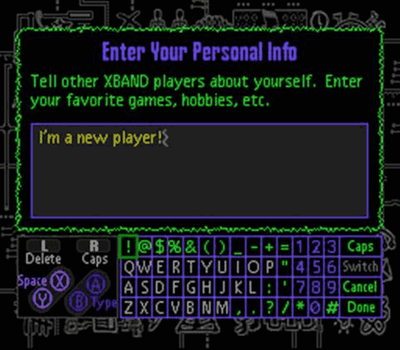
XBAND new user registration screenshot
Since the advent of video games, one of the most attractive features of this type of entertainment has been competition between players. Despite the fact that the fantastic graphics of games like Street Fighter II have gone light years ahead of simple Pong figuresThey all had a competitive spirit. These competitions have always been held in a face-to-face format, but in the early 90s a small group of former Apple engineers realized that the network communications technology, modems, which is gaining popularity among home computer users, has the potential to revolutionize video games. They created a company called Catapult Entertainment and began working on XBAND, a low-cost modem built into an intermediate cartridge, as well as an online service with which it could communicate. The XBAND service was supposed to allow players to play video games with standard cartridges against other players, regardless of their physical location. It was an amazing event, especially considering the relatively small size of the company and the fact that it was a third-party developer,
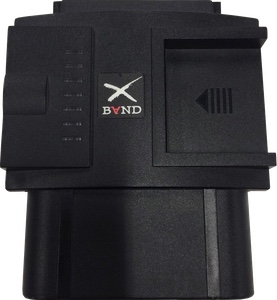
Version for Sega Genesis
The first XBAND model was released for Sega Genesis in late 1994, and the Super NES version appeared next summer. Despite the fact that these two consoles were completely different in terms of hardware and software, the XBAND modems for them turned out to be almost the same: they were installed between consoles and game cartridges (like Game Genie) and gave players seemingly magical possibilities (again, like Game Genie). Gamers simply connected the telephone line to the XBAND cartridge and started playing ... after paying the monthly subscription to the service, of course. Only a small fraction of the games on each of the systems was compatible with XBAND, but all of them gave users something special - the opportunity directly from their living room to participate in online battles with automatic search for opponents.
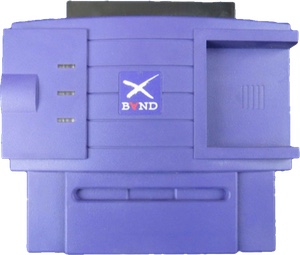
The version for Super NES
XBAND was released at a crossroads: people at that moment already realized that connecting to the network would become an important part of everyday life in the future, but until it was obvious that the Internet would become the main way of communication. Catapult Entertainment managed to attract fifteen thousand subscribers to the XBAND service, but they were not enough to keep the company afloat. The ambitious plans to create future versions of the device for other platforms, including PC and Sega Saturn, were not destined to be realized. The network ended in April 1997, less than three years after the release of the first model.
Despite the lack of long-term success, XBAND is hardly a failure. A small team foresaw the future and created a system with a selection of opponents online, news and e-mail almost a decade before the launch of Xbox Live or PlayStation Network. Simply put, in retrospect their achievement seems amazing.
Channel Wrestling with Gaming recently released an hour-long documentary about XBAND , in which there are detailed interviews with the developers of the device. This is an impressive example of documentary, especially considering that almost all the work was done by one person. I highly recommend this film to anyone interested in such things.
Sega channel

Sega Channel Game Screenshot
A few years before people started using coaxial cables for high-speed Internet access, Sega Channel proved that these cables are not just for television. After testing in a dozen US markets 2 at the end of 1993, the Sega Channel officially debuted in December 1994, and during 1995-96 the network was deployed in the United States and Canada 3 .
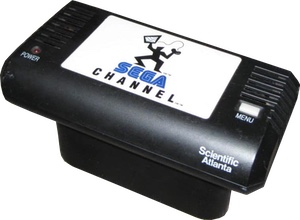
Cartridge Sega Channel
Sega Channel consisted of a special cartridge with a coaxial connector on the back and an online service that offered a monthly updated list of downloadable games. Players only had to register with the Sega Channel service and connect a regular coaxial cable to the back of the cartridge. After that, they could get down to business: in the Sega Channel service there was a news feed with information about games and new releases, as well as an ever-changing list of games downloaded at no extra charge. Although most games were simply downloadable versions of regular Genesis games, the service also became the home of many projects exclusive to the US market, including the rather scarce Genesis port of the first three Mega Man games with NES called The Wily Wars .
Unfortunately, for various reasons, the Sega Channel has not gained much popularity. Firstly, the infrastructure of the first cable service providers was not designed for such use: insignificant electrical noise, which appeared in the television signal as a barely noticeable noise or color change, could completely “break” the Sega Channel. To provide reliable service, it was necessary to eliminate noise and interference on all sections of the way from the cable company equipment to the homes of end users, which was quite a challenge for such a niche service. In addition, the main target audience of the service was children and adolescents, and for them the price of services was quite high: $ 15 per month in 1994 (about $ 25 in 2019). Ultimately, the limited list of cities in which the service was offered,
Sega Channel was one of the first examples of digital services offered over traditional analog cable networks, but in the future there were more such services - the foundation laid by cable service providers for Sega Channel set the stage for the ubiquitous cable modems that captured the Internet services market in early 2000 s.
Morita Shogi 64
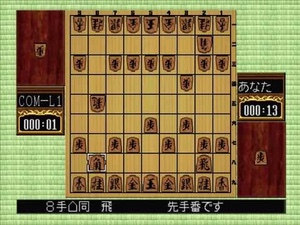
The Japanese strategic board game Shogi is a distant relative of chess with a long and amazing history . 4 . Despite its popularity in Japan (it is even more popular than chess familiar to Westerners), shogi is almost unknown to the rest of the world. In particular, shogi versions exist for almost every console, but Morita Shogi 64 for the Nintendo 64 is something special.
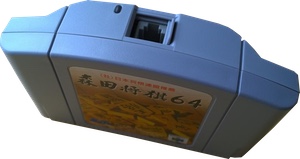
Surprise! At the top of the cartridge is a RJ-11 telephone jack.
Looking at the cartridge, you can reveal its secret: at the top there is a telephone cable connector, making this cartridge the only game for the Nintendo 64 with a built-in modem for online parties that does not require additional equipment. Despite the fact that Morita Shogi 64 was sold only in the Japanese market, it managed to attract the attention of Western gaming media. “It is unlikely that this game will reach the United States,” Electronic Gaming Monthly said in January 1997 (inadvertently disappointing its Canadian readers). “But the new cartridge design poses an interesting question: can Nintendo adapt this plug-and-play system to other N64 games?”
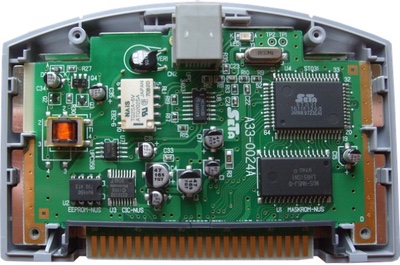
This special cartridge consists of an RJ-11 telephone jack (top middle) and a bunch of additional circuitry.
The answer was a firm no, but Nintendo eventually released a separate modem cartridge designed for the Japanese-launched Nintendo 64 Disk Drive add-on and its Randnet 5 online service .
Unfortunately for shogi lovers from the 21st century, Morita Shogi 64 worked through a gaming Internet service, rather than direct telephone connections between players, and this online service is no longer functioning 6 . This means that even if you manage to find another shogi fan who also has a Nintendo 64 cartridge and a landline phone, you won’t be able to play with each other. Alas!
Almost famous
These three cartridges are not the only examples of existing cartridges for data transmission, but when viewed from the whole, they give a very interesting picture of historical development.
As in many other areas of life, incomplete victories are often more interesting than serious successes. XBAND almost managed to create a viable third-party cross-platform gaming network, which will never happen again 7 . Sega Channel almost digitally uploaded content a decade before it became mainstream 8 , while proving that game subscriptions are a very promising business model for video games. Morita Shogi 64 is almost the beginning of the era of smart cartridges with built-in communication features.
This concludes our brief overview of the stunning versatility of modest gaming cartridges. Next month we will look at examples of the forgotten art of technology concept videos.
Notes
- Microsoft was the first to launch Xbox Live in November 2002. It was followed by Nintendo Wi-Fi Connection in November 2005 , and Sony's PlayStation Network in November 2006 . Probably all three were launched in November because the owners were trying to make it in time for the holiday season .
- Initial testing reached 5,000 consumers in twelve US test markets and began in April 1994. It was so successful that at the end of November, Sega issued a triumphant press release .
- The launch of the Sega Channel in the USA and Canada is documented in some detail , but there is not much detailed information about other countries.
- Shogi and chess are part of one family of games whose roots go back to the beginning of the Middle Ages. Their initial origin is unknown, but most scholars suggest that they appeared in India. I recommend studying the fascinating Wikipedia article on the history of chess.
- Randnet is a short lived online service available only in Japan. He worked for only fourteen months, Randnet provided basic Internet access services, including email, chat, online games, and Nintendo newsletter. The name Randnet is a coined acronym for " R ecruit and Nintendo Net work": Recruit is the name of the media company Nintendo teamed up with to create the service.
- Despite the active searches, I could not find the exact date of the service termination. If anyone knows when it was completed, then I would like to hear about it.
- The closest analogue today is the various social systems that were added to some Android and iOS applications before the integration of similar functions into platforms ( Game Center on iOS in 2010 and Google Play Games on Android in 2013). Most famous for most people is probably OpenFeint . But even they are not complete analogues, because the main idea of XBAND was that Catapult Games was to force XBAND to work with games created and released by third-party companies, without their support and permission.
- In the area of downloadable games, Microsoft was far ahead of Sony and Nintendo: Xbox Live Arcade was launched in May 2004. Sony and Nintendo are two years behind: the PlayStation Store was launched in November 2006, and the Wii Shop Channel in December 2006.
Additional reading
- XBAND Video Game Modem on Super Nintendo Memories
- Sega Channel History on Tedium
- Rare Video Game Hunting: Sega Channel, Solar Panel for Game Boy, etc.
- Looking Back on Sega Channel
- SharkWire Online is an unofficial online service for the Nintendo 64, launched by developers of the GameShark cheating device.
- N64 Games And Hardware You Didn't Know About
- Before There Was 64DD There Was Morita Shogi 64!
- Wikipedia: shogi story
- Wikipedia: the history of chess
- 64DD Wikia: Randnet
- Wrestling With Gaming - The Story of XBAND