May 27, 2019 at 10:19
 Battle of the Hyperstars
Over the past 3 years, in the long-established satellite communications market, one can observe a decent hype around low-orbit (НО) satellite hyper constellation projects - telecommunication systems consisting of many thousands of satellites, expensive and ambitious projects. It seems interesting to me to delve into the technical and economic details of these projects and talk about their prospects.
Satellite communications today and the last 30 years are primarily geostationary relay satellites located, respectively, in a geostationary orbit, where the satellite is approximately stationary relative to the ground observer and is equivalent to a conventional radio relay located on a tower with a height of 35,000 kilometers. Moreover, one single satellite is immediately visible from ~ 35% of the Earth’s area, and three are enough to cover the entire surface except for the polar regions.
Geostationary communication satellites today are very heavy machines weighing up to 4 tons (in working orbit) providing communication channels up to several hundred gigabits wide. Such a look of these satellites has developed, on the one hand, from the gigantic coverage area of the radio signal from the satellite (how many radio towers can boast access to 5 billion potential customers?), And, on the other hand, the weight of the equipment that can squeeze the maximum bandwidth out of the available radio spectrum.
Alignment of the antenna patterns of the Eutelsat 8 West B. geostationary satellite . Coordination of spatial spectral characteristics is today a very difficult task in satellite projects, and low-orbit systems are no exception.
Pay attention to the words “available radio spectrum”. Satellite communications operate at frequencies from 1.5 to 60 gigahertz, but there are not many satellites available in this wide radio range. Firstly, in the range from 1.5 to 10 GHz there are many terrestrial consumers of the radio spectrum - a typical example is wi-fi around the central 2.4 and 5.5 GHz. Secondly, above 20 GHz, rain, hail, and cloudiness begin to affect the operation of the radio channel. Thirdly, the available band has to be divided by at least two in order to organize the Earth-Satellite channel. As a result, the actively used satellite communication ranges (denoted by the letters S, C, Ku, Ka) are only 6 GHz band, for which there is a mortal battle of many operators.
Initially, however, 6 GHz was quite enough. After all, 15 years ago, the main content delivered to subscribers by communication satellites was television, and the same radio signal could deliver TV content to tens of millions of subscribers at once. However, with the advent of the 2000s, the market began to tilt toward digital two-way communication, where the demand for bandwidth is growing linearly with the number of subscribers.

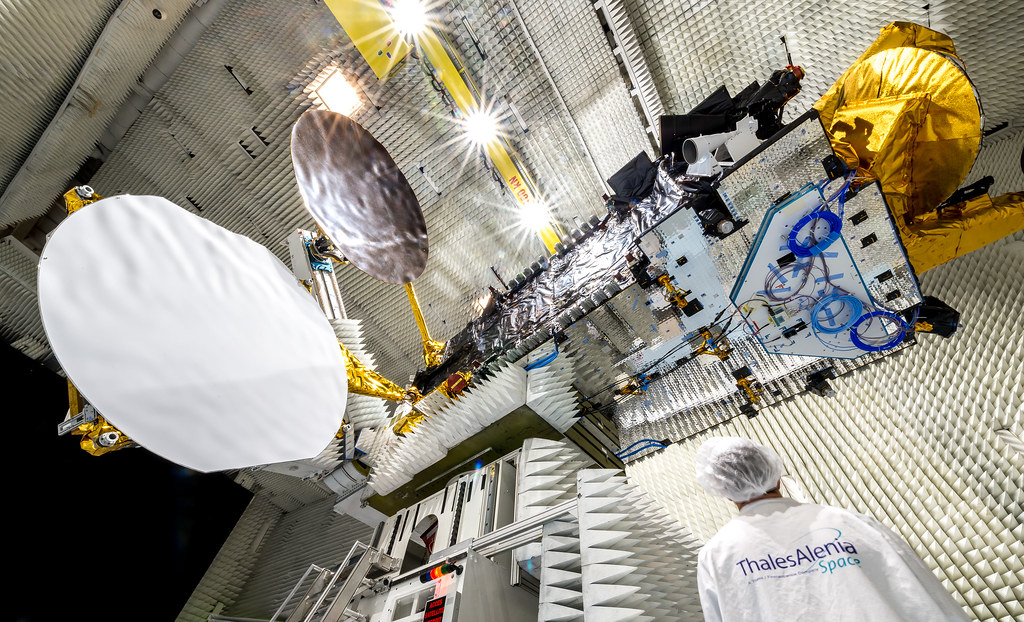
The assembly of the Galileo navigation satellite. In fact, the assembly of modern satellites is reduced to the manual installation of satellite system components on power panels and the manual tracing of dozens of cables and pipelines that connect them, as well as to a large volume of functional tests of the resulting complex. In this regard, satellites are more like precision industrial equipment than, say, airplanes.
GSO satellites responded to a change in the market by spatial reuse of frequencies - the satellite emits a lot of relatively narrow beams in which the same frequencies come across (by the principle of cellular networks). But this shift in needs has also shifted the optimality of GSO machines towards other solutions.
From high-flying GSO satellites, let's move on to low-orbit ones. The idea is to replace one heavy quasi-stationary satellite with a swarm of flying in low orbit. The idea is quite obvious, but until the 90s is not used, due to the balance of pro and contra.
What are the advantages of low-orbit satellites over GSO satellites?
But the business is not limited to only pluses, it is clear:
Despite the unobvious balance of the pros and cons, several operators rushed to realize the new idea of satellite communications in the 1990s. The most famous project of those times was called Teledesic and implied 840 devices in orbit with an altitude of 700 km with the task of delivering Internet to land subscribers. Teledesic raised about a billion dollars, but did not succeed. From the conception of the project in 1990 to the launch of the first experimental satellite in 1998, ground operators managed to win a significant part of the market Teledesic was aiming for, financial models showed cost recovery of $ 9 billion (~ 20 billion in today's dollars), so the project was bankrupt before before deployment.
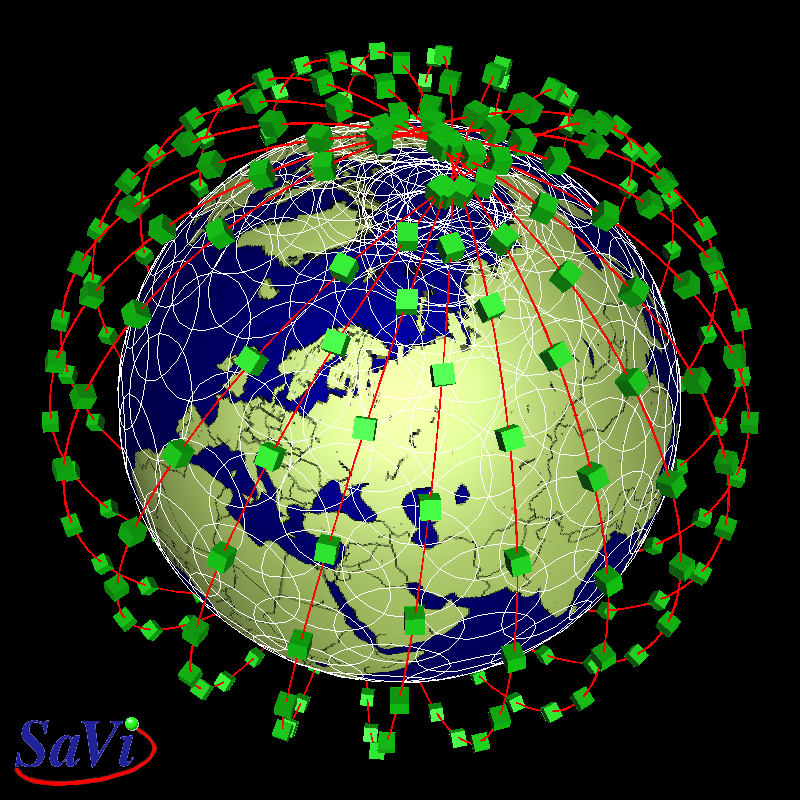
Simulation of the Teledesic satellite constellation (in a reduced version to 288 devices). It can be seen that with a uniform arrangement of the constellation in the circumpolar orbits with increasing latitude, multiple overlapping of the working areas of satellites occurs. This is not such a simple problem, as it seems, and requires either to disconnect part of the satellites from work at latitudes above 45, or to have a lot of sophisticated equipment on board the satellite to reconfigure the working areas when the satellites approach the poles.
Teledesic quickly had two rivals - the Iridium and Globalstar projects, which focused on the then more familiar satellite telephone market, which was generally almost inaccessible to GSO operators (telephony directly from the geostationary station required either a large antenna on the ground or an incredibly large antenna on satellite)
The Iridium project had global coverage due to a constellation of 72 satellites (6x11 planes + reserve of 1 satellite per plane) in 700 km orbits. Each satellite weighed 680 kg, but it possessed rather modest by today's standards capabilities to simultaneously work with only ~ 1,500 subscribers. The satellite orbits had an average height of 780 km for the NOO groups.
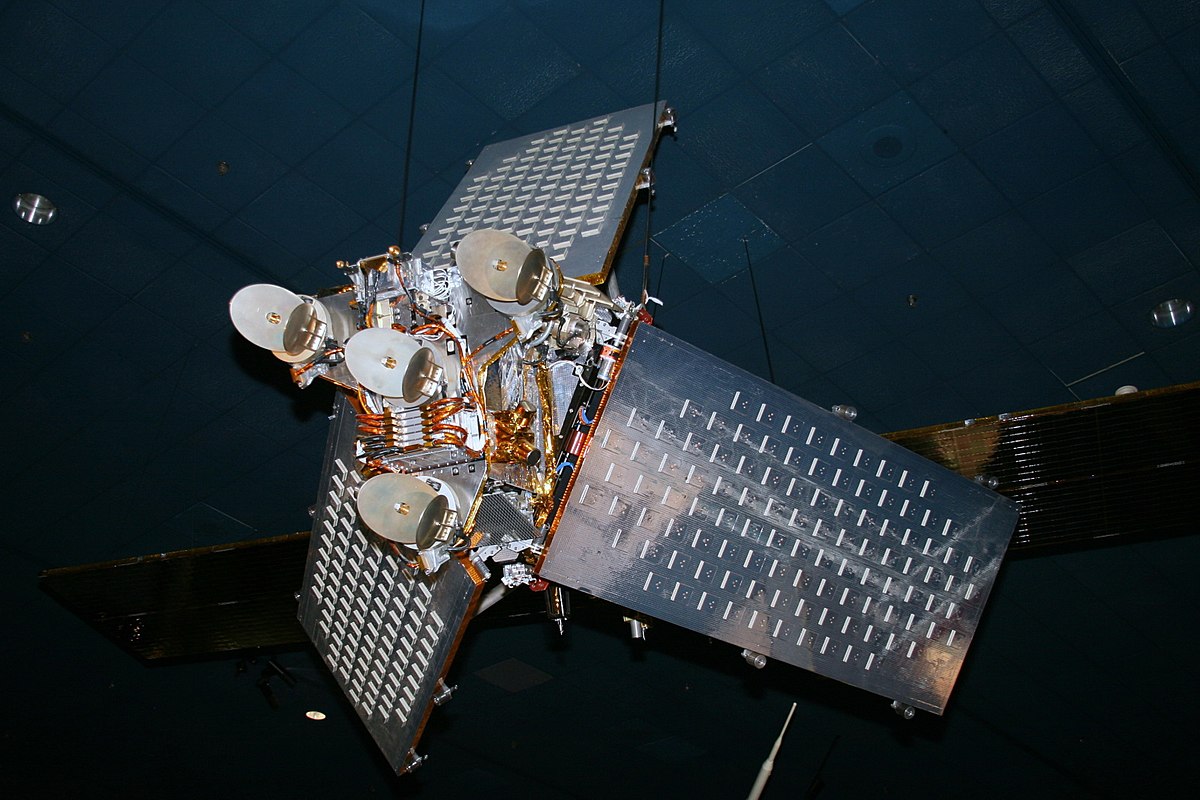
Iridium satellite of the first generation. Three 48-beam subscriber antennas on the sides of the satellite gave us the phenomenon of “ Iridium flares ”. Based on the satellite, 5 Ka-band rotary antennas are visible, providing inter-satellite communications and communication with terrestrial teleporters.
Iridium satellites had developed inter-satellite communication equipment, which allowed routing calls to ground-based communication stations or a subscriber-satellite network-subscriber. This equipment, in general, determined the weight of the satellites.
Almost immediately after the deployment of the group, the company went bankrupt, and only experts would know about it if it were not for the Pentagon, who decided that the system was very useful for military purposes: the bankrupt Iridium was bought out by Pentagon contractors who began to operate the system for money from the military, writing off part capital costs.
Iridium's competitor was Globalstar, a system deployed a year later, initially created according to more economical canons. There were only 48 satellites, weighing 550 kg, with an orbit height of 1,400 km, distributed over 6 pieces in 8 planes. Such a number of vehicles in such orbits did not allow covering the entire surface of the Earth, and communication worked only up to ~ 70 latitudes. However, Globastar was able to work only as a repeater from a subscriber to a ground gateway, so there would be little use for it at the North Pole.
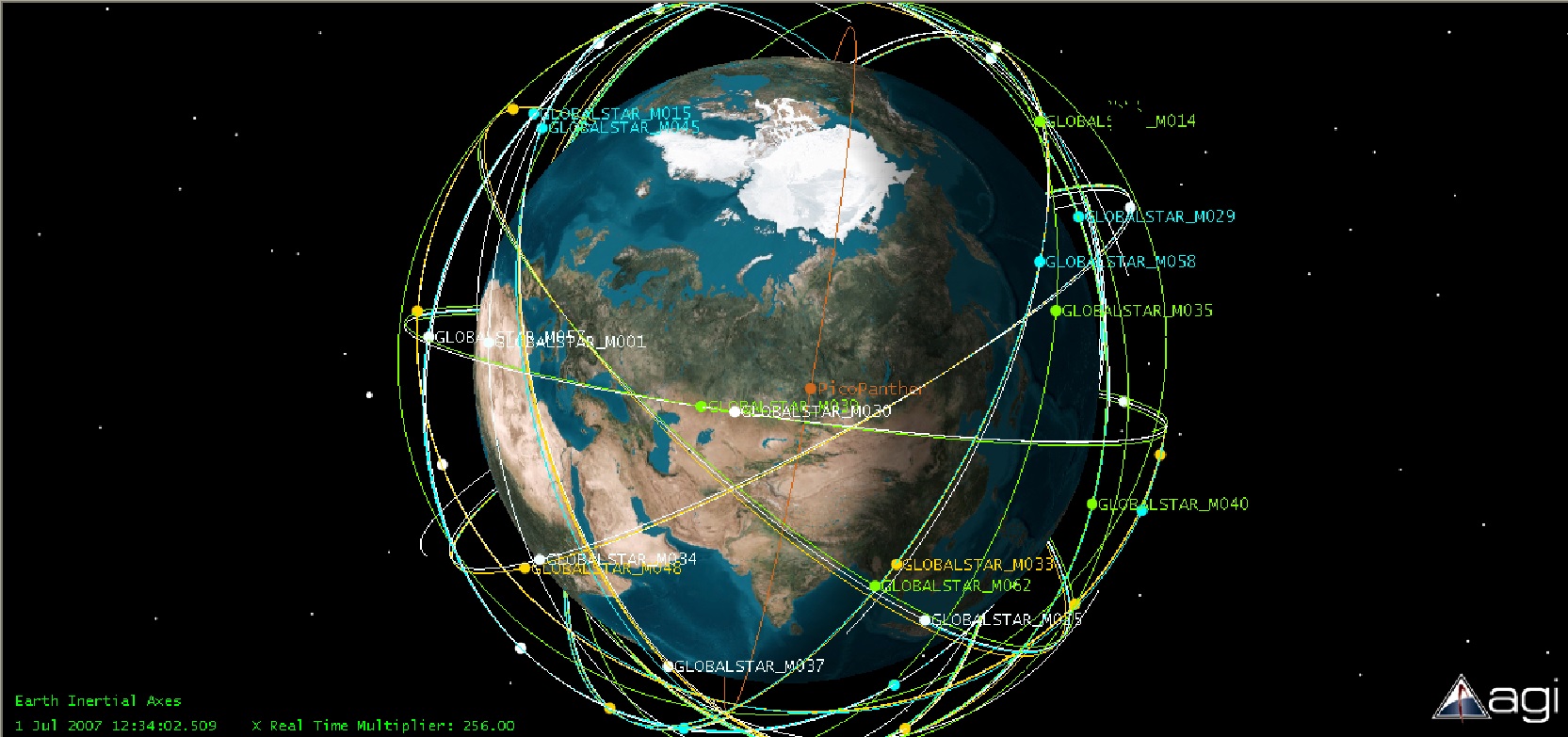
Constellation "Globalstar". The decision to throw polar regions out of service on the one hand saved a lot of money, on the other - it deprived globalstar of its customers working, researching and traveling near the poles - it should be noted that quite a significant part of all satellite telephony customers.
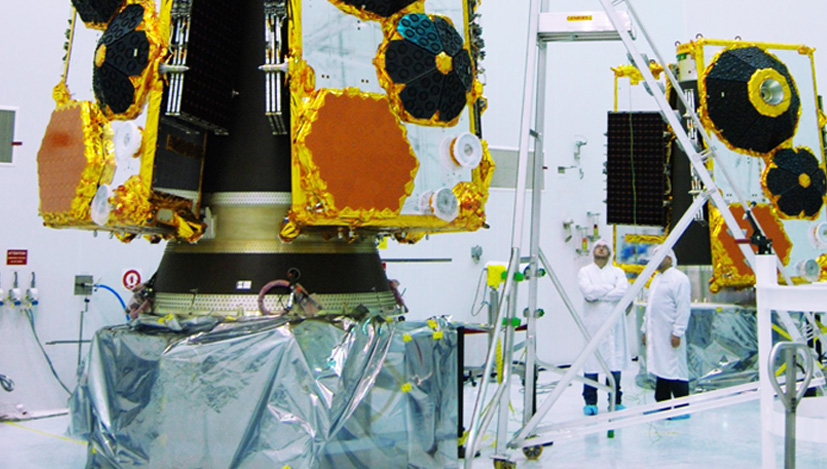
Globastar satellites are installed on the dispenser for orbiting. Strange black and orange pieces are the receiving and transmitting antennas of the Subscriber-Sputnik and Teleport-Sputnik channels.
Such a less expensive model allowed Globalstar to last longer, although in the end he went through bankruptcy.
Finally, in the 1990s, 2 more low-orbit (NOO) groups were created, probably little-known - the domestic “Messenger” and the American Orbcomm. The “messenger” grew out of military-spy satellite systems and implied the possibility of transmitting small data packets or voice messages offline (that is, satellites were used as flying mailboxes). In fact, this is a further simplification from Globastar, and to be honest, I have never heard in my life about using this system for commercial purposes.
Orbcomm essentially implemented the same “satellite-offline mailbox” approach, and in 1998 deployed 36 satellites to provide M2M services (data collection from remote equipment). Like all other companies, Orbcomm went through bankruptcy, but due to the initially minimal investments in the system (no terrestrial teleporters, the lightest satellites, low requirements for continuity of coverage etc), the company straightened out and is still alive today, along with 3 other projects listed above.
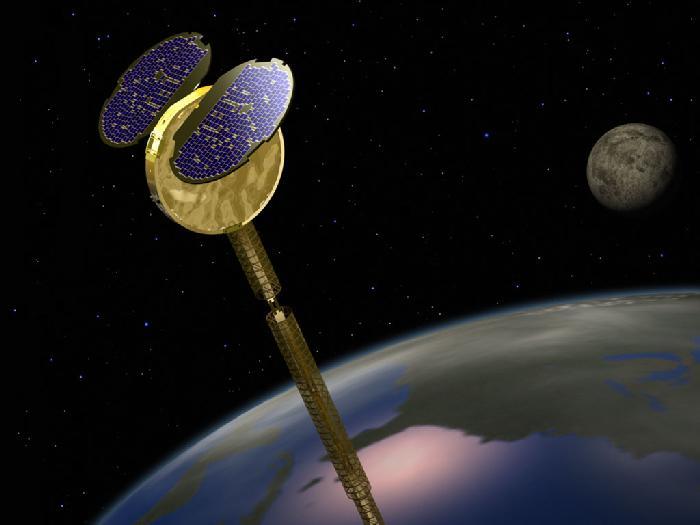
The Orbcomm project was one of the first to take advantage of the reduced size of electronics and satellites in general, using devices weighing only 40 kg for operation.
Thus, the sad experience of the 1990s led to the conclusion that NOU communication groups are possible, but economically unsound. Over the next 10 years, investors fled from new proposals on this topic, like hell from incense. However, all the bad things are quickly forgotten, and now, by the beginning of the 2010s, the world saw a new surge of “low orbitals” seeking investment.
This dawn is supported by some logical statements. Firstly, the Internet from a funny non-profit gizmo in the 1990s turned into one of the most powerful consumption channels, and is very popular everywhere, but at the same time there are still locations where ground operators did not reach their optics. Secondly, the development of both satellite and telecommunication equipment since the 1990s has gone quite far, and the tasks of creating a dynamic multi-beam satellite-to-ground working field, data routing, inter-satellite high-speed laser communications can now be solved in a spacecraft weighing 150-200 kg, instead 1000 kg 20 years ago.
Finally, ground-based subscriber equipment has also made great progress in its capabilities. In the 1990s, it was crazy to offer AFAR equipment (active phased array antennas) to subscribers, which would allow tracking the satellites in the sky with the main beam of the receiving antenna. There were no technologies to produce such antennas for at least some reasonable money. Antennas with a two-stage mechanical drive are also not cheap and were not suitable for mass solutions, but meanwhile, radiophysics of broadband channels required antennas with good amplification (i.e. directional).
Today, satellite communications solutions using AFAR with a dynamic beam are gradually penetrating the satellite communications market - so far mainly in providing ships and aircraft with the Internet, and in the not too distant future such antennas can become widespread.
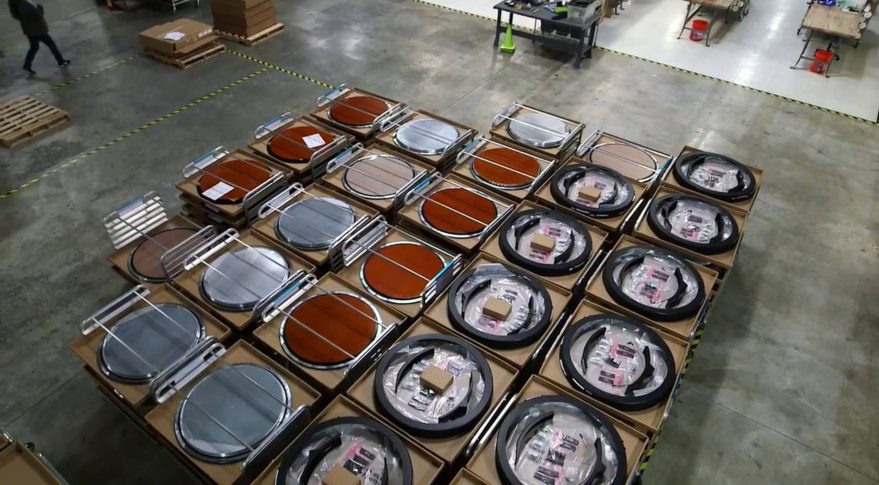
AFAR antennas for the O3b system (about it below), installed on aircraft and ships. Due to GPS and MEMS gyroscopes, the antenna knows its position in space and forms a beam of maximum gain, aimed precisely at the satellite, compensating for the movement and roll of equipment.
The first sign of a new round of development of telecommunication satellite constellations was the O3b project, which started in 2007. This project is not like the others, but not to mention it would be wrong. Launched at a time when the pain of financial losses on Iridium and Globalstar had not yet been forgotten, the project was not focused on end users, but on delivering the Internet to a) cruise liners b) small islands c) airplanes - all this in a relatively near equatorial zone, up to 45 latitude. The constellation of 8 satellites at the beginning and 16 in full configuration rotates in the same orbit 8100 km above the surface, i.e. approximately ¼ of altitude from the geostationary orbit. Each satellite has 12 antennas with two-stage control, and can create 10 client beams with a diameter of approximately 700 km and a bandwidth of 1.6 Gbit per beam.
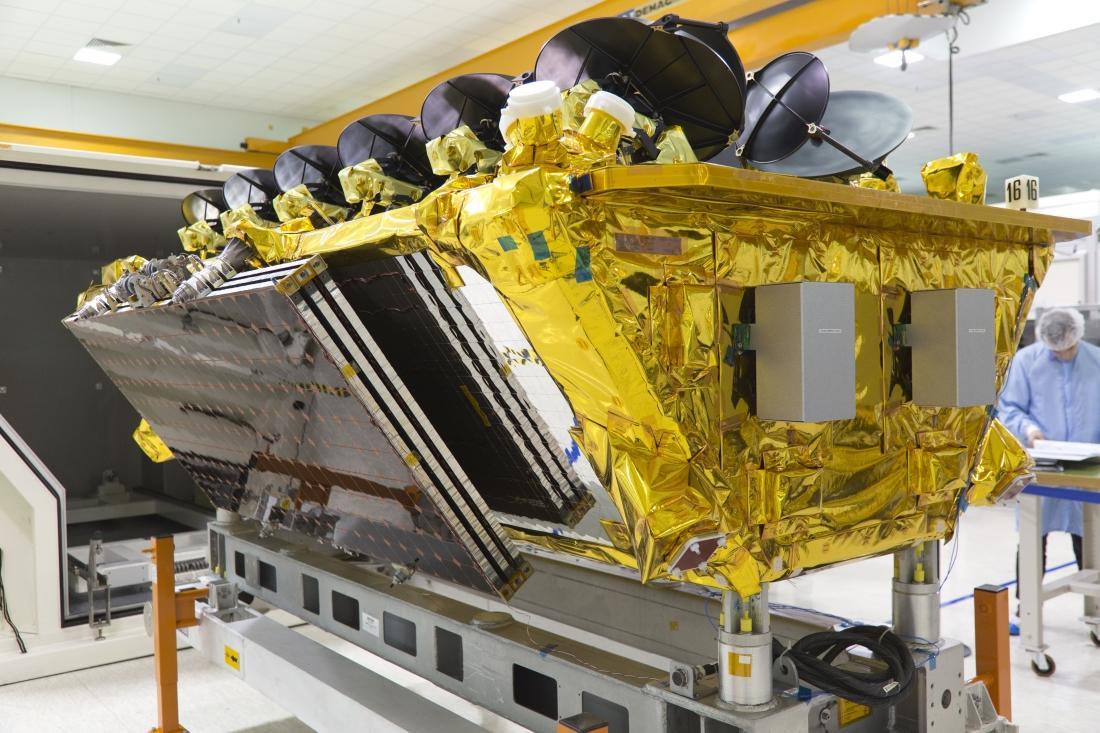
O3b satellite weighing 700 kg.
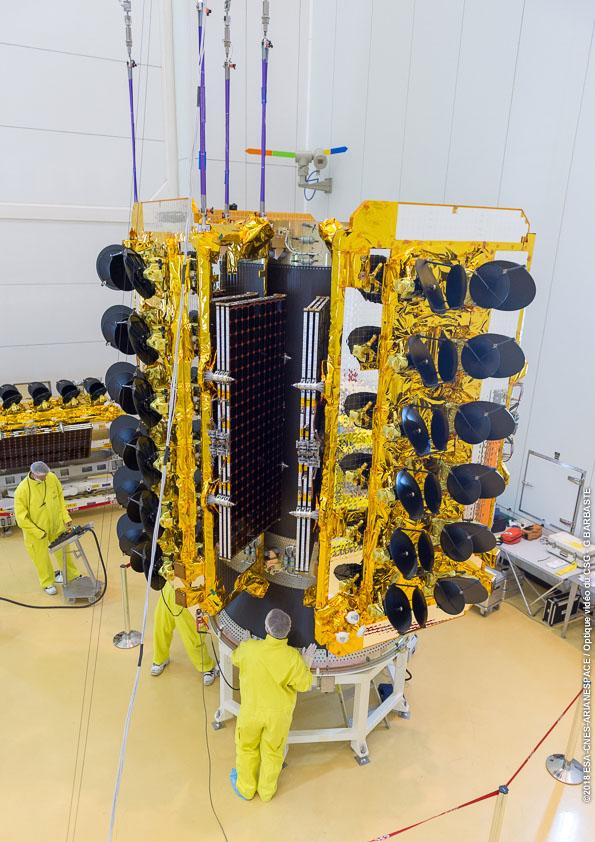
O3b satellites on the dispenser. 12 sets of radio optics with two-stage drives for organizing client beams are visible.
The project successfully raised money for the launch, and in March 2019 completed the deployment of a full constellation of 16 satellites, spending a modest ~ $ 1.5 billion on implementation.

The principle of constructing the O3b grouping. Great niche solution, apparently.
Interestingly, the ideologist and creator of O3b was a man named Greg Wyler, who subsequently launched a completely new satellite project, which marked the beginning of a boom in hypergroups. So, meet - a system of 1600 satellites “OneWeb”.
Founded in 2012 (under the name WorldVu), the company envisioned the launch of more than 2,000 satellites (the number changes over time) into low Earth orbit. The number of necessary satellites WordVu is amazing - it is comparable with all other active satellites in orbit of the Earth.
And the matter is not only in the number as such. When you try to quickly assemble and launch 2,000 satellites, an incredible amount of difficulty will arise. To date, satellites are assembled like a Swiss watch - it’s jewelry manual labor with an incredible amount of control and “chips”, so that, God forbid, leave organics for thermal insulation or damage the electronics by static discharge. Space is cruel. And so, it is proposed to convey not only the assembly of satellites, but also the many necessary components of space-quality (electronics, connectors, chemical andjet engines etc).
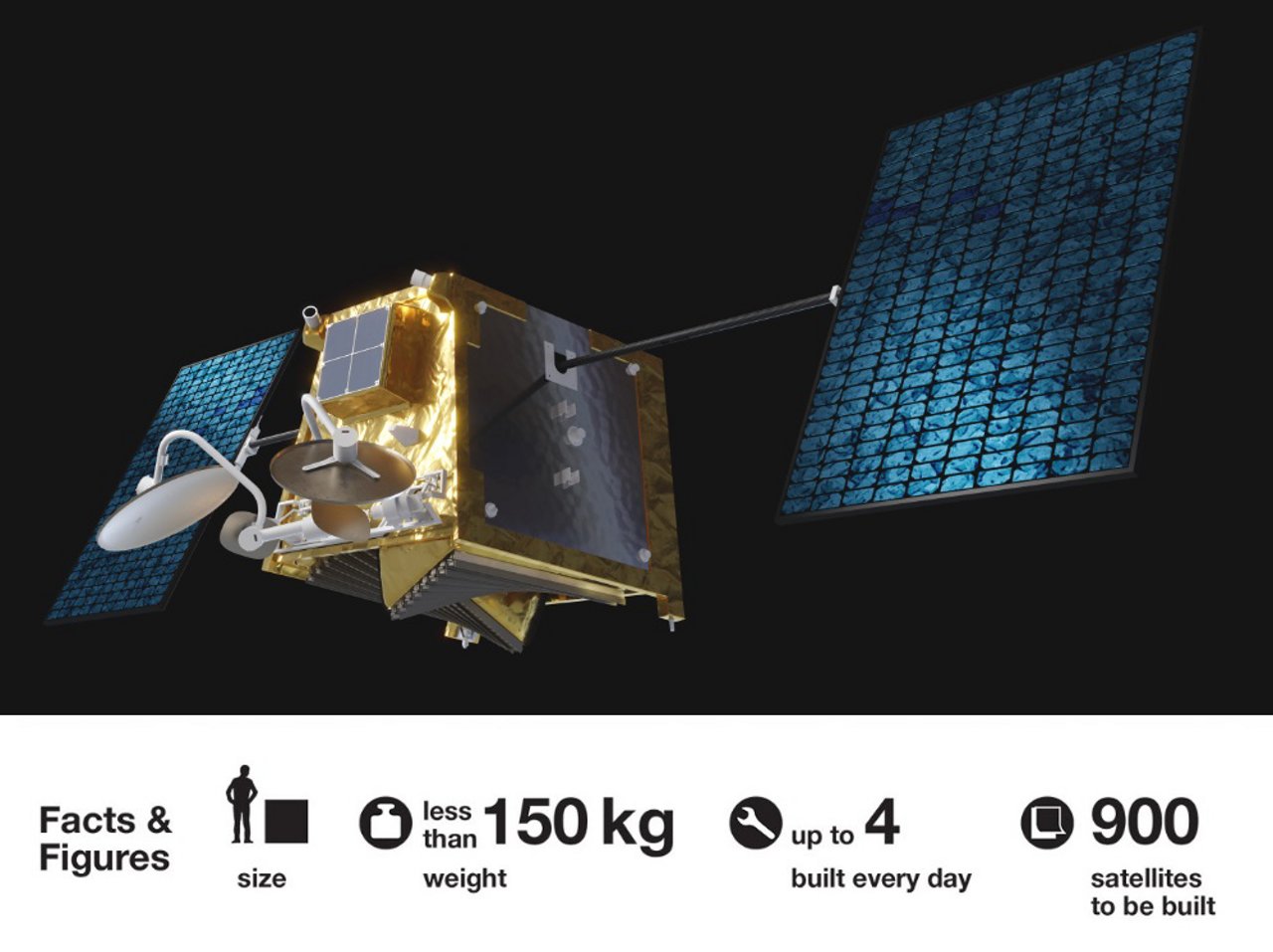
The OneWeb satellite, whose production contract Airbus received, implements Teledesic capabilities with six times less weight and three times less price.
However, such an ambitious plan has logic. Suppose you decide to create a system that distributes the Internet of only a hundred devices, and not 2000. Then you will encounter the fact that the limited bandwidth of each will inevitably account for several million square kilometers. And if over the oceans with rare client yachts this is just great, then over densely populated countries - on the contrary. In your 100-satellite system, there will be 2 satellites in China, Europe, all of Southeast Asia, and as many as 3 in South America. How many clients can such a group serve? Not. Is this enough for payback? Also no. It is necessary to increase the number of satellites. If you take out 2000-4000 satellites and create a subscriber-satellite beam pattern comparable to early GSM networks by the number of cells, business models grow together, and even
The problem, however, is that financial models are wonderful, but the real profitability and relevance of these space projects can be understood only by deploying a network. But many billions of dollars need to be spent on deployment, and the more satellites expected in a complete network, the more billions are needed.
OneWeb advertising video, where the assembly frames of the first batch of satellites also flash. It cannot be said yet that the conveyor assembly technology is visible somewhere, although part of the operations is mechanized.
Now OneWeb (bought by Intelsat, the largest GSO operator) is trying to walk along a narrow path between the abysses of insufficient network bandwidth and too large initial investments, which are impossible to find investors. And while this path looks complicated - not so long ago, the project decided to reduce the total number of deployed satellites to 1600, and the initial stage from 900 to 600 satellites. In this case, the project will focus more on customers in the form of airplanes and ships (where a lot of other satellite operators already work), rather than on a mass of ordinary people. Troubling signs.
The first 6 OneWeb satellites were launched in February 2018 by the Soyuz-2.1B rocket from the Kourou Cosmodrome. It seems that we will not see the full deployment of the system until 2021.
Nevertheless, the OneWeb project is still developing, collecting money (investors have already invested about $ 3 billion, enough for the first 600 deployed satellites), and it has competitors: SpaceX Starlink and Amazon Kuiper hypergroup projects and groupings more modest than Telesat Leo and LeoSat (LEO = low earth orbit, hence such a commitment to this word in the names).
SpaceX Starlink currently provides for the deployment of 1584 satellites at the initial stage and up to 12000 (!!!) in full configuration. It is planned to use altitudes of 550 km (40 orbital planes of 66 each), 330 km (the main mass of satellites will be 7,500 here) and 1,150 km (about 3,000 more). In terms of radio communications, it also envisages the use of many bands at once (including the V range which is poorly mastered by components - 50+ GHz), but at the first stage - the traditional Ku (10-20 GHz) with a bandwidth of several gigabits per satellite. Intersatellite laser communication is provided at speeds of several hundred gigabits.

Starlink satellites are even more advanced than OneWeb, with innovative krypton electric propulsion engines, industrial electronics and reliance on orbital reserve instead of reliability, etc. However, today far from all the details are still known.
In short, the Starlink project is incredibly ambitious and will have to compete for a client with terrestrial cable operators for payback. The project’s prospects are still vague (including the plan to raise the necessary funds for the deployment of the minimum operating group), but the deployment of 60 satellites that took place last week at once with one launch (versus 6 with OneWeb, I remind you) makes my heart beat faster.
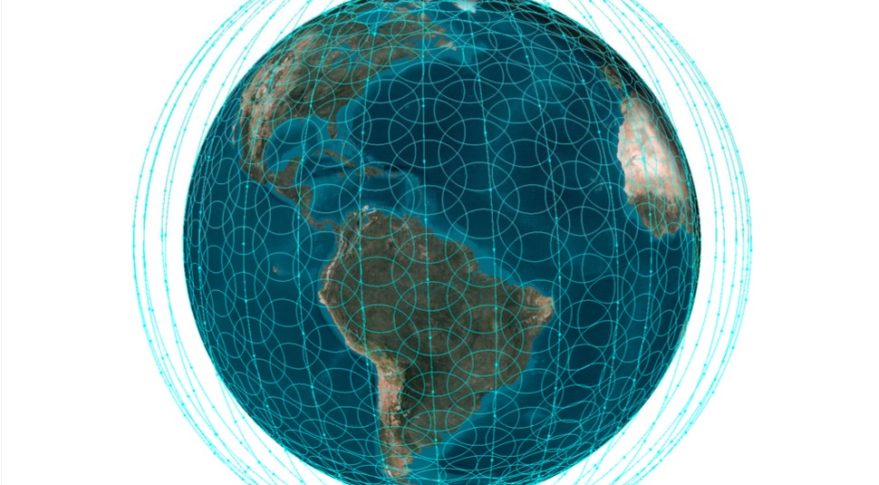
Simulation of the Starlink orbital constellation after the launch of the first 264 satellites.
And simulation of communication via Starlink in a fully deployed constellation of 1584 satellites.
Another no less ambitious player is Amazon, which has applied for the deployment of 3236 satellites as part of the Kuiper project. So far, little is known about the project, except for the traditional words about “3 billion people not connected to the Internet” (as if the problem is in technical difficulties, and not the absence of these 3 billion money on the Internet). But at least a possible synergy is visible for one of the largest online stores in the world in transmitting traffic from a satellite constellation through itself. From this we can expect that the Kuiper project has a better chance of implementation.
In addition to the highly complex projects OneWeb, Starlink, Kuiper, there were several more gestures from Boeing and Samsung, but it seems that these companies did not dare to go into such risky investments.
Finally, briefly about a little less ambitious and a little more niche Telesat Leo and LeoSat. Both of these projects are aimed at competing with terrestrial fiber optic backbones. Their task is to take quite broadband traffic from a business client and carry it via satellite constellation to a teleport somewhere in another part of the globe. Both projects involve the launch of ~ 110 satellites, while Telesat Leo elegantly solves the problem of excess satellite bandwidth at high latitude with uniform filling of inclined orbits - by creating two types of constellation: in orbits ~ 45 degrees and polar orbit. Both of these projects are still raising money, while Telesat (a large satellite operator of GSO satellites) looks more promising.
Simulation of communication through the Telesat LEO system
To summarize, I want to note that the manufacturers of satellites and satellite components receiving incredible orders are still happy with the new boom. Launch service operators are also looking forward to an incredible increase in orders (including Roscosmos, to whom OneWeb in various forms ordered launch at 21 Soyuz-2). Will a new reality be able to gain a foothold with the transfer of communication networks into space? Who knows. However, if this happens, then humanity will clearly receive a noticeable boost in space exploration and a reduction in the cost of manufacturing space technology and the withdrawal of payloads.
Satellite communications today and the last 30 years are primarily geostationary relay satellites located, respectively, in a geostationary orbit, where the satellite is approximately stationary relative to the ground observer and is equivalent to a conventional radio relay located on a tower with a height of 35,000 kilometers. Moreover, one single satellite is immediately visible from ~ 35% of the Earth’s area, and three are enough to cover the entire surface except for the polar regions.
Geostationary communication satellites today are very heavy machines weighing up to 4 tons (in working orbit) providing communication channels up to several hundred gigabits wide. Such a look of these satellites has developed, on the one hand, from the gigantic coverage area of the radio signal from the satellite (how many radio towers can boast access to 5 billion potential customers?), And, on the other hand, the weight of the equipment that can squeeze the maximum bandwidth out of the available radio spectrum.
Alignment of the antenna patterns of the Eutelsat 8 West B. geostationary satellite . Coordination of spatial spectral characteristics is today a very difficult task in satellite projects, and low-orbit systems are no exception.
Pay attention to the words “available radio spectrum”. Satellite communications operate at frequencies from 1.5 to 60 gigahertz, but there are not many satellites available in this wide radio range. Firstly, in the range from 1.5 to 10 GHz there are many terrestrial consumers of the radio spectrum - a typical example is wi-fi around the central 2.4 and 5.5 GHz. Secondly, above 20 GHz, rain, hail, and cloudiness begin to affect the operation of the radio channel. Thirdly, the available band has to be divided by at least two in order to organize the Earth-Satellite channel. As a result, the actively used satellite communication ranges (denoted by the letters S, C, Ku, Ka) are only 6 GHz band, for which there is a mortal battle of many operators.
Initially, however, 6 GHz was quite enough. After all, 15 years ago, the main content delivered to subscribers by communication satellites was television, and the same radio signal could deliver TV content to tens of millions of subscribers at once. However, with the advent of the 2000s, the market began to tilt toward digital two-way communication, where the demand for bandwidth is growing linearly with the number of subscribers.
The assembly of the Galileo navigation satellite. In fact, the assembly of modern satellites is reduced to the manual installation of satellite system components on power panels and the manual tracing of dozens of cables and pipelines that connect them, as well as to a large volume of functional tests of the resulting complex. In this regard, satellites are more like precision industrial equipment than, say, airplanes.
GSO satellites responded to a change in the market by spatial reuse of frequencies - the satellite emits a lot of relatively narrow beams in which the same frequencies come across (by the principle of cellular networks). But this shift in needs has also shifted the optimality of GSO machines towards other solutions.
From high-flying GSO satellites, let's move on to low-orbit ones. The idea is to replace one heavy quasi-stationary satellite with a swarm of flying in low orbit. The idea is quite obvious, but until the 90s is not used, due to the balance of pro and contra.
What are the advantages of low-orbit satellites over GSO satellites?
- Low orbit is much lower ... yes. In fact, this gives a very significant reduction in energy losses in the radio channel (up to 4 orders of magnitude), which allows the use of small antennas and low-power transmitters, both on the ground and on the satellite
- A low orbit also means a low signal delay - the pause in the interlocutor's answers when telephony via GSO is quite noticeable (ping 250 ms one way)
- The structure of “many satellites” allows you to reuse the frequency resource on each (slightly simplifying the situation), and theoretically obtain a significantly larger overall throughput on the same spectrum and serve much more subscribers.
But the business is not limited to only pluses, it is clear:
- A low-orbit system implies the maintenance of a large satellite constellation, a multitude of ground stations interfacing with communication networks — in general, the capital expenditures for deployments are much larger.
- Satellites move over the heads of subscribers, which means that you need to use either omnidirectional antennas or very advanced tracking systems, which almost completely eliminates the advantage in good energy
- To provide in reality, and not on paper, a large system bandwidth with multiple reuse of the spectrum, extremely sophisticated satellites with developed antenna systems, high-speed digital switches, high-speed inter-satellite communications with tracking were needed - all this did not exist in its finished form in the early 1990s.
Despite the unobvious balance of the pros and cons, several operators rushed to realize the new idea of satellite communications in the 1990s. The most famous project of those times was called Teledesic and implied 840 devices in orbit with an altitude of 700 km with the task of delivering Internet to land subscribers. Teledesic raised about a billion dollars, but did not succeed. From the conception of the project in 1990 to the launch of the first experimental satellite in 1998, ground operators managed to win a significant part of the market Teledesic was aiming for, financial models showed cost recovery of $ 9 billion (~ 20 billion in today's dollars), so the project was bankrupt before before deployment.
Simulation of the Teledesic satellite constellation (in a reduced version to 288 devices). It can be seen that with a uniform arrangement of the constellation in the circumpolar orbits with increasing latitude, multiple overlapping of the working areas of satellites occurs. This is not such a simple problem, as it seems, and requires either to disconnect part of the satellites from work at latitudes above 45, or to have a lot of sophisticated equipment on board the satellite to reconfigure the working areas when the satellites approach the poles.
Teledesic quickly had two rivals - the Iridium and Globalstar projects, which focused on the then more familiar satellite telephone market, which was generally almost inaccessible to GSO operators (telephony directly from the geostationary station required either a large antenna on the ground or an incredibly large antenna on satellite)
The Iridium project had global coverage due to a constellation of 72 satellites (6x11 planes + reserve of 1 satellite per plane) in 700 km orbits. Each satellite weighed 680 kg, but it possessed rather modest by today's standards capabilities to simultaneously work with only ~ 1,500 subscribers. The satellite orbits had an average height of 780 km for the NOO groups.
Iridium satellite of the first generation. Three 48-beam subscriber antennas on the sides of the satellite gave us the phenomenon of “ Iridium flares ”. Based on the satellite, 5 Ka-band rotary antennas are visible, providing inter-satellite communications and communication with terrestrial teleporters.
Iridium satellites had developed inter-satellite communication equipment, which allowed routing calls to ground-based communication stations or a subscriber-satellite network-subscriber. This equipment, in general, determined the weight of the satellites.
Almost immediately after the deployment of the group, the company went bankrupt, and only experts would know about it if it were not for the Pentagon, who decided that the system was very useful for military purposes: the bankrupt Iridium was bought out by Pentagon contractors who began to operate the system for money from the military, writing off part capital costs.
Iridium's competitor was Globalstar, a system deployed a year later, initially created according to more economical canons. There were only 48 satellites, weighing 550 kg, with an orbit height of 1,400 km, distributed over 6 pieces in 8 planes. Such a number of vehicles in such orbits did not allow covering the entire surface of the Earth, and communication worked only up to ~ 70 latitudes. However, Globastar was able to work only as a repeater from a subscriber to a ground gateway, so there would be little use for it at the North Pole.
Constellation "Globalstar". The decision to throw polar regions out of service on the one hand saved a lot of money, on the other - it deprived globalstar of its customers working, researching and traveling near the poles - it should be noted that quite a significant part of all satellite telephony customers.
Globastar satellites are installed on the dispenser for orbiting. Strange black and orange pieces are the receiving and transmitting antennas of the Subscriber-Sputnik and Teleport-Sputnik channels.
Such a less expensive model allowed Globalstar to last longer, although in the end he went through bankruptcy.
Finally, in the 1990s, 2 more low-orbit (NOO) groups were created, probably little-known - the domestic “Messenger” and the American Orbcomm. The “messenger” grew out of military-spy satellite systems and implied the possibility of transmitting small data packets or voice messages offline (that is, satellites were used as flying mailboxes). In fact, this is a further simplification from Globastar, and to be honest, I have never heard in my life about using this system for commercial purposes.
Orbcomm essentially implemented the same “satellite-offline mailbox” approach, and in 1998 deployed 36 satellites to provide M2M services (data collection from remote equipment). Like all other companies, Orbcomm went through bankruptcy, but due to the initially minimal investments in the system (no terrestrial teleporters, the lightest satellites, low requirements for continuity of coverage etc), the company straightened out and is still alive today, along with 3 other projects listed above.
The Orbcomm project was one of the first to take advantage of the reduced size of electronics and satellites in general, using devices weighing only 40 kg for operation.
Thus, the sad experience of the 1990s led to the conclusion that NOU communication groups are possible, but economically unsound. Over the next 10 years, investors fled from new proposals on this topic, like hell from incense. However, all the bad things are quickly forgotten, and now, by the beginning of the 2010s, the world saw a new surge of “low orbitals” seeking investment.
This dawn is supported by some logical statements. Firstly, the Internet from a funny non-profit gizmo in the 1990s turned into one of the most powerful consumption channels, and is very popular everywhere, but at the same time there are still locations where ground operators did not reach their optics. Secondly, the development of both satellite and telecommunication equipment since the 1990s has gone quite far, and the tasks of creating a dynamic multi-beam satellite-to-ground working field, data routing, inter-satellite high-speed laser communications can now be solved in a spacecraft weighing 150-200 kg, instead 1000 kg 20 years ago.
Finally, ground-based subscriber equipment has also made great progress in its capabilities. In the 1990s, it was crazy to offer AFAR equipment (active phased array antennas) to subscribers, which would allow tracking the satellites in the sky with the main beam of the receiving antenna. There were no technologies to produce such antennas for at least some reasonable money. Antennas with a two-stage mechanical drive are also not cheap and were not suitable for mass solutions, but meanwhile, radiophysics of broadband channels required antennas with good amplification (i.e. directional).
Today, satellite communications solutions using AFAR with a dynamic beam are gradually penetrating the satellite communications market - so far mainly in providing ships and aircraft with the Internet, and in the not too distant future such antennas can become widespread.
AFAR antennas for the O3b system (about it below), installed on aircraft and ships. Due to GPS and MEMS gyroscopes, the antenna knows its position in space and forms a beam of maximum gain, aimed precisely at the satellite, compensating for the movement and roll of equipment.
The first sign of a new round of development of telecommunication satellite constellations was the O3b project, which started in 2007. This project is not like the others, but not to mention it would be wrong. Launched at a time when the pain of financial losses on Iridium and Globalstar had not yet been forgotten, the project was not focused on end users, but on delivering the Internet to a) cruise liners b) small islands c) airplanes - all this in a relatively near equatorial zone, up to 45 latitude. The constellation of 8 satellites at the beginning and 16 in full configuration rotates in the same orbit 8100 km above the surface, i.e. approximately ¼ of altitude from the geostationary orbit. Each satellite has 12 antennas with two-stage control, and can create 10 client beams with a diameter of approximately 700 km and a bandwidth of 1.6 Gbit per beam.
O3b satellite weighing 700 kg.
O3b satellites on the dispenser. 12 sets of radio optics with two-stage drives for organizing client beams are visible.
The project successfully raised money for the launch, and in March 2019 completed the deployment of a full constellation of 16 satellites, spending a modest ~ $ 1.5 billion on implementation.
The principle of constructing the O3b grouping. Great niche solution, apparently.
Interestingly, the ideologist and creator of O3b was a man named Greg Wyler, who subsequently launched a completely new satellite project, which marked the beginning of a boom in hypergroups. So, meet - a system of 1600 satellites “OneWeb”.
Founded in 2012 (under the name WorldVu), the company envisioned the launch of more than 2,000 satellites (the number changes over time) into low Earth orbit. The number of necessary satellites WordVu is amazing - it is comparable with all other active satellites in orbit of the Earth.
And the matter is not only in the number as such. When you try to quickly assemble and launch 2,000 satellites, an incredible amount of difficulty will arise. To date, satellites are assembled like a Swiss watch - it’s jewelry manual labor with an incredible amount of control and “chips”, so that, God forbid, leave organics for thermal insulation or damage the electronics by static discharge. Space is cruel. And so, it is proposed to convey not only the assembly of satellites, but also the many necessary components of space-quality (electronics, connectors, chemical andjet engines etc).
The OneWeb satellite, whose production contract Airbus received, implements Teledesic capabilities with six times less weight and three times less price.
However, such an ambitious plan has logic. Suppose you decide to create a system that distributes the Internet of only a hundred devices, and not 2000. Then you will encounter the fact that the limited bandwidth of each will inevitably account for several million square kilometers. And if over the oceans with rare client yachts this is just great, then over densely populated countries - on the contrary. In your 100-satellite system, there will be 2 satellites in China, Europe, all of Southeast Asia, and as many as 3 in South America. How many clients can such a group serve? Not. Is this enough for payback? Also no. It is necessary to increase the number of satellites. If you take out 2000-4000 satellites and create a subscriber-satellite beam pattern comparable to early GSM networks by the number of cells, business models grow together, and even
The problem, however, is that financial models are wonderful, but the real profitability and relevance of these space projects can be understood only by deploying a network. But many billions of dollars need to be spent on deployment, and the more satellites expected in a complete network, the more billions are needed.
OneWeb advertising video, where the assembly frames of the first batch of satellites also flash. It cannot be said yet that the conveyor assembly technology is visible somewhere, although part of the operations is mechanized.
Now OneWeb (bought by Intelsat, the largest GSO operator) is trying to walk along a narrow path between the abysses of insufficient network bandwidth and too large initial investments, which are impossible to find investors. And while this path looks complicated - not so long ago, the project decided to reduce the total number of deployed satellites to 1600, and the initial stage from 900 to 600 satellites. In this case, the project will focus more on customers in the form of airplanes and ships (where a lot of other satellite operators already work), rather than on a mass of ordinary people. Troubling signs.
The first 6 OneWeb satellites were launched in February 2018 by the Soyuz-2.1B rocket from the Kourou Cosmodrome. It seems that we will not see the full deployment of the system until 2021.
Nevertheless, the OneWeb project is still developing, collecting money (investors have already invested about $ 3 billion, enough for the first 600 deployed satellites), and it has competitors: SpaceX Starlink and Amazon Kuiper hypergroup projects and groupings more modest than Telesat Leo and LeoSat (LEO = low earth orbit, hence such a commitment to this word in the names).
SpaceX Starlink currently provides for the deployment of 1584 satellites at the initial stage and up to 12000 (!!!) in full configuration. It is planned to use altitudes of 550 km (40 orbital planes of 66 each), 330 km (the main mass of satellites will be 7,500 here) and 1,150 km (about 3,000 more). In terms of radio communications, it also envisages the use of many bands at once (including the V range which is poorly mastered by components - 50+ GHz), but at the first stage - the traditional Ku (10-20 GHz) with a bandwidth of several gigabits per satellite. Intersatellite laser communication is provided at speeds of several hundred gigabits.
Starlink satellites are even more advanced than OneWeb, with innovative krypton electric propulsion engines, industrial electronics and reliance on orbital reserve instead of reliability, etc. However, today far from all the details are still known.
In short, the Starlink project is incredibly ambitious and will have to compete for a client with terrestrial cable operators for payback. The project’s prospects are still vague (including the plan to raise the necessary funds for the deployment of the minimum operating group), but the deployment of 60 satellites that took place last week at once with one launch (versus 6 with OneWeb, I remind you) makes my heart beat faster.
Simulation of the Starlink orbital constellation after the launch of the first 264 satellites.
And simulation of communication via Starlink in a fully deployed constellation of 1584 satellites.
Another no less ambitious player is Amazon, which has applied for the deployment of 3236 satellites as part of the Kuiper project. So far, little is known about the project, except for the traditional words about “3 billion people not connected to the Internet” (as if the problem is in technical difficulties, and not the absence of these 3 billion money on the Internet). But at least a possible synergy is visible for one of the largest online stores in the world in transmitting traffic from a satellite constellation through itself. From this we can expect that the Kuiper project has a better chance of implementation.
In addition to the highly complex projects OneWeb, Starlink, Kuiper, there were several more gestures from Boeing and Samsung, but it seems that these companies did not dare to go into such risky investments.
Finally, briefly about a little less ambitious and a little more niche Telesat Leo and LeoSat. Both of these projects are aimed at competing with terrestrial fiber optic backbones. Their task is to take quite broadband traffic from a business client and carry it via satellite constellation to a teleport somewhere in another part of the globe. Both projects involve the launch of ~ 110 satellites, while Telesat Leo elegantly solves the problem of excess satellite bandwidth at high latitude with uniform filling of inclined orbits - by creating two types of constellation: in orbits ~ 45 degrees and polar orbit. Both of these projects are still raising money, while Telesat (a large satellite operator of GSO satellites) looks more promising.
Simulation of communication through the Telesat LEO system
To summarize, I want to note that the manufacturers of satellites and satellite components receiving incredible orders are still happy with the new boom. Launch service operators are also looking forward to an incredible increase in orders (including Roscosmos, to whom OneWeb in various forms ordered launch at 21 Soyuz-2). Will a new reality be able to gain a foothold with the transfer of communication networks into space? Who knows. However, if this happens, then humanity will clearly receive a noticeable boost in space exploration and a reduction in the cost of manufacturing space technology and the withdrawal of payloads.