
 April 3, 2019 at 12:43
Network Settings from FreeRadius via DHCP
- Tutorial

The task has arrived to arrange the issuance of IP addresses to subscribers. Conditions of the problem:
- We will not give a separate server for authorization - you will manage;)
- Subscribers must receive network settings via DHCP
- The network is diverse. This is both PON equipment, and ordinary switches with configured Option 82 and a WiFi base with points
- If data does not fall under any of the conditions for issuing IP, it is necessary to issue IP from the “guest” network
From the good: there is a server on FreeBSD that can "work", but it is "far away";), not "right on this network."
There is also a wonderful Mikrotik device. The general network diagram is approximately the following:

After a little thought, it was decided to use FreeRadius subscribers to issue network settings. In principle, the scheme is the usual: on Microtick we turn on the DHCP server, on it the same Radius Client. We configure a bunch of DHCP server -> Radius Client -> Radius server.
It seems to be not difficult. But! The devil is in the details. Namely:
- When PON OLT is authorized according to this scheme, a request is sent to FreeRadius with a User-Name equal to the MAC address of the head station, Agent-Circuit-Id equal to the PON Onu MAC and an empty password.
- When authorizing with switches with option 82, a request comes to FreeRadius with an empty User-Name equal to the subscriber's MAC device and the additional Agent-Circuit-Id and Agent-Remote-Id additional attributes containing, again, the relay switch MAC and the port to which the subscriber is connected.
- Some subscribers with WiFI points are authorized through PAP-CHAP protocols
- Some subscribers with WIFI points are authorized with a User-Name equal to the MAC address of the WIFI point, without a password.
Historical note: what is “Option 82” for DHCP.
These are additional options for the DHCP protocol that allow you to transfer additional information, for example, in the Agent-Circuit-Id and Agent-Remote-Id fields. It is usually used to transmit the MAC address of the relay switch and the port to which the subscriber is connected. In the case of PON equipment or WIFI base stations, the Agent-Circuit-Id field does not carry useful information (there is no subscriber port). In this case, the general scheme of DHCP in this case is as follows:
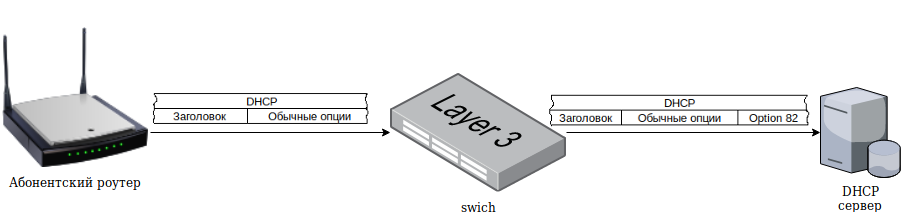
Step by step, this scheme works as follows:
- Subscriber equipment makes a broadcast DHCP request for network settings
- The device (for example, a switch, a WiFi or PON base station) to which the subscriber equipment is directly connected “intercepts” this packet and modifies it, introducing the additional options Option 82 and Relay agent IP address into it, and transfers it further over the network.
- DHCP server accepts the request, forms a response and sends it to the relay device
- The relay device forwards the response packet to the subscriber unit
So all this simply doesn’t work, of course, you need the appropriate configuration of network equipment.
Install FreeRadius
With FreeRadius configuration settings, of course, all this can be achieved, but it’s difficult and not clear ... especially when you snoop in there after N months “everything works”. Therefore, it was decided to write my authorization module for FreeRadius in Python. We will take authorization data from the MySQL database. It makes no sense to describe its structure, anyway, everyone will do it “for themselves”. In particular, I took the structure that is proposed with the sql module for FreeRadius, and slightly changed it by adding the mac and port field for each subscriber, in addition to the login password.
So, to get started, install FreeRadius:
cd /usr/ports/net/freeradius3
make config
make
install clean
In the settings, we note for installation:
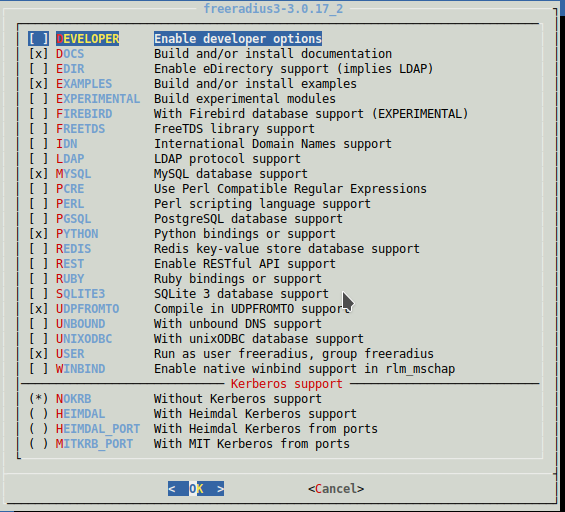
We make a symlink to the python module (ie, “turn it on”):
ln -s /usr/local/etc/raddb/mods-available/python /usr/local/etc/raddb/mods-enabledInstall an additional module for python:
pip install mysql-connectorIn the python module settings for FreeRadius, you need to specify the module search paths in the python_path variable. For example, I have this:
python_path="/usr/local/etc/raddb/mods-config/python:/usr/local/lib/python2.7:/usr/local/lib/python27.zip:/usr/local/lib/python2.7:/usr/local/lib/python2.7/plat-freebsd12:/usr/local/lib/python2.7/lib-tk:/usr/local/lib/python2.7/lib-old:/usr/local/lib/python2.7/lib-dynload:/usr/local/lib/python2.7/site-packages"
The paths can be found by running the python interpreter and entering the commands:
root@phaeton:/usr/local/etc/raddb/mods-enabled# python
Python 2.7.15 (default, Dec  8 2018, 01:22:25)
[GCC 4.2.1 Compatible FreeBSD Clang 6.0.1 (tags/RELEASE_601/final 335540)] on freebsd12
Type "help", "copyright", "credits" or "license" for more information.
>>> import sys
>>> sys.path
['', '/usr/local/lib/python27.zip', '/usr/local/lib/python2.7', '/usr/local/lib/python2.7/plat-freebsd12', '/usr/local/lib/python2.7/lib-tk', '/usr/local/lib/python2.7/lib-old', '/usr/local/lib/python2.7/lib-dynload', '/usr/local/lib/python2.7/site-packages']
>
If you do not take this step, then scripts written in python and run by FreeRadius will not find those modules that are listed in import. In addition, it is necessary to uncomment the authorization and accounting functions in the module settings. For example, this module looks like this:
python {
    python_path="/usr/local/etc/raddb/mods-config/python:/usr/local/lib/python2.7:/usr/local/lib/python2.7/site-packages:/usr/local/lib/python27.zip:/usr/local/lib/python2.7:/usr/local/lib/python2.7/plat-freebsd12:/usr/local/lib/python2.7/lib-tk:/usr/local/lib/python2.7/lib-old:/usr/local/lib/python2.7/lib-dynload:/usr/local/lib/python2.7/site-packages"
    module = work
    mod_instantiate = ${.module}
    mod_detach = ${.module}
    mod_authorize = ${.module}
    func_authorize = authorize
    mod_authenticate = ${.module}
    func_authenticate = authenticate
    mod_preacct = ${.module}
    func_preacct = preacct
    mod_accounting = ${.module}
    func_accounting = accounting
    mod_checksimul = ${.module}
    mod_pre_proxy = ${.module}
    mod_post_proxy = ${.module}
    mod_post_auth = ${.module}
    mod_recv_coa = ${.module}
    mod_send_coa = ${.module}
}
The work.py script (and everyone else) must be put in / usr / local / etc / raddb / mods-config / python There are three scripts in total.
work.py:
#!/usr/local/bin/python
# coding=utf-8
import radiusd
import func
import sys
from pprint import pprint
mysql_host="localhost"
mysql_username="укацук"
mysql_password="ыукаыукаыук"
mysql_base="ыукаыкуаыу"
def instantiate(p):
  print ("*** instantiate ***")
  print (p)
  # return 0 for success or -1 for failure
def authenticate(p):
    print ("*** Аутенфикация!!***")
    print (p)
def authorize(p):
  radiusd.radlog(radiusd.L_INFO, '*** radlog call in authorize ***')
  conn=func.GetConnectionMysql(mysql_host, mysql_username, mysql_password, mysql_base);
  param=func.ConvertArrayToNames(p);
  pprint(param)
  print ("*** Авторизация ***")
  reply = ()
  conf = ()
  cnt=0
  username="";mac="";
  # сначала проверяем "как положено", по связке логин/пароль
  if ("User-Name" in param) and ("User-Password" in param) :
      print ("Вариант авторизации (1): есть логин-пароль")
      pprint(param["User-Name"])
      pprint(param["User-Password"])
      pprint(conn)
      print(sys.version_info)
      print (radiusd.config)
      sql="select radreply.attribute,radreply.value from radcheck inner join radreply on radreply.username=radcheck.username where radcheck.username=%s and radcheck.value=%s"
      print(sql)
      cursor = conn.cursor(dictionary=True,buffered=True)
      cursor.execute(sql,[param["User-Name"], param["User-Password"]]);
      row = cursor.fetchone()
      while row is not None:
                cnt=cnt+1
                username=row["username"]
                reply = reply+((str(row["attribute"]),str(row["value"])), )
                row = cursor.fetchone()
 # вариант, что User-Name - это МАС адрес БС,пароля и порта нет
  if ("User-Name" in param)  and ("User-Password" in param) and (cnt==0):
    if param["User-Password"] =='':
        if ":" in param["User-Name"]:
              pprint(param["User-Name"])
              print ("Вариант авторизации (2): User-Name - это MAC адрес базовой станции, порта и пароля нет")
              sql="select radreply.username,radreply.attribute,radreply.value from radcheck inner join radreply on radreply.username=radcheck.username where REPLACE(radcheck.mac,':','') = REPLACE(REPLACE('"+str(param["User-Name"])+"','0x',''),':','') and radcheck.sw_port=''"
              print (sql)
              cursor = conn.cursor(dictionary=True,buffered=True)
              cursor.execute(sql);
              row = cursor.fetchone()
              while row is not None:
                        cnt=cnt+1
                        username=row["username"]
                        mac=param["User-Name"]
                        reply = reply+((str(row["attribute"]),str(row["value"])), )
                        row = cursor.fetchone()
  if ("Agent-Remote-Id" in param)  and ("User-Password" in param) and (cnt==0):
    if param["User-Password"] =='':
              pprint(param["Agent-Remote-Id"])
              print ("Вариант авторизации (2.5): Agent-Remote-Id - это MAC адрес PON оборудования")
              sql="select radreply.username,radreply.attribute,radreply.value from radcheck inner join radreply on radreply.username=radcheck.username where REPLACE(radcheck.mac,':','') = REPLACE(REPLACE('"+str(param["Agent-Remote-Id"])+"','0x',''),':','') and radcheck.sw_port=''"
              print (sql)
              cursor = conn.cursor(dictionary=True,buffered=True)
              cursor.execute(sql);
              row = cursor.fetchone()
              while row is not None:
                        cnt=cnt+1
                        username=row["username"]
                        mac=param["User-Name"]
                        reply = reply+((str(row["attribute"]),str(row["value"])), )
                        row = cursor.fetchone()
#Вариант, что Agent-Remote-Id - это МАС адрес БС,пароля и порта нет и предыдущие варианты поиска IP результата не дали
  if ("Agent-Remote-Id" in param)  and ("User-Password" not in param) and (cnt==0):
          pprint(param["Agent-Remote-Id"])
          print ("Вариант авторизации (3): Agent-Remote-Id - МАС базовой станции/пон. Порта в биллинге нет")
          sql="select radreply.username,radreply.attribute,radreply.value from radcheck inner join radreply on radreply.username=radcheck.username where REPLACE(radcheck.mac,':','') = REPLACE(REPLACE('"+str(param["Agent-Remote-Id"])+"','0x',''),':','') and radcheck.sw_port=''"
          print(sql)
          cursor = conn.cursor(dictionary=True,buffered=True)
          cursor.execute(sql);
          row = cursor.fetchone()
          while row is not None:
                    cnt=cnt+1
                    mac=param["Agent-Remote-Id"]
                    username=row["username"]
                    reply = reply+((str(row["attribute"]),str(row["value"])), )
                    row = cursor.fetchone()
#Вариант, что предыдущие попытки результата не дали, но есть Agent-Remote-Id и Agent-Circuit-Id
  if ("Agent-Remote-Id" in param)  and ("Agent-Circuit-Id" in param) and (cnt==0):
          pprint(param["Agent-Remote-Id"])
          pprint(param["Agent-Circuit-Id"])
          print ("Вариант авторизации (4): авторизация по Agent-Remote-Id и Agent-Circuit-Id, в биллинге есть порт/мак")
          sql="select radreply.username,radreply.attribute,radreply.value from radcheck inner join radreply on radreply.username=radcheck.username where upper(radcheck.sw_mac)=upper(REPLACE('"+str(param["Agent-Remote-Id"])+"','0x','')) and upper(radcheck.sw_port)=upper(RIGHT('"+str(param["Agent-Circuit-Id"])+"',2)) and radcheck.sw_port<>''"
          print(sql)
          cursor = conn.cursor(dictionary=True,buffered=True)
          cursor.execute(sql);
          row = cursor.fetchone()
          while row is not None:
                    cnt=cnt+1
                    mac=param["Agent-Remote-Id"]
                    username=row["username"]
                    reply = reply+((str(row["attribute"]),str(row["value"])), )
                    row = cursor.fetchone()
 # если так до сих пор IP не получен, то выдаю иего из гостевой сети..
  if cnt==0:
      print ("Ни один из вариантов авторизации не сработал, получаю IP из гостевой сети..")
      ip=func.GetGuestNet(conn)
      if ip!="":
          cnt=cnt+1;
          reply = reply+(("Framed-IP-Address",str(ip)), )
 # если совсем всё плохо, то Reject
  if cnt==0:
    conf = ( ("Auth-Type", "Reject"), )
  else:
    #если авторизация успешная (есть такой абонент), то запишем историю авторизации
    if username!="":
            func.InsertToHistory(conn,username,mac, reply);
    conf = ( ("Auth-Type", "Accept"), )
    pprint (reply)
  conn=None;
  return radiusd.RLM_MODULE_OK, reply, conf
def preacct(p):
  print ("*** preacct ***")
  print (p)
  return radiusd.RLM_MODULE_OK
def accounting(p):
  print ("*** Аккаунтинг ***")
  radiusd.radlog(radiusd.L_INFO, '*** radlog call in accounting (0) ***')
  print (p)
  conn=func.GetConnectionMysql(mysql_host, mysql_username, mysql_password, mysql_base);
  param=func.ConvertArrayToNames(p);
  pprint(param)
  print("Удалим старые сессии (более 20 минут нет аккаунтинга)");
  sql="delete from radacct where TIMESTAMPDIFF(minute,acctupdatetime,now())>20"
  cursor = conn.cursor(dictionary=True,buffered=True)
  cursor.execute(sql);
  conn.commit()
  print("Обновим/добавим информацию о сессии")
  if (("Acct-Unique-Session-Id" in param) and ("User-Name" in param) and ("Framed-IP-Address" in param)):
      sql='insert into radacct (radacctid,acctuniqueid,username,framedipaddress,acctstarttime) values (null,"'+str(param['Acct-Unique-Session-Id'])+'","'+str(param['User-Name'])+'","'+str(param['Framed-IP-Address'])+'",now()) ON DUPLICATE KEY update acctupdatetime=now()'
      print(sql)
      cursor = conn.cursor(dictionary=True,buffered=True)
      cursor.execute(sql)
      conn.commit()
  conn=None;
  return radiusd.RLM_MODULE_OK
def pre_proxy(p):
  print ("*** pre_proxy ***")
  print (p)
  return radiusd.RLM_MODULE_OK
def post_proxy(p):
  print ("*** post_proxy ***")
  print (p)
  return radiusd.RLM_MODULE_OK
def post_auth(p):
  print ("*** post_auth ***")
  print (p)
  return radiusd.RLM_MODULE_OK
def recv_coa(p):
  print ("*** recv_coa ***")
  print (p)
  return radiusd.RLM_MODULE_OK
def send_coa(p):
  print ("*** send_coa ***")
  print (p)
  return radiusd.RLM_MODULE_OK
def detach():
  print ("*** На этом всё детишечки ***")
  return radiusd.RLM_MODULE_OK
func.py:
#!/usr/bin/python2.7
# coding=utf-8
import mysql.connector
from mysql.connector import Error
# Функция возвращает соединение с MySQL
def GetConnectionMysql(mysql_host, mysql_username, mysql_password, mysql_base):
    try:
        conn = mysql.connector.connect(host=mysql_host,database=mysql_base,user=mysql_username,password=mysql_password)
        if conn.is_connected(): print('---cоединение с БД '+mysql_base+' установлено')
    except Error as e:
        print("Ошибка: ",e);
        exit(1);
    return conn
def ConvertArrayToNames(p):
    mass={};
    for z in p:
      mass[z[0]]=z[1]
    return mass
# Функция записывает историю соединения по известным данным
def InsertToHistory(conn,username,mac, reply):
    print("--записываю для истории")
    repl=ConvertArrayToNames(reply)
    if "Framed-IP-Address" in repl:
        sql='insert into radpostauth (username,reply,authdate,ip,mac,session_id,comment) values ("'+username+'","Access-Accept",now(),"'+str(repl["Framed-IP-Address"])+'","'+str(mac)+'","","")'
        print(sql)
        cursor = conn.cursor(dictionary=True,buffered=True)
        cursor.execute(sql);
        conn.commit()
# Функция выдает последний по дате выдачи IP адрес из гостевой сети
def GetGuestNet(conn):
    ip="";id=0
    sql="select * from guestnet order by dt limit 1"
    print (sql)
    cursor = conn.cursor(dictionary=True,buffered=True)
    cursor.execute(sql);
    row = cursor.fetchone()
    while row is not None:
            ip=row["ip"]
            id=row["id"]
            row = cursor.fetchone()
    if id>0:
        sql="update guestnet set dt=now() where id="+str(id)
        print (sql)
        cursor = conn.cursor(dictionary=True,buffered=True)
        cursor.execute(sql);
        conn.commit()
    return ip
radiusd.py:
#!/usr/bin/python2.7
# coding=utf-8
# from modules.h
RLM_MODULE_REJECT = 0
RLM_MODULE_FAIL = 1
RLM_MODULE_OK = 2
RLM_MODULE_HANDLED = 3
RLM_MODULE_INVALID = 4
RLM_MODULE_USERLOCK = 5
RLM_MODULE_NOTFOUND = 6
RLM_MODULE_NOOP = 7
RLM_MODULE_UPDATED = 8
RLM_MODULE_NUMCODES = 9
# from log.h
L_AUTH = 2
L_INFO = 3
L_ERR = 4
L_WARN = 5
L_PROXY = 6
L_ACCT = 7
L_DBG = 16
L_DBG_WARN = 17
L_DBG_ERR = 18
L_DBG_WARN_REQ = 19
L_DBG_ERR_REQ = 20
# log function
def radlog(level, msg):
    import sys
    sys.stdout.write(msg + '\n')
    level = level
As can be seen from the code, we are using all available methods to try to identify the subscriber by his obviously known subscriber MAC addresses or a bunch of Option 82, and if this does not work out, we issue the oldest IP address used from the “guest” network. It remains to configure the default script in the sites-enabled folder so that the necessary functions from the python script twitch at the indicated times. In fact, it is enough to bring the file to the form:
default
server default {
listen {
    type = auth
    ipaddr = *
    port = 0
    limit {
          max_connections = 16
          lifetime = 0
          idle_timeout = 30
    }
}
listen {
    ipaddr = *
    port = 0
    type = acct
    limit {
    }
}
listen {
    type = auth
    port = 0
    limit {
          max_connections = 1600
          lifetime = 0
          idle_timeout = 30
    }
}
listen {
    ipv6addr = ::
    port = 0
    type = acct
    limit {
    }
}
authorize {
    python
    filter_username
    preprocess
    expiration
    logintime
}
authenticate {
    Auth-Type PAP {
	pap
	python
    }
    Auth-Type CHAP {
	chap
	python
    }
    Auth-Type MS-CHAP {
	mschap
	python
    }
    eap
}
preacct {
    preprocess
    acct_unique
    suffix
    files
}
accounting {
    python
    exec
    attr_filter.accounting_response
}
session {
}
post-auth {
    update {
	&reply: += &session-state:
    }
    exec
    remove_reply_message_if_eap
    Post-Auth-Type REJECT {
attr_filter.access_reject
	eap
remove_reply_message_if_eap
    }
    Post-Auth-Type Challenge {
    }
}
pre-proxy {
}
post-proxy {
    eap
}
}
We try to run and see what flies to the debug log:
/usr/local/etc/rc.d/radiusd debugWhat else. When setting up FreeRadius, it is convenient to test its operation using the radclient utility. For example authorization:
echo "User-Name=4C:5E:0C:2E:7F:15,Agent-Remote-Id=0x9845623a8c98,Agent-Circuit-Id=0x00010006" | radclient -x 127.0.0.1:1812 auth testing123Or accounting:
echo "User-Name=4C:5E:0C:2E:7F:15,Agent-Remote-Id=0x00030f26054a,Agent-Circuit-Id=0x00010002" | radclient -x 127.0.0.1:1813 acct testing123I want to warn that it’s impossible to use a similar scheme and scripts “without changes” on an “industrial” scale. At least striking:
- "fake" MAC addresses are possible. It is enough for the subscriber to register a foreign MAC for himself and there will be problems
- the logic of issuing guest networks is below all criticism. There isn’t even a check “can you already have clients with such an IP address?”
It’s just a “solution on the knee” in order to work specifically in my conditions, nothing more. Do not judge strictly ;)