March 9, 2019 at 20:42
Data is written to the disc using magnets and lasers
Earlier this year, a group of engineers from the Netherlands introduced a new way to store data. He combined the methods of magnetic and optical recording and has better performance than classic hard drives. Photo Andrew “FastLizard4” / Flickr / CC BY-SA

One of the most common media in the data center is hard drives. They are quite cheap (compared to SSDs) and have high capacity. However, large arrays of these devices consume significant amounts of electricity.
Considering that the volume of stored data is constantly growing, electricity bills are also increasing. This type of storage can account for half of the energy consumed by data centers. At the same time, the performance of hard drives, despite regularly improving recording technologies, is inferior, for example, to solid-state drives. Scientists from the Eindhoven University of Technology (TU / e) undertook to
solve these problems . They combined the capabilities of magnetic and optical recording to develop new technology.
The solution is based on the effect of all-optical switching, which uses an ultra-short laser pulse to switch the polarity of the magnetic material. This effect was discovered ten years ago, but until today, a series of laser pulses was required for magnetization reversal, which greatly slowed down the recording time.
A team of engineers from TU / e was able to carry out optical switching with a single femtosecond laser . Data was recorded on a synthetic ferromagnet. Cell switching was performed in a few picoseconds, which is hundreds of times higher than the capabilities of classical magnetic devices.
The authors combined this approach to recording with “running memory” - a magnetic “wire” through which electric current carries bits. The bits recorded by the laser pulse move further along the wire and free up space for recording the next piece of information. It turns out a kind of conveyor.
It will be possible to read the recorded information using another high-speed optical device, but so far the engineers from TU / e have not implemented it. Researchers are also looking for ways to reduce the size of all components of a new type of memory, to use it in integrated photonics schemes.
A similar technology for recording data was invented by engineers from Australia. They suggested using fluorescent salt crystals as a carrier. A low-power laser encodes information using special patterns - it changes the fluorescence properties of crystals according to a certain pattern.
Scientists hope that due to the low power of the lasers and the size of the salt in the future, such storages will find application in photon integrated circuits . Crystals can also be embedded in any material - plastic, metal, glass. Therefore, in the future, salt grains will be able to become a full-fledged storage system for custom gadgets.
Similar goals were set by experts from China. They developed10 TB optical disk that can store information for six hundred years. The disk matrix was made of glass and gold. Glass was chosen as the main material because of its durability - it is able to remain unchanged for a thousand years. Information was encoded in five dimensions: three directions in space, plus color and polarization. For recording, the team used a femtosecond laser.
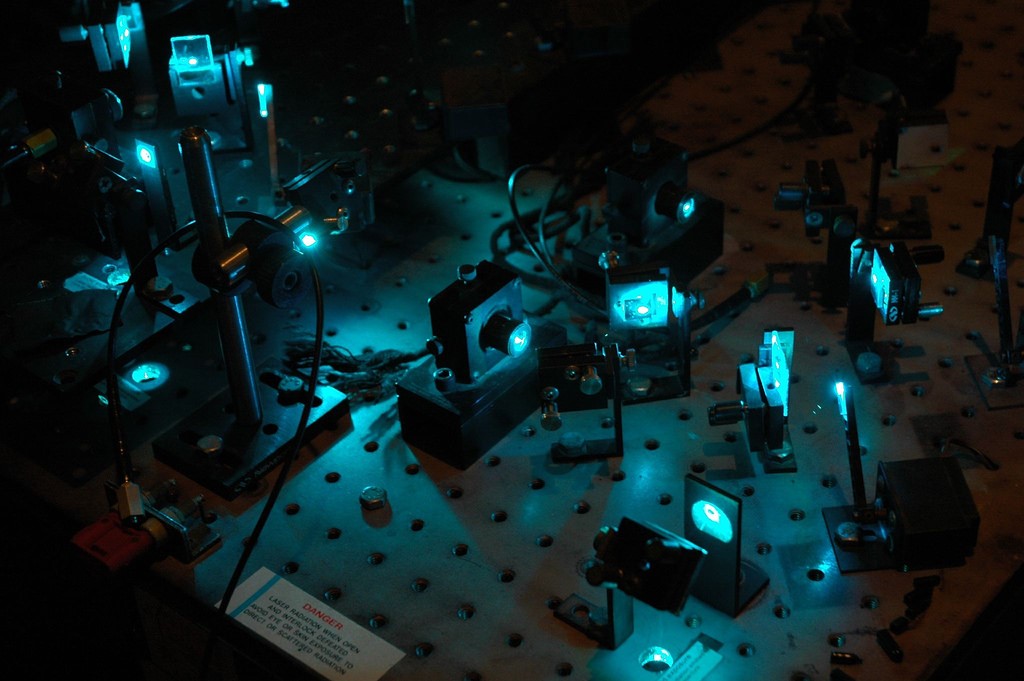
Photo by Rob Lee / Flickr / CC BY-ND
Testing showed that after three hours of artificial aging in a furnace at 180 ° C, the data on the disc is still readable. The results can be found on page 5 of the scientific article .
A similar solution was presentedengineers from the UK and Germany. Their type of optical memory also uses lasers to change state in cells, each of which stores five bits of information. In the future, they plan to use the technology for the development of photonic analogs of microprocessors or to introduce them into optical memory chips.
All of the above optical technologies in the future can completely replace the HDD. High recording speed and low power consumption, which is achieved due to single laser pulses, will allow you to implement the approach in photonic integrated circuits. But so far, all experiments with similar devices are carried out in the walls of laboratories. And it is not known when the first gadgets will appear on the market, if at all.
Posts from our blog:
What is technology?
One of the most common media in the data center is hard drives. They are quite cheap (compared to SSDs) and have high capacity. However, large arrays of these devices consume significant amounts of electricity.
Considering that the volume of stored data is constantly growing, electricity bills are also increasing. This type of storage can account for half of the energy consumed by data centers. At the same time, the performance of hard drives, despite regularly improving recording technologies, is inferior, for example, to solid-state drives. Scientists from the Eindhoven University of Technology (TU / e) undertook to
solve these problems . They combined the capabilities of magnetic and optical recording to develop new technology.
How it works
The solution is based on the effect of all-optical switching, which uses an ultra-short laser pulse to switch the polarity of the magnetic material. This effect was discovered ten years ago, but until today, a series of laser pulses was required for magnetization reversal, which greatly slowed down the recording time.
A team of engineers from TU / e was able to carry out optical switching with a single femtosecond laser . Data was recorded on a synthetic ferromagnet. Cell switching was performed in a few picoseconds, which is hundreds of times higher than the capabilities of classical magnetic devices.
The authors combined this approach to recording with “running memory” - a magnetic “wire” through which electric current carries bits. The bits recorded by the laser pulse move further along the wire and free up space for recording the next piece of information. It turns out a kind of conveyor.
It will be possible to read the recorded information using another high-speed optical device, but so far the engineers from TU / e have not implemented it. Researchers are also looking for ways to reduce the size of all components of a new type of memory, to use it in integrated photonics schemes.
Similar developments
A similar technology for recording data was invented by engineers from Australia. They suggested using fluorescent salt crystals as a carrier. A low-power laser encodes information using special patterns - it changes the fluorescence properties of crystals according to a certain pattern.
Scientists hope that due to the low power of the lasers and the size of the salt in the future, such storages will find application in photon integrated circuits . Crystals can also be embedded in any material - plastic, metal, glass. Therefore, in the future, salt grains will be able to become a full-fledged storage system for custom gadgets.
Similar goals were set by experts from China. They developed10 TB optical disk that can store information for six hundred years. The disk matrix was made of glass and gold. Glass was chosen as the main material because of its durability - it is able to remain unchanged for a thousand years. Information was encoded in five dimensions: three directions in space, plus color and polarization. For recording, the team used a femtosecond laser.
Photo by Rob Lee / Flickr / CC BY-ND
Testing showed that after three hours of artificial aging in a furnace at 180 ° C, the data on the disc is still readable. The results can be found on page 5 of the scientific article .
A similar solution was presentedengineers from the UK and Germany. Their type of optical memory also uses lasers to change state in cells, each of which stores five bits of information. In the future, they plan to use the technology for the development of photonic analogs of microprocessors or to introduce them into optical memory chips.
All of the above optical technologies in the future can completely replace the HDD. High recording speed and low power consumption, which is achieved due to single laser pulses, will allow you to implement the approach in photonic integrated circuits. But so far, all experiments with similar devices are carried out in the walls of laboratories. And it is not known when the first gadgets will appear on the market, if at all.
Posts from our blog: