February 11, 2016 at 01:31
The number of fingers does not affect typing speed
Many people think that the ten-finger typing method is faster than others. This point of view is also promoted at typewriting courses, and developers of programs for teaching quick typing. But no one has ever studied what print strategies exist and how to actually type the text the fastest.
Specialists from Aalto University (Finland) conducted such a study - and found out a startling fact. It turns out that the speed of typing does not depend on the number of fingers that are involved in printing. "Self-taught" can type with a few fingers on each hand as fast as "professionals" with a ten-finger blind method.
As part of the experiment, small reflective markers were attached to the fingers of the experimental subjects, the position of which was recorded by 12 high-speed infrared cameras (the same high-precision systems are used for film production). In addition, the direction of view was monitored using glasses.

The experiment involved 30 volunteers of different ages and experience.
“We were very surprised that people who graduated from printing courses showed the same average speed and accuracy as self-taught students using an average of six fingers,” says doctoral student Anna Feit.
Dr. Daryl Weir adds that simply information about the keys pressed and knowing which fingers a person is using is not enough for a complete analysis. A system of markers with video cameras made it possible for the first time to determine with which finger a person presses a particular key, and the sequence of such presses and hand movements (printed strategy).
The video shooting revealed several factors that correspond to faster typing: this is the minimum movement of the hands above the keyboard and the tendency to use the same fingers to type the same letters.
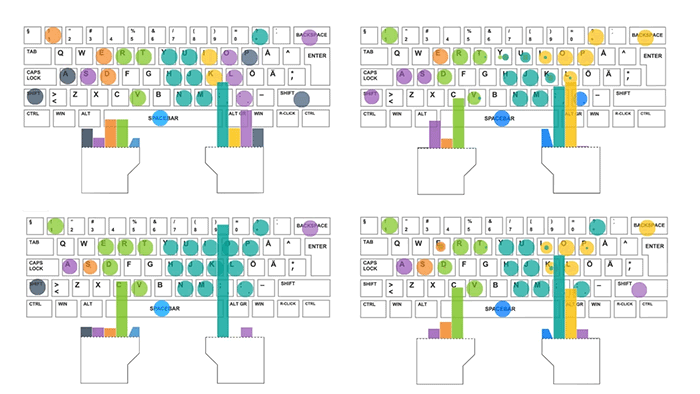
Interestingly, most subjects used their left and right hands in different ways. While the left hand remained almost motionless, the right hand moved much more actively and covered a large number of letters. The diagram shows that the index finger of the right hand of a fast self-taught typesetter covers almost half of the keys. His typing speed is the same as that of an experienced stenographer using a ten-finger blind method.

In general, the analysis revealed four user groups that showed similar statistics on the use of fingers of the left hand, and six user groups with similar patterns for the right hand.

Self-taught printing strategies vary, but they usually use one or two fingers on each hand. Unique patterns have been discovered, such as using CapsLock instead of Shift or pressing the spacebar with two thumbs.
But in each group of experimental subjects, no matter how many fingers they used, there were people with low typing speed and high speed. The average typing speed does not depend on the number of fingers that are involved in the work.
Nevertheless, researchers note that non-professional users, that is, those who have not completed the courses of “blind” typing, look at the screen less time, and more time look at the keyboard. Theoretically, this can affect the speed of performing complex text editing tasks.