December 1, 2015 at 15:52
LED lamps from Auchan store
Most of the LED lamps that I test and write about can be bought only in specialized online stores, however, ordinary buyers usually buy lamps in hypermarkets. I went to Auchan and Leroy Merlin stores, bought 48 LED lamp models there and tested them. I returned the lamps back to the shops, as there is a possibility of return. I will tell about lamps from Leroy Merlin next time, today - 22 lamps from Auchan.
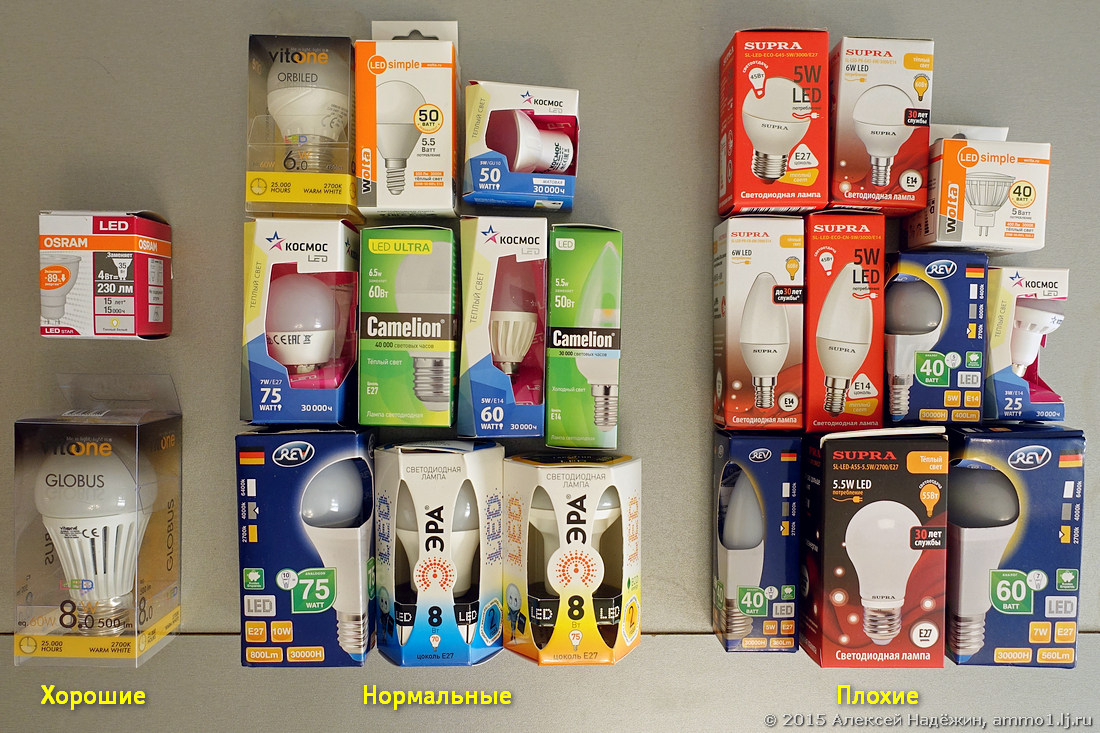
As you can see, quite a few lamps turned out to be bad. First of all, they have a high ripple (flicker) of light. All lamps with a ripple level of more than 45%, I consider substandard. Such flickering is visible visually and it is very uncomfortable to be in a room lit by lamps with high ripple.
The results of measurements by instruments Viso LightSpionand lupine .
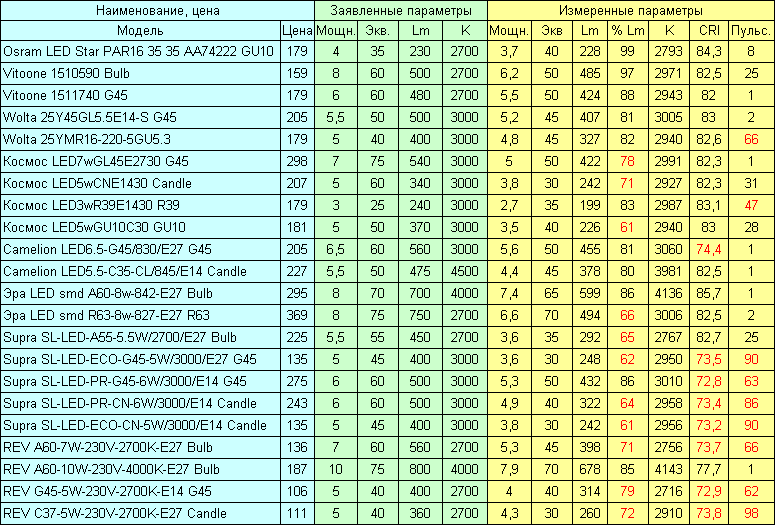
None of the tested lamps gives the luminous flux promised by the manufacturer and only two lamps have 99% and 97% of the promised luminous flux, which fits into the requirements of GOST R 54815-2011 , according to which the measured initial luminous flux of the LED lamp must be at least 90% of the nominal luminous flux. These are Osram LED Star PAR16 35 35 AA74222 GU10 and Vitoone 1510590 Bulb lamps, which fell into the group of good ones. The remaining 20 lamps have a luminous flux of 61-88% of the nominal and do not comply with GOST.
9 lamps have a CRI below 80. They should not be used in residential premises.
I will say a few words about the lamps of each of the tested brands.
Osram.
One lamp tested. All parameters correspond to the declared. Good light bulb.
Vitoone.
Two lamps tested. I tested a 4-watt candle of this brand in the spring and everything was bad with it - an unacceptable level of ripple and low CRI. With new lamps, everything is much better. The ripple of one lamp is 25% (this is quite acceptable), the second ripple is practically nonexistent. CRI is more than 80, luminous flux - 97 and 88% of the declared. For their price, quite decent bulbs.
Wolta.
Two lamps tested. Wolta has two series of lamps - ordinary in orange boxes and simple in white. All the orange that I tested were good. Many whites have an unacceptable level of light pulsation. So the 5.5-watt bulb lamp has practically no ripple, while the spot GU5.3 has as much as 66%. This lamp cannot be used. As for the bulb, the only complaint against it is 81% of the declared luminous flux. It shines like a 45-watt incandescent lamp, and the manufacturer claims the equivalent of 50 watts.
Space.
Four lamps tested. First of all, "Cosmos" misleads the consumer with the equivalent. On a 5-watt candle, the capital letters write the equivalent of 60 W, and very small ones, 340 Lm, but this is not 60 W equivalent, but only 40. In fact, there isn’t this either - the lamp gives only 242 Lm and shines like a 30-watt incandescent lamp . The same thing with other lamps - a 7 W bulb has an actual power of 5 W, gives 422 Lm instead of the 540 promised, and shines like a 50-watt incandescent lamp, but not at all like a 75-watt bulb. A 5-watt spot consumes only 3.5 W, gives 226 Lm instead of the 370 promised and shines like a 40-watt halogen spot, and not like a 50-watt one. The 3-watt R39 mirror lamp gives 199 Lm instead of the 240 promised, but then the manufacturer made a mistake with the equivalent in the opposite direction. The fact is that mirror bulbs give much less light than ordinary ones. A 30-watt R39 incandescent light bulb gives just 160 Lm, so 199 Lm is the equivalent of 35 watts. All lamps have good values CRI 82.3-83.1. The ripple of the light of the first three lamps does not exceed 31%, but the R39 lamp has a ripple of 47% and it is already visible, so I have to reject this lamp.
Camelion.
Two lamps tested. Both lamps have no ripple in light, but their CRI turned out to be very different. The candle has 82.5, but the ball has 74.4, so it is better not to use it in living quarters. Luminous flux - about 80% of the declared.
Era.
Two lamps tested. Both lamps have no ripple of light, CRI 85.7 and 82.5. The luminous flux of the bulb lamp is 86% of the declared, the equivalent is 65 W (promised 70 W), but the luminous flux of the “mirror” R63 is only 66% of the declared, but here most likely there is a manufacturer's error with the light flux and the equivalent of DSLRs. The tested lamp shines like a 70-watt SLR (equivalent to 75 watts declared). Good light bulbs. It is only necessary to take away 5-10 watts from the promised equivalent in the mind when buying.
Supra.
Five lamps tested. They all fell into the “bad”: four ripple light 63-90%, but with the fifth lamp Supra SL-LED-A55-5.5W / 2700 / E27 Bulb, everything is quite unusual. It has a low light ripple of 25%, good CRI 82.7, but visually the lamp light is unpleasant with a greenish tint. Luminous flux of only 65% of the declared and the real equivalent of 35 watts instead of the 55 watts promised. Not sure if this manufacturer has good lamps.
REV.
Four lamps tested. Three of them fell into "bad" because of the high pulsation of light 62-98%. Surprisingly, one REV A60-10W-230V-4000K-E27 Bulb lamp has no ripple at all. Although CRI is still low - 77.7. Luminous flux - 85% of the promised.
The test results were quite unexpected for me. Half of the tested lamps are only in the garbage. The remaining half is only satisfactory. The only lamp that can be called great is the Osram spot. However, in Auchan there are still Philips lamps that I did not buy, since I already tested them.
Looking ahead, I’ll say that in Leroy Merlin with bulbs, everything is much better.
All parameters of the tested lamps and Viso reports, as well as all other results of my LED lamp tests, see lamptest.ru .
© 2015, Alexey Nadezhin
As you can see, quite a few lamps turned out to be bad. First of all, they have a high ripple (flicker) of light. All lamps with a ripple level of more than 45%, I consider substandard. Such flickering is visible visually and it is very uncomfortable to be in a room lit by lamps with high ripple.
The results of measurements by instruments Viso LightSpionand lupine .
None of the tested lamps gives the luminous flux promised by the manufacturer and only two lamps have 99% and 97% of the promised luminous flux, which fits into the requirements of GOST R 54815-2011 , according to which the measured initial luminous flux of the LED lamp must be at least 90% of the nominal luminous flux. These are Osram LED Star PAR16 35 35 AA74222 GU10 and Vitoone 1510590 Bulb lamps, which fell into the group of good ones. The remaining 20 lamps have a luminous flux of 61-88% of the nominal and do not comply with GOST.
9 lamps have a CRI below 80. They should not be used in residential premises.
I will say a few words about the lamps of each of the tested brands.
Osram.
One lamp tested. All parameters correspond to the declared. Good light bulb.
Vitoone.
Two lamps tested. I tested a 4-watt candle of this brand in the spring and everything was bad with it - an unacceptable level of ripple and low CRI. With new lamps, everything is much better. The ripple of one lamp is 25% (this is quite acceptable), the second ripple is practically nonexistent. CRI is more than 80, luminous flux - 97 and 88% of the declared. For their price, quite decent bulbs.
Wolta.
Two lamps tested. Wolta has two series of lamps - ordinary in orange boxes and simple in white. All the orange that I tested were good. Many whites have an unacceptable level of light pulsation. So the 5.5-watt bulb lamp has practically no ripple, while the spot GU5.3 has as much as 66%. This lamp cannot be used. As for the bulb, the only complaint against it is 81% of the declared luminous flux. It shines like a 45-watt incandescent lamp, and the manufacturer claims the equivalent of 50 watts.
Space.
Four lamps tested. First of all, "Cosmos" misleads the consumer with the equivalent. On a 5-watt candle, the capital letters write the equivalent of 60 W, and very small ones, 340 Lm, but this is not 60 W equivalent, but only 40. In fact, there isn’t this either - the lamp gives only 242 Lm and shines like a 30-watt incandescent lamp . The same thing with other lamps - a 7 W bulb has an actual power of 5 W, gives 422 Lm instead of the 540 promised, and shines like a 50-watt incandescent lamp, but not at all like a 75-watt bulb. A 5-watt spot consumes only 3.5 W, gives 226 Lm instead of the 370 promised and shines like a 40-watt halogen spot, and not like a 50-watt one. The 3-watt R39 mirror lamp gives 199 Lm instead of the 240 promised, but then the manufacturer made a mistake with the equivalent in the opposite direction. The fact is that mirror bulbs give much less light than ordinary ones. A 30-watt R39 incandescent light bulb gives just 160 Lm, so 199 Lm is the equivalent of 35 watts. All lamps have good values CRI 82.3-83.1. The ripple of the light of the first three lamps does not exceed 31%, but the R39 lamp has a ripple of 47% and it is already visible, so I have to reject this lamp.
Camelion.
Two lamps tested. Both lamps have no ripple in light, but their CRI turned out to be very different. The candle has 82.5, but the ball has 74.4, so it is better not to use it in living quarters. Luminous flux - about 80% of the declared.
Era.
Two lamps tested. Both lamps have no ripple of light, CRI 85.7 and 82.5. The luminous flux of the bulb lamp is 86% of the declared, the equivalent is 65 W (promised 70 W), but the luminous flux of the “mirror” R63 is only 66% of the declared, but here most likely there is a manufacturer's error with the light flux and the equivalent of DSLRs. The tested lamp shines like a 70-watt SLR (equivalent to 75 watts declared). Good light bulbs. It is only necessary to take away 5-10 watts from the promised equivalent in the mind when buying.
Supra.
Five lamps tested. They all fell into the “bad”: four ripple light 63-90%, but with the fifth lamp Supra SL-LED-A55-5.5W / 2700 / E27 Bulb, everything is quite unusual. It has a low light ripple of 25%, good CRI 82.7, but visually the lamp light is unpleasant with a greenish tint. Luminous flux of only 65% of the declared and the real equivalent of 35 watts instead of the 55 watts promised. Not sure if this manufacturer has good lamps.
REV.
Four lamps tested. Three of them fell into "bad" because of the high pulsation of light 62-98%. Surprisingly, one REV A60-10W-230V-4000K-E27 Bulb lamp has no ripple at all. Although CRI is still low - 77.7. Luminous flux - 85% of the promised.
The test results were quite unexpected for me. Half of the tested lamps are only in the garbage. The remaining half is only satisfactory. The only lamp that can be called great is the Osram spot. However, in Auchan there are still Philips lamps that I did not buy, since I already tested them.
Looking ahead, I’ll say that in Leroy Merlin with bulbs, everything is much better.
All parameters of the tested lamps and Viso reports, as well as all other results of my LED lamp tests, see lamptest.ru .
© 2015, Alexey Nadezhin