How a 27-year-old man earned several million by “financing the death spiral” of pennies
- Transfer

Late last year, Joshua Sason entered the Providence boxing ring to the applause of two thousand spectators. He followed the actor Miles Teller, and the crowd was an extras: this was how the shooting of the film about boxing from the director of the drama “ Boiler Room ” took place . Boiler Room ]. Sason had to play an episodic role of a man from the environment of a boxer, since he became the producer of the film together with Martin Scorsese and financed the shooting of the picture. He is now 27 years old.
In December, at the end of filming, Sason went to Malaysia to celebrate Christmas with his girlfriend, model Rachel Marie Thomas. He made repairs at his penthouse in Tribeca, and also opened a recording studio in London to help record an album for an Israeli singer and actress, with whom his firm Magna, who described him as an international investment company, signed a contract.
Six years ago, Sason lived in a house on Long Island with his parents, worked as a clerk at a law firm specializing in debt collection, and dreamed of becoming a pop star. After some time, a friend of his family told him about one trick, which, according to many, brought him millions in the stock market. He does not say what he is doing and how much he receives, but judging by the reports of dozens of companies, Magna has provided them with investments worth more than $ 200 million since 2012.
Sason, whose tattoos on his hands are hiding a strict English suit, calls himself a self-taught investor. His company has about 30 employees in the fields of trade, venture capital, music and film. “I’m not going to disclose the details of our work,” he said in an interview in his office on the 16th floor of a building in downtown Manhattan in January. “We create companies and invest money.”
In fact, everything is not so simple. Sason found a way to buy back stocks (read more about working in the stock market here) companies in difficult or desperate situations, with huge discounts, in turn, providing them loans. Magna has entered into transactions with at least 80 companies. Shares of 71 companies out of 80 have fallen since the investment. Sezon could still make a profit, since the terms of the transaction allowed him to exchange debt securities for shares with a fixed value. Regardless of where they trade these shares, he buys them cheaper.
Magna acts as a pawnshop, buying up cheap shares of little-known risky enterprises, the resale of which is carried out certainly not according to the rules of the New York Stock Exchange. His clients included a miner who mined copper ore, allegedly from Chile, the inventor of mentally-controlled telephones, and at least two managers who were later accused of fraud. They came to Sason and sold a large number of their shares for a small amount of money. Often they realized that the deal was likely to bring nothing good to their shareholders.

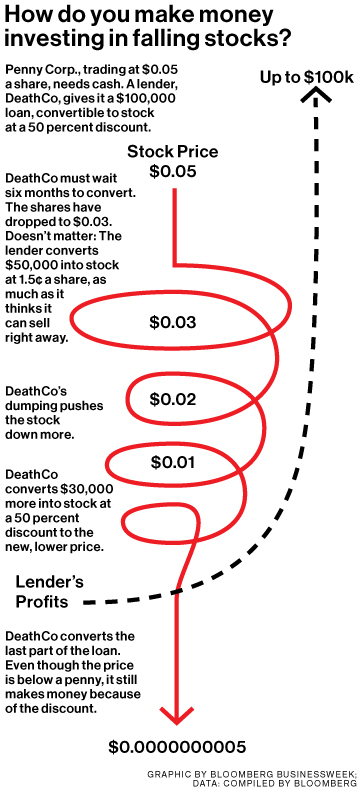
If the stock price drops even lower before Magna can withdraw its investments, companies will have to sell even more stocks, all in order to eliminate Sason’s risks. Critics call this phenomenon “lethal spiral financing,” because in this case, stocks depreciate. Other experts say that sometimes an investor receives twice, triple, or even 10 times the amount after only a few months.
The business itself is legal, but the loopholes used in securities laws are used by the most cunning banks and hedge funds. At least six other lenders working with crashing companies were sued by the Securities and Exchange Commission (SEC) for violating stock dumping rules and several other laws; one lender was arrested by the FBI. Sason came out of the water dry, and he had no problems with the authorities. Now he makes money on the “death spiral”, expanding the scope of his company and turning into a tycoon in the entertainment industry.
As the son of an Israeli immigrant contractor, Sason grew up in Plainview, a Long Island working village an hour's drive from Manhattan, and lived in a ranch-type house just off Seaford-Oyster Bay [English Seaford-Oyster Bay Expressway ]. At the age of 10-11 years old, together with local boys, he founded a rock band called The Descent. They performed covers for songs of the Blink-182 group, and he sang and played drums, guitar and synthesizer.
Sason opened a recording studio in the basement of his parents' house and began writing music for his band. The Descent was a success. In the second year, someone sent their notes to Trevor Price, the defender of the Denver Broncos team weighing 120 kilograms, among other things, who financed various music groups. He flew to Long Island so that the band signed a contract with his recording studio, but first he needed to discuss everything with the concerned parents of the musicians. “I was sitting in the living room with five Jewish families who surrounded me and began asking about the possible amount of money,” he says. “It was just ridiculous.” According to Chris Antonelli, one of the band’s members, Price gave Sason and other band members $ 5,000 each,
“We called it Rocker Friday,” Antonelli admits. “I wore my grandmother’s mink coat and sunglasses, and Josh wore a boa.”
The Descent presented their numbers to the directors of major labels, but the other guys that Sason and Antonelli took to themselves were not so good. “They just messed up,” Price says.
“There was a noticeable decline in the group,” says Antonelli. “Everyone was waiting for us to become superstars, but that didn't happen.”
Sason entered Hofstra University, located nearby, and stayed with his parents. His second band, Vibes, was less successful and performed their best shows at Temple Beth Am School in Merrick, New York. Michael Morgan says that Sason longed for another big success.
“When you have a contract with a studio and you are in school, your attitude towards success should change,” Morgan said. “You say to yourself,“ Okay, that’s possible. Now what? What's next?"
Sason got a delivery service at an Asian restaurant, delivering food on his black Mustang. Later, he began to file documents in a debt collection company. Morgan claims that they went in for sports every day at the local Jewish community center: now they play basketball here from the Joshua A. Sason School, renamed after a donation in 2013.
In 2009, at an entrepreneurship lesson at the University, Sason offered to supply sand from Israel and sell it under the name Sand from the Holy Land to collectors. He liked the 2006 documentary titled The Secret, recommended by Oprah Winfrey and based on a book about self-development and the power of positive thinking. One of Sason’s friends remarks that he believed in the “law of attraction” from a book: how you can achieve anything by imagining how it comes true.
So Sason explains that almost the same thing happened to him. He said that while he was relaxing with his family in Puerto Rico, he read the book The Intelligent Investor, written by Bejamin Graham in 1949 and often mentioned by Warren Buffett as a source of his inspiration. “Probably, at that moment my life changed,” says Sason. “First, I read it once. Then, reading it a second time, I wrote out the main points from the book, which later became my guide in writing my interpretation. ”
Season claims that after that, in the same year, he doubled the amount donated to him for a bar mitzvah by investing in blue chips. “I realized that I might have the ability to invest,” says Sason. He lent his mother's retirement savings, took a “minimum six-figure” loan from a family friend, and founded Magna without getting out of bed. According to Sason, the business was growing, and there were rumors that Magna could provide financing to small companies.
“Growth has been gradual and continuous,” he says in an interview in January. “Honestly, I can't remember anything concrete from what was happening then.”
I still do not understand how a guy from Long Island, who was trying to become a musician, almost instantly earned millions on investments. I came across a lawsuit in 2012 in which a financier named Yosef Kahlon accused Sason of stealing his business model, but Sason only said that they had not talked for a long time.
There is something else on the web about Kahlon. His number is not in the phone book, but his address was indicated in the lawsuit, so I decided to go to his house, located in Great Neck, New York, a prosperous town on the long coast of Long Island. A white Range Rover was parked on a driveway near a colonial-style brick mansion, which last year sold for $ 6.3 million.
From within came dance music. A thin man with sleek dark hair and gray bristles opened the door and said that Kahlon was not at home. The next day I received an email that said: “My name is Yossi Kahlon. I heard that you are looking for me. " We agreed to meet at a restaurant in Manhattan, and at the appointed time the same man came in with sleek dark hair. In the end, it turned out that this was Kahlon. “It's nice to see you again,” he said. Then he pulled out a pack of ten- and one-hundred-dollar bills to pay for a gin and tonic, and told me the story of how he met Josh Sason and trained him.
 Kahlon, 48, also emigrated from Israel. Arriving in Queens in 1989 and having worked there as a taxi driver, he earned a decent amount by entering the computer games market early and financing dealership auto centers. He hired Sezon's father to do housework and soon made friends with his family, inviting them to his weekend. Once during the Jewish Passover, Josh won the traditional game "hide matzo", which usually brings the winner 1 or 10 dollars, and Kahlon, according to him, gave the boy $ 1,000.
 Around 2009, Kahlon learned that the Seasons had financial difficulties. He told Sason Sr. that he could help. “I said:“ Bring your son here, I will teach him how to make money, ”recalls Kahlon, who at that time was already making money on cheap stocks.
It is believed that the formation of the cheap stock market began with the struggle of brokers who traded stocks not accepted by the New York Stock Exchange. In a 1920 article in Munsey's magazine, such brokers were called "a crowded cluster of creatures, apparently humans" and mentioned an auction where they sold a doll with shares inside.
Cheap stocks exist for this, so that, say, a cunning driller about to drill an oil well can earn the money he needs without having to get access to trading on the exchange. They satisfy the desire to have a mechanism that would double or triple investments without much effort.
This market sector has a dubious reputation: many tolerances turn out to be fake. In the best case, they can be sent by an ordinary guy with some idea, and often this idea is to raise funds from which he can pay himself a high salary. The remaining admission to trading belongs to these companies, which large exchanges refused because they were on the verge of bankruptcy.
Kahlon paid brokers to find cheap high-volume stocks on the market and then find out from the companies if they are going to issue new stocks. Companies that are on the verge of bankruptcy cannot publicly trade new shares in the traditional way, with the support of the appropriate investment bank, because it is too expensive and the cost of securities is rather low. But they can sell them to private investors like Kahlon. Companies give him very high discounts, and he immediately sells these shares on the public market, often doubling the initial amount by “diluting” the remaining shares. Normally, laws prohibit this, but Cahlon found Texas to be an exception. He registered his company there, while he himself worked in New York.
Kahlon says that he showed Sason how to trade in this way, and then how to break the contract so that no one could accuse him of a crime. “I will teach you how to do business, but as soon as you start your business, we will no longer be able to contact,” he told Sason. “I have no friends in this business.” The company's business papers indicated that Sason registered the Magna Group in Texas in 2010, using the same mailbox as Cahlon.
As soon as Magna began her work, Sason's younger brother named Ari dropped out of Buffalo University and began working with him at their parents' house. They removed the sewing machine table from the garage and placed it in Sason's bedroom for Ari. The brothers quickly made enough money to move to the office building at 5 Hanover Square in Manhattan, and hired a team of "bloodhounds" to search for "victims."
“At least two people at the company mostly made cold calls to other companies they found on the Internet,” says John Perez, who worked at Magna for several months in 2012 as an assistant sales manager. “The other two made deals.” One of Sason’s sales agents, Ari Morris, took the pseudonym Michael Goldberg and introduced himself in a telephone conversation. In 2012, Goldberg was listed on the Magna website as “director of structural investment.” Customers say that it was pleasant to communicate with him.
Magna were not the only ones making calls to such companies. The executives of companies selling cheap stocks argue that as soon as the volume of trading in their stocks became high, young sellers and annoying bank employees inundated with calls asking them if they needed cash; and often they replied that they were needed.
Such market activity has attracted the attention of the SEC. In the summer of 2012, the Commission sued Kahlon and other financiers involved in the trading of cheap stocks, claiming that their ingenious loophole was not really such. The SEC estimates that Kahlon earned $ 7.7 million by buying cheap stocks at huge discounts and publicly dumping stocks. Kahlon himself claims that he did not violate anything; the case is still pending.
Kahlon closed his foundation in the hope that his former student would help him with the payment of legal costs. Sason did not do this and, according to Kahlon, greatly offended him, not showing a single drop of respect for what he taught Sason. In the end, Kahlon sued Sezon, saying that he severed relations with his broker; The judge dismissed this claim.
“I just want to help the company, honestly”
When I asked Sason about Kahlon’s story, he said that was not true. “No one taught me this business,” he writes in his email. If his family friend inspired him to study cheap stocks, he believes that Magna’s activities have nothing to do with Kahlon’s work, the general mailbox is just a coincidence, and he never won $ 1,000 during Passover.
None of the SEC reports mention Magna, and Sason has never had a problem with the Commission. Almost all of the company's clients reporting indicates that the transactions were more skillful than Kahlon did.
Paul Riesz’s deal with Magna in July 2011 was unremarkable. The company of a businessman from New York, Pervasip, was developing a communication application and was supposed to compete with Skype, but its budget was reduced to 100 thousand dollars, which would hardly be enough for a month, given the speed with which the company was losing its money. According to Riesz, a certain Michael Goldberg from Magna called him and offered to take a loan, nor did he even ask him to show him the application.
“All they wanted to find out was the liquidity of our stock,” says Riess. “They were interested in how much money we spend every month.”
At first glance, a $ 75,000 loan from Magna seemed like a good offer. It represented the issuance of an “8 percent convertible bill of exchange,” which meant a [annual] return of 8% of the investment and gave Sezon the right to transfer it to shares. It was written in small print that if Pervasip did not pay the debt within six months, the creditor could make this transfer at a discount of 45% of the market value. Thus, no matter where Pervasip shares were traded, the company would have to issue [136] Magna shares worth more than $ 136,000 — a 82 percent refund in just six months. In essence, Magna provided itself with a fixed return.
The lower the value of the shares, the more Pervasip owed [to the company] Magna, which could receive its money. Magna took risks only if market players refused to buy Pervasip shares at an arbitrarily low price. “Unfortunately, it all came down to the money we had,” says Riess.
Pervasip did not manage to repay the debt and gave back Magna shares with the agreed discount in January 2012. Riess claims that he has no papers showing how much Magna earned on this. Pervasip shares rose briefly to 3 cents apiece, and now they can be bought for 0.009 pennies. According to Riesz, lenders still call him and offer even more money.
An analysis of 80 reports sent by [Magna] to government agencies showed that after a deal with Magna, the stock price of the company falls by an average of 55% per year. Most never recover and, ultimately, are forced to trade them for thousandths of a penny or less. Sason claims that his company is not to blame for anything.
“I just want to help the company, honestly,” he says. “We would never begin to invest our money if we knew that our activities in the market could lower the value of the company [in which we invest]. It would be unprofitable for us. ”
In January 2013, Sason bought a penthouse in Tribeca for $ 4.2 million. He moved from Mustang to a sports Mercedes-Benz worth 200 thousand dollars, according to his school friend Antonelli. He began to appear frequently in Lavo, a nightclub in downtown Manhattan, popular among various celebrities. “From Thursday to Sunday he can be found in the club surrounded by attractive waitresses,” says Antonelli.
The biggest success came to Magna in 2013, when the firm helped Newlead, the Greek shipping company, avoid bankruptcy. The company, which previously owned 15 tankers and container ships, left four vessels. She had enough cash to recover her monthly operating expenses.
But then the nature of the transaction changed dramatically: instead of giving Newlead a loan, Magna paid several Newlead lenders for the right to collect old company debts. After Magna filed a lawsuit against Newlead for debt collection, both companies quickly reached an agreement whereby Newlead pledged to give Magna a discount on stocks that could be immediately purchased. The New York State Court approved this agreement.
In a written statement attached to the case, Sason claimed that Magna, together with an unnamed partner, repaid $ 45 million in debt and stocks later sold for $ 62 million, which means $ 17 million in profit excluding expenses.
The financing technique is considered legal as long as the debts paid are real, and the financier does not leave the income from the sale of shares in his company, according to Mark Lefkowitz, who also financed cheap shares and was accused of violating these rules in 2012. “The bottom line is that this technique needed to be used to reliably translate debt into securities,” says Lefkowitz, who collaborated with the FBI. He quickly completed his interview, explaining that he was due to be sentenced soon, and he had to find out something from his assistant from the FBI before saying anything.
Funding may have saved Newlead as a company (it avoided bankruptcy and acquired several new tankers), but it led to the depreciation of its shares. The company was so ruined that if you bought its shares for $ 3 million in March 2013, just before Magna’s investment, you would be penniless. Based on the results of the consolidation, the value of the share is $ 0.0000000002. Newlead declined to comment.
It's hard to say how much Magna has earned since 2010. Sezon claims that Magna conducted transactions totaling $ 200 million, which is confirmed by calculations from customer documents, although some transactions were concluded with partners of the company. He said that the bulk of the company's securities belong to him, the rest to his employees.
Competitors of the company believe that financiers who earn on cheap stocks usually require a 50% refund, according to the SEC. Sezon claims that the number of failed transactions he can “count on the fingers”. According to experts, the profitability of his transactions exceeds the refund of almost any hedge fund. “Every return of our funds is guaranteed,” said Sason. “We do not enter into business and do not use strategies that do not bring us profit.”
After a successful deal with Newlead, Magna began providing investment to a wide variety of companies. Sason set up a “venture” department that invested in PledgeMusic, a London-launched website that allows musicians to sell their albums before they are released, and Mainz, one of the leaders in outsourcing. In addition, he hired a former director of Madonna's recording studio to help him in the entertainment department.
Chad Verdi helped to get into the cinema. He started producing films since 2011 after financing companies with cheap shares that were not successful in the disposal of nuclear waste and the detection of chemical warfare agents. Verdi was a producer of VoD movies. Video on Demand] when he met Sason. After Sason began financing one romantic comedy, Verdi introduced him to Martin Scorsese at an office in the New York City's theater district. The famous director talked about a documentary called "New York Review of Books", which he shot at that time.
“In the end, we provided a certain amount to complete the filming and became executive producers of this project,” says Sason.
Verdi later invited Sason to finance the filming of a biography of Vinnie Pazienza, a boxer from Rhode Island who returned to sports after breaking his neck in a car accident and decided to win three champion titles. Scorsese acted as the producer of the movie titled, “Bleed For It,” [Eng. Bleed for This]. In addition, the filming was directed by the director of the film Boiler Room Ben Younger. In the Boiler Room, frauds with cheap stocks are well described, however, Yanger said he did not see any connection with them.
“We were looking for sources of funding,” says Yanger, “and then Joshua came and saved us.” According to Yanger, Sason’s participation in the filming was not the idea of Sason himself. "He is a creative person, so he respects the work of other artists." Younger and Verdi say the budget for Bleeding For This is $ 6 million; Sason believes that it is less, but does not name the exact amount.
Sason plans to move Magna on Wall Street 40 to a skyscraper not far from the New York Stock Exchange, where he rented two full floors. He stated that stock trading now occupies one-twelfth of Magna's business.
“In fact, I'm trying to create an organization that will last another 1000 years,” says Sason. “I want to create something useful, something important and lasting.”