June 23, 2015 at 13:16
Compressed Air Energy Storage (CAES) - Pneumatic Battery
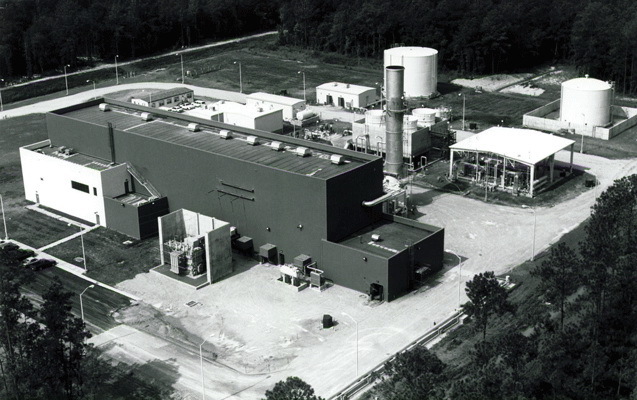
A cave, a compressor and a gas turbine - this is how a pneumatic energy accumulator is arranged. In the United States, the first such device was built in 1991 in Mclntosh, Alabama. Its purpose is to smooth out peak loads at power plants.

Air is driven by compressors into an underground storage (natural salt cave) with a volume of 538 thousand cubic meters to a pressure of 77 atm. When the power consumption in the network increases unexpectedly, the air exits and gives power to the system.
The time of emptying the tank to a lower working pressure of 46 atm is 26 hours, during which the station delivers 110 MW of power.
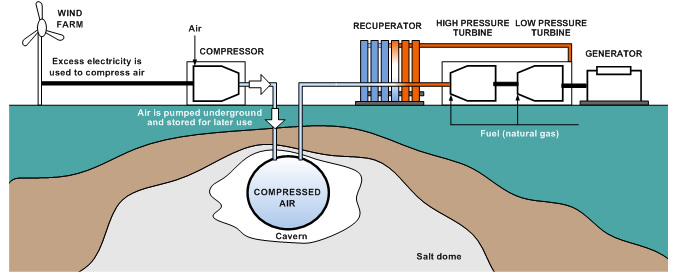
Compressed air does not rotate the turbine by itself, but enters the gas turbine. Since usually 2/3 of the power of a gas turbine is spent on a compressor drive that pumps air into it, a considerable saving is obtained. Before entering the turbine, the air is heated in the heat exchanger (recuperator) with combustion products, which also adds efficiency.
They note a reduction in gas consumption by 60 ... 70% compared to a traditional gas turbine, quick start from a cold state (several minutes) and good work at low loads.
The project in Alabama is not unique. Back in 1978, the Germans in Huntorf launched a storage facility at 290 MW (2 hours of operation) in two salt caves located at a depth of 600 ... 800 m with a pressure range of 50 ... 70 atm. Initially, the storage served as a hot reserve for industry in the north-west of Germany, and now it is used to smooth out the peaks of wind power generation.
They write that in the Donbass during the Soviet Union they planned to equip a 1050 MW pneumatic battery in the same cave; alas, his fate is unknown.
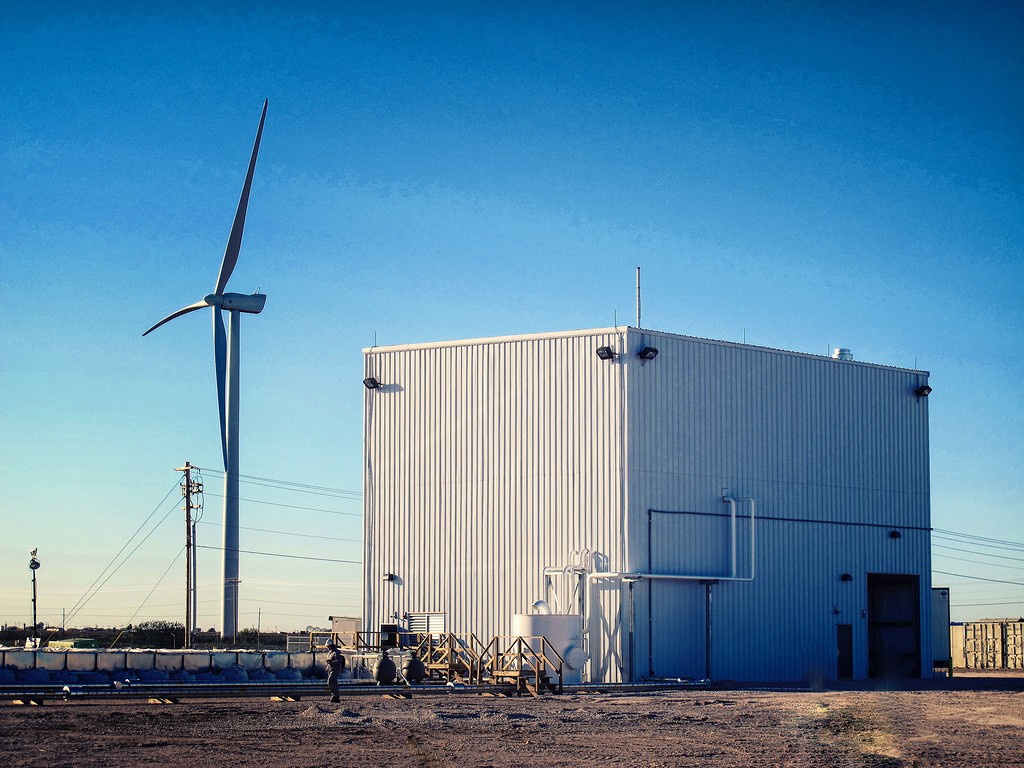
In 2012, in Texas, near a 2-megawatt wind farm, a pneumatic storage facility for 500 MW-hours was opened , but the specifics of it are not enough.
The overall efficiency of such stations is 41 ... 53% and indicatethat the construction cost is 360 ... 650 $ / kW or more, depending on whether you use a natural cave or you need to dig a new one.
However, you can do without caves, and store energy in bags at the bottom of the sea .
Air is driven by compressors into an underground storage (natural salt cave) with a volume of 538 thousand cubic meters to a pressure of 77 atm. When the power consumption in the network increases unexpectedly, the air exits and gives power to the system.
The time of emptying the tank to a lower working pressure of 46 atm is 26 hours, during which the station delivers 110 MW of power.
Compressed air does not rotate the turbine by itself, but enters the gas turbine. Since usually 2/3 of the power of a gas turbine is spent on a compressor drive that pumps air into it, a considerable saving is obtained. Before entering the turbine, the air is heated in the heat exchanger (recuperator) with combustion products, which also adds efficiency.
They note a reduction in gas consumption by 60 ... 70% compared to a traditional gas turbine, quick start from a cold state (several minutes) and good work at low loads.
The project in Alabama is not unique. Back in 1978, the Germans in Huntorf launched a storage facility at 290 MW (2 hours of operation) in two salt caves located at a depth of 600 ... 800 m with a pressure range of 50 ... 70 atm. Initially, the storage served as a hot reserve for industry in the north-west of Germany, and now it is used to smooth out the peaks of wind power generation.
They write that in the Donbass during the Soviet Union they planned to equip a 1050 MW pneumatic battery in the same cave; alas, his fate is unknown.
In 2012, in Texas, near a 2-megawatt wind farm, a pneumatic storage facility for 500 MW-hours was opened , but the specifics of it are not enough.
The overall efficiency of such stations is 41 ... 53% and indicatethat the construction cost is 360 ... 650 $ / kW or more, depending on whether you use a natural cave or you need to dig a new one.
However, you can do without caves, and store energy in bags at the bottom of the sea .