How do smart watches, sports trackers and other gadgets measure the pulse? Part 2
Hello everybody!

We continue a fascinating journey into the world of pulse meters. In the first part, we talked about the methods of measurement based on ECG and plethysmography - the most popular on the market. Optical plethysmography is also used in our EMVIO project - a watch that measures your stress.
The company of the EMVIO project starts on the Kickstarter platform on March 17, 2015. We have almost completed all the organizational work, now the final layout of the Kickstarter page is underway. You can subscribe to the newsletter on the project’s website to keep abreast of all the news.
We offer to support our project. All details and price offers will be presented in a separate post before the start of the company. For the very first (Early bird) backers, we have prepared a limited number of EMVIO hours for $ 129 USD.
Now let's continue. How else can you measure your pulse?
This method is known to all, without exception, just not everyone knows that it is called that. The method of sphygmography implements registration of arterial pulse by deformation of the artery vessel wall. The result is a curve similar to plethysmography. Pulse registration should be carried out in places where arteries come close to the surface of the skin, for example, from the back of the wrist or above the elbow, where the radial artery runs with one trunk. The beating of the artery wall is very small, so in order to amplify the signal at the end of the 19th century, an original method was invented: clamping the artery to a level where the artery still passes blood flow, but creates an obstacle to the shock wave of blood. In this case, strong ripples arose that could be fixed by mechanical means.
The main photo of the post contains an image of the first device - a sigmograph, brought to practical use. Sounds like a Van Helsing dart thrower. The invention of the French physiologist Etienne Jules Marais. Almost wearable gadget 1863 release. The device pressed the artery with the help of the adjusting mechanism, mechanically increased the amplitude of the pulse wave and made a pen recording of mechanical vibrations on paper. It was a prototype of the familiar cuff for measuring pressure.

Here then see an animated working principle of this device and its design in 3D
In general, the processes that occur in the vessels of an artery when it is clamped are rather complex. Studying these issues is relevant if you want to measure pressure. When you just need a pulse, the registration scheme can be simplified: remove the cuff, replace the acoustic sensor (microphone) or an ordinary stethoscope with a mechanical sensor - a piezoelectric element. This element operates in the direct piezoelectric effect mode (deformation -> polarization) and is capable of detecting deformations at the micrometer level.
Piezosensor
The idea of a method based on a piezoelectric element is well disclosed in the Wrist plethysmograph patent .US 20070287923 A1. The picture shows a diagram of the device. The entire design of the device works on the sensor - the strap provides tensile force at the edges of the piezosensor and acts as a kind of cuff, the case gives the necessary rigidity and support.

A patented method of recording a pulse based on a piezoelectric sensor.
The calculation of the pulse by the sphygmogram is the same as in plethysmography, since the obtained pulse curves are almost identical.
In practical implementation, there may be nuances associated with individual characteristics. There is an interesting studyin which the dependence of the amplitude of the pulse signal on the pressure force of the piezoelectric transducer, the individual parameters of the patient’s arm, and the like was studied. The sensor was brought to the wrist by a feedback stepper motor and, thus, the pressure force was normalized. The article indicates that the dispersion of individual pressures is quite high, and there are also problems with registration in overweight people with an increased thickness of the subcutaneous fat layer. There is work to do.
HealBe
The principle of mechanical pulse measurement is implemented in the acclaimed HealBe Go bracelet .
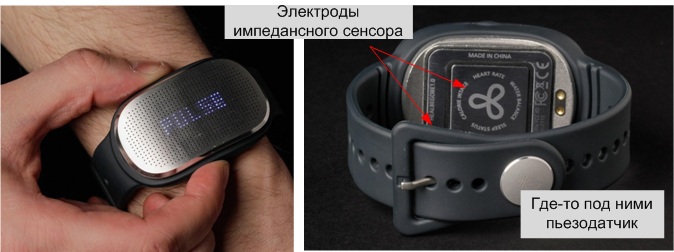
The HealBe Go bracelet uses a piezo sensor to measure your heart rate.
According to the stated parameters, the pulse wave signal is read from the wrist using a piezoelectric pressure sensor. In the scientific and technical report of the HealBe developers, an example of a pulse curve from a sensor is given, the waveform is quite typical for plethysmography and sphygmography. Interestingly, in no gadget known to us, this method is not used. So HealBeGo can be said pioneers.
Flexible sensors
There are concepts and scientific studies on the use of such sensors. Here is an example article that describes the implementation of an ultra-thin flexible sensor based on gold nanotubes.
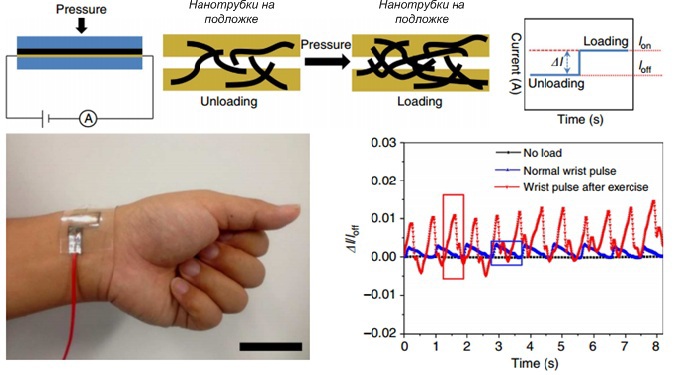
When the sensor surface bends, a current delta occurs. This delta is enough to fix the dynamic component of pressure from 13 Pa (for comparison: 1 Pa (N / m2) equals 7.50062 μm of mercury) ( hence , the mix from figure 1 and 6).
The sensor is fixed on the skin in the wrist area and registers pulse waves. A study of the sensor showed that the amplitude of the signal is affected by the level of the current sound background, for example voice and music, which is quite expected.
Here is another example of a sensor based on a 2D array of piezo cells.

Microtechnology in action ( hence , taken from figure 1).
This sensor is more perfect and functionally finished: it contains a primary amplification circuit and has contacts for connection. Here are examples of sensor stickers on various parts of the body.

Any points are accessible to the sensor ( from here , taken from figure 4)
If you take the signal from the wrist and neck, you can implement the method of measuring blood pressure based on the calculation of the relative velocity of the pulse wave (pulse wave velocity (PWV)) between the artery on the neck and the artery on the wrist (phase shift between signals). Actually in the article, the sensor is positioned to solve this particular problem. Here are good ideas for future heart rate gadgets.
Perhaps soon we will see flexible translucent bracelets for measuring heart rate. Flexible batteries have already appeared.
The ballistocardiography method uses the effect of detonation of the body from the shock wave when pumping blood through the vessels. In clinical practice, it was used not for the measurement of heart rate, but for the analysis of dynamic indicators of blood flow.

Another megadevice from the past. Fearfully? (picture taken from here ) The
signal is the mechanical vibrations of the body under the influence of a shock wave from pumping blood through the vessels. I think many, lying in bed, noticed this effect. Here is a very simple demonstration of the principle of work in photographs.
At the modern level, this method was implemented in the form of a smart pillow Darmato control posture. Since the time of the institute, in my memory, ballistic cardiography has been associated with a bulky device, and I was pleasantly surprised by this project in terms of choosing a method for registering a pulse. The project performed well on Kickstarter.

A girl in a green dress monitors her posture with Darma. Feel the difference with a man on a swinging table, for this we love such projects.
The pulse appears rather as an additional parameter, the main thing is the control of the correct posture. Their promotional materials present the characteristic appearance of a ballistic cardiogram (BCG) and its specific points. Pulse values are calculated between local maxima (point J). An interesting device, but if you constantly turn and fidget in your chair, this solution is not for you.
Here's another Beddit gadget. It is made in the form of a belt and is placed on a bed under a person’s body during sleep.

Girl in White and Beddit Gadget. For men - the version is cardinally black.
The device is positioned as a sleep monitor. It can record the pulse, the breathing curve, the phases of sleep. Also implemented a “smart alarm clock." This is what his signal looks like.

Signal ballistic cardiogram with Beddit. Against the background of respiratory fluctuations, detonations of the heart are visible (taken from the report. )
In principle, such devices can be built directly into mattresses or made in the form of baby diapers, blankets, etc. For double options, you can zone the check-in area. Wake up with a vibration motor.
The method is based on the registration of acoustic noise during a heartbeat and the operation of its valves. Using this method, a diagnosis of disorders in the functioning of the heart and valves is carried out. The simplest implementation is to attach a microphone or an ordinary stethoscope to the heart, fix it and listen to low-frequency beat-noises.

Listen to how the heart beats. Shot from the film “Diamond Hand.”
In principle, it is enough to consider acoustic beats to register a pulse, but there is a slight nuance. The phonocardioscopy signal contains the so-called tones - oscillations associated with the systole-diastole of the heart, the operation of its valves and simply non-periodic noises. Normally, several tones are normal for each cardiac cycle, usually 4 tones are distinguished (they are indicated by Roman numerals). Basic: I tone - the beginning of systole, II tone - the beginning of diastole. In English literature distinguish segments S1 (first heart sound) - the beginning of systole and S2 (second heart sound) - the beginning of diastole. Depending on the listening position, the relative amplitude of the tones may vary. Here is an example of a signal.

Examples of phonocardioscopy signal: on the left synchronously with the ECG and fundamental tones ( hence), on the right, an example of automated signal segmentation is normal. ( from here )
Of course, now that an ultrasound machine with a diagnostic method based on the Doppler effect has become a common medical device available in any clinic and hospital, phonocardiography has somewhat lost its clinical significance.
However, stethoscopes have not disappeared and are the most popular and affordable means of initial examination. Therefore, it is natural that the developers of the gadgets took up them. Do you have a bluetooth in your stethoscope? Then we go to you! There are many such devices on the market.
Here's an example of such a hybrid gadget from Thinklabs Medical LLC .

Versions of Thinklabs smart stethoscopes: from imitating classics to minimalism.
A big plus of this method is that this functionality is available on almost any phone. The microphone sensor is already on board. Why then a stethoscope? Unsurprisingly, an IPhone program called iStethoscopePro has already been developed.

Screens iStethoscopePro (developer Peter_J._Bentley ).
It turned out that this is a fairly popular application, and that the most interesting, according to Peter Bentley, is used by doctors, because it allows you to record and reproduce heart murmurs. You can experience how it works. Here is an example of SKEEPER Heart Rate program for Android.

SKEEPER Heart Rate Screens. Press and listen.
Still, it’s interesting how smartphones gradually absorb functionality that was not originally planned. In the next section, you will see an example of the fantastic possibility of using a smartphone to register a pulse.
A very original and, one might say boldly, innovative way of registering a pulse.

Perhaps the medical tricorder in Startrek was equipped with just such a sensor. (Shot from Star Trek: The Original Series) The
classic radar technology based on Ultra-Wide Band signals is used. A signal is emitted, it is reflected from the internal organs, chest and heart; accordingly, the time-of-fight of the reflected signal will depend on the distance to the antenna, the mobility of the chest and heart.

Model for the formation of temporal characteristics of the reflected UWB signal in the chest ( from here ).
By analyzing the low-frequency periodic modulation of the delay, the respiratory and pulse components can be distinguished. The type of signal and its spectral power density are shown in the figure. The signal is generated by the first derivative of the Gauss function.

UWB signal and spectral range boundaries ( from here ).
One of the first patents for such a device is dated 1996. Posted by Thomas E. McEwan US 5573012 A Body monitoring and imaging apparatus and method .

Functional diagram of the pulse radar device and the type of output signals.
Today, studies on the use of UWB radars in medicine are published regularly. You can google UWB heart rate radar .
In Russia there is a group UWBgroup.ru, on the basis of the Research Center for Ultrawideband Technologies of the Moscow Aviation Institute (SIC UWB MAI), which is engaged in the development of medical radars. The work of the group can be seen on the publications on their website. Here is an example of a prototype of such a heart rate radar, which was developed by the participants of this scientific group.

The appearance and location of the UWB radar (from the abstract ).
Now this topic is very popular, given the fact that the UWB range itself is very promising for data transfer at gigabit speeds (ultra-wideband communication) and inexpensive radio transmitting modules have appeared on the market.
The result is truly fantastic opportunities! Heart rate monitoring through walls! Search for living people under the rubble. Using smartphones as a probe signal generator! Anti-terrorism multipath systems for identifying suspicious individuals.

Bioradiolocation for special applications. The smartphone can be used as a probe sound signal generator ( from here ). Of course, this is just an idea.
Dogs are trending.
To date, we have managed to find only one such device, brought to the mass product. This is a Voyce dog bracelet .

Collar bracelet to monitor your dog’s health.
For people, nothing like this has been proposed. Apparently, there are problems with the certification of such emitters for use by people, but maybe these are temporary problems. In general, dogs and other pets can already be worn.
Well, that’s all. Technology does not stand still, and we will definitely see unusual solutions and an original “reading” of the classical methods of registering a pulse on our wrists.
PS: Yes, even the pulse can be measured using ultrasound, monitoring the contraction of the walls of the heart. This is a standard function of any cardiological ultrasound device, but it is not yet used in portable gadgets, although there are portable ones the size of a small hairdryer . But still, this is already an almost complete apparatus for clinical diagnosis.
Till! All good health!
And once again, we invite you to the site of our EMVIO project .
We continue a fascinating journey into the world of pulse meters. In the first part, we talked about the methods of measurement based on ECG and plethysmography - the most popular on the market. Optical plethysmography is also used in our EMVIO project - a watch that measures your stress.
The company of the EMVIO project starts on the Kickstarter platform on March 17, 2015. We have almost completed all the organizational work, now the final layout of the Kickstarter page is underway. You can subscribe to the newsletter on the project’s website to keep abreast of all the news.
We offer to support our project. All details and price offers will be presented in a separate post before the start of the company. For the very first (Early bird) backers, we have prepared a limited number of EMVIO hours for $ 129 USD.
Now let's continue. How else can you measure your pulse?
1. Pulse measurement based on sphygmography
This method is known to all, without exception, just not everyone knows that it is called that. The method of sphygmography implements registration of arterial pulse by deformation of the artery vessel wall. The result is a curve similar to plethysmography. Pulse registration should be carried out in places where arteries come close to the surface of the skin, for example, from the back of the wrist or above the elbow, where the radial artery runs with one trunk. The beating of the artery wall is very small, so in order to amplify the signal at the end of the 19th century, an original method was invented: clamping the artery to a level where the artery still passes blood flow, but creates an obstacle to the shock wave of blood. In this case, strong ripples arose that could be fixed by mechanical means.
The main photo of the post contains an image of the first device - a sigmograph, brought to practical use. Sounds like a Van Helsing dart thrower. The invention of the French physiologist Etienne Jules Marais. Almost wearable gadget 1863 release. The device pressed the artery with the help of the adjusting mechanism, mechanically increased the amplitude of the pulse wave and made a pen recording of mechanical vibrations on paper. It was a prototype of the familiar cuff for measuring pressure.
Here then see an animated working principle of this device and its design in 3D
In general, the processes that occur in the vessels of an artery when it is clamped are rather complex. Studying these issues is relevant if you want to measure pressure. When you just need a pulse, the registration scheme can be simplified: remove the cuff, replace the acoustic sensor (microphone) or an ordinary stethoscope with a mechanical sensor - a piezoelectric element. This element operates in the direct piezoelectric effect mode (deformation -> polarization) and is capable of detecting deformations at the micrometer level.
Piezosensor
The idea of a method based on a piezoelectric element is well disclosed in the Wrist plethysmograph patent .US 20070287923 A1. The picture shows a diagram of the device. The entire design of the device works on the sensor - the strap provides tensile force at the edges of the piezosensor and acts as a kind of cuff, the case gives the necessary rigidity and support.
A patented method of recording a pulse based on a piezoelectric sensor.
The calculation of the pulse by the sphygmogram is the same as in plethysmography, since the obtained pulse curves are almost identical.
In practical implementation, there may be nuances associated with individual characteristics. There is an interesting studyin which the dependence of the amplitude of the pulse signal on the pressure force of the piezoelectric transducer, the individual parameters of the patient’s arm, and the like was studied. The sensor was brought to the wrist by a feedback stepper motor and, thus, the pressure force was normalized. The article indicates that the dispersion of individual pressures is quite high, and there are also problems with registration in overweight people with an increased thickness of the subcutaneous fat layer. There is work to do.
HealBe
The principle of mechanical pulse measurement is implemented in the acclaimed HealBe Go bracelet .
The HealBe Go bracelet uses a piezo sensor to measure your heart rate.
According to the stated parameters, the pulse wave signal is read from the wrist using a piezoelectric pressure sensor. In the scientific and technical report of the HealBe developers, an example of a pulse curve from a sensor is given, the waveform is quite typical for plethysmography and sphygmography. Interestingly, in no gadget known to us, this method is not used. So HealBeGo can be said pioneers.
Flexible sensors
There are concepts and scientific studies on the use of such sensors. Here is an example article that describes the implementation of an ultra-thin flexible sensor based on gold nanotubes.
When the sensor surface bends, a current delta occurs. This delta is enough to fix the dynamic component of pressure from 13 Pa (for comparison: 1 Pa (N / m2) equals 7.50062 μm of mercury) ( hence , the mix from figure 1 and 6).
The sensor is fixed on the skin in the wrist area and registers pulse waves. A study of the sensor showed that the amplitude of the signal is affected by the level of the current sound background, for example voice and music, which is quite expected.
Here is another example of a sensor based on a 2D array of piezo cells.
Microtechnology in action ( hence , taken from figure 1).
This sensor is more perfect and functionally finished: it contains a primary amplification circuit and has contacts for connection. Here are examples of sensor stickers on various parts of the body.
Any points are accessible to the sensor ( from here , taken from figure 4)
If you take the signal from the wrist and neck, you can implement the method of measuring blood pressure based on the calculation of the relative velocity of the pulse wave (pulse wave velocity (PWV)) between the artery on the neck and the artery on the wrist (phase shift between signals). Actually in the article, the sensor is positioned to solve this particular problem. Here are good ideas for future heart rate gadgets.
Perhaps soon we will see flexible translucent bracelets for measuring heart rate. Flexible batteries have already appeared.
2. Pulse measurement based on ballistic cardiography
The ballistocardiography method uses the effect of detonation of the body from the shock wave when pumping blood through the vessels. In clinical practice, it was used not for the measurement of heart rate, but for the analysis of dynamic indicators of blood flow.
Another megadevice from the past. Fearfully? (picture taken from here ) The
signal is the mechanical vibrations of the body under the influence of a shock wave from pumping blood through the vessels. I think many, lying in bed, noticed this effect. Here is a very simple demonstration of the principle of work in photographs.
At the modern level, this method was implemented in the form of a smart pillow Darmato control posture. Since the time of the institute, in my memory, ballistic cardiography has been associated with a bulky device, and I was pleasantly surprised by this project in terms of choosing a method for registering a pulse. The project performed well on Kickstarter.
A girl in a green dress monitors her posture with Darma. Feel the difference with a man on a swinging table, for this we love such projects.
The pulse appears rather as an additional parameter, the main thing is the control of the correct posture. Their promotional materials present the characteristic appearance of a ballistic cardiogram (BCG) and its specific points. Pulse values are calculated between local maxima (point J). An interesting device, but if you constantly turn and fidget in your chair, this solution is not for you.
Here's another Beddit gadget. It is made in the form of a belt and is placed on a bed under a person’s body during sleep.
Girl in White and Beddit Gadget. For men - the version is cardinally black.
The device is positioned as a sleep monitor. It can record the pulse, the breathing curve, the phases of sleep. Also implemented a “smart alarm clock." This is what his signal looks like.
Signal ballistic cardiogram with Beddit. Against the background of respiratory fluctuations, detonations of the heart are visible (taken from the report. )
In principle, such devices can be built directly into mattresses or made in the form of baby diapers, blankets, etc. For double options, you can zone the check-in area. Wake up with a vibration motor.
3. Pulse measurement based on phonocardioscopy
The method is based on the registration of acoustic noise during a heartbeat and the operation of its valves. Using this method, a diagnosis of disorders in the functioning of the heart and valves is carried out. The simplest implementation is to attach a microphone or an ordinary stethoscope to the heart, fix it and listen to low-frequency beat-noises.
Listen to how the heart beats. Shot from the film “Diamond Hand.”
In principle, it is enough to consider acoustic beats to register a pulse, but there is a slight nuance. The phonocardioscopy signal contains the so-called tones - oscillations associated with the systole-diastole of the heart, the operation of its valves and simply non-periodic noises. Normally, several tones are normal for each cardiac cycle, usually 4 tones are distinguished (they are indicated by Roman numerals). Basic: I tone - the beginning of systole, II tone - the beginning of diastole. In English literature distinguish segments S1 (first heart sound) - the beginning of systole and S2 (second heart sound) - the beginning of diastole. Depending on the listening position, the relative amplitude of the tones may vary. Here is an example of a signal.
Examples of phonocardioscopy signal: on the left synchronously with the ECG and fundamental tones ( hence), on the right, an example of automated signal segmentation is normal. ( from here )
Of course, now that an ultrasound machine with a diagnostic method based on the Doppler effect has become a common medical device available in any clinic and hospital, phonocardiography has somewhat lost its clinical significance.
However, stethoscopes have not disappeared and are the most popular and affordable means of initial examination. Therefore, it is natural that the developers of the gadgets took up them. Do you have a bluetooth in your stethoscope? Then we go to you! There are many such devices on the market.
Here's an example of such a hybrid gadget from Thinklabs Medical LLC .
Versions of Thinklabs smart stethoscopes: from imitating classics to minimalism.
A big plus of this method is that this functionality is available on almost any phone. The microphone sensor is already on board. Why then a stethoscope? Unsurprisingly, an IPhone program called iStethoscopePro has already been developed.
Screens iStethoscopePro (developer Peter_J._Bentley ).
It turned out that this is a fairly popular application, and that the most interesting, according to Peter Bentley, is used by doctors, because it allows you to record and reproduce heart murmurs. You can experience how it works. Here is an example of SKEEPER Heart Rate program for Android.
SKEEPER Heart Rate Screens. Press and listen.
Still, it’s interesting how smartphones gradually absorb functionality that was not originally planned. In the next section, you will see an example of the fantastic possibility of using a smartphone to register a pulse.
4. Pulse Measurement Based on Bio Radar
A very original and, one might say boldly, innovative way of registering a pulse.
Perhaps the medical tricorder in Startrek was equipped with just such a sensor. (Shot from Star Trek: The Original Series) The
classic radar technology based on Ultra-Wide Band signals is used. A signal is emitted, it is reflected from the internal organs, chest and heart; accordingly, the time-of-fight of the reflected signal will depend on the distance to the antenna, the mobility of the chest and heart.
Model for the formation of temporal characteristics of the reflected UWB signal in the chest ( from here ).
By analyzing the low-frequency periodic modulation of the delay, the respiratory and pulse components can be distinguished. The type of signal and its spectral power density are shown in the figure. The signal is generated by the first derivative of the Gauss function.
UWB signal and spectral range boundaries ( from here ).
One of the first patents for such a device is dated 1996. Posted by Thomas E. McEwan US 5573012 A Body monitoring and imaging apparatus and method .
Functional diagram of the pulse radar device and the type of output signals.
Today, studies on the use of UWB radars in medicine are published regularly. You can google UWB heart rate radar .
In Russia there is a group UWBgroup.ru, on the basis of the Research Center for Ultrawideband Technologies of the Moscow Aviation Institute (SIC UWB MAI), which is engaged in the development of medical radars. The work of the group can be seen on the publications on their website. Here is an example of a prototype of such a heart rate radar, which was developed by the participants of this scientific group.
The appearance and location of the UWB radar (from the abstract ).
Now this topic is very popular, given the fact that the UWB range itself is very promising for data transfer at gigabit speeds (ultra-wideband communication) and inexpensive radio transmitting modules have appeared on the market.
The result is truly fantastic opportunities! Heart rate monitoring through walls! Search for living people under the rubble. Using smartphones as a probe signal generator! Anti-terrorism multipath systems for identifying suspicious individuals.
Bioradiolocation for special applications. The smartphone can be used as a probe sound signal generator ( from here ). Of course, this is just an idea.
Dogs are trending.
To date, we have managed to find only one such device, brought to the mass product. This is a Voyce dog bracelet .
Collar bracelet to monitor your dog’s health.
For people, nothing like this has been proposed. Apparently, there are problems with the certification of such emitters for use by people, but maybe these are temporary problems. In general, dogs and other pets can already be worn.
Well, that’s all. Technology does not stand still, and we will definitely see unusual solutions and an original “reading” of the classical methods of registering a pulse on our wrists.
PS: Yes, even the pulse can be measured using ultrasound, monitoring the contraction of the walls of the heart. This is a standard function of any cardiological ultrasound device, but it is not yet used in portable gadgets, although there are portable ones the size of a small hairdryer . But still, this is already an almost complete apparatus for clinical diagnosis.
Till! All good health!
And once again, we invite you to the site of our EMVIO project .