March 1, 2015 at 17:10
Brian Chesky and Alfred Lin: What is the secret of company culture?
- Transfer
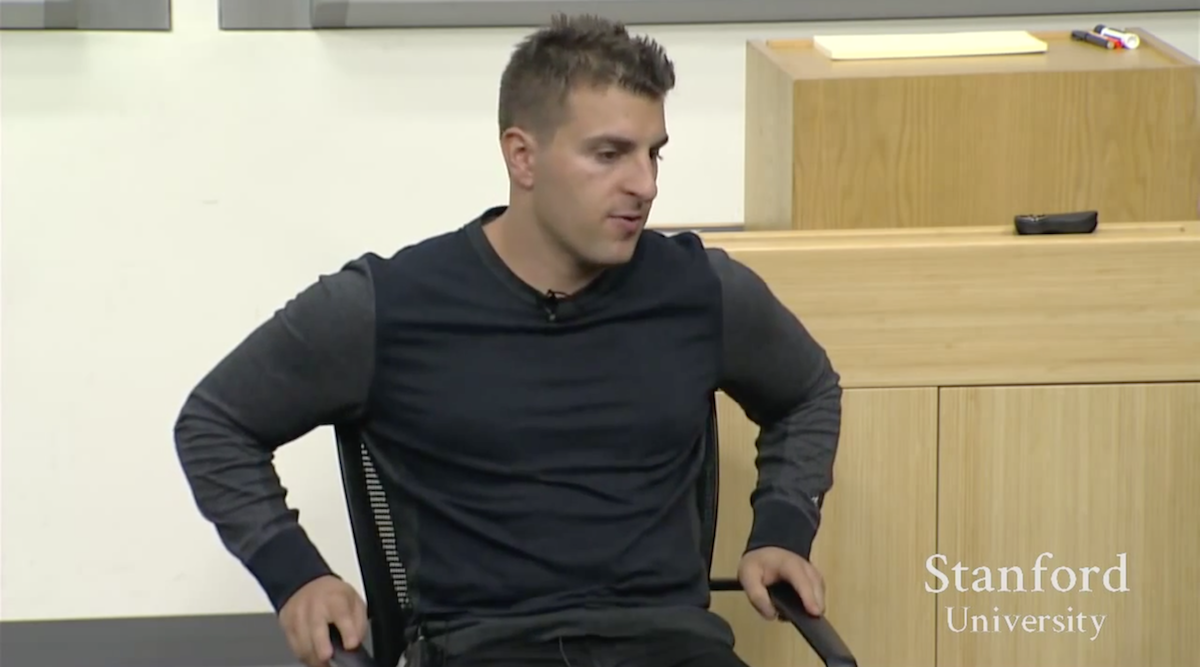
Stanford course CS183B: How to start a startup . Started in 2012 under the leadership of Peter Thiel. In the fall of 2014, a new series of lectures by leading entrepreneurs and experts of Y Combinator took place:
Second part of the course
First part of the course
- Sam Altman and Dustin Moskowitz: How and why to create a startup?
- Sam Altman: How to build a startup team and culture?
- Paul Graham: An Illogical Startup ;
- Adora Chung: Product and honesty curve ;
- Adora Chyung: Rapid startup growth ;
- Peter Thiel: Competition is the lot of the losers ;
- Peter Thiel: How to build a monopoly?
- Alex Schulz: Introduction to growth hacking [ 1 , 2 , 3 ];
- Kevin Hale: Subtleties in working with user experience [ 1 , 2 ];
- Stanley Tang and Walker Williams: Start Small ;
- Justin Kahn: How to work with specialized media?
- Andressen, Conway and Conrad: What the investor needs ;
- Andressen, Conway and Conrad: Seed Investment ;
- Andressen, Conway and Conrad: How to work with an investor ;
- Brian Chesky and Alfred Lin: What is the secret of company culture?
- Ben Silberman and the Collison Brothers: Nontrivial Aspects of Teamwork [ 1 , 2 ];
- Aaron Levy: B2B Product Development ;
- Reed Hoffman: About Leadership and Leaders ;
- Reed Hoffman: On Leaders and Their Qualities ;
- Keith Rabois: Project Management ;
- Keith Rabois: Startup Development ;
- Ben Horowitz: Dismissals, promotions and transfers ;
- Ben Horowitz: Career Tips, Westing and Options ;
- Emmett Shire: How to conduct interviews with users;
- Emmett Shire: How Twitch talks to users ;
- Hossein Rahman: How hardware products are designed at Jawbone;
- Hossein Rahman: The Design Process at Jawbone.
Alfred Lin : I will start with a few slides and comments, but the most important thing on our stage will be Brian when he comes out here and talks about how he created the AirBnB culture.
So, here you have watched several presentations and learned how to create a startup. You have assembled a team, you know what your product should look like, it is in demand, and your company is growing. People love your project, you know how to get their attention. You figured out how to create a single and unique company, and you have no competitors in the market, and this is already worth something. And the market you want to enter is still a little more than the paper airplane market, so everything is fine with you. Now what?

We are here to prove that culture, in fact, is a very important component in the development of a company, as important as a team. I hope that after our conversation you will learn what culture is. Why is she important? How to form core values? You will also learn about the components that form the core values and culture that form a good, effective team, and gain some practical skills in this area.
What is culture? Does anyone want to define culture? What did you say? Simple values in a team? Nice try. Did you give this definition because you have a computer at your fingertips and Internet access? You can find a couple of definitions in Webster's dictionary, but you and I are at Stanford. This is a kind of trick question. There are never simple questions in the computer science office.

When asking this question, I had in mind: “What should corporate culture look like?” We can use the word culture in different contexts: when we talk about society, about groups, places or other things. Here we will talk about corporate culture.
Can anyone define corporate culture? We can take the previous definition and change it a little. Here's a tip on how to define a corporate culture: “_____ and _____ of each team member, aimed at achieving _____ company”.

People entered completely different things in the passes. The first pass included: assumptions, opinions, values and, my favorite point, core values. In the place of the second pass, they often enter behavior and, my favorite word, actions, how will you act? For what? The third pass seeks to answer this question. For the sake of achieving goals - somehow weak enough to pursue large and complex goals - it is already a little better, but the best definition is the achievement of the company's mission.

Now we know the definition. So what do we do with it and why is it important? Here is a quote from Gandhi: "Your beliefs become your thoughts, your thoughts become your words, your words become your actions, your actions become habits, habits become values, and your values become your destiny." If your company does not have a culture, then you cannot follow the path of your destination.

Culture is important because it lays down the basic principles that you will be guided by when making decisions. Culture is a way to instill in people values, important companies, and provide some level of stability that you can rely on.
Culture also establishes a level of trust, and people begin to trust each other, but it can also show us what needs to be done and, more importantly, what is not worth doing. This approach will help you keep the “right” employees. There are people who do not fit into your company, but if you have a good and strong culture, strong core values, then you can understand who wants to stay in the company and who does not. Once you know who is who, it will help you move forward faster.

You think I'm telling you some muddy things, but here's something else, this time more scientific. Here are the stock indices from 1994 to 2013 - these are the S & P500, Russell 3000, and Fortune 100 indices. The creators of the Fortune 100 index included all the companies with which, in their opinion, it is best to work with them.
The growth rate of investments in companies from this list amounted to 11.8%, which is two times more than the other two indices. We can conclude that the real strength of the company is ensured by a good attitude to employees, trust in the team - that is, by building a strong corporate culture.

How do you build values and build a company culture? I am often asked about this.
You need to start with the leader of the company and its founder, that is, ask yourself what qualities are most important to you? Which ones relate to business? Who are the people you would like to work with? What do they value?
Answering these questions, you highlight the necessary set of values. Think about what kind of people you would not like to work with. What are their values? Think about them opposite, maybe they will suit your company. Finally, remember that your values must follow the mission of the company, and if they do not follow it, then you are missing something, in the end, they must be trustworthy and uniquely connected with your mission.
For example, in order to unambiguously follow our mission, we at Zappos focused on creating a culture “committed” to excellent customer service. The first value was providing excellent service. Our culture was built very specifically, in the first place we wanted to serve customers perfectly, leaving an amazing impression about us.
We [at the company] had a short text explaining what we are raising under this. We wanted to support people, to pleasantly surprise them, to help our employees, our customers, our trading partners and investors. But at the same time, as if in contrast to what was said, we did not want to work with arrogant people, so modesty became one of our core values. Here are two examples of how we created reliable core values that uniquely follow our mission.

Upon reflection, you will isolate your basic values, there may be several, be it honesty, reliability, high quality service or teamwork. It can be a whole list, which can start with three points and grow to ten, or even thirty.
When Zappos went through this, we asked all employees to highlight a few core values, and they wrote out thirty-seven pieces. We reduced their number to ten. To do this, it took us a long time, about a year. You may ask why? Well, if you entered the word “honesty” on the list, I immediately believed you! Everyone wants culture to be honest, nobody wants to be lied to every day.
Service, what do you mean by “service”? This word has much more hidden meaning than it seems. Everyone is constantly talking about teamwork, but this is not the kind of teamwork that we see at university competitions or baseball. How to understand what is teamwork? What will not be useful for the team?
Many of these things are connected with communication and mutual understanding, with the study of people by something, and here you can dwell in more detail. Zappos has always had a lot of smart people. And when they argued with each other about who is right and who is not, it was a waste of time. We wanted people to help and advise each other to make any idea better. It was about the company getting an improved idea, and not about one of the employees proving that he was right. We wanted to promote the idea that the company always comes first, the department second, the team third, and only then you yourself. How to achieve this?

Let's delve into the question. There is another element of highly effective teams that I really love. This element is a pyramid created by Patrick Lensioni, who wrote an interesting book, The Five Vices of the Team.
In it, the author talks about the reasons for the disagreements in the teams. Many teams break up due to a lack of trust, and even if there is one, then why is it needed? If there is trust, then debate and discussion can arise, during which truth is born. If there is no argument, it turns out that the blind leads the blind. How can you know for sure that you made the right decision if you did not discuss it? In fact, people don’t want to make a commitment, they’re afraid of doing it.
Let's assume that you have moved to another level: you are able to get down to business. What could go wrong? As a rule, problems arise because people are not responsible for the actions they perform. If people are not responsible for what they have done, then they will not achieve results. If you think of the company as a black box, at the output of which there is either financial profit, or an excellent product, or something else as a result of the company's work, then at the entrance to the black box one of the most important parameters will be the company's culture. We will discuss some other practices in a series of questions and answers, which is likely to result in a conversation that you need to combine the company's mission and its values, which I have already mentioned.

In the course of work, you need to seriously think about the values that you initially selected. Many companies do not do one thing: when hiring, they interview the applicant on the subject of technical skills, but do not check on their compliance with the culture of the company, do not evaluate whether he will believe in the ideas of the company and follow its mission.
I think that this is an absolutely wrong approach. I believe that you may have the most intelligent engineer in the world, but if he does not believe in a mission, he will not put his heart and soul into his work. Hiring staff is one of those things during which it is very important to think about your corporate culture: if you make this thoughtful approach a part of your daily routine, then you will go far in creating a value base for your company.

Concluding the conversation, I will say that corporate culture is like customer service and fitness, like motherhood and apple pie. Everyone wants to provide excellent customer service, and each company wants to create a good corporate culture. What they forget is to make it their daily habit. You cannot become slim unless you exercise regularly. Suddenly you lose shape, become fat, and then say, “Oh, I need to go on a tough diet to get in shape.” This will not work, and this applies not only to fitness, but also to culture. Well, I think we went through all the points, and we can move on to questions and answers with Brian.

Brian Chesky:Hello everybody. How quiet here. [Audience laughter]. To be honest, now I feel freer. There is nothing worse when you are in a quiet room with a bunch of people, and they all look at you, but now I have calmed down.
Alfred Lin: Well, I talked about 5-10 minutes, you can spend a little more time. So, Brian, can you talk about how you came to understand that culture is very important in building a company and AirBnB in particular?
Brian Chesky: Yes, but I will not tell the whole story of the formation of AirBnB, but try to tell in brief. Some of you may know her. Here's an abridged version of the story: AirBnB was not conceived as a company and startup. I quit my job and lived in Los Angeles.
I once moved to San Francisco, where I began to live with my friend at the Rhode Island School of Design, Joe Gebbia. I had a thousand dollars in my bank account, and I had to pay a thousand and a hundred and fifty dollars for rent. That weekend, an international congress of designers was held in San Francisco. All hotels were reserved, so we decided to turn our house into a bed and breakfast during the conference.
I didn’t have a bed, but Joe had three air mattresses, which we took out of the closet and called our hotel “The Air Bed and Breakfast”. So the company was born.
I recalled this story ten thousand times, and did not think that I would have to tell it to someone. I remember how I grew up, how I went to college, my parents were social workers and never thought that I would go to art school. They were worried that I would not get a job after college, although I am sure that all parents are concerned about this issue.
Mom asked me to promise her that I would find work with health insurance, and I ultimately created AirBnB. I remember how she told me: "I guessed that you would never find a job with health insurance."
The reason I'm telling you this is because AirBnB was never a great idea. It was a way to pay rent, so we could think about something more significant. But it so happened that we turned the solution to this problem into something significant.
Today we will not touch on how we created our product, this is a topic for another conversation, today we will talk about how you need to build a team and an excellent company. In the early days, there were only three founders: Joe, Nate, and I. I think one of the reasons for our success was my amazing luck.
I don’t think that I was lucky to come up with the idea of AirBnB, and I don’t think that we were lucky to create a successful team, I’m sure that we could try many other ideas and succeed. I think I was lucky because I found two wonderful people with whom I would like to start a startup, and with whom I sympathized. They were just frighteningly smart.
I think this is one of the first tasks - to build a team of talented people so that you are a little uncomfortable with them - it gives confidence that you will break through together.

In 2008, we started working together, and we were like one family. You consider the co-founders as your family, and the company as a child. And the behavior of the child will depend on what kind of relationship has been established between parents. If the parents are able-bodied, but do not work as a team, then the child, frankly, will be the same blockchain. You do not need it.
You want the culture of the company to be top notch. Therefore, Joe, Nate and I were a real family at the start, we usually worked 18 hours a day, seven days a week . When we were part of Y Combinator, we worked together, ate together and even went to the gym together. We were like special forces on a mission.
We perfectly shared responsibilities and performed them with great responsibility, which served as the foundation of the company. And then we thought: at a certain moment you transfer the product to the second stage, which consists in building a company, which in turn will already produce the product.
Most of the talk begins on how to produce a product, how to find a niche in the market. As soon as it comes to such conversations, people need to create a company. It doesn’t matter how great and original your product is, if you don’t create a company, it won’t survive in the market. We thought about it and realized that we wanted to do this for a long time and build a business.
We wanted to create a competitive company, and to do this, we began to look closely at other businesses with which we had something in common. All the companies around that existed for a long time had a completely understandable mission. They had a clear understanding of their values, and when creating something unique, characteristic only for themselves, they acted in much the same way.
And so, three people: Joe, Nate and I decide to pay attention to these businesses. I noticed Apple. The main value for Steve Jobs was the belief that people deeply convinced of something were able to change the world. He said: "Our products are changing, but our values are never." We studied Amazon, we studied Nike, we learned about their origins. In this vein, we can talk about nations. If a nation has values, and people of this nation have rights, then such a people will last a long time.
We began to understand that we need a goal, we need to create a company culture. And so we met with Alfred. We received funding from Sequoia, and Alfred just joined them with Zappos, and I heard that Zappos has an incredible culture. To find out more about her, we met with Tony in Las Vegas.
Alfred Lin:Well, what did you find out?
Brian Chesky: Well you guys are just flying away. We learned that if corporate culture is the path to success, then this is a whole art, even two different types of art.
One of them is orders , and they can change, maybe in 50 years. Rituals and orders change and differ, but there are things that never change.
The second - principles , ideas that last for a long time and make you you. And I, thinking about the basic values: integrity, honesty; I realized that they are not basic. These are qualities that everyone should possess.
In addition to them, there should be others: three, five, six pieces that are unique to you personally. Think of such things in your own life.How do you differ from all other people?
With what three words can you describe yourself so that other people understand what kind of person you are? At Zappos, when they already had a hundred employees, they realized this and brought out ten core values. I learned this from Tony, and I did not want to wait until we hire 100 people, I wanted to realize the idea and write out the core values as soon as possible. I spoke with Sam, and he believes that we are the only company in which we determined core values before hiring someone.

Alfred Lin: How long did it take you to hire the first employee?
Brian Chesky: Well, our engineer was our first employee, we searched for him for about 4-5 months. I looked at the profiles of thousands of people and personally conducted an interview with at least a hundred.
Alfred Lin: How much time has passed between when you painted your values and when you hired your first employee? One day, two, three?
Brian Chesky: I think we started working on this at the time in Y Combinator, around January 2009. It was a process that took 6-7 months to unfold. We finished Y Combinator in April 2009, and hired our first engineer in July. Probably 6 months have passed. Some people asked why we spent so much time hiring the first employee.
I think that attracting your first engineer is akin to having a DNA chip in the company. If we are a successful company, this person will be a model for thousands of future employees. It was not a matter of attracting someone who would add the following three functions to the product, we needed a starting point for users. The first engineer was chosen with an eye to the future and for a long time.
Do I want to work with a thousand people like him? In the company you need a variety of views, you need different people of different ages. But you do not need a variety of values, beliefs must be uniform. This is the only thing that should not be different for all your employees.
Alfred Lin: So what were those values?
Brian Chesky: There were six of them. I will talk about three of them.
The first core value we'll talk about is fighting for an idea.
This means that we want to hire people who came to the company because of an idea. We do not need people who believe that our company is prestigious, who like the design of our office or need work, to those who simply consider our company cool. We need people who come here for one thing that will not change - our mission. Many people describe AirBnB as a way to book a room or home and travel around the world. And this is what we do, but the reason why we do it is different. To answer this question, I will tell you a story, I think it will give you an idea of our mission.
In 2012, I met a landlord named Sebastian, we are looking for such people around the world where demand is growing. Sebastian lives in the north of London, he is about fifty. He looked at me and said: "Brian, there is one word that you do not use on your site." I asked him what the word was, to which he replied: "This is the word friendship, I would be glad to read the story of friendship."
“Well, tell me a story about friendship,” I say. Which he did: “Six months ago, violent riots started right in front of my house, and I was very scared. The next day, my mother called me to find out how I was doing. I said that everything was fine with me. Then she asked about the house, and I said that he was also okay. ”
Here he continued: “And here is an interesting thing, from the moment the riots broke out in front of the house, until the moment my mother called me, 24 hours passed. During this time, seven previous AirBnB tenants called me and asked if everything was okay with me. Just think, seven of my guests called me before my mother. ”
I think this speaks more about his mother than about guests, but every day of this summer four hundred twenty five thousand people who lived in each other’s houses and came to each other from one hundred ninety different countries of the whole world, except North Korea, used our service , Iran, Syria and Cuba. Having heard this story, I realized what value we have. It is much more than just booking a room or traveling. Our service helps unite the world. We do this by giving you a sense of comfort wherever you go.
Our mission is to feel at ease everywhere. I don’t know if we will continue our business in five or twenty years, but I can guarantee that we will always pursue the goal of uniting people. This is our main idea.
Therefore, when you hire people to work, the first thing you need to make sure is that the person supports your ideas and will fight for your mission. You defend your mission, living life according to its rules. Do you believe that? Do you have stories related to this? Do you use [our] product? Do you believe in him?
I asked crazy questions in an interview; Sam reminded me of one of those questions. I interviewed the first three hundred AirBnB employees, and people thought I was neurotic, although they may be right. I asked them a question: “If you had only one year to live, would you take up this work?” I tweaked it a little, because people who said yes probably don't like their families. Therefore, I replaced “year” with “ten years”.
I believe that no matter how much you have to live, you should use this time. All that you want to do over the past 10 years, you must do. I really want you to think about it, because this time is enough to do what you dreamed about, and this does not have to be work in our company. I agree if you tell me that you want to travel or create your own company - well, go and do it, don’t come to us. Go and do it.

There is an old parable about two men who lay a brick wall. Someone came to the first man and asked what he was doing. To which he replied: "I am building a wall." When a newcomer asked the other worker the same question, he answered: "I am building a cathedral." There is work, but there is a calling. We want to hire people who are not just looking for work, but a vocation. Therefore, to uphold the company's mission is our core value.
I do not want to take a lot of time, but I will tell you something else.
Our second value is to be humble, and on this occasion I will tell you another story.
The stories about the foundation of your company ultimately become what thousands of people tell and generate your values. But back to AirBnB, as I recall, Marc Andreessen mentioned in his last speech that this was the worst idea that has ever worked.
I remember people who thought we were crazy, I remember telling people about our idea. I spoke with Paul Graham and told him about AirBnB. He asked if this was really in demand? I said yes. What was followed by the question: "What is wrong with these people?"
I understood that the interview was not going well, and I knew that Paul Graham would not accept us. And we told a story about how we founded the company and how it is moving now. We were introduced to Michael Seibel, a partner of Y Combinator, who introduced me and Joe to fifteen investors in the Valley, including those who were already here, and everyone said no. They could buy a 10% stake in the company for $ 150,000, but everyone said no, considering the idea crazy, they believed that no one would ever stay in someone else's house.
In the end, it all ended with the fact that we financed the company with credit cards. You know, children collect baseball cards. Special holders are sold for these cards. We needed to store credit cards somewhere and had to put them in these things. That's how many credit cards we had, and we were head over heels in debt. In the fall of 2008, we provided housing for arrivals at the National Assembly of Democrats and Republicans. We had this crazy idea, because we could not sell many orders.
A year after the launch, a hundred people visited our page every day, and there were only two orders - very bad. It's like releasing a song that only three people will listen to every day in a year. It will probably not be a very popular song. But I believed in our project. Joe and Nate also believed.
And now we are head over heels in debt, and this idea with a meeting comes to our mind. At The Air Bed and Breakfast, we provide housing for the National Assembly of Democrats and Republicans. What happens if we feed them simple cereal for breakfast? And we came up with themed Obama flakes. And they called them Obama O's, Breakfast of Changes . And then they introduced cereal for the Republicans with John McCain. We learned that he was a navy captain, so the flakes were called " Captain-McCain's, independence in every spoon ."
We had no money, and pennilessly we tried to call General Mills, they told us that we would not achieve anything, asked to stop calling them and threatened that they would turn to the court otherwise. Through the graduates of the Rhode Island School of Design, we found local vendors who made a deal with us and produced a thousand cereal boxes for us. We agreed and sent them a sketch for printing. Quite unexpectedly, during the week these flakes hit the news on national television. We made $ 40,000 selling breakfast cereals.

In 2008, our site brought us $ 5,000 dollars, and we made $ 40,000 selling breakfast cereals. I remember how my mother asked if we had become a cereal company. There was nothing wrong with making money from selling cereal boxes, the bad part was that the answer to my mother’s question was yes.
But the reason I am telling all this is that our second main value is: “to be a cereal entrepreneur”, excuse me for a crappy quibble. We truly believe and believe that limitations give vent to creativity. When you “raise” eight million dollars, it means that you were moving towards this slowly and gradually, and this moment is easy to miss.
It's easier for people to say: “I need this contract for $ 50,000.” I need this, I need that. When people are desperate and indiscreet, don’t try to solve the problem creatively or tell me that they cannot do something, I just take a box of cereal and say that even Obama-O's recommends being consistent and modest.
Again, I repeat that much in the company is based on values and principles. Everyone knows that if you don’t care what the company cares, you should not work in it. And this does not mean that if you care about it, then you should be here. You must be creative, be an entrepreneur and be able to fight for your cause. And these are the values that we have experienced personally.
Alfred Lin: So, gentlemen, now you should think about what you want to ask, but I also have a couple of questions. It all sounds great, the stories are beautiful. But the people who gathered here are very skeptical about everything, this is the department of computer engineering, the left hemisphere is more actively working for these people. How does a strong company culture help you make important, complex decisions?
Brian Chesky:In light of this question, something else to be said about culture. There are three things that no one talks about.
First, no one ever talks about culture. No one talks about her, and no one says that she should be strong. There are many articles about creating a great product, there are tons of articles about growing and accepting your product by your audience, and only a few about culture. It’s just mysticism: it’s not clear why this is happening. This is the first problem.
The second problem is the complexity of the measurement. What is difficult to measure is often overlooked and ignored.
In addition, there is a third, most significant problem: culture does not pay off in a short time.. If you want to establish a company and sell it in a year, don’t think about culture. Just hire people fast. Culture makes you slowly select employees, carefully weigh your decisions, which slows down progress.

First of all, you need to clearly understand for yourself what is so special about you and what views you hold. Once you have determined this, you hire people with the same views. You need to be sure that you hire and fire people based on values.
We constantly repeat this: during the interview you need to make sure that the person is simply a world-class specialist and corresponds to the culture. After the interview, I asked people: if you could hire any person in the world, would you hire the one sitting opposite you? If our vision is the best in the world, why don't we hire the best in the world? Everyone should hire a person who is better than all the previous ones.
You must constantly raise the bar.Then, when it comes to discussing values, you should divide people into interviewers who are not related to the area of knowledge of the applicant. For example, if you are an engineer, then the core values interviewer will not be an engineer to avoid bias and judgment about your knowledge. And the interviewer will ask questions only on the topic of values, to make sure that the same thing is important for a person. We said no to a large number of wonderful specialists, because we were sure that they would take root with us over time. This is one of the reasons.

Here are a few more examples of situations in which we had to make difficult decisions. In mid-2011, we worked mainly in the United States, and we got an Internet clone created by Samwer brothers, has anyone heard of them? They literally cloned Internet companies. Not so long ago, these stories were publicized.
They took American websites and copied them, and then quickly tried to sell them to their owners, as if holding a gun to their temple. They did this with Groupon, which was the fastest growing website in the world, but stopped working on it and switched to us at the moment when the company had 40 employees and we reached the bar of seven million dollars. They copied us and hired four hundred people in 30 days, after which they wanted to sell the company, and if they could not, they were going to destroy us.
The problem with AirBnB was that the site did not work around the world, and since it is not possible to work in Europe, the functionality is not complete, like a phone without e-mail. So we had a problem. We discussed the situation and came to two decisions: pragmatic when we simply agree to a purchase, and a decision that agrees with our moral values. The pragmatic decision was simple - just agree to not risk global status and create an international company. But we decided not to make a deal with them.
The reason we didn't buy the company was because I didn’t like their culture. I did not want to include those four hundred people into the company. They would look like mercenaries among missionaries. I felt that they didn’t go to work for the idea, and I thought that they just want to quickly earn a lot of money.
I believed in war, I believed that missionaries would endure and survive mercenaries. I also felt that the best way to take revenge on an Internet clone is to get them to work for as long as possible. You have a child, now you need to raise him. And we settled on this decision, although very controversial. Many believed that nothing would come of it, and told me that I should buy a company.
Alfred Lin: What percentage of revenue comes from Europe?
Brian Chesky: Over 50%.
Alfred Lin:I suppose that worked. Ok, does anyone want to ask a question? Otherwise, I can continue. No one? At Zappos, we had a statement that culture and brand are two sides of the same coin. AirBnB has a great culture and brand. Do you want to talk about the brand, about a kind of weakness that we are not inclined to pay special attention to?
Brian Chesky:I actually just talked about it to Sam. I think that Silicon Valley is historically [in this regard] not very strong, we are not talking much about culture and brand. These are two sides of the same coin. Culture is the principles and beliefs that constantly reign within the company, no matter what happens in it, in the long run, it will become known about it, you cannot prevent it. A brand is what everyone associates your company with. I believe that having a clear mission and making sure that all levels of the company follow it is the best thing that can be done for culture and values.
The second thing - a brand - is what other people think about your company, and this most often depends on your followers, that is, employees. We often think that companies that hire employees with a strong desire to work are popular with customers. These are companies with a strong brand and a weak culture.
Zappos has a very strong brand. Many companies, such as Google, invest a lot in culture, they often ask if this person is suitable for Google? Is he able to absorb digital culture? Google does not just have a strong culture - it is unique. There is no such thing as a bad culture or a good one; there is a weak or strong culture. A good culture for you can be bad for someone else.
I think the brand is also very important. The brand connects you with your customers and if you have a very strong culture, then the brand will pass through it. The last thing that can be said about the brand: a lot of people, when they talk about their brand, talk about what they sell. If you are Apple, then here is your option: “We sell computers and new smartphones that are bigger and faster and have such and such specifications.”

I remember Steve Jobs's very important speech in 1997, where he says that the path to victory is not chatter about bits and bytes. The path to victory is to say that we value what our true values are, what we believe in: passionate people can change the world.
So they presented the Think Different campaign, so Apple became a company with high values, even before their incredible ascension. They launched the Think Different campaign, during which they talked about what they believe in. And if you buy a computer from Apple, then you also say: "I believe in it." And the conviction must be deep, if this does not happen, then your product is just raw materials that cost nothing.
Alfred Lin: The question is, how do you convey company culture and values to the outside world?
Brian Chesky:Do you want to know how we conveyed to people the mission of AirBnB in the early stages of the company? We learned a lot at the start, because we positioned ourselves as a service. We said that AirBnB is a cheap and affordable alternative to hotels. Our motto was: “Forget hotels, save with AirBnB.”
And after some time, we felt that it was too restrained and cheapened the idea, and we changed it to “Travel as a person,” which we also did not save, but at that moment we seemed to say: “we live in a world where travel - a product of mass consumption. " Usually [on a trip] you feel cut off from the world, you feel like a stranger, and we wanted to bring back the old times when services came from people, when on a trip you felt at home, and you were treated like a person.
No matter how successful you are in life, travel often reminds you that you are not such a successful person. Passing control of transport safety, stops at ordinary hotels, problems that you sometimes have to face. We really wanted people to feel special. That's what we did at the very beginning - we told stories. I mean, we told the story of AirBnB ten thousand times, and in a way it was related to our culture. Somehow they asked me what is the work of the CEO? The CEO does a lot, but he basically formulates the vision of the company. Formulating a vision, you build a strategy and hire people who are culturally appropriate. If you do these three things, you have created a company that is likely to be successful.
And the company will be successful if you have the right vision, good strategy and the right people. And in the end, you will simply voice your vision again and again when applying for a job, communicating with investors, seeking financing, giving PR interviews and giving a lecture in the classroom. You always strengthen values. You do this even in the process of writing an email to a customer.
A very good question: how can we be sure that homeowners reinforce the AirBnB culture? The answer is: we are working in this direction, but so far not everything is perfect. When we first started AirBnB, I went through Craig Newmark's school of thought. Craig, the founder of Craigslist, said everyone should be able to use AirBnB. If you want to rent a house, you should have this opportunity.
It turned out that many people believe in our values, because we talked about them and believed in them. But there were people who used AirBnB, not because they believed in our values, but because they realized that they could make a lot of money by renting their homes. Not everyone fit perfectly into our culture. In fact, these people caused a lot of problems, and this was a lesson to me. At first, it was not obvious to me that homeowners should also be culturally appropriate. We met with them and attracted people like us.
We realized that the owners of the houses are our partners, and they must believe in the same thing that we believe in.
Now we have a program called Super Host, where they must demonstrate their values in order to reach a level that corresponds to priority customer support. We have very important meetings of the owners of the houses, where they meet together and communicate, thereby strengthening our values. In response to the question, I’ll say: we were late with this thought, but now we are strengthening our culture at every step.

Q: Brian, AirBnB has made a huge contribution to the open source community. Do you have any thoughts on what this brings to your culture and company values?
Brian Chesky:Yes, in general, this applies to AirBnB in two ways. We strive to ensure that our culture is sufficiently open, we believe in a common world where people share information, collaborate and make communities and individual business sectors stronger. My philosophy is to talk openly about everything, except for things related to personal information of clients. If your question does not concern confidential information, then we will talk about it.
In addition to developing an open source culture, we wanted to make sure that all the people working for us feel like one team, and we would not want to share all our source code with others - after all, every company wants to somehow protect itself from competitors. Unique technologies could provide such an opportunity to “protect oneself,” but we did not want to rely only on them.
We wanted to be distinguished from our competitors by the fact that we and our huge community provide the best customer experience in the world. We believed that this moment is more important than the technologies used by us, therefore, we considered it possible to share part of our technological developments with others. This moment is also connected with our values - I never asked anyone to do this. We just hired developers who share our values, and they decided that doing it right was right.
Question: What did you do when you did not have money, and you only received payment from users of the site? What have you done to increase the number of users? How did you get them to the site?
Brian Chesky:Well, the question is not related to culture, but I will answer it anyway. The best advice I heard was Paul Graham giving me. I remember how he said the following: “It’s better to have a hundred people who love you than a million people like you.”
Indeed, it is better to have a hundred people who love you. And the reason is this: if you have one million customers or users and they don’t care about you, they just use your application and think that you are doing fine, then making them participate in your destiny is a very difficult task. I don’t know how to make a million people take care of something overnight. But I know that if you have a hundred people who love you dearly, then each of them will go out and tell another hundred people. Everything that leads to the creation of a company or idea begins with hundreds of people.
Why is this so important? To explain this to us, Paul gave us another lesson: if all you need to do is make a hundred people fall in love with you, you need to perform tasks that cannot be scaled. If you have a million users, it’s very difficult to meet each of them. But you can meet and talk with a hundred people. That is what we did. Joe, Nate and I walked door-to-door in New York or Denver, where the nationwide congress of the Democratic Party was taking place, we literally lived with our users.
There is a joke, they say, if you buy an iPhone, Steve Jobs will not descend on you [literally: “If you buy an iPhone, Steve Jobs will not come to spend the night with you”]. But I will come. Staying with our users has proven to be very rewarding. All that had to be done was to make friends with them and share a passion for the idea we had invented.
Before ending this conversation, I will give one more example. Now with AirBnB you can click on the button and enter your home in the database, and a professional photographer will come to your home and take his photos for free. We have 5,000 photographers around the world, and they took photos of hundreds of thousands of homes. So this is probably one of the largest on-demand photography groups.
It all started when Joe and I stopped at the same hostess in New York. Her house was simply magnificent, but the photos of the house were just awful, and we asked why she would not upload a better photo? It was in 2008, before the advent of excellent cameras, and she could not figure out how to download photos from her phone to her computer. She was not a very tech savvy woman. And I suggested taking a photo for her. Actually, I asked: what will you say if, after you press the button, someone will ring your doorbell and take professional photos? She said that would be just magical.
The next day I knocked on her door, then took pictures of her at home. After that I sent several emails stating that we had a magic service for photographing houses, when a professional photographer comes to you at the touch of a button. And when people clicked on this button, I received a notification.
We rented a camera in Brooklyn, and in January, making our way through the snow, we walked and photographed people's homes. We did it manually, without the use of any technology. We managed all of this with spreadsheets. I did not ask Nate to design anything for the photographs. Then we began to hire photographers to work. It so happened that we hired an intern who managed all the photographers. Then we opened a full-time position for a manager who would manage the interns working with photographers. At some point (before we developed software solutions for this topic) we had too many people, it became difficult to manage them. We had hundreds of photographers. Then we created tools to work with them, but we did it after we realized what an ideal service of this kind should look like.

Question: Another question: with regard to AirBnB, many believe that this is not so much a technology company as a marketing one.
Brian Chesky: Good question, I will answer it with a story.
Alfred Lin: Let me rephrase the question in a series of questions. Do you have your own developments?
Brian Chesky: Yes
Alfred Lin: Do you have “technological protection” from competitors?
Brian Chesky: Yes
Alfred Lin: Does your business have a network effect?
Brian Chesky: Yes
Alfred Lin: Can you dictate your prices to the market?
Brian Chesky: Yes
Alfred Lin: Do you have a good brand?
Brian Chesky: Yes
Alfred Lin: Are you monopolists?
Brian Chesky: I will not answer this question.
Alfred Lin: Returning to the question, just forget about everything that I just said. People believe that companies with network effects that were able to enter the market are just lucky.
Brian Chesky: Let me answer this question. This is a completely fair question, and since people say that, I will answer it. The guy who owns Sequoia Capital is called Doug Leone. About a year and a half ago, he told me: "You have a lousy job." I asked what the hell, and what does he mean? He replied that I have the worst job for the CEO that he has in his portfolio. Then I asked him to explain.
Here's what he said: “First of all, you are a technology company.” To which I replied that it was. “You go through the same trials as other companies I deal with, but you work in 190 different countries. And you need to understand how to become an international company. You have to hire people in every country in the world. ”
And we are present in literally every country, with the exception of North Korea, Iran, Syria and Cuba. We are a financial company. We operate with billions of dollars in remittances per year, and we have a license to do business in California, and the constant risks of fraud. The site should be protected like Fort Knox. He replied: "As a rule, the problems of companies end there, but you have to worry about other things, about trust and security."
We have 425,000 clients sleeping in other people's beds on their personal sheets. Think of a woman from Texas who stopped in the Midwest, or vice versa. Think about cultural conflicts and misunderstandings that may arise. Every day 425,000 people use your service. It's like being the mayor of Auckland. Imagine you are the mayor of Auckland and remember what happens every day in Auckland. You must provide both trust and security.
Now we have problems with management. We work in thirty thousand different cities, and each city has its own rules, its own laws, many of which were written centuries ago. They were written before any technology appeared. They need to be sought and recognized.
The Google search engine is pretty good at what it does, but it can give me results, of which only one or two are correct. We have forty thousand houses in Paris - you will not find anything better for yourself there than we have. Therefore, we must be the best at bringing people and technology together. Another example, Facebook is a digital product. Their product is a website.
Our product is the experience you get in the real world. We are not just an online product, but not only an offline business. In short, the bottom line is that we must have world-class technology, world-class design, and our brand must also be world-class.
We must convince the government that we are worthy neighbors, we must convince people that we are not crazy, but we have to do it, and we must make sure that the trust and security of our business is at the highest level. We manage all payments and work with risks. And I didn’t even mention culture. This is not culturally related, but I do not see AirBnB as a marketing company.
Alfred Lin: Thanks
Brian Chesky: Thank you.
[ Translation of the next startup school lecture ]