February 21, 2015 at 11:41
Who gave the world video game cartridges
Game cartridges appeared during the first generation of consoles . Devices for the Magnavox Odyssey were a set of jumpers that included an in-memory game, and the first cartridge, which carried an arbitrary game program, was used in the 1976 prefix of Fairchild Channel F. Jerry Lawson, the inventor of this medium, in the seventies began an era that lasted until 2003 - End of support for Nintendo 64 .

Fairchild Semiconductor was one of the key companies in Silicon Valley in the 1960s: it was its developers who created the world's first integrated circuit suitable for mass production. Six months after its founding, the company began to make a profit: the first was a deal with IBM to sell hundreds of transistors for one hundred and fifty dollars each.
In the 1970s, Robert Noyce, one of the company's employees, developed the eight-bit Fairchild F8 processor. Based on this processor, the Fairchild Channel F game console was built, which went on sale in 1976 at a price of $ 169.95. There were two games built in the console - Pong and Hockey. Later, in order to compete with Atari's VCS (they also started using cartridges in it, having seen the effectiveness of such an approach using the example of Fairchild), the company released Channel F System II. Atari chose the name to take it away from the Fairchild console, originally named VES. The commercial success, comparable with Atari, Nintendo and Sega, the console did not receive. In total, twenty-six cartridges were released for the first version, sometimes with several games, and for the second - six more.
The cartridge as a game program medium was developed by Jerry Lawson, an engineer at Fairchild Semiconductors. His love for science was instilled in him by his father, who worked at the docks, but constantly read. One of Jerry’s first gifts was irish mail, a mixture of a trolley and an ATV. A little later, Jerry already had his own radio station in the room, then he sold several home-made radios. As a teenager, he was repairing electronics throughout the city. Prior to Fairchild, he worked at Grumman Electric, Faircraft, and Kaiser Electronics, while at Fairchild, he received a team job to create a set-top box from the company's vice president.

Minute gameplay. Tanchiki - in the fifth minute
A drop of advertising.
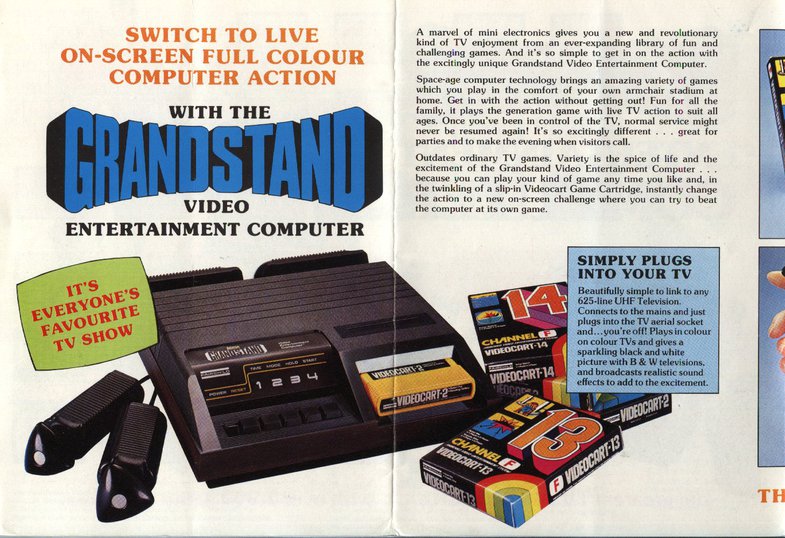
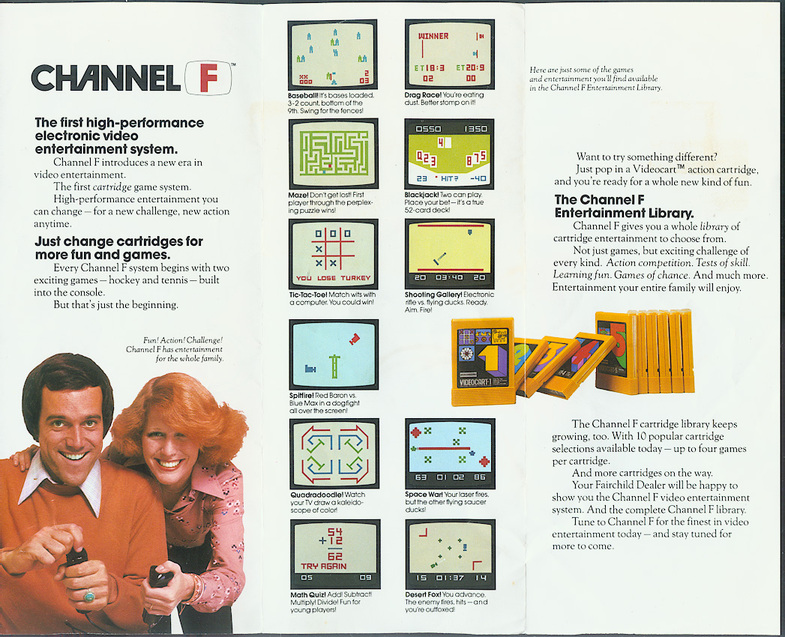
By the way, Lawson also made a prototype game controller for Fairchild Channel F.

Fairchild Semiconductor was one of the key companies in Silicon Valley in the 1960s: it was its developers who created the world's first integrated circuit suitable for mass production. Six months after its founding, the company began to make a profit: the first was a deal with IBM to sell hundreds of transistors for one hundred and fifty dollars each.
In the 1970s, Robert Noyce, one of the company's employees, developed the eight-bit Fairchild F8 processor. Based on this processor, the Fairchild Channel F game console was built, which went on sale in 1976 at a price of $ 169.95. There were two games built in the console - Pong and Hockey. Later, in order to compete with Atari's VCS (they also started using cartridges in it, having seen the effectiveness of such an approach using the example of Fairchild), the company released Channel F System II. Atari chose the name to take it away from the Fairchild console, originally named VES. The commercial success, comparable with Atari, Nintendo and Sega, the console did not receive. In total, twenty-six cartridges were released for the first version, sometimes with several games, and for the second - six more.
The cartridge as a game program medium was developed by Jerry Lawson, an engineer at Fairchild Semiconductors. His love for science was instilled in him by his father, who worked at the docks, but constantly read. One of Jerry’s first gifts was irish mail, a mixture of a trolley and an ATV. A little later, Jerry already had his own radio station in the room, then he sold several home-made radios. As a teenager, he was repairing electronics throughout the city. Prior to Fairchild, he worked at Grumman Electric, Faircraft, and Kaiser Electronics, while at Fairchild, he received a team job to create a set-top box from the company's vice president.
Minute gameplay. Tanchiki - in the fifth minute
A drop of advertising.
By the way, Lawson also made a prototype game controller for Fairchild Channel F.