August 31, 2017 at 21:16
Soviet HI-FI and its creators: Estonian children of perestroika - laser players in the USSR
The Soviet sound cycle would not be complete without a story about almost mythical devices, Soviet CD players, as well as the discs that were produced for them. At the beginning of the narrative, it should be recalled that the USSR was a unique country in which a total shortage of consumer goods could coexist with unique technical developments.
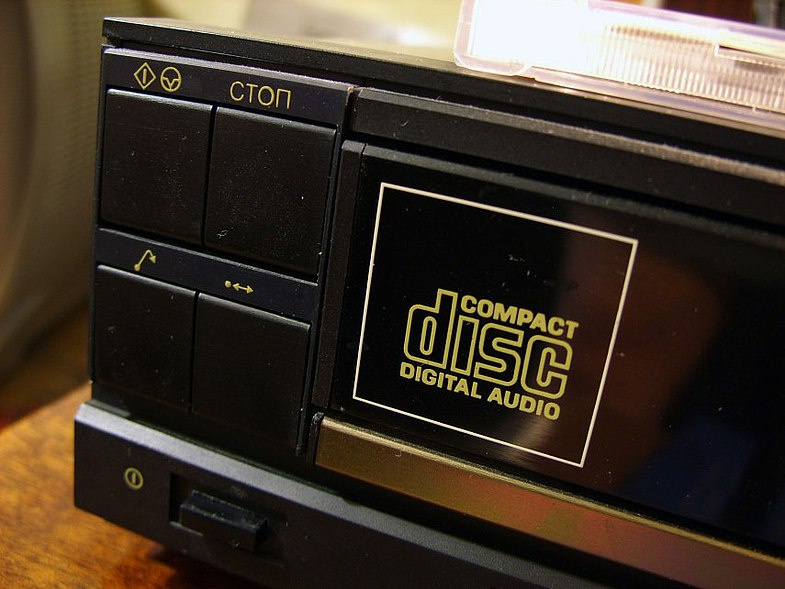
So, the first laser players in the Union appeared before CDs officially began to be published. At the same time, the population stood in lines for cassettes and vinyl plastics, which they got with great difficulty, as well as high-quality equipment for reproducing them. Apart from vinyls with speeches of the Soviet leaders and the Soviet stage, which were present in relative abundance on the shelves of music stores.
Moreover, such a format as CD has existed in the world since 1979, and players and discs managed to degenerate from luxury goods to relatively affordable equipment for the middle class. In the USSR, on the contrary, throughout all these years the broad masses simply did not know about the existence of such a format. Units of those who had the opportunity to buy a CD player outside the boundless Motherland, as a rule, did not use this chance. At times, tape recorders and LP players were often bought. For disks in the USSR were not even for sale by “farmers”, and if they did appear, they cost crazy money. The situation changed in 1987.
Ironically, the development of the first laser player in the USSR began in the city, which provided the country with audio cassettes. It was the Tallinn Music Cassette Plant that collaborated with BASF and was the leader in Soviet cassette production. But this is not about him now.
The initiative to create the Soviet CD-player belonged to the Orbit organization, unique for the late USSR. Smart people from this marketing department, whose names history has not kept in the sources accessible to me, in 1985 insisted that the Ministry of Communications Industry attend to the release of something so necessary for Soviet people.
It is important that in the 80s the technological lag of Soviet enterprises from Western ones (especially in the consumer market) was so strong that the population had a reasonable question about the effectiveness of the Soviet economic system. Perestroika and glasnost, which fell on the heads of Soviet people with the advent of Gorbachev, increased the degree of public discontent.
At that time, it seemed to many that the appearance on the shelves of new high-tech products and their availability in the distribution network could significantly weaken the protest mood. Not the last role in this attempt to prove to Soviet people that the collapsing Union "is still capable of catching and surpassing ..." was assigned to sound-reproducing equipment.
As far as one can judge from the scattered recollections of the employees of the Tallinn Punane RET plant, there were no organizational problems and issues with the need for development at that time. It was no longer the 70s, when Likhnitsky and Co. had to convince the stagnant Brezhnev authorities that the country needed Brigs and Corvettes. Interestingly, as in the case of the legendary amplifiers, the first CD player was developed at the enterprise, whose main profile was orders for the military-industrial complex. Direct project management was entrusted to 30-year-old engineer Vladimir Makarchuk.
As in the case of other techniques of high fidelity of reproduction, the existing Western models were taken as a basis. They turned out to be popular in Germany and France CD players Philips . Based on several Philips models (mainly Philips-100), the player’s layout was created. A characteristic feature of these samples was the lid, which opened upwards, like many tape recorders of that time. At the same time, they borrowed the design concept from the Japanese company SHARP. This kind of plagiarism was characteristic of all audio equipment produced under the trademark “Estonia”.
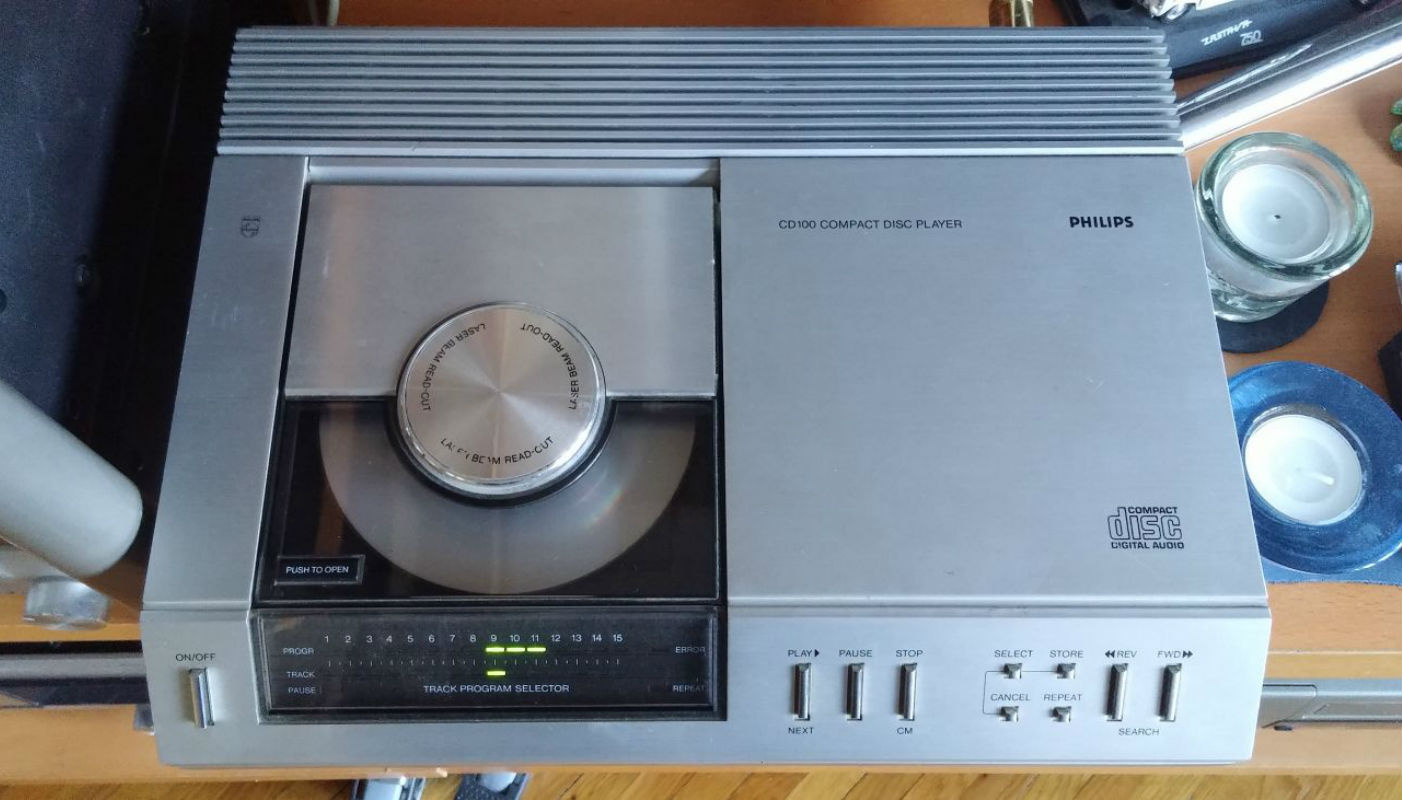
Philips-100
It cannot be said that the prototypes were completely copied, but many technical solutions were borrowed, since there was simply no experience in creating such a technique. By the end of 1986, it became clear that in the short term it was impossible and irrational to create your own drive for CD and DAC. Such independent development and even copying of existing ones implied the allocation of an incredible amount of resources, both human and material, and temporary. At the same time, the order of the "party and government" (tm) for the Soviet laser player was to be implemented for the mechanical engineering exhibition dedicated to the 70th anniversary of the Great October Revolution.
As a result of research conducted by Tallinn specialists, Philips CDM-2 was chosen as the basic drive for the Soviet device, Philips 2X TDA 1540P became the DAC. Circuitry in many respects repeated Western analogues, however, it was adapted for the use of Soviet components.
The employees of the design bureau of the Punane RET plant, which developed the player, were among the first to introduce microprocessor control in a CD player. Two 8-bit Intel microprocessors were used. Many also claim that the reliability of the power supply system of the Soviet player was many times greater than the original from Philips .
This is how the Estonian LP-010 Stereo player appeared, which is deservedly considered the first CD player created in the USSR. There are completely different data regarding the number of these devices. Some sources indicate that they were mass-produced for 2 years and there were more than 2500, others write that there were only a few units (50 pieces), and also that there was only small-scale production and the number did not exceed 200 pieces per union.
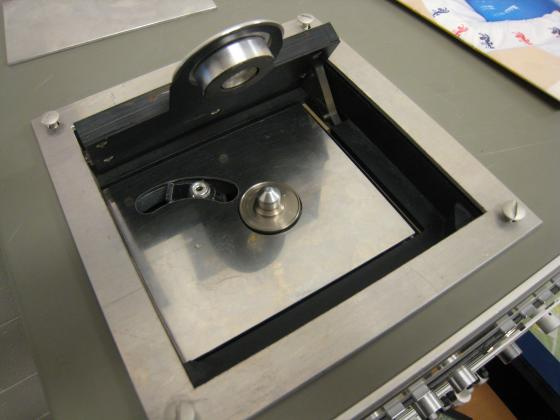
One way or another, there is fairly reliable evidence that at least one player “Estonia LP-010” got into the retail network and was sold in GUM for 1100 Soviet rubles. The plot from the exhibition at which the Soviet miracle of technology was demonstrated fell into the Vremya program.
However, the majority of Soviet people did not feel better about it. CDs were not produced in the USSR (since 1990, they were produced in small batches, mainly for export), and the cost of the device was equivalent to the cost of a new car.
Already in 1988, the USSR adopted 2 new GOSTs that describe compact discs - GOST 27667-88 “Digital sound system“ Compact disc ”. Parameters ”and GOST 28376-89“ CD. Parameters and sizes. "
There is also information that the device was released earlier, in 1984 - 1985, and in 1987 it just got to the exhibition and was shown to the general public. And also, that engineer Makarchuk, just an employee of the Punane RET plant, who went to the exhibition, and other people were engaged in the development (they say he was still young in 1984). There is no evidence of either the first or second version, the only fact remains is that in the mid-80s the first Soviet CD player was developed.
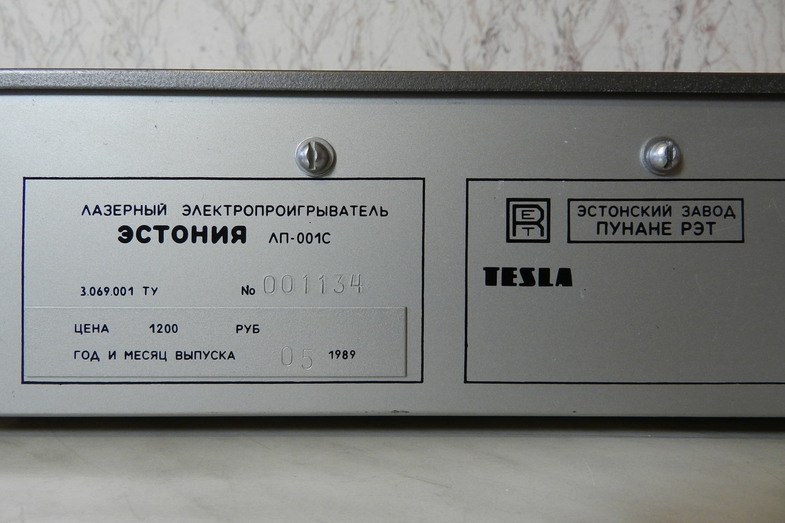
The second (and according to many - the first) serial player in the USSR was Estonia LP-001, launched into production in 1989. It was practically an exact copy of the Philips CD204 in circuitry and design. Unlike the previous development, almost the entire elemental base was borrowed. In addition to the case, foil fiberglass for boards, plastic parts, vacuum-luminescent boards, resistors, wires and fasteners, all parts of the device were imported. Of the characteristic features that significantly distinguished it from the first one, it is possible to distinguish a sliding tray for a disk, instead of a cover.

Philips CD204

Estonia LP-001
“Circulation” of the device for most sources that can be considered reliable did not exceed 2500. To get this unit was a little easier than described above, but it was almost impossible to buy in the store. At that time, in order to get something, there were special people. The commissions of these “useful” people accounted for about 100% of the cost of the delivered scarce goods.
Before the collapse of the union, several more Soviet CDs were released, which, unfortunately, could not significantly change the situation, due to both an acute shortage of media and small series of releases.

Domestic production of compact discs began only in 1990. It is known that the most zealous supporter of their own release of CDs in the Union was the leading specialist of the Office of the All-Russian Military Group “Melody” Vadim Vasilievich Smirnov. He was known as an expert in digital media and urged the leadership of the All-Union record company to buy equipment, and not let it go over the hill.
This person determined what equipment was needed and set the stage for its purchase.
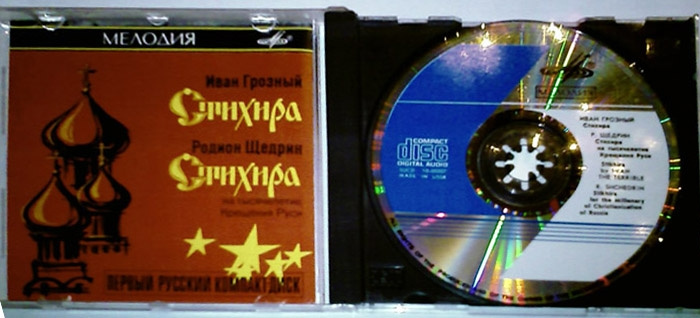
The release of the first CDs in the USSR was preceded by a 2-year internship for Melody employees at Western enterprises, where they studied in detail the technologies for recording and producing discs. Trained specialists did not let us down, and in 1989 the first Soviet CD appeared with the recording of "Verse for the Millennium of the Baptism of Russia", composer Rodion Shchedrin.
We all know that the efforts of engineers and officials from the industry went to waste in August 1991. The serial production of newborn Soviet laser players and CDs was not destined to exist for more than 4 years. The socio-economic madness of the 90s and massive privatization destroyed industry, a crushed colossus. The company, which began the production of the first Soviet CD-players, ended up in another country. But this is a completely different story ...
So, the first laser players in the Union appeared before CDs officially began to be published. At the same time, the population stood in lines for cassettes and vinyl plastics, which they got with great difficulty, as well as high-quality equipment for reproducing them. Apart from vinyls with speeches of the Soviet leaders and the Soviet stage, which were present in relative abundance on the shelves of music stores.
Moreover, such a format as CD has existed in the world since 1979, and players and discs managed to degenerate from luxury goods to relatively affordable equipment for the middle class. In the USSR, on the contrary, throughout all these years the broad masses simply did not know about the existence of such a format. Units of those who had the opportunity to buy a CD player outside the boundless Motherland, as a rule, did not use this chance. At times, tape recorders and LP players were often bought. For disks in the USSR were not even for sale by “farmers”, and if they did appear, they cost crazy money. The situation changed in 1987.
Laser beam in the dark kingdom of the Gorbachev era
Ironically, the development of the first laser player in the USSR began in the city, which provided the country with audio cassettes. It was the Tallinn Music Cassette Plant that collaborated with BASF and was the leader in Soviet cassette production. But this is not about him now.
The initiative to create the Soviet CD-player belonged to the Orbit organization, unique for the late USSR. Smart people from this marketing department, whose names history has not kept in the sources accessible to me, in 1985 insisted that the Ministry of Communications Industry attend to the release of something so necessary for Soviet people.
It is important that in the 80s the technological lag of Soviet enterprises from Western ones (especially in the consumer market) was so strong that the population had a reasonable question about the effectiveness of the Soviet economic system. Perestroika and glasnost, which fell on the heads of Soviet people with the advent of Gorbachev, increased the degree of public discontent.
At that time, it seemed to many that the appearance on the shelves of new high-tech products and their availability in the distribution network could significantly weaken the protest mood. Not the last role in this attempt to prove to Soviet people that the collapsing Union "is still capable of catching and surpassing ..." was assigned to sound-reproducing equipment.
Without sticks in wheels is always easier
As far as one can judge from the scattered recollections of the employees of the Tallinn Punane RET plant, there were no organizational problems and issues with the need for development at that time. It was no longer the 70s, when Likhnitsky and Co. had to convince the stagnant Brezhnev authorities that the country needed Brigs and Corvettes. Interestingly, as in the case of the legendary amplifiers, the first CD player was developed at the enterprise, whose main profile was orders for the military-industrial complex. Direct project management was entrusted to 30-year-old engineer Vladimir Makarchuk.
Philips and Sharp hybrid, as well as the first Intel chips in Soviet technology
As in the case of other techniques of high fidelity of reproduction, the existing Western models were taken as a basis. They turned out to be popular in Germany and France CD players Philips . Based on several Philips models (mainly Philips-100), the player’s layout was created. A characteristic feature of these samples was the lid, which opened upwards, like many tape recorders of that time. At the same time, they borrowed the design concept from the Japanese company SHARP. This kind of plagiarism was characteristic of all audio equipment produced under the trademark “Estonia”.
Philips-100
It cannot be said that the prototypes were completely copied, but many technical solutions were borrowed, since there was simply no experience in creating such a technique. By the end of 1986, it became clear that in the short term it was impossible and irrational to create your own drive for CD and DAC. Such independent development and even copying of existing ones implied the allocation of an incredible amount of resources, both human and material, and temporary. At the same time, the order of the "party and government" (tm) for the Soviet laser player was to be implemented for the mechanical engineering exhibition dedicated to the 70th anniversary of the Great October Revolution.
As a result of research conducted by Tallinn specialists, Philips CDM-2 was chosen as the basic drive for the Soviet device, Philips 2X TDA 1540P became the DAC. Circuitry in many respects repeated Western analogues, however, it was adapted for the use of Soviet components.
The employees of the design bureau of the Punane RET plant, which developed the player, were among the first to introduce microprocessor control in a CD player. Two 8-bit Intel microprocessors were used. Many also claim that the reliability of the power supply system of the Soviet player was many times greater than the original from Philips .
Estonia LP-010 Stereo
This is how the Estonian LP-010 Stereo player appeared, which is deservedly considered the first CD player created in the USSR. There are completely different data regarding the number of these devices. Some sources indicate that they were mass-produced for 2 years and there were more than 2500, others write that there were only a few units (50 pieces), and also that there was only small-scale production and the number did not exceed 200 pieces per union.
One way or another, there is fairly reliable evidence that at least one player “Estonia LP-010” got into the retail network and was sold in GUM for 1100 Soviet rubles. The plot from the exhibition at which the Soviet miracle of technology was demonstrated fell into the Vremya program.
However, the majority of Soviet people did not feel better about it. CDs were not produced in the USSR (since 1990, they were produced in small batches, mainly for export), and the cost of the device was equivalent to the cost of a new car.
Already in 1988, the USSR adopted 2 new GOSTs that describe compact discs - GOST 27667-88 “Digital sound system“ Compact disc ”. Parameters ”and GOST 28376-89“ CD. Parameters and sizes. "
There is also information that the device was released earlier, in 1984 - 1985, and in 1987 it just got to the exhibition and was shown to the general public. And also, that engineer Makarchuk, just an employee of the Punane RET plant, who went to the exhibition, and other people were engaged in the development (they say he was still young in 1984). There is no evidence of either the first or second version, the only fact remains is that in the mid-80s the first Soviet CD player was developed.
Philips and Estonia are twin brothers
The second (and according to many - the first) serial player in the USSR was Estonia LP-001, launched into production in 1989. It was practically an exact copy of the Philips CD204 in circuitry and design. Unlike the previous development, almost the entire elemental base was borrowed. In addition to the case, foil fiberglass for boards, plastic parts, vacuum-luminescent boards, resistors, wires and fasteners, all parts of the device were imported. Of the characteristic features that significantly distinguished it from the first one, it is possible to distinguish a sliding tray for a disk, instead of a cover.
Philips CD204
Estonia LP-001
“Circulation” of the device for most sources that can be considered reliable did not exceed 2500. To get this unit was a little easier than described above, but it was almost impossible to buy in the store. At that time, in order to get something, there were special people. The commissions of these “useful” people accounted for about 100% of the cost of the delivered scarce goods.
Before the collapse of the union, several more Soviet CDs were released, which, unfortunately, could not significantly change the situation, due to both an acute shortage of media and small series of releases.
Soviet CD
Domestic production of compact discs began only in 1990. It is known that the most zealous supporter of their own release of CDs in the Union was the leading specialist of the Office of the All-Russian Military Group “Melody” Vadim Vasilievich Smirnov. He was known as an expert in digital media and urged the leadership of the All-Union record company to buy equipment, and not let it go over the hill.
This person determined what equipment was needed and set the stage for its purchase.
The release of the first CDs in the USSR was preceded by a 2-year internship for Melody employees at Western enterprises, where they studied in detail the technologies for recording and producing discs. Trained specialists did not let us down, and in 1989 the first Soviet CD appeared with the recording of "Verse for the Millennium of the Baptism of Russia", composer Rodion Shchedrin.
Total
We all know that the efforts of engineers and officials from the industry went to waste in August 1991. The serial production of newborn Soviet laser players and CDs was not destined to exist for more than 4 years. The socio-economic madness of the 90s and massive privatization destroyed industry, a crushed colossus. The company, which began the production of the first Soviet CD-players, ended up in another country. But this is a completely different story ...