November 14, 2016 at 14:16
Semantic Scholar ranked the most influential neuroscientists
If we talk about studies that have influenced the development of neuroscience, then University College London (UCL) has something to boast about. This conclusion is not the opinion of an expert or the result of an analysis of the huge staff of some analytical agency: the computer did all the work. Semantic Scholar
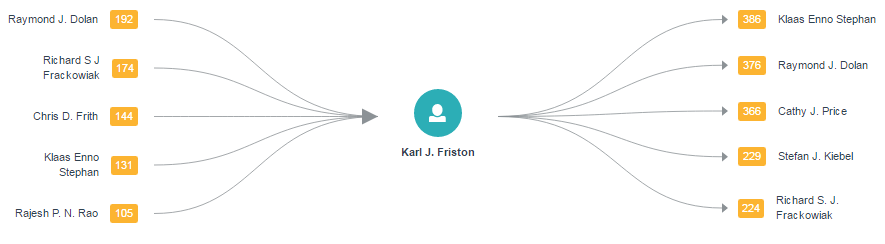
Programanalyzed the content of 2.5 million scientific articles and the citation of their authors, and then calculated the assessment of the influence of each author on the rest. As a result, it turned out that three of the most influential scientists in this field work for the benefit of science at University College London: Carl Friston, a specialist in parametric methods of statistics (1st place), Raymond Dolan, an expert in the field of emotional influence on cognition (2nd place) and Chris Frith, researcher in the field of cognitive basis of schizophrenia and social cognition (7th place).

Semantic Scholar is an online tool that was created in the laboratory of the Allen Institute for Artificial Intelligence (AI2) in Seattle, Washington. April debut Semantic Scholar made a good impression: the service was rated the most influential scientists in the field of computer science, based on 2 million academic research papers. Since then, the AI2 team has expanded the base of articles to 10 million, a quarter of which are work in the field of neurobiology. A team of scientists is going to increase the base of biomedical literature to 20 million documents by next year.
When Semantic Scholar analyzes an article, he sees more than a typical academic search engine and much more than a person. According to project manager Oren Etzioni, general manager of AI2, his team used machine learning, natural language processing and computer vision technology in their work to gain insight into semantics.
To evaluate the capabilities of Semantic Scholar, scientists suggest a lookon the results of a semantic analysis of scientific papers in which the basal kernels of the brain of songbirds are examined from different angles. In the left area of the screen, we see the keywords that the service selected from these documents: not only traditional bibliographic data, such as the date of publication and information about the authors, but also the types of cells used in the experiments, and even methods.

Other scientists are also interested in the development of researchers from AI2. So, Sam Gershman, a specialist in computational neurobiology from Harvard University, tried out Semantic Scholar. He said that this is a very interesting tool that has undeniable advantages over Google Scholar. For example, Semantic Scholar has the ability to fine-tune the sorting of articles. In addition, it shows links to the article, some numbers and charts.
Along with this, Gershman immediately discovered a problem that applies to all search engines: poor quality data, or "dirty data". In some works, the names of the authors do not match. And the ambiguity of some terms inhibits the work of the search engine. In addition, errors are also encountered in research metadata: one of Gershman’s works dates back to 1987, when the scientist was only two years old.
The most mysterious thing in this story for Gershman was the fact that articles published in the most influential publications do not get high points: “None of the most influential articles of Thomas Griffiths from the University of California at Berkeley fell into the top five most quoted articles. This is strange." - says Gershman.
Oren Etzioni emphasizes that work on the Semantic Scholar is ongoing. He admits that the service is not perfect and may produce errors. Despite this, the tool quite successfully coped with compiling a rating of the most influential neuroscientists based on current data. It turned out that three of them are familiar with each other from the very beginning of their career. “We have been working at UCL since 1993 in one department,” says Chris Frith. He also added that the Semantic Scholar worked correctly.
Topping the list, Carl Freeston is the first developer of visual brain data analysis techniques and the creator of a computer model of brain work. When he was informed that he was the first in the TOP-10 scientists, he took this news with a certain amount of humor: “My first thought was“ To whom can I say this and not seem immodest? ” Then I realized that the only people who would like to hear about it are my children! ”
The need to create a service capable of assessing the contribution of a scientist to the development of science arose long ago. The main difficulty along this path is that the influence of the researcher is difficult to measure. Until now, the citation index has helped to cope with this task, but in the end, such a counter has become the cornerstone of the metrics of the academic publishing industry. Not all quotes can be considered equivalent. Agree that inspirational quoting of entire pages of a work is different from a brief mention of the name of the work in the list of sources used. That is why the scientific environment needs a tool that can conduct semantic analysis and produce a more accurate result.
In the future, scientists from the Allen Institute of Artificial Intelligence plan to develop their Semantic Scholar project and turn it into “Siri for Science”. The main goal is for the system to learn to recognize questions in English and look for answers to them.
The work was published in the journal ScienceInsider on November 11, 2016
DOI: 10.1126 / science.aal0371