October 9, 2016 at 01:04
What happens if you supply direct current to the mains?
 The current war ended, and Tesla and Westinghouse seemed to have won. DC networks are now used in some places on the railway, as well as in the form of super-high-voltage transmission lines.
 The vast majority of power networks operate on alternating current. But let's imagine that instead of an alternating voltage with an effective value of 220 volts, the same 220 V, but direct current, suddenly began to flow into your house.
The theater begins with a hanger, and our electric circus - with an opening shield.
Automatic machines
And right away the good news: circuit breakers will work as expected. The machine has two releases: thermal and electromagnetic. Thermal serves to protect against prolonged overload. The current heats the bimetallic plate, it bends and opens the circuit. The electromagnetic element is triggered by a short-term current pulse during a short circuit. It is a solenoid that draws the core into itself and, again, breaks the chain. Both of these systems work perfectly on direct current.

picture source: switch-automatic.rf
Add - ons from Bronx and AndrewN :
The magnetic trip is triggered by the amplitude value of the current, that is, 1.4 times more than the current. At constant current, its trip current will be 1.4 times higher.
It is more difficult to extinguish a direct current arc, so that with a short circuit, the time for breaking the circuit will increase and the wear of the machine will accelerate. There are special machines designed to work with direct current.
RCD
In addition to automatic machines, there is a residual current device (RCD) in the shield. Its purpose is to detect a leakage of current from the network to the ground, for example, when a person touches live parts. The RCD measures the current strength in two conductors passing through it. If the same current flows into the load that flows, everything is in order, there is no leakage. If the currents are not equal, the RCD will sound the alarm and break the circuit.
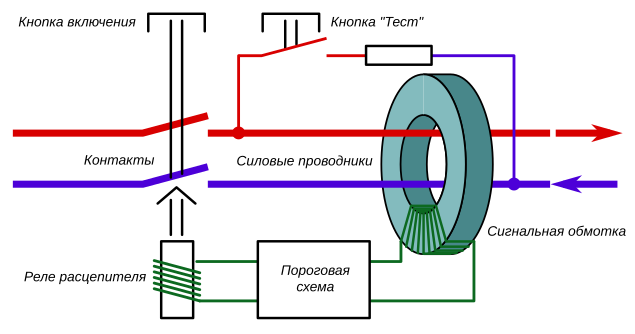
The sensitive element of the RCD is a differential transformer. Such a transformer has two primary windings connected in opposite directions. If the currents are equal, their magnetic fields cancel each other out and there is no signal at the output. If the currents are not compensated, a voltage appears at the output of the signal winding, to which the RCD circuit responds. The transformer will not work on direct current, and the RCD will be useless.
Counter
It doesn’t matter what kind of electric meter you have - an old mechanical or a new electronic one - it won’t work. The mechanical counter is an electric motor, where the metal disk serves as the rotor, and the stator contains two windings. One winding is connected in series with the load and measures the current, the second is connected in parallel and measures the voltage. Thus, the greater the power consumption, the faster the disk spins. The operation of such a counter is based on the phenomenon of electromagnetic induction, and with constant current in the windings, the disk will remain stationary.
The electronic meter is arranged differently. It directly measures voltage (through a resistive divider) and current (using a shunt or Hall sensor), digitizes them, and then the microprocessor recalculates the received data in kilowatt hours. In principle, nothing prevents such a circuit from working with direct current, but in all household meters, the constant component is filtered out programmatically and does not affect the readings. DC meters exist in nature, they are installed, for example, on electric locomotives, but you won’t find one in the apartment panel.
Well, okay, there wasn’t enough to pay for all this mess! We go further along the chain and see what electrical appliances we can meet.
Heaters
Everything is fine here. An electric heater is a purely resistive load, and the thermal effect of the current does not depend on its shape and direction. Electric stoves, kettles, boilers, irons and soldering irons will work on direct current in the same way as on alternating current. Bimetallic thermostats (as, for example, in the iron) will also function correctly.
Incandescent lamps
The good old Ilyich bulb on direct current feels no worse than on alternating current. Even better: there will be no pulsations of light, the lamp will not hum. On alternating current, the bulb may hum due to the fact that the spiral (especially if it is sagging) works like an electromagnet, contracting and stretching twice during a period. When powered by direct current, this unpleasant phenomenon will not be.
However, if you have installed dimmers (dimmers), then they will stop working. The key element of the dimmer is a thyristor - a semiconductor device that opens and begins to pass current at the moment of applying a control pulse. The thyristor closes when the current through it stops flowing. When the thyristor is supplied with alternating current, it will close at each transition of the current through zero. By applying a control pulse at different times relative to this transition, you can change the time during which the thyristor will be open, and therefore the power in the load. This is exactly how the dimmer works.

When powered by direct current, the thyristor will not be able to close, and the lamp will always burn at 100% power. And perhaps the control circuit will not be able to "catch" the transition of the mains voltage through zero and will not give an impulse to open the thyristor. Then the lamp will not light at all. In any case, the dimmer will be useless.
Fluorescent lamps
A fluorescent lamp cannot be connected directly to the network; for normal operation, it needs a ballast control device (PRA). In the simplest case, it consists of three parts: a starter, a throttle and a capacitor. The latter is needed not by the lamp itself, but by other consumers in the network, since it improves the power factor and filters out the noise created by the lamp. A starter is a neon bulb, one of the electrodes of which bends when heated and touches the second electrode. Choke - a large inductor connected in series with the lamp:
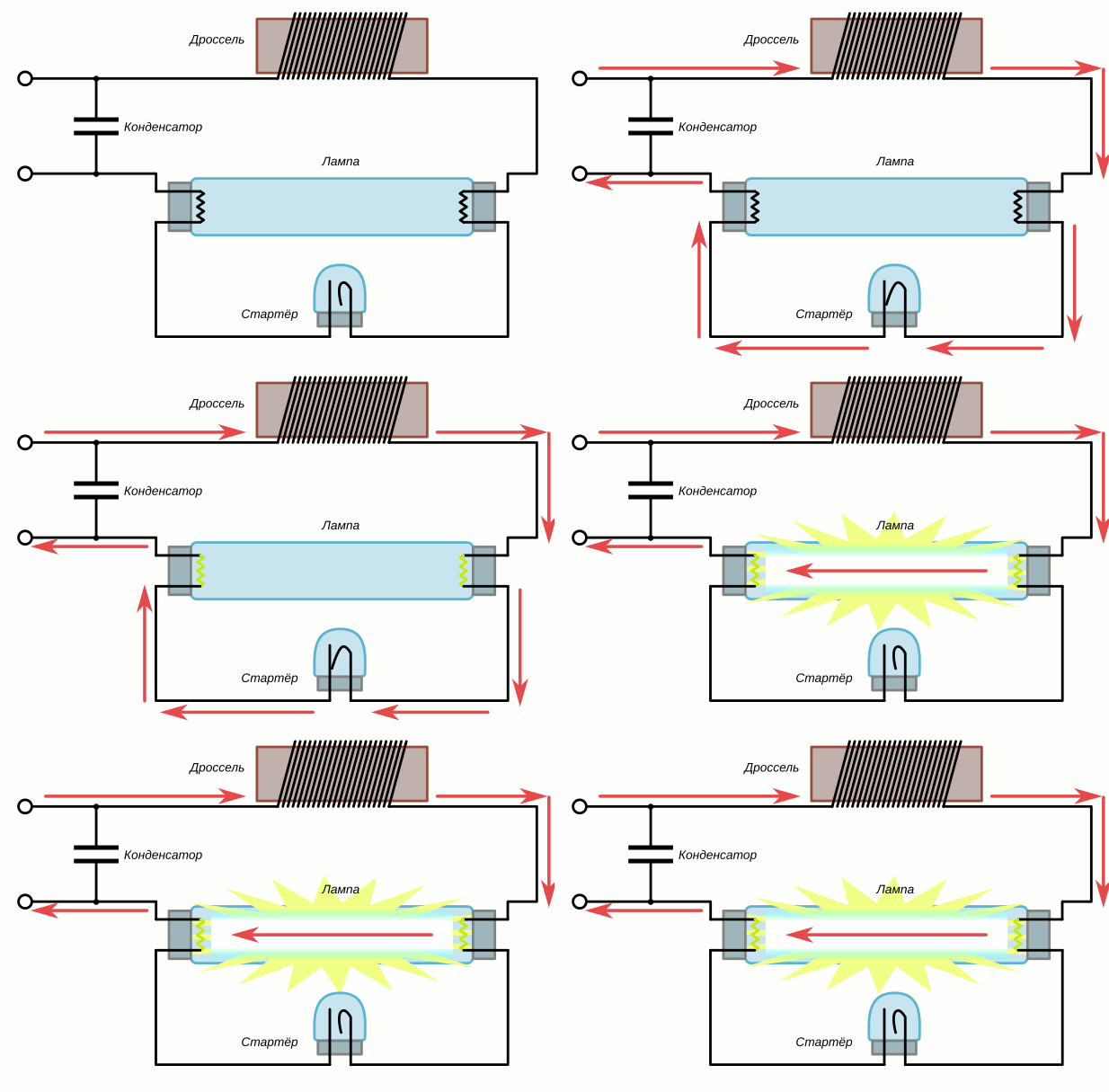
Normally, all this works as follows: when turned on, the discharge in the starter is ignited, its contacts heat up and close together. The current flows through the filaments of the lamp, which makes them warm up and begin to emit electrons. At this time, the starter cools down and opens the circuit. The current drops sharply, and due to self-induction, a high voltage pulse appears on the inductor. This pulse ignites a discharge in the lamp, and then it burns on its own. The inductor now limits the discharge current, working as an additional resistance.
What will be on a direct current? The starter will work, the lamp will light up as expected, but then everything goes awry. In the DC circuit, the inductor will not have inductive resistance (only the active resistance of the wires, but it is small), which means that it will no longer be able to limit the current. The higher the discharge current, the more ionized the gas in the lamp, the resistance drops, and the current grows even stronger. The process will develop like an avalanche and end with a lamp explosion.
Lamps with electronic gear
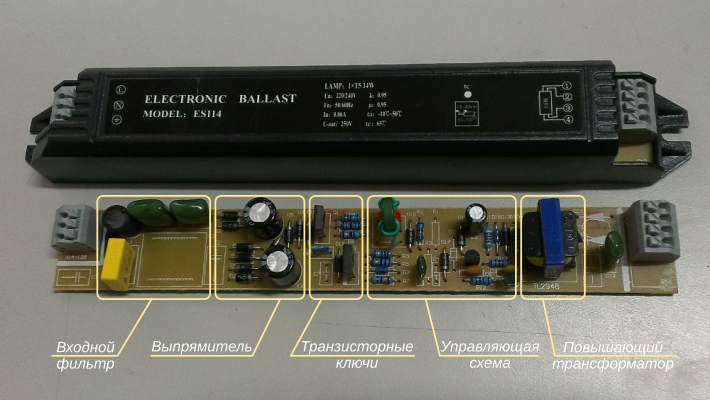
Electromagnetic ballasts are simple, but not without drawbacks. They have low efficiency, the throttle is bulky and heavy, it buzzes and heats up, the lamp lights up with a wild blink, and then flickers at a frequency of 100 Hz. All these shortcomings are deprived of the electronic ballast (electronic ballast). How does he work? If you look at the schemes of various electronic ballasts , you can notice the general principle. The mains voltage is rectified (converted to constant), then the generator using transistors or a microcircuit generates an alternating voltage of high frequency (tens of kHz), which powers the lamp. In expensive electronic ballasts there are schemes for heating the threads and smooth starting, which extend the lamp life.
picture source: aliexpress.com
Similar circuitry has both blocks for linear lamps and compact "energy-saving", which are screwed into a conventional cartridge. Since there is a rectifier at the input of the electronic ballast, you can power the entire circuit with a constant voltage.
LED lamp
The LED requires a small constant voltage (about 3.5 V, usually connect several diodes in series) and a current limiter. The schemes of LED lamps are very diverse, from simple to quite complex.
The simplest thing is to put a quenching resistor in series with the LEDs. Over voltage will drop on it, it will also limit the current. Such a circuit has a monstrously low efficiency, so in practice a quenching capacitor is used instead of a resistor. It also has resistance (for alternating current), but thermal power is not dissipated on it. According to this scheme, the cheapest lamps are assembled. The LEDs in them flash at a frequency of 100 Hz. Such a lamp will not work on direct current, because for direct current the capacitor has infinite resistance.
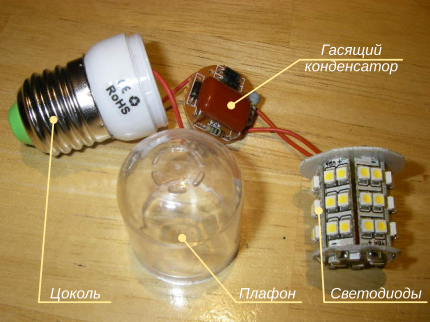
image source: bigclive.com
More expensive lamps are more complex, very similar to electronic ballasts for fluorescent lamps. The power source in them contains a high-frequency switching regulator, which is powered by a rectified mains voltage. As in the case of electronic ballasts, the circuit will work normally if a constant voltage is applied to it.
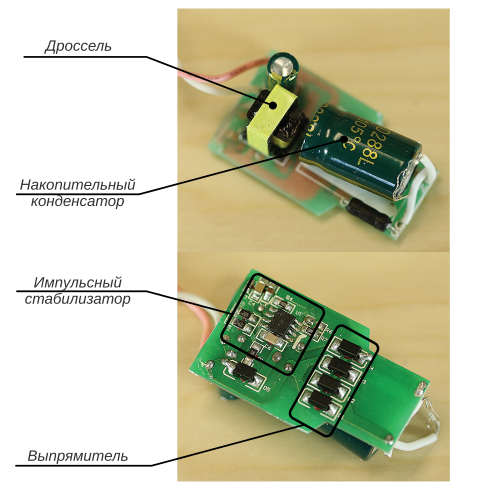
picture source: powerelectronictips.com
Universal Brush Motors
Universal Collector Motor (UKD) consists of a fixed stator and a rotor that rotates inside. The stator has one winding, and the rotor is several at once. Rotor windings are connected through a collector - a cylinder with contacts, along which carbon brushes slide. The interaction of the magnetic fields of the stator and rotor causes the rotor to rotate. The collector is designed so that all the time it turns on one of the windings that is perpendicular to the stator winding - for it the torque will be maximum.
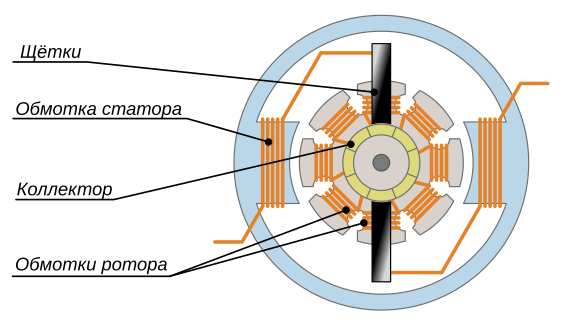
Such an engine can operate when powered by both alternating and direct current. Actually, that's why it is called "universal." When the polarity changes, the direction of the magnetic field in the stator and in the rotor changes simultaneously, as a result, the motor continues to rotate in the same direction. At direct current, the UKD develops even a larger moment than at alternating current due to the lack of inductive resistance of the windings. Universal collector motors are used where you need to get more power with small dimensions. In household appliances, UKDs are in washing machines, vacuum cleaners, hair dryers, blenders, mixers, meat grinders, and also in power tools. All these devices will continue to work if the voltage in the outlet suddenly "straightens up."
Synchronous motors
A synchronous motor in the stator has several windings that create a rotating magnetic field. The rotor contains a permanent magnet or a winding powered by direct current. The stator magnetic field is coupled to the rotor field and rotates it behind itself. A feature of such an engine is that its rotation frequency depends only on the frequency of the supply current. At direct current, obviously, such an engine will rotate at zero frequency, that is, it will stop.
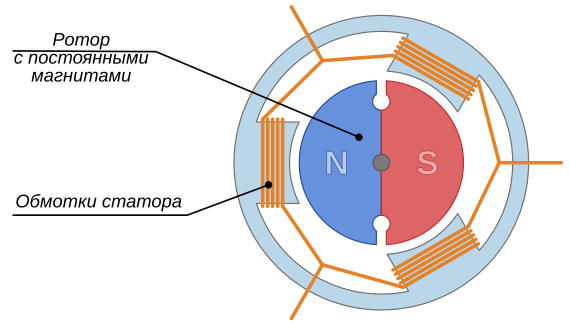
In everyday life, low-power synchronous motors are used where it is necessary to maintain a strictly constant speed. Basically, these are electromechanical watches and timers. Also synchronous are the plate rotation motor in the microwave oven and the drain pump motor in the washing machine.
Induction motors
An asynchronous motor is similar in its device to a synchronous one. In it, the stator also has several windings and creates a rotating field. But the rotor winding is not connected anywhere and is short-circuited. The current in it is created due to the phenomenon of electromagnetic induction in the alternating field of the stator. This current creates its own magnetic field, which interacts with the rotating field of the stator and makes the rotor rotate.
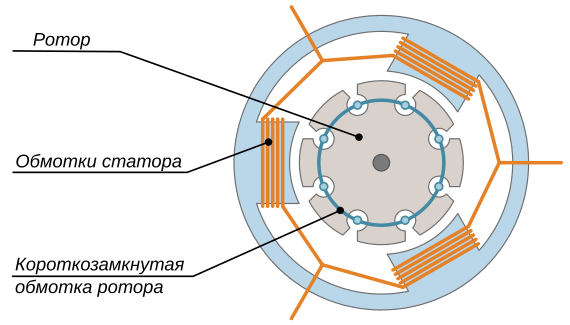
Induction motors are distinguished by low noise and a large resource due to the absence of rubbing brushes. They can be found in refrigerators, air conditioners and fans. When supplied with direct current, the stator magnetic field will not rotate. Also, there will be no current in the squirrel-cage rotor. The motor will remain stationary, and the winding will simply heat up like a regular piece of wire.
Valve motors
Strictly speaking, this is not a separate type of engine, but a way to control it. The motor itself can be synchronous or asynchronous. The main feature is that the voltage on the windings is formed by the control circuit according to the signal from the rotor position sensor. This allows you to adjust speed and torque over wide ranges, limit inrush currents and provides a ton of possibilities, such as speed stabilization. Here are a couple of good articles explaining all this magic:
One
two
Valve motors are increasingly being used in household appliances: in washing machines, refrigerators, air conditioners, and vacuum cleaners. Typically, such a technique can be recognized by the adjective "inverter" in advertising. The valve motor is indifferent to the shape of the supply voltage. The mains voltage is first rectified, and then the control unit “sculpts” several different sinusoids from it (usually three) to power the motor windings. Naturally, such a system will quietly work on direct current.
Transformer (linear) power supplies
The transformer consists of several windings connected by a common magnetic circuit. Alternating current in one winding (primary) generates induction currents in all other windings (secondary). The key feature of the transformer, for which it is usually used, is that the voltage across the windings is the same as the number of turns in these windings. If you wrap 1000 turns in the primary winding, and 100 in the secondary winding, such a transformer will reduce the voltage by 10 times. If you turn it on the other way - increase 10 times. Very simple and convenient.
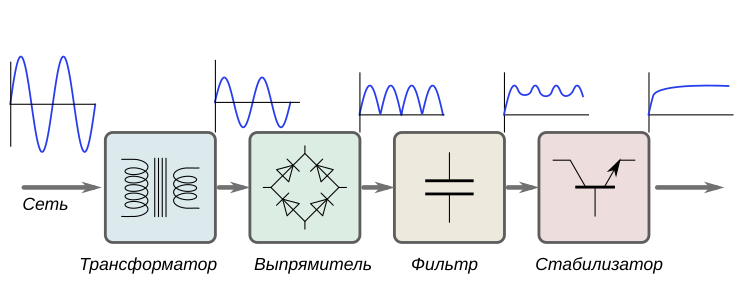
In the linear power supply unit, the mains voltage is lowered (or increased, if necessary) to the required level using a transformer. Next is a rectifier that converts alternating voltage to constant, and a filter that smooths ripples. Then a regulator can go that keeps the output voltage constant.
Linear power supplies are gradually being replaced by switching ones, but the former work a lot more where. In the microwave, if it is not “inverter”, there is a powerful transformer that raises the 220 V network to several kilovolts needed for the operation of the magnetron. The control electronics in washing machines, stoves and air conditioners are powered by transformers. Transformer power supplies are used in audio equipment and cheap chargers.
What will happen to the transformer if it is connected to a DC network? Firstly, voltage will not appear on the secondary windings, since electromagnetic induction occurs only when the current changes. Secondly, the winding will not have inductive resistance, which means that a much larger current will flow through it than calculated. The transformer will overheat and burn out quite quickly.
Switching Power Supplies
The higher the frequency of the alternating current, the more efficient the transformer (within reasonable limits, of course). If you use a frequency of several tens of kilohertz instead of the network 50 Hz, you can decently reduce the dimensions of the transformers with the same transmitted power. This idea is the basis of switching power supplies. Such a unit works as follows: the mains voltage is rectified, the received direct voltage feeds the transistor generator, which again gives an alternating voltage, but of a high frequency. It can now be lowered or raised by a transformer, rectified and fed into the load.

According to this scheme, the vast majority of electronics are now powered: computers, monitors, televisions, chargers for laptops, phones and other gadgets. Since the input voltage is first rectified, the switching power supply should work without problems with direct current. But there are a couple of points that can ruin everything.
Firstly, the voltage after the rectifier is almost the amplitude value of the alternating voltage. That is, for ~ 220 V at the input, the rectifier will give 311 V. By condition, we supply a constant voltage of 220 V, which is 30% lower. This will most likely not cause problems, because modern power supplies can operate in a wide voltage range, usually from 100 to 250 V.
Secondly, the rectifier consists of four diodes that work in pairs: one pair on the positive half-wave of the current, the other on the negative. Thus, each diode passes the current only half the time. If we apply a constant voltage to the rectifier, one pair of diodes will always be open, and double power will dissipate on them. If the diodes do not have a double current margin, they can burn out. But this is not too much trouble: you can just throw out the rectifier and apply a constant voltage immediately after it.
Conclusion
After you put out a few fires and scooped up a bunch of damaged appliances, it's time to take stock. The transition to direct current will survive either the old and simple technique (incandescent lamps, heaters, collector motors with mechanical control) or, conversely, the most modern (with switching power supplies and inverter motors).
Fortunately, the described scenario is unlikely to be put into practice unless the possibility of a specially organized sabotage is considered. In no event of a possible accident in the power supply network will the alternating voltage suddenly become constant. True, in case of possible accidents other bad things happen , but this is a completely different story. Take care of yourself and make backups.