The history of "soft" (flexible) drives
Today, we use HDD, SSD, SD-cards, USB-flash drives to store information. Already much less often we insert laser disks into laptops. I personally do not have a single device supporting this media at home.
Many of us have not seen audio and video tapes, bobbins with magnetic films, floppy disks, and even more so punched cards and punched tapes. These carriers, some of which have been known since the 18th century, have almost disappeared.
But only almost. Today we will talk about the times when soft data carriers were in use, and that they are still alive thanks to their firm rooting in state and military institutions and research centers.
Punched cards, which we know as a way of storing and transmitting information for computers in the 1920-1950s, go back to pre-computer time. Namely, in 1725, when perforated paper was used to control a loom.
Basil Bouchon, son of an organ picker, adapted the system used to automatically play music (“deployed” a cylinder with pins / cribs) to the needs of weaving.
He used perforated paper in a roll so that the machine reproduced the pattern on the fabric. Bouchon's colleague, Jean-Baptist Falcon, replaced the paper tape with perforated cards fastened together.

The Basil Bouchon loom
The mechanism was perfected by Joseph Marie Jacquard. Own loomfor coarse fabrics he created in 1804. Perforated cards allowed in automatic mode, almost without the participation of the master, to carry out a certain alternation of raising and lowering the warp threads in order to display a given pattern on the fabric.

Perforated cards in the Jacquard loom.

The result of the Jacquard loom.
In the weaving business, the Jacquard looms, improved and automated, are still used. But punch cards still work. Below you see an example of a punch card from the home economics site for the Brother machine - with a motorcyclist for a children's sweater.

Card for modern knitting machine Brother
Charles Babbage in 1822 built the first model of his difference machine, which consisted of rollers and gears rotated with a special lever. Then he asked the British government to finance his future work. In the process, he faced many problems, so after nine years the work got up. Although partially the machine functioned and performed calculations. He later returned to work in 1847-1849. Babbage even designed a printer for this huge calculator, which in 2000 was launched at the London Museum of Science.
Main partsThe analytical machines had a “warehouse” for storing numbers, a “mill” for performing arithmetic operations, a device that controls operations, and input and output devices. Punch cards were used to enter data into the memory: one mechanism with punch cards set the operations of the mill, the second controlled the transfer of data between the mill and the warehouse. The output device, that is, the printer, could reproduce the result in one or two copies in the form of a print or punch it on punch cards.

Punches for Babbage Analytical Machine
In those same years, in the first half of the 19th century, the Russian inventor Semyon Korsakov worked on mechanical intelligent machines. He became one of the pioneers in the use of perforated cards in computer science. In 1832, he created his first device, operating on the basis of perforated tables and designed for the tasks of information retrieval and classification. It was a homeoscope with fixed parts.
Each line of the homeoscope corresponds to a certain symptom - a symptom of the disease. In the vertical column was a set of signs - pathological symptoms, of which one or more characterized the disease. The bottom line contained the solution to the problem - a medicine that will help with the disease.
The homeoscope itself was a cylinder with pins. The operator selected symptoms from the first column — for example, a cough and a runny nose — and pushed pins. Then he led the cylinder to the right along the table: when the cells were perforated in the right places, the homeoscope stopped, and information on the treatment of the disease could be read in the bottom line.
It was a kind of Excel spreadsheet (before spreadsheets), tailored to the needs of a doctor.

Homeoscope with Fixed Parts The
U.S. Census in 1880 took eight years, and the 1890 census took just a year. This difference is due to the introduction of a counting machine working on punch cards.
In the 1880s, inventor Herman Hollerith patented punch card equipment. His statistical tabulator allowed to speed up the census, after which Choleritus became a professor at Columbia University.
The buyers of TMC's Tabulating Machine, the Tabulating Machine Company, are railway departments and government agencies. In 1924, the company was renamed IBM - International Business Machines.

Punch
card Hollerita IBM produced electric tabs on punch cards until 1976. The latest model was the IBM 407. Its rental cost from $ 800 per month - about $ 5,000 for 2016.

IBM 407

card for language FORTRAN
In the USSR producedT-5M, T-5MU, T-5MV and TA80-1 tabs. The first three worked with digital information, and the fourth with alphanumeric. To enter information, 80-column and 45-column perforated cards were used. The tabulators worked with summary, reading and reproducing rotary hammers, with electronic computing and multiplying consoles at machine-counting stations.

T-5 MV

tabulator at a machine-calculating station: Source Soviet-designed 80-column punch card for IBM tabulator, 1980
In 1938, German engineer Konrad Zuse built one of the first programmable computers in the world - Z1. The machine had an input device in the form of a keyboard made of a typewriter, an electric drive and was able to calculate data in the decimal system in the form of floating point numbers. Data was displayed using the panel on the lamps.
The machine performed the multiplication in 5 seconds. The clock frequency was 1 Hz. The system worked due to the engine of a vacuum cleaner with a capacity of 1 kilowatt.
The Z1 was equipped with a punched tape reader that provided an opcode for each instruction.

Konrad Zuse and recreated after World War II computer machine Z1

Punched tape for computer Z1
In the 1940s, American gunners used shooting tables containing information about the corrections of the sight in accordance with the distance to the target. Trajectory calculations by one person for one type of gun and one projectile took more than two weeks. It was necessary to calculate about three thousand trajectories for many combinations of parameters - air temperature, soil density, wind speed and so on. A scientist from the University of Pennsylvania, John William Mokley, decided to use vacuum tubes as an element base for an electronic differentiating machine. This begins the story of ENIAC, and then its improved version - EDVAC.
ENIAC was assembled in 1945. The first task was mathematical modeling of a thermonuclear explosion of a super-bomb according to the Ulam-Teller hypothesis. The task was so complex that even with ignoring many physical effects and simplifying the equation as much as possible, it took a million punch cards to enter the program into the computer.
For reading punch cards used the IBM tabulator. One of the problems of this storage medium was the low speed: it took too much time to punch on the cards the data output during the calculations and enter them into the machine for further calculations. To solve this problem, the inventors began to work on new ways of entering and storing data - on magnetic tapes.

The first ENIAC programmers: Squatting - Ruth Lichterman, standing - Marilyn Weskoff. 1946 year. A source

Spools of clean punched tape Soviet-made. A source
In 1898, the Danish physicist and engineer Waldemar Poulsen patented a method of magnetic recording over wire. The device was called the "telegraph." From the amplifier, the signal was supplied to the recording head, along which the wire moved at a constant speed and was magnetized according to the signal.
In 1927, a German engineer Fritz Pfleimer sprayed iron oxide powder onto thin paper with glue, and a year later received a patent for the use of magnetic powder on paper or film. But the patent was canceled due to the fact that such use of the powder was set forth in the Poulsen patent.
The ideas of Poulsen and Pfleimer were used by AEG, which developed the Magnetofon-K1 magnetic recording device. The magnetic tape for the “magnetophone” was produced by the chemical concern BASF. The device was presented at a radio exhibition in Berlin in 1935.

U.S. Patent for magnetic wire recorder. Source
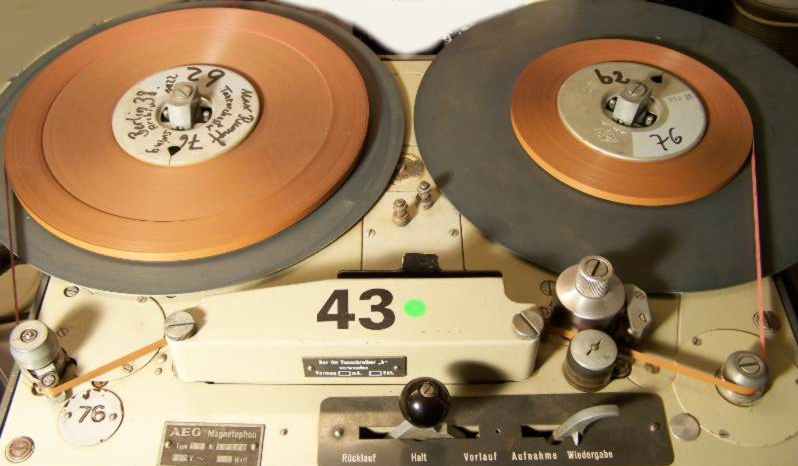
"Magnetophone-K1"
In 1951, the inventors of the ENIAC computer, John Eckert and John Mockley, worked on a new machine. She became the first conditionally commercial computer in the United States - UNIVAC I. The computer was built for the needs of the Air Force and the topographic service of the US Army, and the order was placed on behalf of the Census Bureau. A total of forty-six copies of UNIVAC I were produced for installation in government offices, private corporations and universities. The second copy was installed in the Pentagon. The last copies were turned off in 1970 after 13 years of service at a commercial insurance company.
The cost of the car began with $ 159,000. Over time, the price ranged from $ 1,250,000 to $ 1,500,000. Translated into 2016 money, the maximum price of UNIVAC I was $ 12,480,000.
For the first time, magnetic tape was used in this computer as a storage medium. Up to ten UNISERVO tape drives could be connected at the same time.
UNISERVO was the first tape drive for a commercial computer and was a success. UNIVAC nickel-plated bronze tapes were half an inch wide and up to 450 meters long. Data was recorded on eight tracks, where six were for data, one for parity, and one for synchronization. One tape contained 1,440,000 six-bit characters.
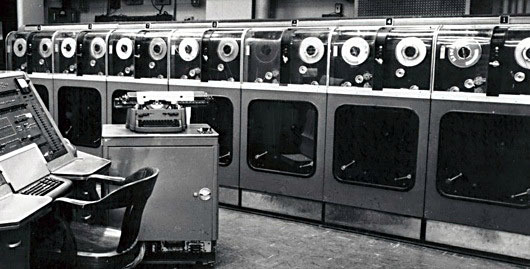
UNISERVO tape drives for UNIVAC
In 1960, IBM developed the first plastic cardwith a magnetic strip. Barcodes and perforations were not reliable, and for bank cards it was necessary to come up with a new way to store data. The choice fell on magnetic tape. Today, all bank cards have magnetic tape, although they are increasingly starting to use chips and NFC.
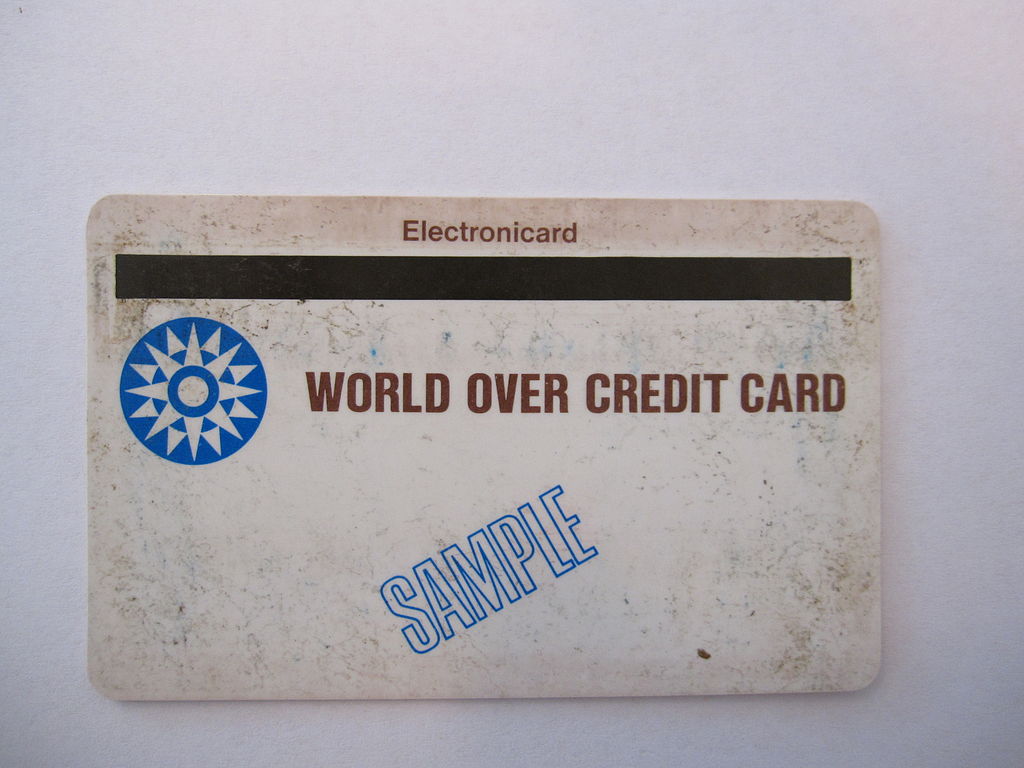
The first prototypes of magnetic stripe cards.
In personal computers of the 1970-1980s, audio cassettes were often used to store information. Playback and recording of programs was carried out either with the help of special drives, or with the help of ordinary household audio tape recorders. Try saying out loud an “audio recorder” - it sounds somehow unusual, right?

Sinclair ZX Spectrum + 2

Atari XC12 tape recorder for Atari 65XE and 130XE computers. A source
Many have already forgotten what audio cassettes and video cassettes look like. Someone had never seen or held them. But for business and research centers, magnetic tapes are still of great importance.
CERN uses magnetic tape to store the results of the work of the Large Hadron Collider ; in addition, they combine clouds with NASA magnetic tapes and Discovery TV channel. Large corporations also sometimes choose magnetic tapes. The advantage of the technology is the price - each gigabyte of storage costs from two to three cents. The speed of working with files is low due to sequential access - from several tens of seconds to a minute. But for data that does not require quick access, it is perfect. Up to 80% of corporate data can be recorded on tape, IBM believes.
IBM continues to work on improving formats. In 2015, scientists from the company were able to record data on magnetic tape with an efficiency of 123 billion bits per square inch. So they exceeded in 88 the existing LTO-6 format since 2012, according to which you can record 2.5 TB of data on a middle-class film. Even earlier, in 2012, IBM, together with Fujifilm, began developing prototypes of cassettes measuring 10 x 10 x 2 centimeters, capable of storing up to 35 terabytes of data.
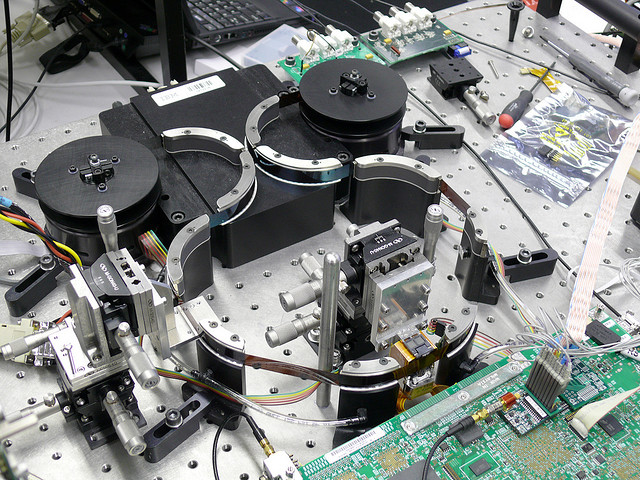
The main drawback of magnetic tape is sequential access to data. This problem was solved in the 1960s by the team of Alan Shugart in the IBM laboratory. One of the senior engineers David Noble in 1967 proposed the use of a flexible magnetic disk with a protective casing. In 1971, the company introduced the first 8-inch floppy disk with 80 kilobytes and a drive for it.
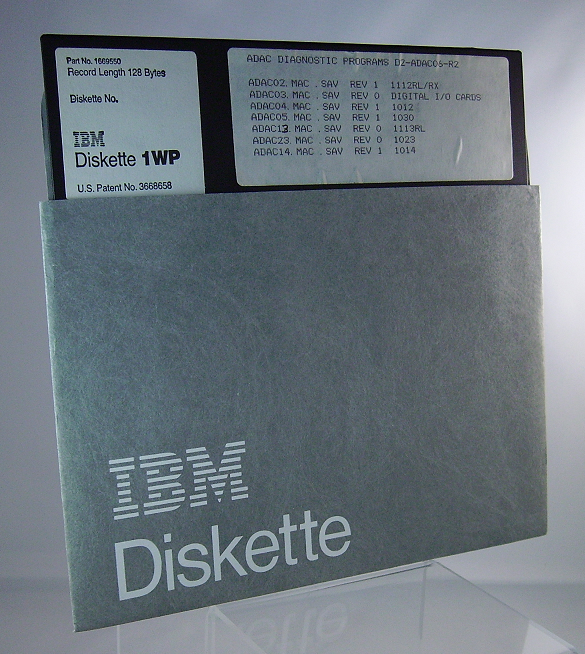
8-inch IBM 128-kilobyte diskette

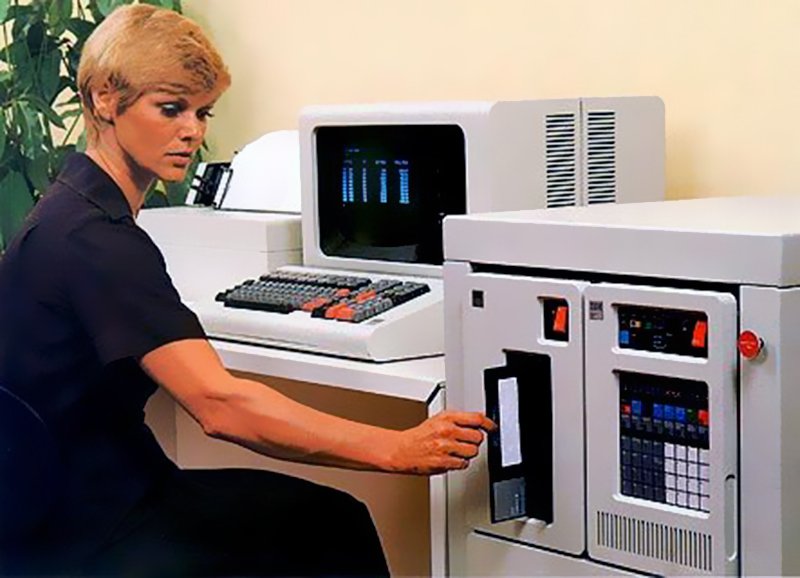
A computer operator uses an 8-inch diskette.
Shugart founded his own company Shugart Technology in 1971 and joined the development of mini-floppy disks for personal computers in 1976. The company released a drive for 5 диск-inch floppy disks, which displaced 8-inch drives from the PC market.
In 1981, Sony released its own version of floppy disks, this time with a diameter of 3½ inches. They began to be used in computers HP, Macintosh, IBM, Atari, Commodore.
The first versions of floppy disks had a capacity of 720 kilobytes, in later floppy disks this figure was increased to 1.44 megabytes. The result was improved by Toshiba, introducing a 2.88 megabyte disk in the 1980s. I only remember 1.44 MB floppy disks - because the format from Toshiba did not take root .
Floppy Disk Advertising, 1986

External USB Drive

Three generations of
Hitachi floppy disks discontinued floppy disks in 2009. Sony shut down factories in 2010, after selling a total of forty-seven million floppy disks.
Toshiba in 2014 found a new application for its floppy disk factory: converted it into a farm for growing lettuce, which does not need to be washed.

Toshiba Vegetable Farm is a converted floppy drive workshop. Source
It would seem that the era of floppy disks ended in December 2015, when the Norwegian government stoppeddistribution of patient lists of clinics on floppy disks. But this is not so. In June 2016, we learned that hospitals in South Australia continue to use medical software based on MS-DOS, developed back in the 1980s, and use diskette to store data.
But here we are talking about 3½ floppy disks, a relatively modern version. At the same time, the US nuclear arsenal is controlled using 8-inch floppy disks! IBM Series / 1 was integrated into the arsenal infrastructure in the 1970s, and these systems still work. Systems are planning to replace in 2017.
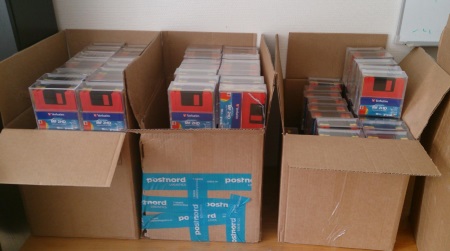
3.5 gigabytes of medical information on two and a half thousand floppy disks. Norway 2015
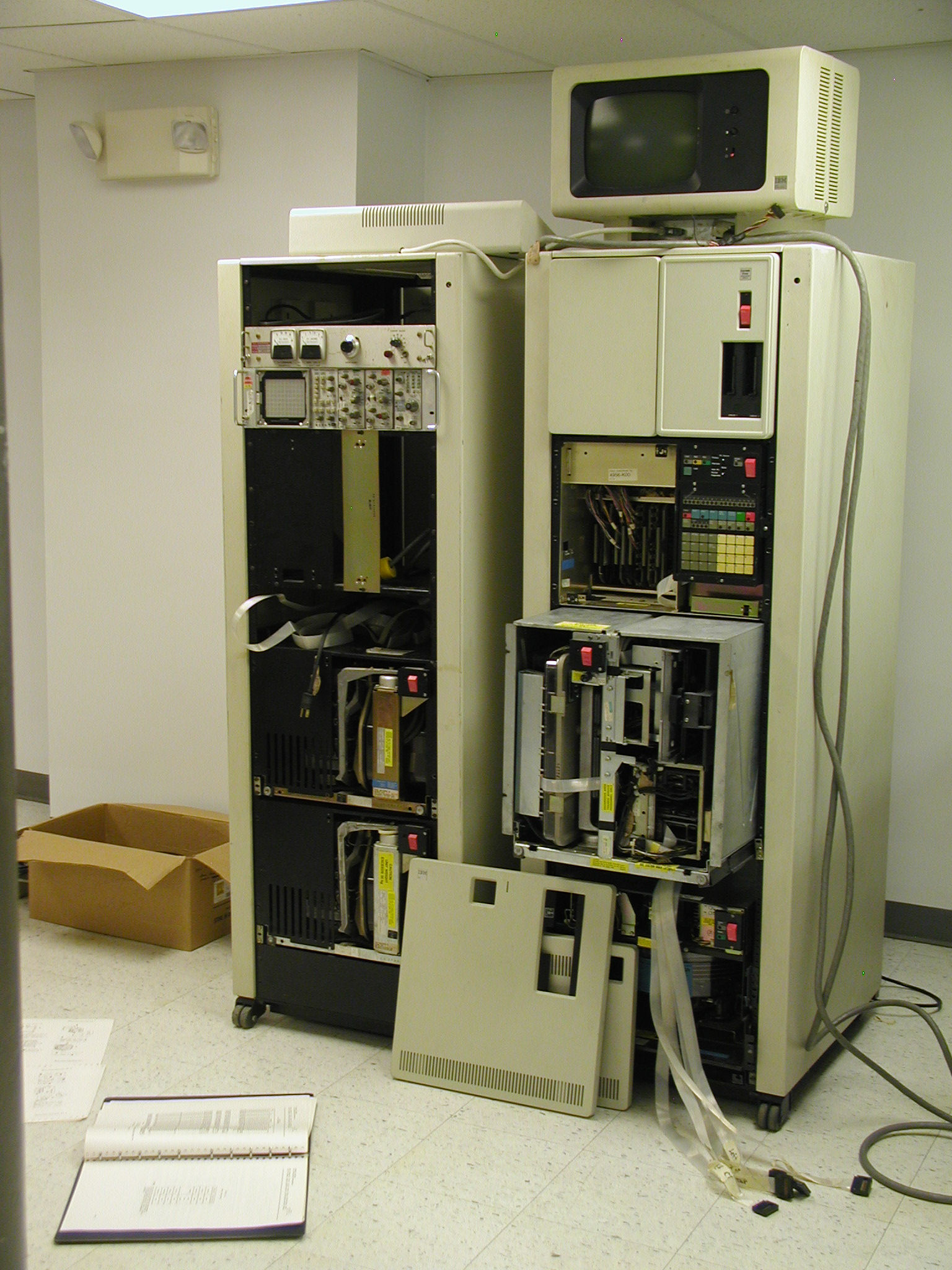
IBM Series / 1
Today, magnetic tapes, punch cards and floppy disks seem like yesterday. But they continue to be used. Magnetic tapes allow you to store data cheaper than when using SSD and HDD. Floppy disks cannot get away due to tight integration in some institutions, for example, in the healthcare system of some countries. And one of the very first carriers, a punched card, is still used for the same purpose for which it was created - in weaving and knitting machines.
Many of us have not seen audio and video tapes, bobbins with magnetic films, floppy disks, and even more so punched cards and punched tapes. These carriers, some of which have been known since the 18th century, have almost disappeared.
But only almost. Today we will talk about the times when soft data carriers were in use, and that they are still alive thanks to their firm rooting in state and military institutions and research centers.
Punched cards and punched tapes
Punched cards, which we know as a way of storing and transmitting information for computers in the 1920-1950s, go back to pre-computer time. Namely, in 1725, when perforated paper was used to control a loom.
Basil Bouchon, son of an organ picker, adapted the system used to automatically play music (“deployed” a cylinder with pins / cribs) to the needs of weaving.
He used perforated paper in a roll so that the machine reproduced the pattern on the fabric. Bouchon's colleague, Jean-Baptist Falcon, replaced the paper tape with perforated cards fastened together.
The Basil Bouchon loom
The mechanism was perfected by Joseph Marie Jacquard. Own loomfor coarse fabrics he created in 1804. Perforated cards allowed in automatic mode, almost without the participation of the master, to carry out a certain alternation of raising and lowering the warp threads in order to display a given pattern on the fabric.
Perforated cards in the Jacquard loom.
The result of the Jacquard loom.
In the weaving business, the Jacquard looms, improved and automated, are still used. But punch cards still work. Below you see an example of a punch card from the home economics site for the Brother machine - with a motorcyclist for a children's sweater.
Card for modern knitting machine Brother
Charles Babbage in 1822 built the first model of his difference machine, which consisted of rollers and gears rotated with a special lever. Then he asked the British government to finance his future work. In the process, he faced many problems, so after nine years the work got up. Although partially the machine functioned and performed calculations. He later returned to work in 1847-1849. Babbage even designed a printer for this huge calculator, which in 2000 was launched at the London Museum of Science.
Main partsThe analytical machines had a “warehouse” for storing numbers, a “mill” for performing arithmetic operations, a device that controls operations, and input and output devices. Punch cards were used to enter data into the memory: one mechanism with punch cards set the operations of the mill, the second controlled the transfer of data between the mill and the warehouse. The output device, that is, the printer, could reproduce the result in one or two copies in the form of a print or punch it on punch cards.
Punches for Babbage Analytical Machine
In those same years, in the first half of the 19th century, the Russian inventor Semyon Korsakov worked on mechanical intelligent machines. He became one of the pioneers in the use of perforated cards in computer science. In 1832, he created his first device, operating on the basis of perforated tables and designed for the tasks of information retrieval and classification. It was a homeoscope with fixed parts.
Each line of the homeoscope corresponds to a certain symptom - a symptom of the disease. In the vertical column was a set of signs - pathological symptoms, of which one or more characterized the disease. The bottom line contained the solution to the problem - a medicine that will help with the disease.
The homeoscope itself was a cylinder with pins. The operator selected symptoms from the first column — for example, a cough and a runny nose — and pushed pins. Then he led the cylinder to the right along the table: when the cells were perforated in the right places, the homeoscope stopped, and information on the treatment of the disease could be read in the bottom line.
It was a kind of Excel spreadsheet (before spreadsheets), tailored to the needs of a doctor.
Homeoscope with Fixed Parts The
U.S. Census in 1880 took eight years, and the 1890 census took just a year. This difference is due to the introduction of a counting machine working on punch cards.
In the 1880s, inventor Herman Hollerith patented punch card equipment. His statistical tabulator allowed to speed up the census, after which Choleritus became a professor at Columbia University.
The buyers of TMC's Tabulating Machine, the Tabulating Machine Company, are railway departments and government agencies. In 1924, the company was renamed IBM - International Business Machines.
Punch
card Hollerita IBM produced electric tabs on punch cards until 1976. The latest model was the IBM 407. Its rental cost from $ 800 per month - about $ 5,000 for 2016.
IBM 407
card for language FORTRAN
In the USSR producedT-5M, T-5MU, T-5MV and TA80-1 tabs. The first three worked with digital information, and the fourth with alphanumeric. To enter information, 80-column and 45-column perforated cards were used. The tabulators worked with summary, reading and reproducing rotary hammers, with electronic computing and multiplying consoles at machine-counting stations.
T-5 MV
tabulator at a machine-calculating station: Source Soviet-designed 80-column punch card for IBM tabulator, 1980
In 1938, German engineer Konrad Zuse built one of the first programmable computers in the world - Z1. The machine had an input device in the form of a keyboard made of a typewriter, an electric drive and was able to calculate data in the decimal system in the form of floating point numbers. Data was displayed using the panel on the lamps.
The machine performed the multiplication in 5 seconds. The clock frequency was 1 Hz. The system worked due to the engine of a vacuum cleaner with a capacity of 1 kilowatt.
The Z1 was equipped with a punched tape reader that provided an opcode for each instruction.
Konrad Zuse and recreated after World War II computer machine Z1
Punched tape for computer Z1
In the 1940s, American gunners used shooting tables containing information about the corrections of the sight in accordance with the distance to the target. Trajectory calculations by one person for one type of gun and one projectile took more than two weeks. It was necessary to calculate about three thousand trajectories for many combinations of parameters - air temperature, soil density, wind speed and so on. A scientist from the University of Pennsylvania, John William Mokley, decided to use vacuum tubes as an element base for an electronic differentiating machine. This begins the story of ENIAC, and then its improved version - EDVAC.
ENIAC was assembled in 1945. The first task was mathematical modeling of a thermonuclear explosion of a super-bomb according to the Ulam-Teller hypothesis. The task was so complex that even with ignoring many physical effects and simplifying the equation as much as possible, it took a million punch cards to enter the program into the computer.
For reading punch cards used the IBM tabulator. One of the problems of this storage medium was the low speed: it took too much time to punch on the cards the data output during the calculations and enter them into the machine for further calculations. To solve this problem, the inventors began to work on new ways of entering and storing data - on magnetic tapes.
The first ENIAC programmers: Squatting - Ruth Lichterman, standing - Marilyn Weskoff. 1946 year. A source
Spools of clean punched tape Soviet-made. A source
Magnetic tape
In 1898, the Danish physicist and engineer Waldemar Poulsen patented a method of magnetic recording over wire. The device was called the "telegraph." From the amplifier, the signal was supplied to the recording head, along which the wire moved at a constant speed and was magnetized according to the signal.
In 1927, a German engineer Fritz Pfleimer sprayed iron oxide powder onto thin paper with glue, and a year later received a patent for the use of magnetic powder on paper or film. But the patent was canceled due to the fact that such use of the powder was set forth in the Poulsen patent.
The ideas of Poulsen and Pfleimer were used by AEG, which developed the Magnetofon-K1 magnetic recording device. The magnetic tape for the “magnetophone” was produced by the chemical concern BASF. The device was presented at a radio exhibition in Berlin in 1935.
U.S. Patent for magnetic wire recorder. Source
"Magnetophone-K1"
In 1951, the inventors of the ENIAC computer, John Eckert and John Mockley, worked on a new machine. She became the first conditionally commercial computer in the United States - UNIVAC I. The computer was built for the needs of the Air Force and the topographic service of the US Army, and the order was placed on behalf of the Census Bureau. A total of forty-six copies of UNIVAC I were produced for installation in government offices, private corporations and universities. The second copy was installed in the Pentagon. The last copies were turned off in 1970 after 13 years of service at a commercial insurance company.
The cost of the car began with $ 159,000. Over time, the price ranged from $ 1,250,000 to $ 1,500,000. Translated into 2016 money, the maximum price of UNIVAC I was $ 12,480,000.
For the first time, magnetic tape was used in this computer as a storage medium. Up to ten UNISERVO tape drives could be connected at the same time.
UNISERVO was the first tape drive for a commercial computer and was a success. UNIVAC nickel-plated bronze tapes were half an inch wide and up to 450 meters long. Data was recorded on eight tracks, where six were for data, one for parity, and one for synchronization. One tape contained 1,440,000 six-bit characters.
UNISERVO tape drives for UNIVAC
In 1960, IBM developed the first plastic cardwith a magnetic strip. Barcodes and perforations were not reliable, and for bank cards it was necessary to come up with a new way to store data. The choice fell on magnetic tape. Today, all bank cards have magnetic tape, although they are increasingly starting to use chips and NFC.
The first prototypes of magnetic stripe cards.
In personal computers of the 1970-1980s, audio cassettes were often used to store information. Playback and recording of programs was carried out either with the help of special drives, or with the help of ordinary household audio tape recorders. Try saying out loud an “audio recorder” - it sounds somehow unusual, right?
Sinclair ZX Spectrum + 2
Atari XC12 tape recorder for Atari 65XE and 130XE computers. A source
Many have already forgotten what audio cassettes and video cassettes look like. Someone had never seen or held them. But for business and research centers, magnetic tapes are still of great importance.
CERN uses magnetic tape to store the results of the work of the Large Hadron Collider ; in addition, they combine clouds with NASA magnetic tapes and Discovery TV channel. Large corporations also sometimes choose magnetic tapes. The advantage of the technology is the price - each gigabyte of storage costs from two to three cents. The speed of working with files is low due to sequential access - from several tens of seconds to a minute. But for data that does not require quick access, it is perfect. Up to 80% of corporate data can be recorded on tape, IBM believes.
IBM continues to work on improving formats. In 2015, scientists from the company were able to record data on magnetic tape with an efficiency of 123 billion bits per square inch. So they exceeded in 88 the existing LTO-6 format since 2012, according to which you can record 2.5 TB of data on a middle-class film. Even earlier, in 2012, IBM, together with Fujifilm, began developing prototypes of cassettes measuring 10 x 10 x 2 centimeters, capable of storing up to 35 terabytes of data.
Floppy Disk
The main drawback of magnetic tape is sequential access to data. This problem was solved in the 1960s by the team of Alan Shugart in the IBM laboratory. One of the senior engineers David Noble in 1967 proposed the use of a flexible magnetic disk with a protective casing. In 1971, the company introduced the first 8-inch floppy disk with 80 kilobytes and a drive for it.
8-inch IBM 128-kilobyte diskette
A computer operator uses an 8-inch diskette.
Shugart founded his own company Shugart Technology in 1971 and joined the development of mini-floppy disks for personal computers in 1976. The company released a drive for 5 диск-inch floppy disks, which displaced 8-inch drives from the PC market.
In 1981, Sony released its own version of floppy disks, this time with a diameter of 3½ inches. They began to be used in computers HP, Macintosh, IBM, Atari, Commodore.
The first versions of floppy disks had a capacity of 720 kilobytes, in later floppy disks this figure was increased to 1.44 megabytes. The result was improved by Toshiba, introducing a 2.88 megabyte disk in the 1980s. I only remember 1.44 MB floppy disks - because the format from Toshiba did not take root .
Floppy Disk Advertising, 1986
External USB Drive
Three generations of
Hitachi floppy disks discontinued floppy disks in 2009. Sony shut down factories in 2010, after selling a total of forty-seven million floppy disks.
Toshiba in 2014 found a new application for its floppy disk factory: converted it into a farm for growing lettuce, which does not need to be washed.
Toshiba Vegetable Farm is a converted floppy drive workshop. Source
It would seem that the era of floppy disks ended in December 2015, when the Norwegian government stoppeddistribution of patient lists of clinics on floppy disks. But this is not so. In June 2016, we learned that hospitals in South Australia continue to use medical software based on MS-DOS, developed back in the 1980s, and use diskette to store data.
But here we are talking about 3½ floppy disks, a relatively modern version. At the same time, the US nuclear arsenal is controlled using 8-inch floppy disks! IBM Series / 1 was integrated into the arsenal infrastructure in the 1970s, and these systems still work. Systems are planning to replace in 2017.
3.5 gigabytes of medical information on two and a half thousand floppy disks. Norway 2015
IBM Series / 1
Today, magnetic tapes, punch cards and floppy disks seem like yesterday. But they continue to be used. Magnetic tapes allow you to store data cheaper than when using SSD and HDD. Floppy disks cannot get away due to tight integration in some institutions, for example, in the healthcare system of some countries. And one of the very first carriers, a punched card, is still used for the same purpose for which it was created - in weaving and knitting machines.