April 13, 2016 at 13:54
How a programmer created software for tracking market manipulations and became a thunderstorm for exchanges and HFT merchants
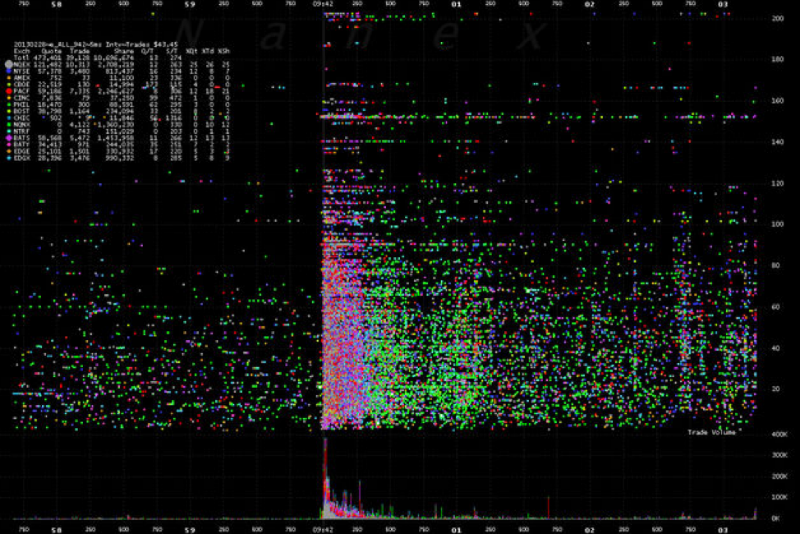
In our blog on Habrahabr, we talked about the Nanex system, which is used to visualize stock trading data. The resulting charts allow you to visually see the distribution of trading volumes and identify anomalies in price changes. Today we’ll talk about the creator of this system, which has become a real hit and a thunderstorm for hedge funds and HFT companies.
Thanks to his knowledge and thirst for justice, Eric Scott Hunseider has turned from a simple programmer from the American heartland into a real fighter with unfair play in the financial market and became his real star. Journalists from MarketWatch described the biography of the creator of Nanex, and we chose its highlights.
Self-taught programmer, light school
Hunseider was born in 1963 and grew up in the city of Manati, Florida. Talking about his youth, he recalls with a smile sailing along the coast of the Gulf of Mexico. His father was a farmer and grew tomatoes, and his mother was a housewife. The Hunseider, the second oldest among four siblings, was a smart teenager who easily attended school. “It was easy for me,” he said in an interview with MarketWatch. The Hunseider began trading stocks after graduating from college. He concluded that he needed to automate applications in order to succeed, so he decided to independently learn the C ++ programming language. His first trading program, which opens up long and short futures positions when their moving averages intersect, allowed him to make $ 36,000 out of $ 6,000 a year.
Such success could turn the young man's head, but instead he decided that he clearly lacked knowledge. He decided to leave independent trading for a while and began developing software for traders, having worked in a variety of companies conducting such projects.

Eric Hunseider
In 1995, confident that the Internet would fundamentally change trade, he quit corporate work to write a program that displays real-time information on stocks and futures. In 1996, he sold this Quote.com program, where he launched Livecharts, a real-time data visualization system, and QCharts, an automated trading workstation for Windows. When Lycos bought Quote.com in 1999, the Hunseider received a large sum of money and built a house in Illinois - his whole family lives there now.
And already in 2000, the Hunseider founded Nanex. A three-person company collected information on stock, futures and options trading on the New York Stock Exchange, Nasdaq, BATS and the Chicago Mercantile Exchange.
Nanex buys stock data - it uses both historical information and real-time quotes. The system stores about 4600 days of information, starting in 2003. “We are constantly buying new servers,” says Hunseider.
“I looked behind the scenes and I didn’t like what I saw”
Exchanges began to master electronic trading about three decades ago. E-commerce has allowed some companies to take advantage of the rapidly changing market situation in milliseconds faster than their competitors had time to do, which triggered a technological arms race . Over the past 15 years, the global financial market has become much more fragmented: where previously there were three major US exchanges, now there are more than 40 exchanges and alternative trading systems.
Today, HFT traders use algorithms to analyze the market situation and instantly respond to the slightest changes that can also be caused by the actions of robots. Technology has made trading faster and more efficient. But the system has not become more transparent, rather the opposite. Many began to wonder if HFT-traders are useful, which, in fact, can gain advantages over other bidders due to their incredible speed.
On May 6, 2010, the Dow Jones Index fell nearly 1,000 points, the biggest intraday drop of all time. Government investigation called a large warrant as the reason for the failure, which provoked a panic sale of financial instruments, which led to an instant collapse of the stock market. However, the structural problem, which led to a sharp drop in the largest financial market by 10% in 20 minutes, was not identified.
In a study published in June of the same year, the Hunseider suggested that high-frequency trading companies reacted to the same large order with a huge number of their applications, which were canceled before execution. This has led to the "clogging" of the flow of quotes, which is necessary for traders to complete transactions.
According to Hunseyder, the use of techniques like this creates an illusory liquidity, which led to the collapse of the stock market and subsequent dramatic events. To describe the problem, he introduced the new term “quote stuffing”. The Hunseider said that "it was something similar to a network attack on a website, the system simply cannot handle it and is falling apart."
Hunseider, being confident that he was able to identify the main structural problem, later published more than 2,000 reports telling about all kinds of manipulations. Some, with just a few suggestions, others with a detailed explanation of how, in his words, the markets are being manipulated.
“I looked behind the curtains and didn’t like what I saw,” says Hunseider. In reports and social media, he criticizes non-HFT merchants, exchanges that are free from criminal prosecution; regulatory structures that do not do enough to protect investors.
The use of “clogging quotes” and other similar tactics must be prosecuted. But so far, such cases have been isolated, and the Hunseider explains this by the fact that the exchanges themselves are not actively investigating the manipulations on their trading floors - in many of them large customers can be blamed that no one wants to quarrel with.
In turn, representatives of exchanges, such as BATS and the Chicago Mercantile Exchange, assure that their companies are closely monitoring possible violations of trade rules, since their main task remains to protect the interests of investors. Some of them, such as the New York Stock Exchange and Nasdaq, generally refuse to comment on Hunsader's accusations.
Hunsader's investigations have earned him fame as a fighter with the system, whose advice is asked by traders, brokers and economists. When there are sharp drops in the market like a collapse on August 24, 2015, when the Dow Jones index fell by 1000 points in 30 minutes, journalists and investors bombard him with letters and calls. Representatives of the state are trying to enter into a dialogue with him - the Hunsader was invited to round tables and discussions in the Federal Reserve System of Chicago.

Hunsader has become a small media outlet about the situation in the financial markets - he sends dozens of tweets per day, the number of his followers on Twitter exceeds 72,000, including major exchanges, banks, officials, traders, portfolio managers and journalists. He often illustrates his posts with graphs, attaches links to other articles and screenshots of other people's posts. He calls his profile the source of "clean news without a filter." “Whether they want it or not, he has a voice in this discussion,” says Brad Katsuyama, director general of the IEX alternative trading system.
In life, Hunseider is very friendly and polite, he prefers informal conversation to formal interviews. He especially loves to talk about his family and the achievements of his four daughters. However, in public, he can be quite tough and adamant. On Twitter, he called one reporter a “ lobbyist ” and suggested that subscribers ignore the marketing research of one CEO so as not to “waste valuable time” and “a few IQ points .” He recently added a Wisconsin congressman to the Wall of Shame and used a swear word for a popular TV network .
MarketWatch reporters tried to contact representatives of financial companies, which Hunsader often criticizes. Citadel and KCG declined to comment for an article about him. Virtu did not respond to a few comment requests. In response to a request to comment on the views of the Hunsader, Bill Harts, CEO of Modern Markets Initiative, replied via e-mail that the group “does not know that Mr. Hunsader has conducted any outstanding research” on high-frequency trading.
Alternative to familiar exchanges
Hunseider is a supporter of the IEX trading platform, owned by asset managers and venture investors - we wrote about this site in this article . Unlike other exchanges, IEX organizers introduced a delay of 350 microseconds to execute orders in order to equalize the capabilities of all bidders. According to Hunseyder, the data show that the IEX exchange has the highest percentage of completed transactions at the midpoint between the purchase and sale prices, which indicates honesty and objectivity.
IEX, which carries out about 2% of transactions with US securities, is fighting to obtain registrationas a national stock exchange. The company filed an application back in September 2015, but the Securities and Exchange Commission is in no hurry to satisfy it - despite a large number of statements in support of the initiative by traders and investors. Old US exchanges and large HFT companies like Citadel opposed IEX registration.
The main threat is a loss of confidence in the market
According to Hunseider, faith in justice and transparency reinforces his fears. The current rules are sufficient to protect investors' interests, but often the exchanges themselves, large financial organizations do not comply with these rules, and regulatory authorities do not hold them accountable. This is partly due to the fact that a technology has not yet been introduced that would help track possible manipulations in real time.
Hunsader complains about the lack of a consolidated system of financial analytics, which would process information about the auction and analyze market events. The existence of such an instrument would help regulators to monitor anomalies prior to asset price fluctuations. Without all this, the Securities and Exchange Commission simply does not have enough convincing evidence of offenses, even when their presence seems very likely.
Some agree with the Hunsader. In September 2015, Commissioner Commissioner Kara Stein said that “speed and complexity have become almost insurmountable forces in the market, effective supervision simply cannot happen without a consolidated financial analytics system.” The co-founder of Themis Trading and, concurrently, another critic of the HFT merchants, Joe Saluzzi, told reporters that "the markets have advanced several light years ahead, while the surveillance system is very outdated."
In 2012, the Securities and Exchange Commission ordered the creation of a consolidated financial analytics system, entrusting it with a partnership of national stock exchanges and associations, among which the New York Stock Exchange, Nasdaq, BATS, the Chicago Mercantile Exchange and the Financial Institutions Regulatory Agency (independent non-profit organization authorized by Congress to regulate market participants).
The project was planned to be implemented in 2015. According toFinancial Times, more than 700 meetings were held to discuss options, costs, suppliers, etc. As a result, as of November 2015, only a short list of potential data providers was published, including the Financial Institutions Regulatory Agency (Finra), SunGuard and Thesys, which the Commission is still considering. All this greatly upsets the Hunseider, who calls the task “indecently simple”, since he himself is able to collect similar data from his system, although they will not contain identifying codes of bidders. He recently announced on his Twitter account that such an analytical system for detecting manipulations “will never be created.” The SEC does not comment on the progress of this project.
The Hunseider also complains about the legal immunity of the exchanges - an investor who believes that the site has provided important financial information to other players earlier will not be able to sue it. Such immunity was granted to exchanges, as they were initially created as non-profit membership organizations and regulated by federal agencies.
Many observers believe that they should have lost this immunity, becoming full-fledged commercial corporations. Without immunity, it would be easier to make exchanges accountable to market participants. Hunseyder also believes that the fines for breaking the rules are too small.
The Hunseider is always adamant about his demands for justice and the rule of law. Both in interviews and in social networks, he says that he fears a possible undermining of investor confidence in the financial system due to the problems that he identified. And this, in turn, can lead to serious upheavals in the markets themselves: “As soon as people understand that they are being deceived, they will cease to participate in this. What then will become with the subject of pride of the United States? ”
Other materials on the topic of algorithmic trading on the ITinvest blog :
- How Big Data is Used for Stock Market Analysis
- Experiment: creating an algorithm to predict the behavior of stock indices
- GPU vs CPU: Why are GPUs used to analyze financial data?
- How to Predict Stock Price: Adaptive Filtering Algorithm
- Algorithms and Exchange Trading: Hiding Large Transactions and Stock Price Prediction