August 8, 2017 at 07:46
Isaac Semenovich Brook - a tireless creator, an original designer, an uncompromising leader
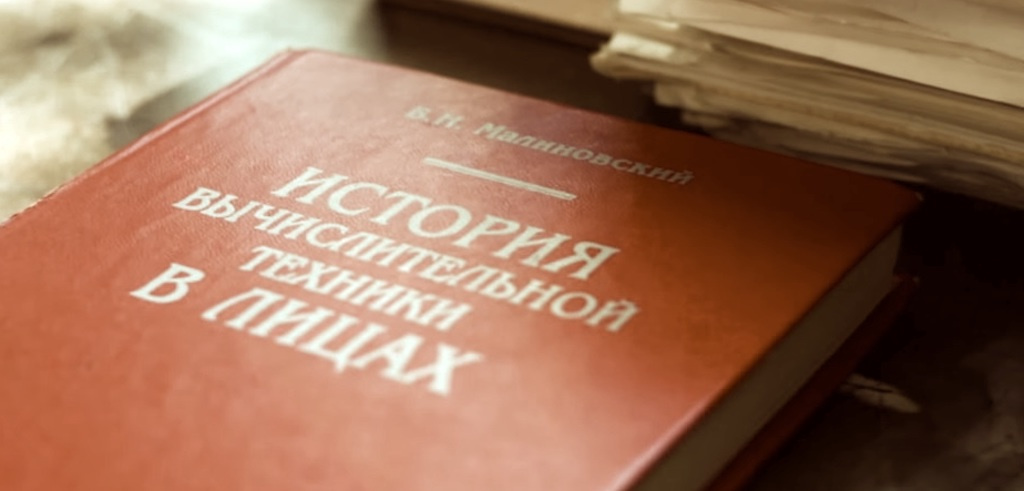
The universe is infinite, so vast that any point can be considered its center
Turning over the pages of the history of the development of domestic computer technology, one cannot help but recall the outstanding inventor and experimenter Isaac Semenovich Brook. More than 100 scientific works, 50 inventions, he made a significant contribution to the creation of small and control machines. A remarkable scientist, a corresponding member of the USSR Academy of Sciences and just an interesting person, it combined an irresistible desire for knowledge of the new and fearlessness when translating ideas into reality. I.S. Brooke became the first director of the Institute of Electronic Control Machines (INEUM) of the Academy of Sciences of the USSR, where under his leadership small digital computers M-1, M-2, M-3, M-4, M-5, M-7-200 and M-7-800.
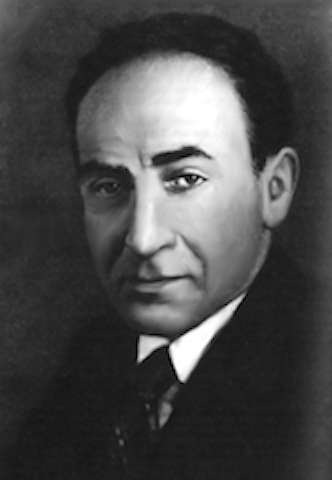
In the city of Minsk on November 8, 1902, Isaac Semenovich Brook was born into a Jewish family. Father was a simple employee in a tobacco factory, although the family was not rich, but parents did everything possible to ensure that their children received a good education and upbringing. In 1920, Isaac graduated from a real school, and his two sisters - Masha and Mirra - studied at the gymnasium and music school. From an early youth, Isaac showed considerable interest in technology, machines, various mechanisms. He was a frequent guest at the Energia electromechanical plant, where he came in the hope of obtaining unnecessary parts, pieces of iron from the masters. He brought them home, turning his room into a real workshop. How the sponge absorbed explanations about the principles of operation and the arrangement of machine tools. He was a very curious boy, read a lot of J. Verne, J. London, painted, was fond of astronomy.
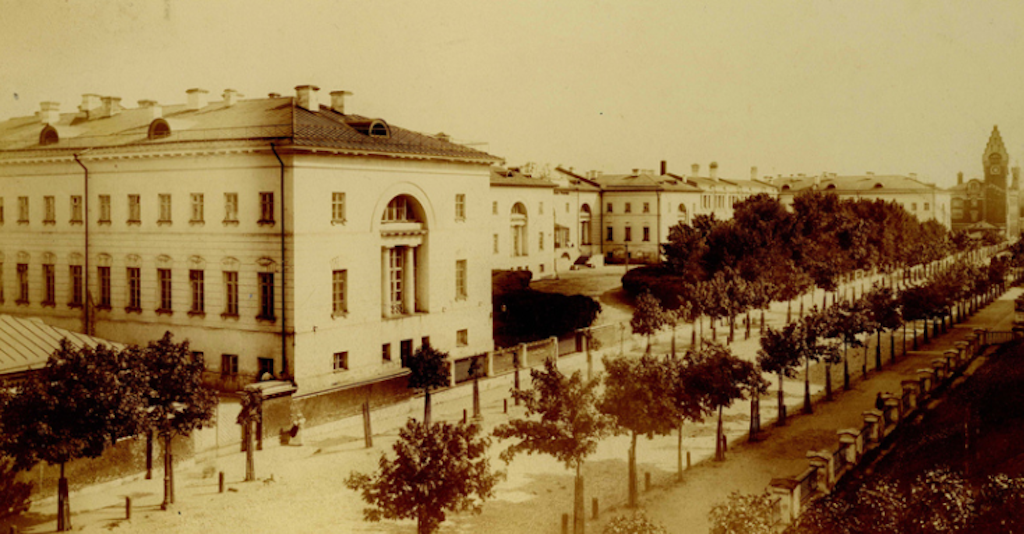
Faculty of Electrical Engineering MVTU im. N.E. Bauman
In 1920, Isaac entered the Faculty of Electrical Engineering of MVTU im. N.E. Bauman in Moscow. While studying, he was engaged in research, his thesis was on how to regulate asynchronous motors. Working at the All-Union Electrotechnical Institute. V.I. Lenin, took part in the creation of a new series of induction motors and in solving the problems of parallel operation of electric generators. Despite the fact that these were difficult post-war years, Brooke was happy doing what he loved.
Electrical Systems Laboratory
From 1930 to 1935, a young researcher worked at an electrical plant in Kharkov, where under his watchful guidance electric machines of a new design, explosion-proof asynchronous motors were created. Returning to Moscow, a talented young engineer was recommended by academician K.I.Shenfer to work at the Energy Institute of the USSR Academy of Sciences (ENIN). In the laboratory of electrical systems organized by Brooke, the regimes of powerful energy systems were calculated. The simulation of such systems required the creation of an AC current table, later called an analog computer. For which, in May 1936, Isaac Brook was awarded the degree of candidate of technical sciences. He defended the dissertation “Longitudinal compensation of power lines” in October.
Research in the electric power industry required complex calculations, the scientist was well aware that moving forward without the help of computing tools was simply unrealistic. In 1939, under his leadership, a mechanical differential analyzer was created, which made it possible to solve systems of differential equations up to the sixth order. The dimensions of the device were impressive - the area occupied by it was 60 sq.m. After introducing the integrator-analyzer at the Presidium of the Academy of Sciences, Brook was elected a corresponding member of the USSR Academy of Sciences.
During the war, Brooke was engaged in research in the field of energy, research on the static stability of energy systems. Under his leadership, work was carried out on the development of frequency and active power control equipment for the largest power plants in the USSR.
The scientist did not stop working on analog computers. Isaac Semenovich studied foreign publications on digital computers, was an ardent participant in a scientific seminar under the Presidium of the USSR Academy of Sciences, which raised questions about the need for automation of computing. As a result, the Institute of Precision Mechanics and Computer Engineering began its existence in the summer of 1948. But, alas, Brooke and his laboratory were not included in the formed institute. This happened why ...

B. I. Rameev
In 1948, I. S. Brook, together with the young designer B. I. Rameev, who raved about the idea of creating something similar to the first American computer “Eniac”, jointly developed a digital computer project with tight program control. In December 1948, they managed to obtain a copyright certificate for the invention of the “Automatic Digital Machine”. The first copyright certificate for an invention in the field of digital electronic computing in the USSR. Isaac was a born creator of machines, but not the chief designer, and therefore, when Rameev was drafted into the army in 1949, the scientist lost his only performer. The high-profile project remained just on paper, unrealized.
Creation of M-1 - the first small digital computer or bet on youth
Isaac Semenovich understood that now, as never before, he needed assistants, because in 1950 he made a request to the personnel department of the Moscow Energy Institute. Young, enthusiastic people began to gather in the laboratory of electrical systems, led by Brooke. According to the memoirs of M.A. Kartsev - at the beginning of the 50s he was a leading computer developer in the laboratory - none of those who came to pick up Soviet computer equipment was a specialist in this field, and in principle it was not known whether an electronic computer could exist. 10 people, among whom there was a graduate of Moscow Power Engineering Institute N. Matyukhin, graduates T. Alexandridi, M. Kartsev, who graduated from college R. Shidlovsky,
began working on the development and creation of a small digital computer M-1.
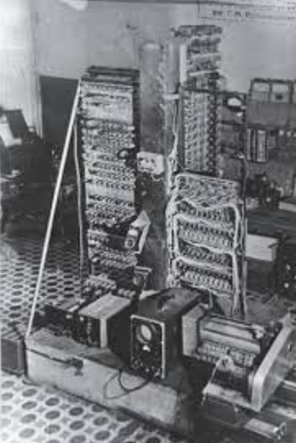
ACVM M-1. View from the side of the magnetic drum
From the memoirs of Nikolai Yakovlevich Matyukhin:
Our group was small, and, probably, this was one of the main factors that made I. S. Brook direct our efforts towards creating small computers (at that time). None of the recruits, of course, imagined the whole complexity of the work ... Perhaps that is why we had no doubt that we would make a car, although the level of electronic equipment of those years among experienced specialists could cause serious concerns about the reality of this venture. Fortunately, we had no idea that the lamps and radio components tend to fail quite often, and without any hesitation set to work ...
The work was in full swing, after only two months in April 1950, I. S. Brook drew up a resolution of the Presidium of the USSR Academy of Sciences on the creation of a digital computer. In one of his books, B. N. Malinovsky writes that such decisive actions were caused by the arrival of N. Ya. Matyukhin, a young specialist in the field of radio engineering, in Brook’s laboratory. He was incredibly talented, while still a student he took part in scientific research. Brooke set him the first task - to design an important computer unit, a tubeless decoder. Initially, having no idea what a computer is, Matyukhin actually became the chief designer of the M-1.
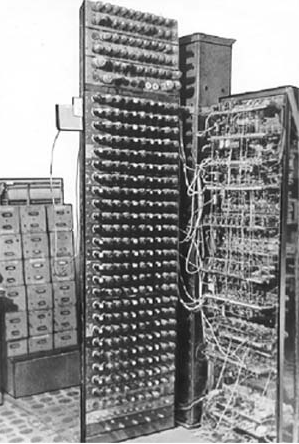
I. S. Brook, the scientific leader of the development, provided the student with the necessary literature, more than once had conversations in which he touched on such issues as the principles of computer operation, the binary number system, and numerical methods of calculations. His idea was to use German cuprox rectifiers instead of electron tubes to build logic elements. The following were implemented in M-1: a two-address command system, the arithmetic logic and control circuits of the machine were built on the basis of semiconductor diodes, cathode ray tubes from ordinary oscilloscopes were used as RAM elements, and a teletype was used as an input-output device.

young N. Ya. Matyukhin
In 1952, a machine built on the basis of architecture with a stored program was put into operation. M-1 - the first computer in the world in which all logic circuits were made on semiconductors, performed 15-20 operations per second on 23-bit numbers and had a memory capacity of 256 words.

The program of the first task solved at M-1, 1951
It was an incredible breakthrough of a young talented team - it took less than two years for the M-1 to work. I would like to take into account the fact that all 9 employees, except Brook, who were involved in the creation of the device, did not even have academic degrees.
Creating a more advanced digital computer M-2

In the spring of 1952, I. S. Brook allocated a group of 7 people to M. A. Kartsev for the development of the M-2 digital computer. A group of MPEI graduates led by M. A. Kartsev designed and built a more advanced computer, its performance was equal to that of Strela and BESM computers - 2 thousand operations per second. Oscillographic CRTs were used as memory elements, and semiconductor diodes were used in logic circuits. Due to this, the M-2 had 4 times less electronic tubes, the energy consumption decreased by 7 times, 22 square meters were required to place the device. meter. In January 1953, the M-2 was already working with a magnetic drum, and in the summer with electronic memory.

Over the next three years, Kartsev realized the idea of shortened addresses in teams and shortened operation codes. In 1957, the M-2 was modernized, the capacity of the OP was up to 4096 words. On a small computer, calculations were performed for the Institute of Atomic Energy, the Institute of Theoretical and Experimental Physics of the Academy of Sciences of the USSR, the Design Bureau of Academician S.P. Korolev and many others. The M-2 machine was in a single copy and worked at the Energy Institute of the USSR Academy of Sciences for 15 years, there were rumors that they tried to create it in China.
Small computer M-3 for design and research institutes
In 1955 - 1956, Isaac Brook formulated the concept of small computers and their differences from machines of maximum performance. The Laboratory of Control Machines and Systems of Brook, Academy of Sciences of the USSR and NIIEP began to develop a small computer M-3. The main ideas of the construction were proposed by Brooke, Matyukhin, Belynsky, Kagan, Dolkart.

Small computer M-3 A
machine with a capacity of 30 operations per second operated with 30-bit fixed-point binary numbers, had a two-address instruction format, memory on a magnetic drum with a capacity of 2048 numbers, performance increased when working with ferrite memory - 1.5 thousand operations per give me a sec. Occupied area M-3 - 3 square meters. meter, was mass-produced at the plant them. S. Ordzhonikidze in Minsk. M-3 became the prototype for two industrial computer series - Minsk and Hrazdan. M-3 consisted of 3 cabinets:
- main cabinet with arithmetic unit, local and central control systems and machine control panel
- a storage cabinet with a magnetic drum, recording and reading amplifiers, and a number selection control device
- power cabinet
There was a table for placing telegraph equipment, which was used as input devices for information from punch tape and printing and punch tape.

Construction of the plant. S. Ordzhonikidze in Minsk
An interesting fact: the work on creating the M-3 computer was not originally included in state plans, because the commission, headed by academician N. G. Bruevich, did not want to accept the car, two years passed before it was put into mass production.
Creating a control computer M4, M-5, M-7
The first domestic machine, built on the second-generation elemental base, was developed in 1958-1964 for real-time control of a complex of radar stations (the complex was part of a radio-electronic monitoring system for artificial Earth satellites).
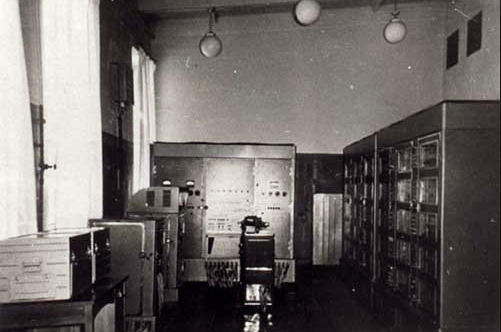
M-4
Initially, M-4 with an OP capacity of 1,024 24-bit numbers and a read-only memory program with a capacity of 1,280 30-bit numbers worked with 23-bit fixed-point numbers. Performance M-4 - 30 thousand operations per second.
The upgraded M4-2M with a capacity of 220 thousand operations per second, with RAM up to 16 29-bit words, since 1964, has been in serial production for 15 years. In 1968, peripheral machines M4-3M were created for it for input and primary data processing.
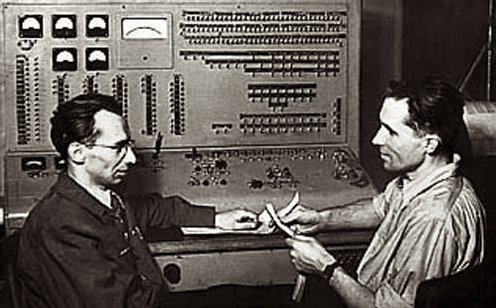
M-5
Under the direction of I.S. In 1958-1961, Brook created the M-5 universal computer based on transistor elements and ferrite memory with a multiprogram mode of operation. It was developed for planning and economic calculations, was built on the technical basis of the second generation, but its architecture was literally the forerunner of computers of the third generation. The computer operated with 37-bit fixed-point and floating-point numbers; the 37-bit unicast instruction format contained address, key, index, and operation code fields.
M-5 never went into mass production, as the Minsk plant them. S. Ordzhonikidze, who was supposed to do this, at that time launched the production of the Vesna computer.
In 1966-1969, I. S. Brook was the head of the development of the M-7 control machine. It was a digital sequential control machine with memory on a magnetic drum and developed communication devices with the object, operated with 12-bit fixed-point numbers.
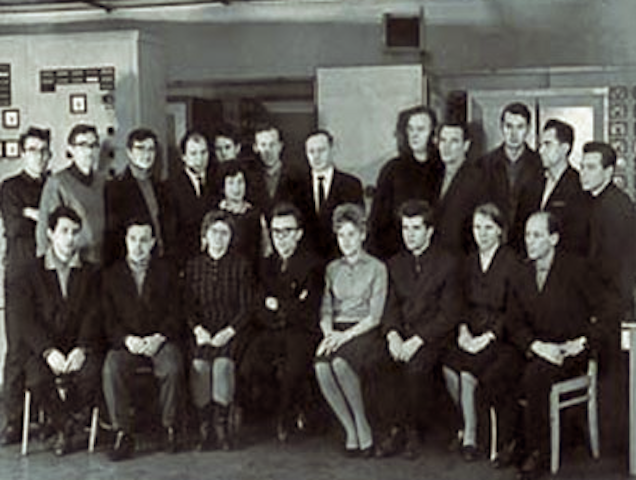
M-7 and its creators
Such a computer was created for control systems of powerful heat and power units of power plants; its functions were to support operating modes of a power unit, minimize fuel consumption, complex logic programs for starting and stopping a power unit, and analyze combinations of power unit operation parameters.
Institute of Electronic Control Machines (INEUM), USSR Academy of Sciences
At a session of the USSR Academy of Sciences on Automation in 1956, Isaac Semenovich made a report in which he talked about the main areas of industrial use of computers and control machines. The Institute of Electronic Control Machines of the Academy of Sciences of the USSR (INEUM) and many research institutes and design bureaus in the field of creating control machines and systems of the USSR were created to solve the scientific problem posed by Brook in 1957, “Development of the theory, principles of construction and use of electronic control machines ". It was published by the USSR Academy of Sciences in 1958 in the series “Questions of Soviet Science”. Here the very concept of specialized control and computing machines was formulated, their important role for the national economy was substantiated,
Control computers differed from universal computers not only in the nature of communication with the control object, but also in high reliability, real-time operation, and the possibility of using the external environment in extreme industrial conditions.
The first director of INEUM was appointed I.S. Brook. In 1958, he was approved by the Presidium of the Academy of Sciences of the USSR as the scientific adviser on the problem “Development of the theory, principles of construction and application of control machines”.
In the walls of INEUM from 1957 - 1969, control vehicles M-4, M-5, M-7-200 and M-7-800 were created.
I. S. Brook understood that in addition to using computers for scientific calculations and facility management, they can serve to process economic information and solve problems directly related to modeling the economy.

M-7-800
At INEUM, Isaac carried out work on the application of mathematical methods and computer technology to solve economic problems at the state level. Experts from the field of economics were involved, but such actions caused a storm of indignation from the leadership of the USSR State Planning Committee. Due to contradictions in 1964, Brooke resigned as director of the Institute of Electronic Control Machines.
Upon retirement, I.S. Brooke continued to work at INEUM as a scientific consultant and head of the INEUM Scientific and Technical Council. He took part in discussions and the choice of architectural, circuitry and design solutions for ASVT-M models. In the future, his recommendations were used in the development of the computer M-4000 / M-4030, M-400, SM 3 / SM 4.

Computer M-4000
Brooke is a great teacher and mentor
Isaac Semenovich could not stand any difficulties, incomprehensibility. Simplicity, reliability and durability, this is what a talented scientist was guided by. These concepts fully characterize his style of working with students and machines. After many years, the students warmly recalled the great mentor. Incredibly talented, optimistic about the result - Teacher with a capital letter. At his school, reigned respect, support and no hint of failure. Brooke found an approach to everyone, lit a light and zeal to create something new.
L. S. Legizo: “He knew how to approach everyone, and knew how to create a certain creative atmosphere around him. As a result, he created a team around him that gave powerful sprouts in our entire industry ... I would say that Brooke was like the core of the galaxy, generating some mental matter ... We learned concrete technical solutions from him, got a lot of thematic work experience, learned a systematic approach to future developments. ”
Isaac Semenovich Brook lived in a laboratory, constantly knocking out laboratory equipment, money, and employee bonuses from the management.
The scientist could not stand the deception, hypocrisy, being a man of his word, did not forgive the failure to fulfill promises and neglect of work. He was not afraid to criticize and express his disagreement with questions concerning not only computers, but also public administration.
I.S. Brook, as a teacher, played an important role in the formation and development of domestic computer technology. His students - B.I. Rameev, N. Ya. Matyukhin, M.A. Kartsev, G.P. Lopato, B.N. Naumov subsequently created their own teams and schools in which they followed the principles of the engineering school for the development of computational and control machines created by I. S. Brook.
The basic principle formed by Brooke is a careful balance of performance, reliability and cost characteristics when developing small and middle class machines. He required brilliant knowledge of the theoretical foundations of electrical engineering, pulse technology, the ability to make bold technical decisions when conducting major developments. He drew attention to the need for close cooperation of engineers and programmers during the development and creation of computers.
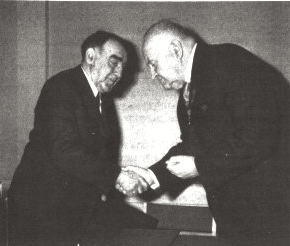
Isaac Semenovich Brook on the left
Isaac Semenovich Brook was awarded four orders of the Red Banner of Labor and USSR medals for his services in the field of domestic science and technology. More than 100 scientific papers bear his name, he received more than 50 copyright certificates for inventions.
He died on October 6, 1974 and was buried in Moscow at the Vvedensky cemetery.
I would like to end the article with surprisingly simple and at the same time deep words of an outstanding inventor:
We must try to understand how it works that you are dealing with, how it could be done better, and not put up with the shortcomings noted
As an advertisement. Stock! Only now get up to 4 months of free use of VPS (KVM) with dedicated drives in the Netherlands and the USA (configurations from VPS (KVM) - E5-2650v4 (6 Cores) / 10GB DDR4 / 240GB SSD or 4TB HDD / 1Gbps 10TB - $ 29 / month and above, options with RAID1 and RAID10 are available) , a full-fledged analogue of dedicated servers, when ordering for a period of 1-12 months, the terms of the action are here, existing subscribers can get 2 months as a bonus!
How to build the infrastructure of the building. class using Dell R730xd E5-2650 v4 servers costing 9,000 euros for a penny?