November 11, 2016 at 16:45
3D construction printers and our experience with them

3D printing in construction
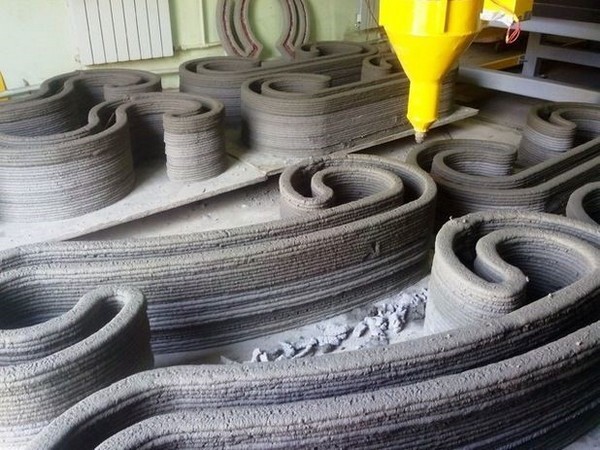
3D construction printers are engineering devices that create structural elements of buildings, small architectural forms or entire structures in layers - just like any 3D printer prints objects made of plastic or other material.
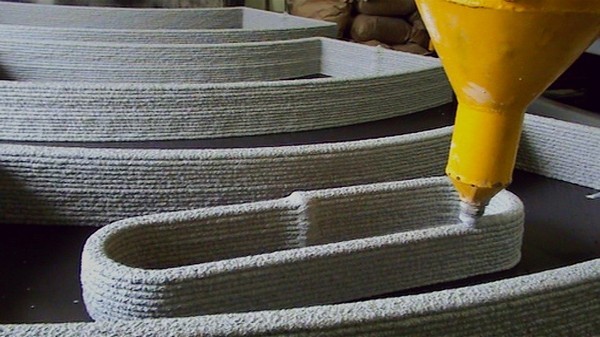
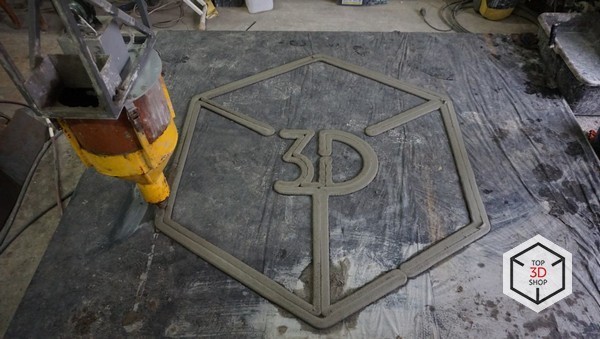
The building differs from the usual 3D printer in the used material and dimensions - the site of the construction site or workshop serves as its working surface, and it prints with a cement mixture.
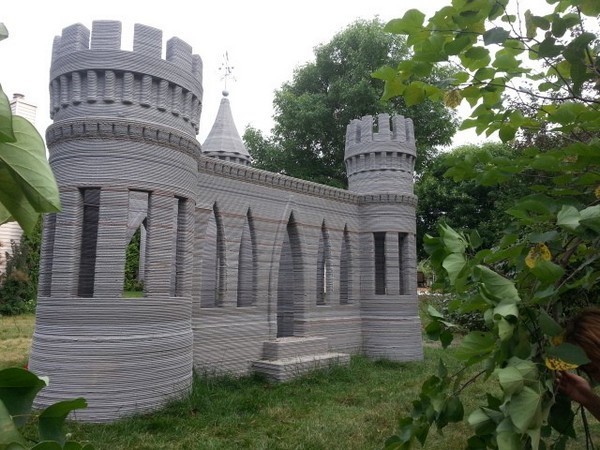
There are also structural differences due to the specifics of the material - in particular, there is no need for a heating element in a 3D building printer. Such devices allow you to quickly and without unnecessary difficulties print objects of almost any given form, which is simply impossible for ordinary serial construction using standard mixtures.
Start
We are interested in any promising application of 3D printers, so as soon as information on the use of 3D printing in construction began to appear on the network, we quickly found people working on this and agreed on cooperation. It was especially nice to know that in Russia there are companies that are thoroughly engaged in construction 3d printers and produce a very high-quality product.

In Russia, SpetsAvia became the pioneer of 3D printing in commercial use . Its staff developed and tested a prototype of a 3D building printing machine and carried out test printing.

We agreed on cooperation, and sent a service engineer to Yaroslavl for training, where he learned a lot of useful things. The training program included, in particular:
- Short introductory course on the interface and functionality of control software
- Instruction on the algorithm of work in the SheetCam program, which converts files into a layered format perceived by the printer
- Instructions on how to manage the printer in Mach 3, directly during printing
- Calibration - zeroing in different areas of the print field
- Adjustment of concrete flow during printing
- Instructions on the operation and maintenance of the mechanical part of the printer
- Troubleshooting
- Preparation of working mixtures

First steps in practice
Having received the first order in this area, we sent our employee to the buyer in Kazakhstan to install the first construction 3D printer S-6045 and to train the customer’s staff to work with him.
Before sending the equipment, make sure that the packaging is reliable. Transport companies do not always handle goods with care, it’s better not to risk it again - in our case, only a few contacts left during transportation, but it also cost nerves and several hours, about which below. If something breaks during transportation, the costs can be much more serious.

In the first days of the trip, our employee checked the completeness of the delivered equipment, made measurements of the premises to calculate the installation, coordinated with the customer’s representatives the location of the future printer, introduced them to the course of the planned work and began the installation.
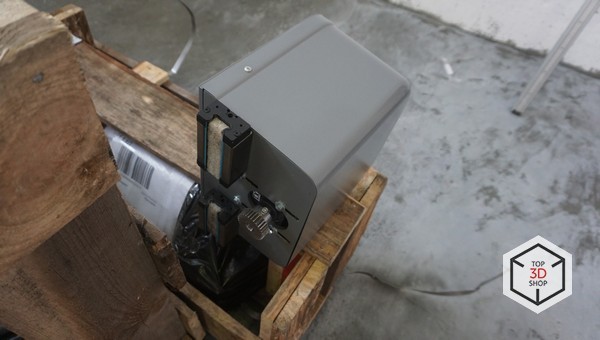
Marking was made for installation and holes were drilled in the floor under the racks.

After carrying out preparatory work and installing the racks, it was the turn of the mounting of the supporting beams. The structural elements are very weighty and for such work several people are needed, which is also better to agree with the customer in advance, otherwise delays are inevitable. People, in the end, were found and everything was done.

Another difficulty that can arise when installing a 3D construction printer is an uneven floor. If there is no flat surface, print quality is unlikely to be good. The obvious way out of this situation - floor leveling - is hardly possible at the printer installation stage. There is simply no time for this.
It was such a surprise, namely, a significant roll of the floor, which we discovered after leveling.

It was decided to weld the frames from the steel profile, which would compensate for the roughness.
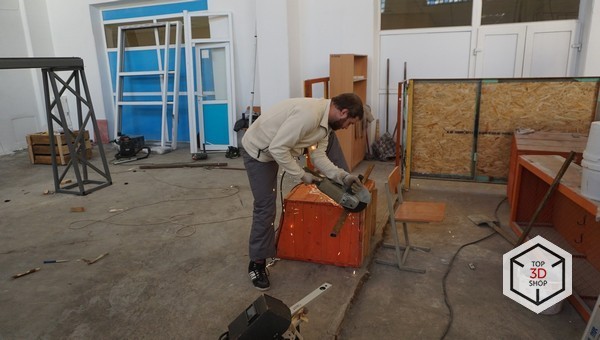
It also took some time. In the end, the necessary profile was brought in, properly cut and welded.
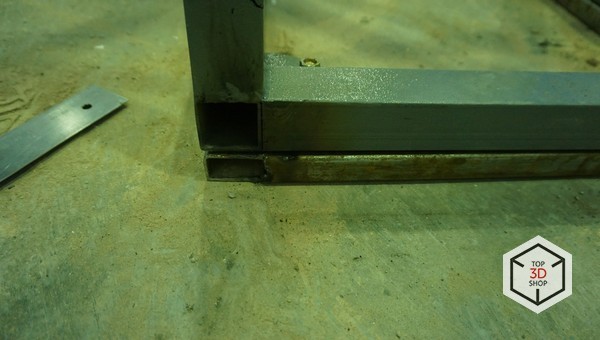
To install the leveling frames, already mounted racks with beams had to be raised with a construction crane.
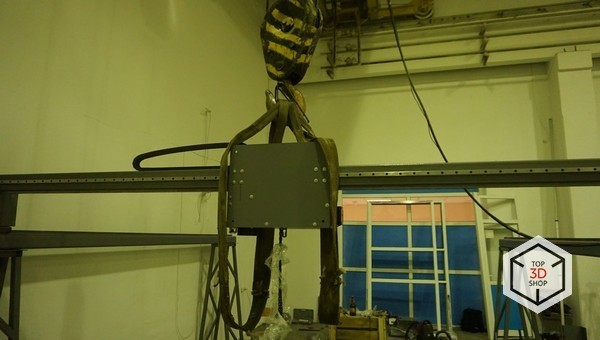
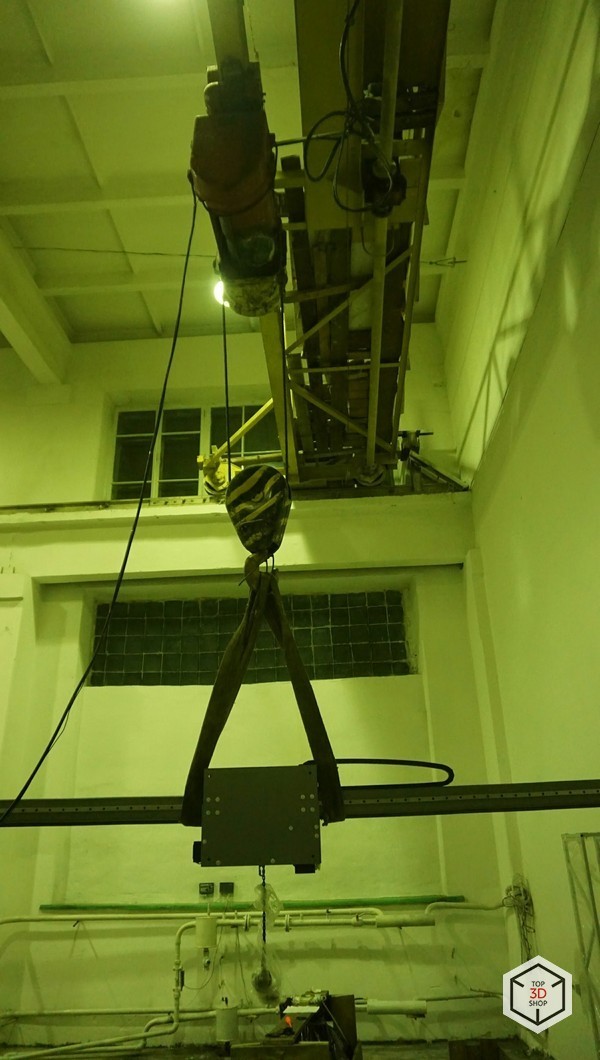
Calipers and bearings were mounted for them, after which it was the turn of the portal beam. Here again, the help of a construction crane came in handy, but I had to tinker with it - because of the configuration of the room and the design features of the crane, I had to go up to the ceiling and turn off the limit switches restricting it, the crane, and mobility. The ceiling there is about 15 meters.
The installation of the extruder boom and the eccentrics controlling it took some time - the welds on the boom itself interfered with the connection with the docking grooves of the platform. I had to level with a grinder.
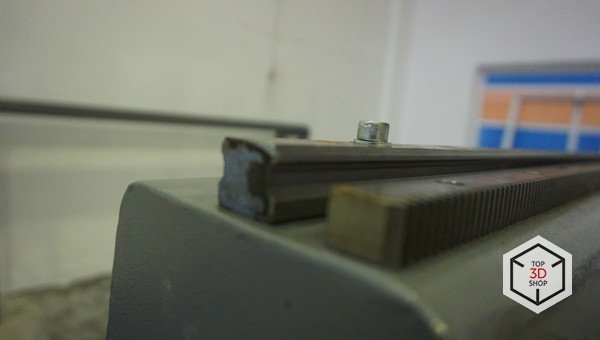
At the final stage, all connections were tightened, an extruder hopper was mounted and an optional part of the structure - a concrete mixer.
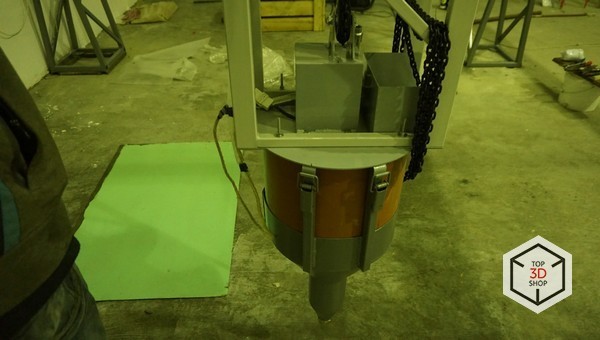
Connecting power and control circuits did not immediately go smoothly. However, SpetsAvia reacted promptly to the letter of request sent to Yaroslavl, providing all the necessary connection recommendations, despite the end of the working day.

During the inspection, it turned out that during transportation the contacts on one of the system boards had departed. After the restoration of contacts, everything worked.
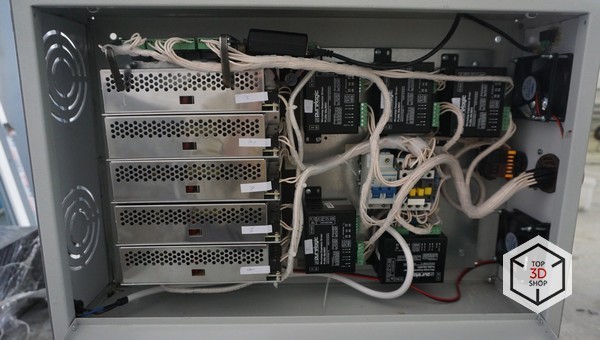
After connecting and checking the connection, grease fittings were mounted on all bearings, protective guards of the boom eccentrics and complete plates, on which the installation itself was completed.
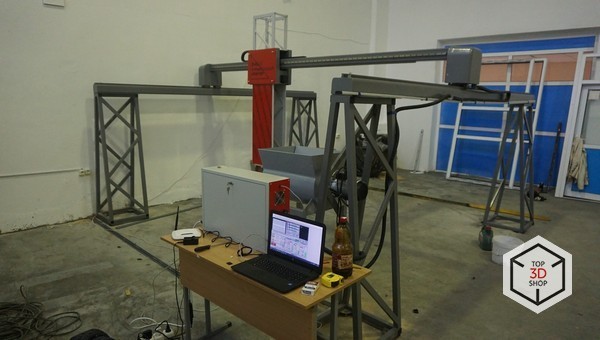
Next - installing and configuring software, checking functionality. Installation of the substrate for the overhanging wires connecting the moving parts - it is not provided for in the scope of delivery, but we are meeting our customers.

Training customer personnel to use the printer during the test run.
The customer decided to try a mixture of his own authorship, contrary to our recommendations. Well, the master is the master. The solution, as expected, crawled. However, the printer itself is working properly and there are no complaints about us.

In the process of training the client staff to work with the software, we wanted to demonstrate the operation of the 3D printer with the correct mixture, but there were no ingredients for the new mixture.
Speaking of mixtures:
Staff training and commissioning were as positive as possible. Customer representatives were completely satisfied with the delivered and installed equipment and satisfied with the cooperation.
It was a rewarding experience. We have identified for ourselves a few rakes that we will not step on for the second time — and this will make further work more pleasant and efficient. Undoubtedly, 3D construction printing equipment is a very interesting area of activity, both in terms of the result obtained, and in that it requires maximum ingenuity and a non-standard approach from those involved in it.
Want more interesting news from the world of 3D technology?
Subscribe to us in the social. networks: