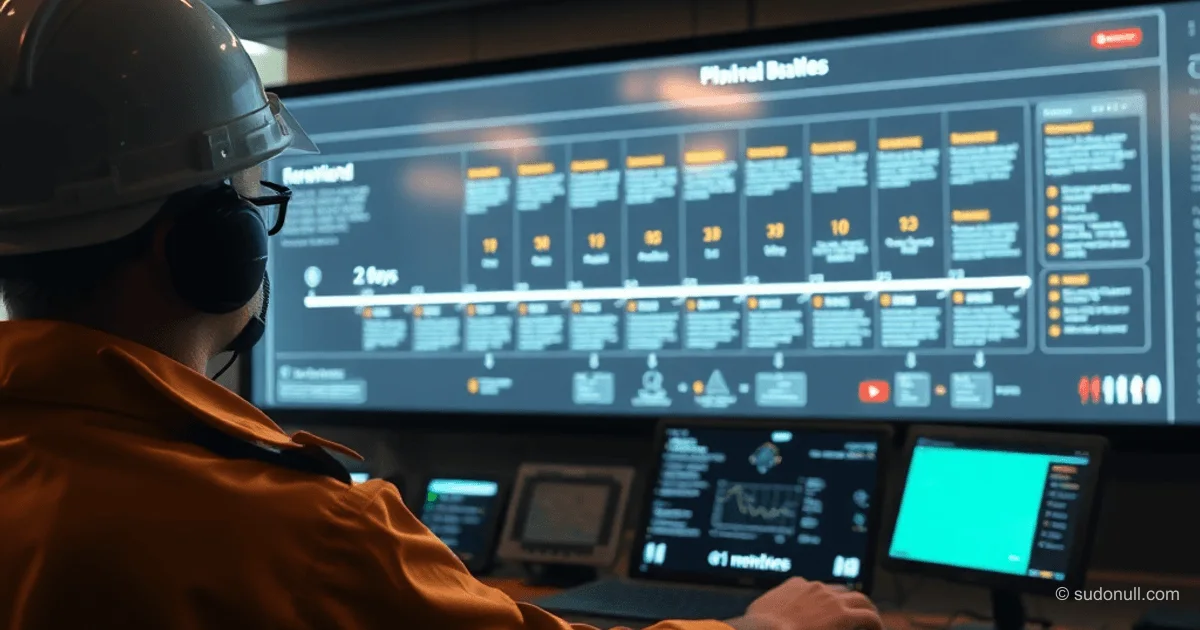
MVP in Enterprise: Why 2 Days Is an Unrealistic Timeline for Industry
In the midst of rapid advancements in AI agents promising to build an MVP in just two days, large industrial enterprises are grappling with a widening gap between stakeholder expectations and actual implementation timelines. An analysis of development steps in the oil and gas sector reveals that a true MVP—one that delivers real business value—takes not months, but years.
Real Definition of MVP in Enterprise
A Minimum Viable Product (MVP) in the context of large enterprises isn't just the first working version; it's a solution that meets three key criteria:
- Minimally sufficient functionality to solve the user's core task.
- Ability to gather feedback from real users in production.
- Generation of measurable business value from day one of operation.
In startups, these criteria are often met in weeks. But in industrial enterprise settings (5000+ employees, integration with legacy systems, multi-level approvals), the process is fundamentally different. Here, any change requires not just development but deep adaptation to existing infrastructure and business processes. The industry's conservatism stems from the need to protect data and minimize risks, making simplistic startup analogies inappropriate.
Why Development Stages Aren't the Same as MVP
The key mistake is equating intermediate stages with an MVP. In a typical enterprise project, there are 21 steps, but only completing the 21st (deploying the production version with real users and data) qualifies as an MVP. Previous stages, including:
- Development on the contractor's stand (step 10)
- Testing on the company's test data (step 13)
do not deliver business value, as they lack real users and live data. Without meeting criteria 2 and 3, these are just development phases, not an MVP. Ignoring this leads to false reports of MVP achievement and stakeholder disappointment.
Analysis of Real Timelines: Plan vs. Actual
Consider a typical project in an oil and gas company:
- Plan: 140 days (6 months), with 100 days on core development (step 10) and the rest on documentation and approvals.
- Actual: 218 days (10 months) or more, even with some stages run in parallel.
Reasons for delays:
- Complexity of integrating with legacy systems (average 30% of delays)
- Multi-level approvals (legal, IT security, operating units—up to 40% of time)
- Unforeseen risks (regulatory changes, resource shortages—20%)
Important: 10 months is the time from idea to value realization. In startups, a similar phase takes 2-3 months, but in enterprise, the scale of issues multiplies due to syncing with dozens of systems and processes.
Maturity Assessment: A Tool for Aligning Expectations
To bridge the gap between stakeholders and reality, use multidimensional maturity assessment:
- TRL (Technology Readiness Level): Technological readiness—from lab tests (TRL 1) to industrial deployment (TRL 9).
- MRL (Manufacturing Readiness Level): Production process readiness—integration into the production line (MRL 1-10).
- CRL (Commercial Readiness Level): Market readiness—alignment with business and user needs (CRL 1-9).
These metrics enable more accurate timeline forecasting and help explain to stakeholders why stages 1-20 aren't an MVP. For example, reaching TRL 6 (prototype in real conditions) doesn't guarantee MRL 4 (production integration), which is critical for industry. This approach reduces misunderstanding risks and sets objective KPIs.
Key Takeaways
- A true enterprise MVP is the first production version with real users (step 21 in a typical process), not intermediate builds.
- Average time from idea to MVP in industry is 10 months, not days or weeks.
- Overhyped expectations from AI agents pose risks: stakeholders demand startup speed in an enterprise environment.
- The only solution is shifting to multidimensional maturity assessment (TRL/MRL/CRL) for objective progress evaluation.
In conclusion: AI agents and cloud technologies do accelerate development, but in industrial enterprise, their impact is limited by infrastructure and process barriers. Realistic timelines are still measured in months, not days. The top priority is shaping stakeholders' objective understanding of stages and MVP criteria. Only then can we avoid the disconnect between market promises and enterprise realities.
— Editorial Team










No comments yet.