
 November 8, 2016 at 13:27
Toshiba introduced a neuromorphic processor with low power consumption
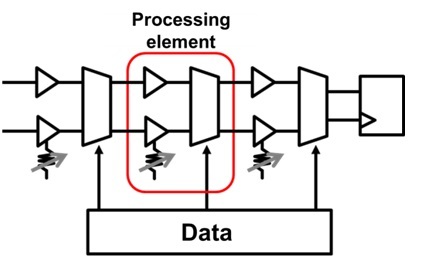
Japanese company Toshiba announced its contribution to the development of the Internet of things and big data analysis. This time, she developed a very low power neuromorphic processor for time lag neural networks (TDNN). This network consists of a large number of modules that use not digital, but analog data processing.
Deep learning algorithms require a huge number of calculations. They are performed on high performance processors that consume a lot of power. However, if we want these algorithms to work on the Internet of things, various sensors and smartphones, we need energy-efficient chips that can perform a large number of operations, while consuming extremely little energy.
The Toshiba chip uses an analogue of the time interval and methods of mixed signal processing (TDAMS). They allow you to reduce the size of the neuromorphic processor. Arithmetic operations such as addition are efficiently performed in TDAMS by delaying a digital signal that transmits the logic element as an analog signal. Using this technique, the processor for in-depth study is constructed from only three logical elements and a single-bit memory with a fully spatially expanded architecture. The Japanese company has created a prototype chip with static memory cells (SRAM), which successfully recognized handwritten text. The energy consumption per operation was 20.6 femtojoules, which is equivalent to 46 trillion operations per second with 1W of power consumption. The result was 1/6 times better than the last achievement,demonstrated at the International Solid-State Circuits Conference 2016.
In von Neumann's computer architecture, most of the energy is consumed when moving data between memory and the processor. The most effective alternative way to shorten the data path is to place a huge number of processors, each of which will process only one element of the data set that is nearby. When an input signal is converted to an output, data points are assigned a specific weight. It is the weight that is the parameter that will automatically control the deep learning process. The closer the point is to the output, the more weight.
Architecture resembles the human brain: the strength of the connection between neurons is a weight coefficient that is built into synapses (processors). Synaptic connections between neurons have different strengths. This bond strength is determined by the output signal. Thus, the synapse performs a kind of processing. This architecture is attractive to developers, but it has one significant drawback: its mass production requires a large number of arithmetic schemes that quickly become too large.
Of course, this is not the first neuromorphic processor that can be used in working with artificial neural networks. Qualcomm, IBM, Human Brain Project, KnuEdge Inc. and others are actively developing chips that mimic the functioning of the human brain. In 2014, IBM Research introducedTrueNorth chip of a million digital neurons and 256 million synapses, which are part of 4096 synapse cores. Over the past six years, employees of the company commissioned DARPA to work on this development. They were not in vain: in 2011, the prototype consisted of only 256 neurons, and after three years totaled a million. In a demonstration of the possibilities, the chip recognized cars, cyclists and pedestrians in the video from the intersection. An ordinary laptop handled this task by processing frames 100 times slower and consuming 1000 times more power than an IBM chip. Since 2016, the chips have been tested at the Livermore National Laboratory. Researchers are trying to figure out in which area they will be most effective.
Qualcomm introducedits prototype processor that simulates the properties of the human brain, a year earlier than IBM - in 2013. The project was called Zeroth (“zero”). The creators said that their processor, located in smartphones, computers, robots and other devices, will allow them to self-learn in the process. The first chips were supposed to appear in 2014, but this did not happen. Instead, the company released in 2015 the eponymous recognition and computing platform.
Another example is the KnuPath Hermosa processorfrom KnuEdge Inc .: 256 processor cores, 64 programmable DMA modules, 72MB of internal memory, 34 watts of power consumption. The processor has 16 bi-directional I / O channels, which allows providing throughput of the RAM subsystem up to 320 Gbit / s. Now the company is actively working on creating software compatible with a neuromorphic processor. She has already released the KnuVerse program, which can recognize and identify voice. Unlike other voice assistants, KnuVerse can operate in noisy environments. In addition, the developers of the program solved many security problems. The development was released five years ago, but was used only by the military.
As for the practical application of neuromorphic technologies, Samsung uses the FinFET Exynos 8890 chip in its Galaxy S7 and S7 Edge smartphones. Its main feature is the M1 core, which has a neural network built in .