October 7, 2016 at 23:19
Why does the earth have a liquid core?
- Transfer
Having dropped the keys into the molten lava flow, say goodbye to them, because, well, dude, that's all.
- Jack Handy
Looking at our home planet, you can see that 70% of its surface is covered with water.
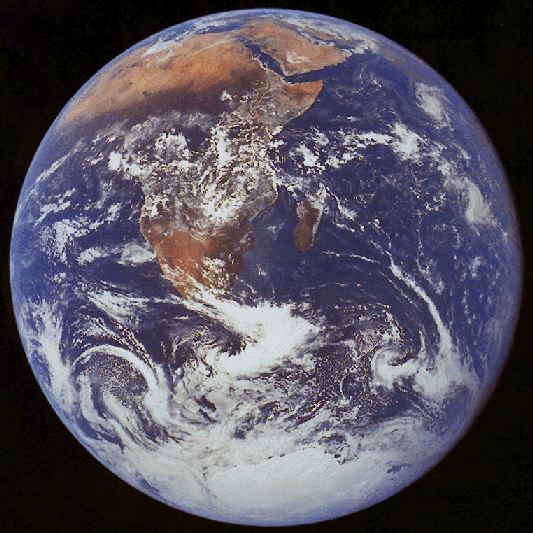
We all know why this is so: because the oceans of the Earth float above the rocks and mud that make up the land. The concept of buoyancy, in which less dense objects float above more dense, plunging below, explains much more than just oceans.
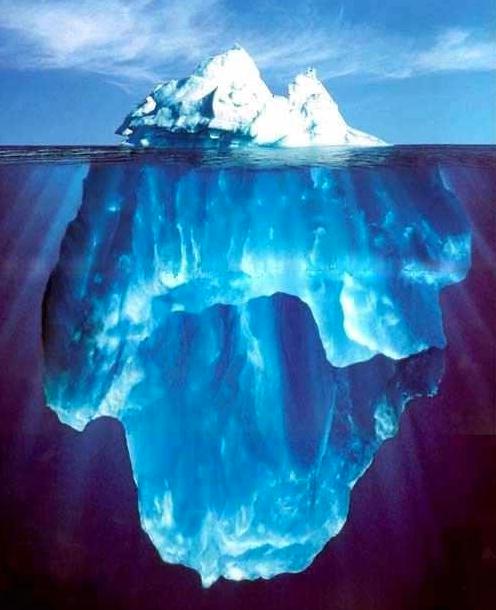
The same principle that explains why ice floats in water, a helium balloon rises in the atmosphere, and stones drowning in a lake, explains why the layers of planet Earth are arranged this way.
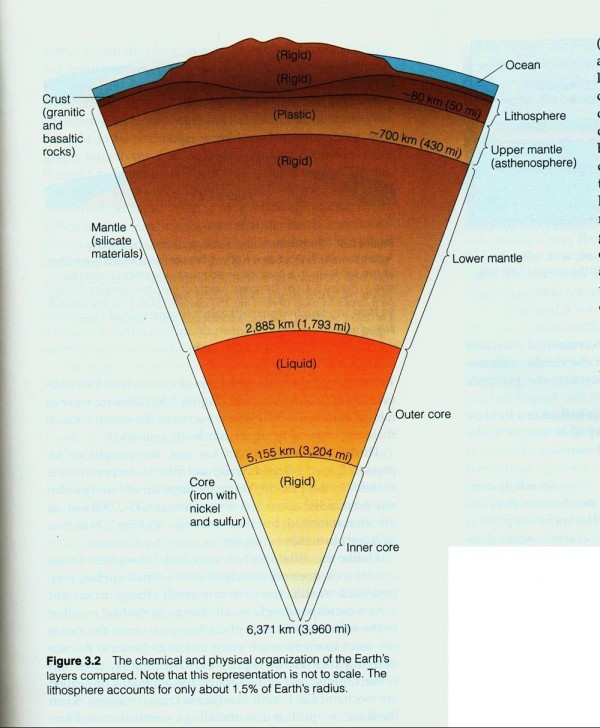
The least dense part of the Earth, the atmosphere, floats above the water oceans that float above the earth’s crust, which is above the denser mantle, which does not sink into the densest part of the Earth: the core.
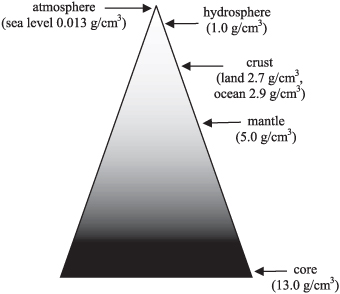
Ideally, the most stable state of the Earth would be one that would be ideally distributed into layers, in the manner of the bulbs, and the densest elements were in the center, and as each outward layer moved further out, it would consist of less dense elements. And every earthquake, in fact, moves the planet toward this state.
And this explains the structure of not only the Earth, but also of all the planets, if you recall where these elements came from.
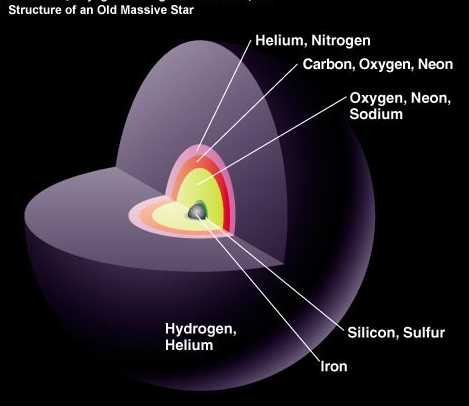
When the Universe was young - only a few minutes old - only hydrogen and helium existed in it. Increasingly heavier elements were created in the stars, and only when these stars died did the heavy elements enter the Universe, allowing new generations of stars to form.
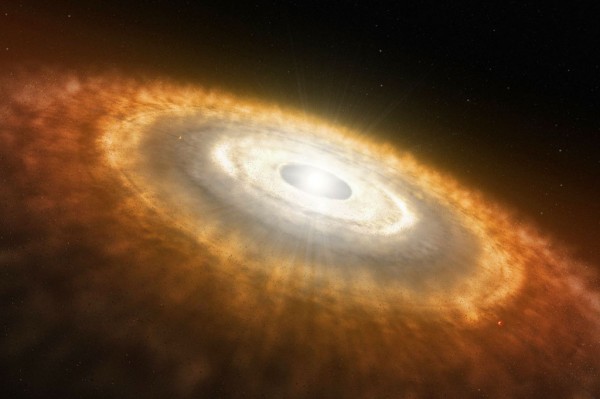
But this time, a mixture of all these elements - not only hydrogen with helium, but also carbon, nitrogen, oxygen, silicon, magnesium, sulfur, iron and others - forms not only a star, but also a protoplanetary disk around this star.
Pressure from within to outside in the forming star pushes lighter elements, and gravity leads to the fact that the irregularities in the disk collapse and form the planets.
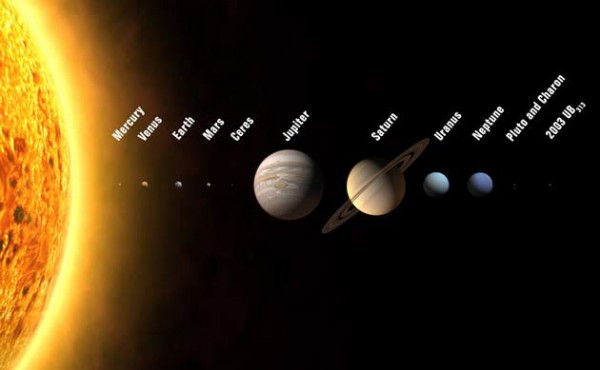
In the case of the solar system, the four inner worlds are the densest of all the planets in the system. Mercury consists of the most dense elements that could not hold a large amount of hydrogen and helium.
Other planets, more massive and more distant from the Sun (and therefore receiving less of its radiation), were able to retain more of these ultra-light elements - this is how gas giants formed.
On all worlds, as on Earth, on average, the densest elements are concentrated in the nucleus, and the lungs form ever less dense layers around it.
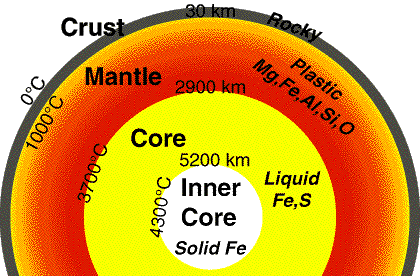
It is not surprising that iron, the most stable element, and the heaviest element created in large quantities at the supernova border, is the most common element of the earth’s core. But perhaps surprisingly, between the solid core and the solid mantle there is a liquid layer with a thickness of more than 2000 km: the outer core of the Earth.
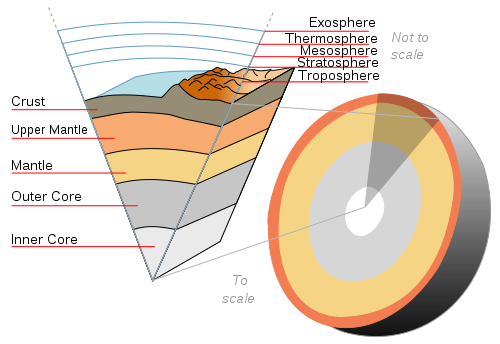
Earth has a thick liquid layer containing 30% of the mass of the planet! And we learned about its existence by a rather witty method - thanks to seismic waves originating from earthquakes!
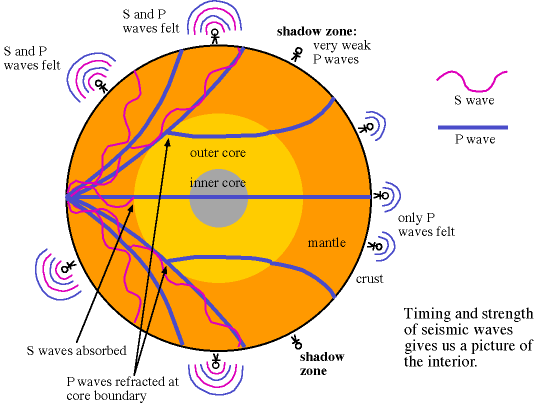
Two types of seismic waves are generated in earthquakes: the main compression wave, known as the P wave

along the longitudinal path and the second shear wave, known as the S-wave , similar to waves on the surface of the sea.

Seismic stations around the world are able to pick up P- and S-waves, but S-waves do not pass through a liquid, and P-waves not only pass through a liquid, but they also refract!
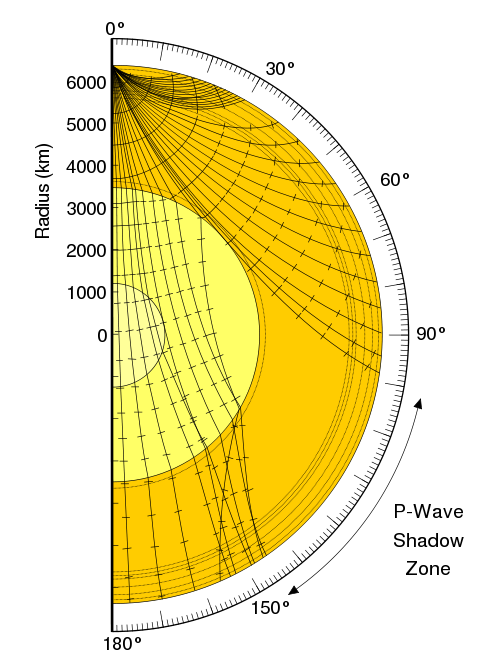
As a result, we can understand that the Earth has a liquid outer core, outside which there is a solid mantle, and inside - a solid inner core! That is why the Earth’s core contains the heaviest and densest elements, and so we know that the outer core is a liquid layer.
But why is the outer core liquid? Like all elements, the state of iron, solid, liquid, gaseous, or other, depends on the pressure and temperature of the iron.
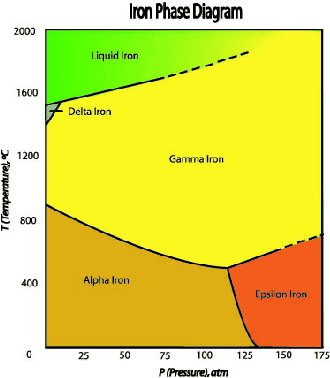
Iron is an element more complex than many familiar to you. Of course, it can have different crystalline solid phases, as indicated in the graph, but we are not interested in ordinary pressures. We descend to the core of the earth, where the pressure is a million times higher than the pressure at sea level. And what does the phase diagram look like for such high pressures?
The beauty of science is that even if you don’t immediately have an answer to a question, it’s likely that someone has already done the necessary research in which you can find the answer! In this case, Arens, Collins and Chen in 2001 found the answer to our question.
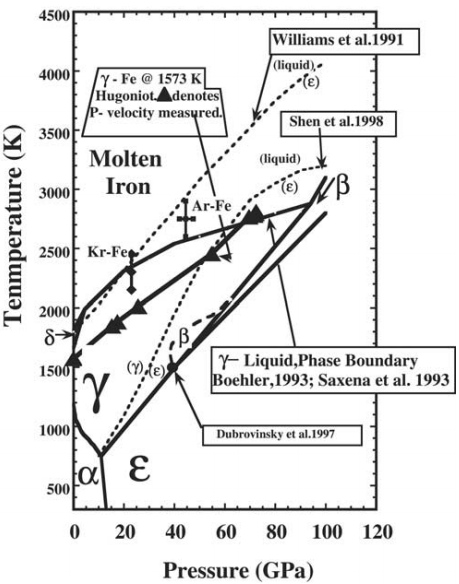
And while the diagram shows gigantic pressures up to 120 GPa, it is important to remember that atmospheric pressure is only 0.0001 GPa, while in the inner core the pressures reach 330-360 GPa. The upper solid line shows the boundary between the melting iron (above) and solid (below). Have you noticed how a solid line at the very end makes a sharp turn up?
In order for iron to melt at a pressure of 330 GPa, a huge temperature is required, comparable to that prevailing on the surface of the Sun. The same temperatures at lower pressures will easily maintain iron in a liquid state, and at higher pressures - in a solid state. What does this mean in terms of the core of the earth?
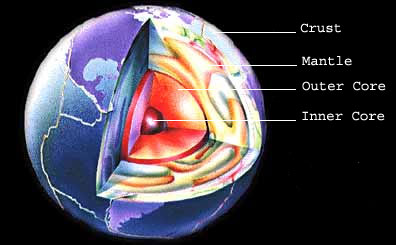
This means that with the cooling of the Earth its internal temperature drops, and the pressure remains unchanged. That is, during the formation of the Earth, most likely, the entire core was liquid, and with cooling, the inner core grows! And in the process of this, since the density of solid iron is higher than that of liquid iron, the Earth slowly shrinks, which leads to earthquakes!
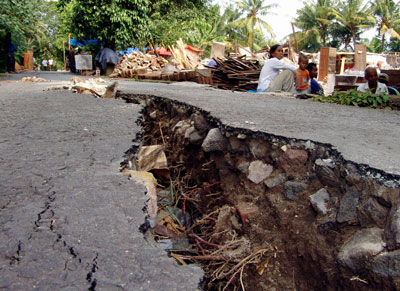
So, the Earth’s core is liquid because it is hot enough to melt iron, but only in regions with low enough pressure. As the Earth ages and cools, a larger part of the core becomes solid, and therefore the Earth shrinks a little!
If we want to look far into the future, we can expect the appearance of the same properties that are observed in Mercury.
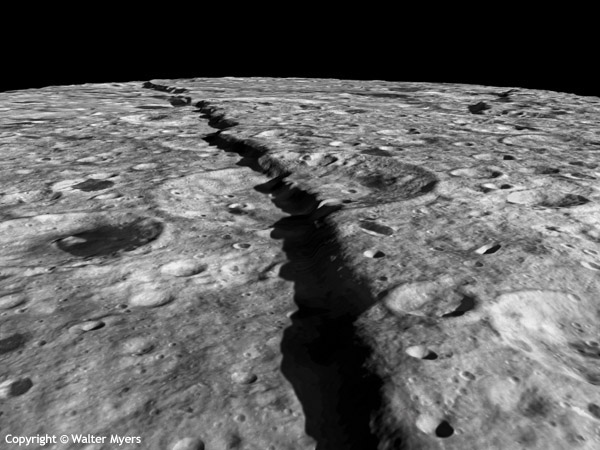
Due to its small size, Mercury has already significantly cooled and compressed, and has faults hundreds of kilometers long, which appeared due to the need for compression due to cooling.
So why does the earth have a liquid core? Because it has not yet cooled. And every earthquake is a small approximation of the Earth to a final, cooled and solid state through. But don’t worry, the Sun will explode long before this moment, and everyone you know will be dead for a very long time.