September 4, 2016 at 19:20
Ask Ethan No. 86: The Last Light in the Universe
- Transfer
Can unburnt stars or stellar remains reignite light in the universe?
One small light creates a space in which darkness cannot exist. Light casts out darkness. And no matter how she tries, darkness cannot conquer the light.
- Donald L. Hicks
And although it seems inevitable that darkness will ultimately win when the last photon of light leaves the field of view, this moment will come much later than anyone expects. Among the questions you sent out, the following, asked by Andrew Dodds, stands out:
I drew attention to one star system - Lyuman 16 - consisting of two brown dwarfs. I wonder - is it possible that such systems will unite with each other after falling in a spiral, and form a red dwarf? And if so, does this mean that we will have stars even after many trillions of years?
Today it is easy to look at the Universe, especially with all the equipment available to us, and conclude that our eyes have an almost unlimited supply of material. And the longer we look, the more we see!
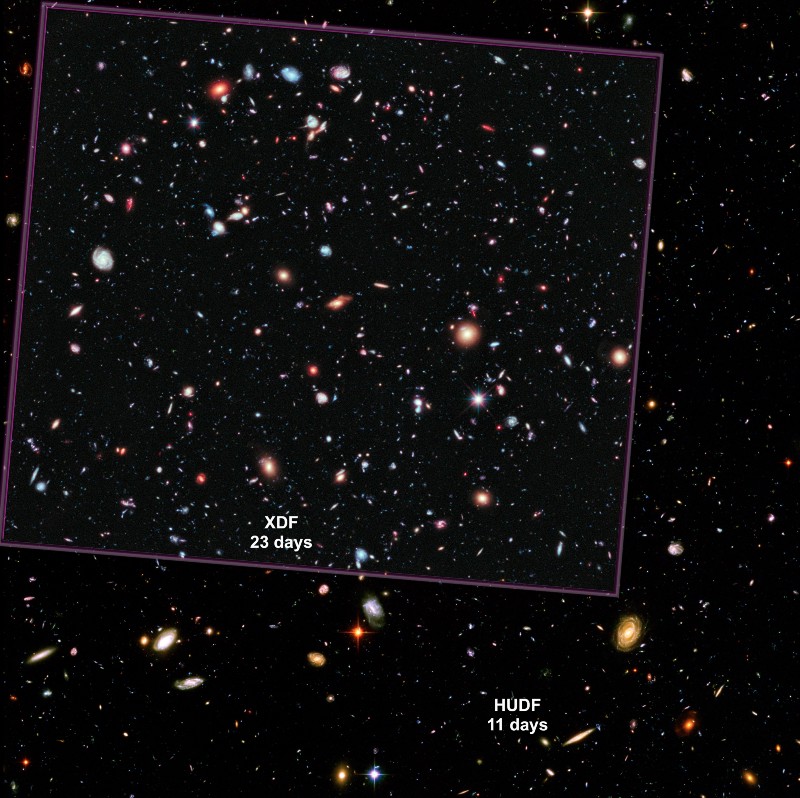
No matter what part of the sky we look at:
• To the center of the Milky Way,
• to the hearts of nebulae or clusters,
• to galaxies beyond ours,
• or to a piece of sky that looks empty,
we will be surrounded by luminous objects of deep space. Each of them shines either because it is a star, or because it is a group of stars.
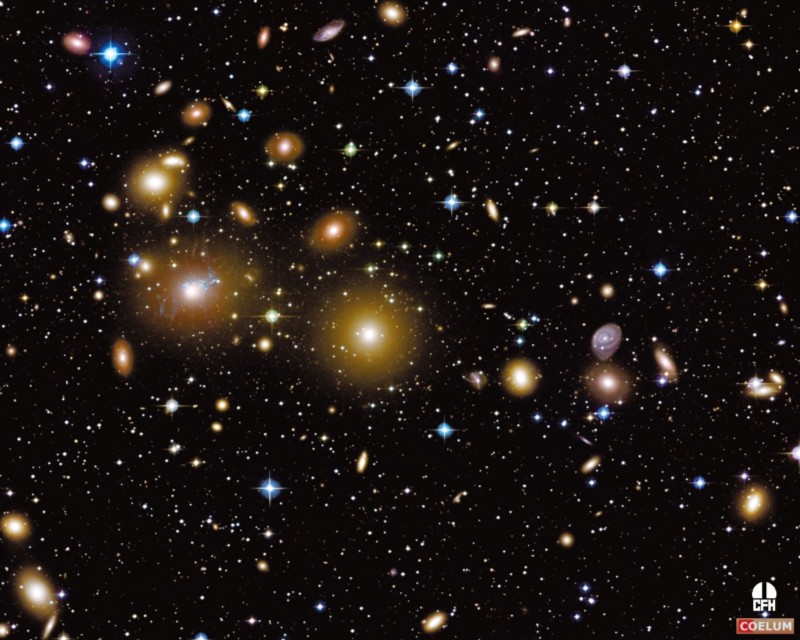
But, despite all the stars in our galaxy (about 400 billion), all the galaxies in the visible part of the Universe (at least 170 billion, and most likely much more), and the fact that the Universe is expanding, the amount of light reaching us is constantly decreasing .
There are two reasons for this - one that affects remote sources, and one for the next. Here they are.

1) Most of all in the Universe of dark energy.Thanks to three independent measurement methods — cosmic microwave background radiation, remote type Ia supernovae and baryonic acoustic oscillations — we have determined that matter is not the predominant form of energy in our Universe. At least not anymore. Instead, normal matter, of which we are composed, and dark matter, which is five times larger, make up only a third of the total amount of existing energy. The other two-thirds is a new form of energy inherent in space itself: dark energy.

When dark energy began to dominate the expansion of the universe about 6 billion years ago, distant galaxies that moved away from us began to move away even faster. Over time, these galaxies move farther away from ours, and the light emitted by them loses the opportunity to reach us in the future due to the exponential expansion of space.
Now it’s clear that after 100-150 billion years, the galaxies of our local group - Andromeda, the Milky Way, the Triangle galaxy, Magellanic clouds and another 40-50 dwarf galaxies - will merge together into one giant elliptical galaxy, and it will last a very long time. Thanks to dark energy, all other outer galaxies will be so distant from us that they will become invisible. But we still have the stars in our new giant elliptical house: Milkdromeda.
Some time. Because ...

2) In the Universe, stellar fuel ends.The rate of formation of new stars in the Universe is slower than ever: only 3% of the peak that happened many billions of years ago. And although we get a big splash when the Milky Way unites with Andromeda, after that the speed of star formation will drop significantly.

The most massive stars will turn into supernovae, less massive ones, like the Sun, will drop outer shells, which will then become planetary nebulae, and their insides will shrink and turn into white dwarfs. These supernovae and planetary nebulae emit quite a lot of unburned (or barely burned) fuel - hydrogen and helium - so new stars can continue to form over trillions of years. However, the speed of star formation will have to fall further, and in tens of trillions of years the appearance of even one star from gas clouds will become an incredibly rare event.

Here's what else you need to remember: the stars with the smallest mass live longer than all. The real star is separated from the unburnt (or from the brown dwarf) whether it can synthesize helium from hydrogen in its core. This requires a minimum temperature of 4 million degrees. This requires a mass of 7.5 to 8% of the solar. This separates the brown dwarfs from the red dwarfs. With a minimum mass, the red dwarf will burn for 20 trillion years, and will be the most long-lived star.
In addition, the fate of red dwarfs is the simplest: instead of a catastrophic death in the form of a supernova, or dropping of the upper layers with the formation of a planetary nebula, red dwarfs can convert 100% hydrogen to helium, and shrink into a helium white dwarf.
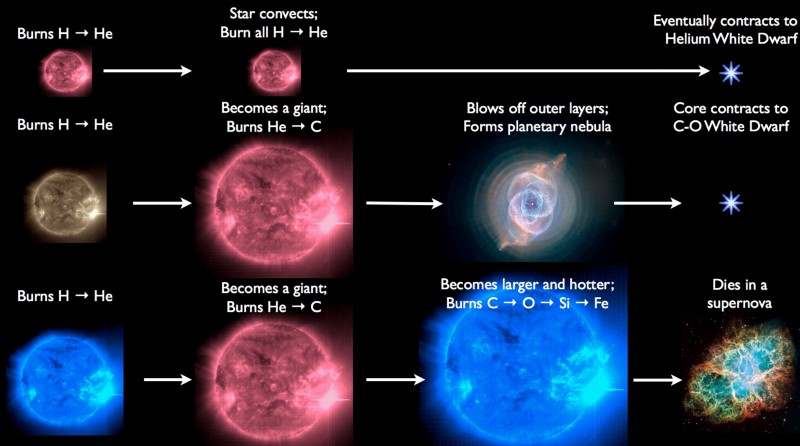
If you asked us ten years ago, which stars are most often found in the Universe, we would say that these are M-class stars, or red dwarfs, and that approximately three out of every four stars belong to this class. Given this, plus the fact that all sun-like stars will become red giants, discard their outer layers and then turn into white dwarfs - it could be decided that after 100 trillion (10 14 ) years, all that remains is the full sky of white dwarfs.
And this is not so far from the truth! Given that these white dwarfs will remain “white” for a period of about 1 to 10 quadrillion (10 15 - 10 16) years, until it finally cools down so that (according to the Kelvin-Helmholtz mechanism) in order to stop emitting visible light, it would be possible to decide that this period was allotted for there still to be something left in the sky to look at.
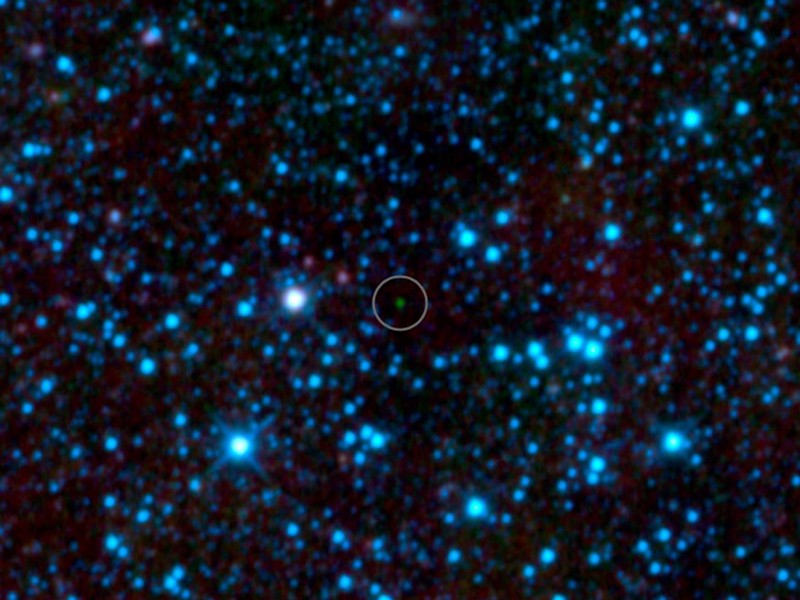
But now something else is known thanks to infrared observations like WISE. In addition to all the known stars - and all future ones - there are a large number of “almost” stars. If you look at the two star systems closest to Earth, then two fresh additions will appear: both of them are brown dwarf systems. And just as two red stars of small mass can unite and form a bluer star of greater mass, two brown dwarfs that have not reached the hydrogen burning border can unite and become a real star!
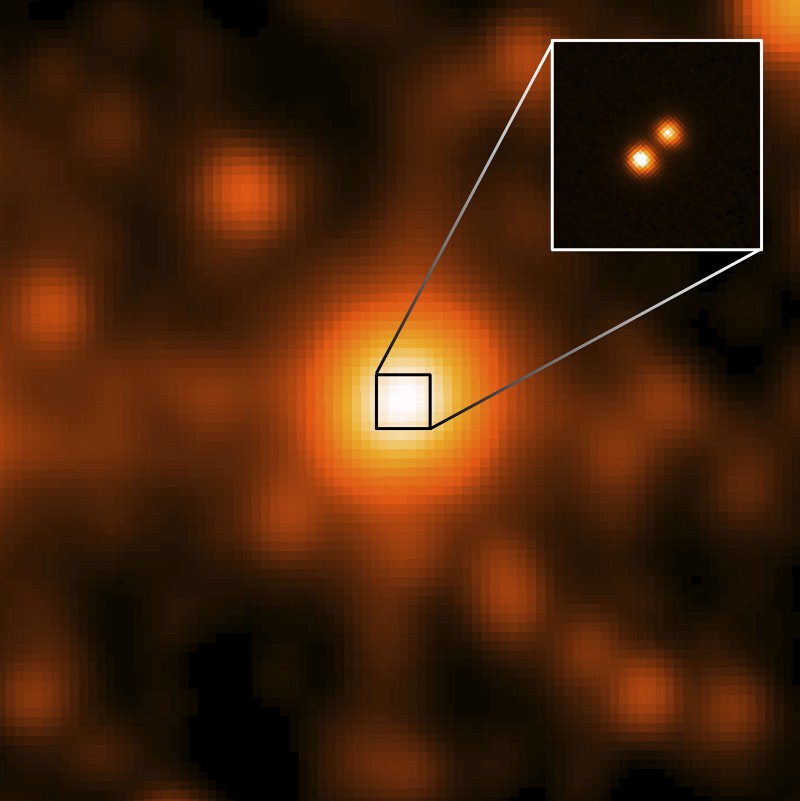
Two brown dwarfs from the Lyuman system 16
It turns out that the question is when will they unite, and what other processes exist that have an impact on their fate? Based on the fact that the decrease in their orbits occurs due to gravitational radiation, two objects of the Lyuman 16 system will take from 10 60 to 10 150 years to fall on top of each other in a spiral and unite. The mass of both objects is estimated at 4% of the solar, so after combining they should form a real star.
But there are other processes that make just such an outcome of this particular system unlikely.

1) Forced release.If these two stars were ideally isolated, in the end they would fall on each other. But they spend most of their time in a gigantic swarm-like galaxy filled with a trillion (or more) stars and stellar remnants. Quite often, a star passes by one or both of these brown dwarfs, and each time it has a chance to become more gravitationally
attached to the galaxy and throw these objects out!
This, of course, is unlikely, but something unlikely can happen in sufficient time. The average time for such an event is approximately 10 18 years. And although most of the objects will be thrown out, those that gravitationally bind more strongly will have a different fate ...

2) Objects may collide, which will lead to amazing results!Depending on the collisions, any of the following events may occur:
• When two neutron stars collide, they will create a black hole and a burst of gamma rays.
• In the collision of two heavy (carbon-oxygen) white dwarfs, they will create a type Ia supernova.
• When light (helium) white dwarfs collide, they will start carbon synthesis and create a red giant.
• And when two brown dwarfs collide, they will create either a more massive brown dwarf (boring) or a new M-class star.
What time periods are we talking about? On average, about 10 21 years. So, unless these two brown dwarfs rotate extremely close to each other (inside the orbit of Mercury, for example), it is unlikely that they will merge together at the end.
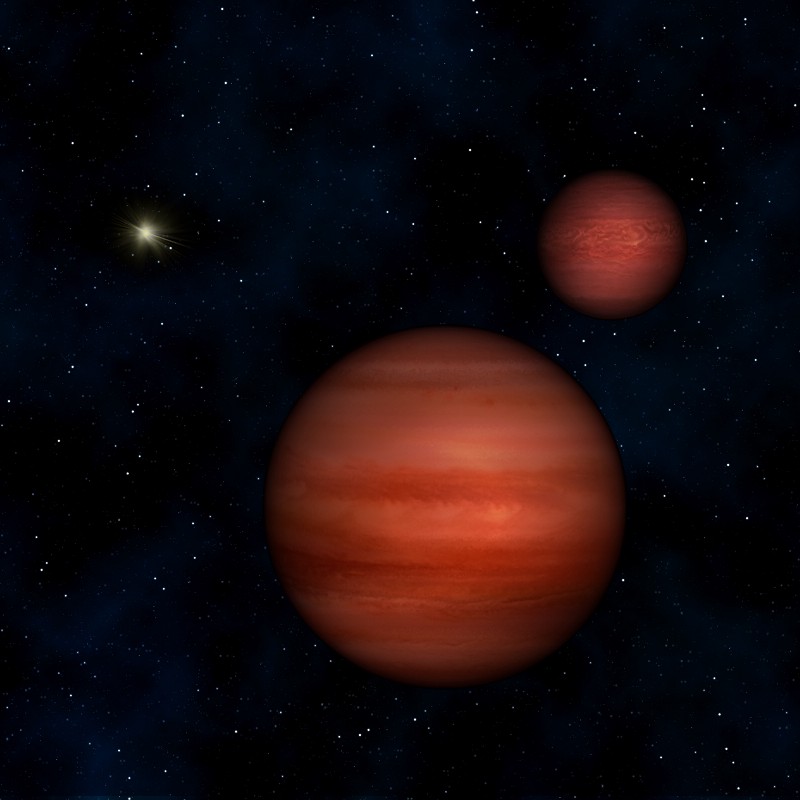
But it is likely that if they are not thrown out, that they will encounter anything else. Considering that helium white dwarfs will collide and merge, as well as a large number (which we are just starting to evaluate) of brown dwarfs at intervals of about 10 21 years, it is reasonable to assume that even after the last star burns out, we will have rare stars in the distant the future.
If you are very lucky, then planets, spaceships or organic material may appear, awaiting the appearance of another source of energy and a chance to life. The last chance to revive the previously existing, albeit briefly, may come at a time when the Universe will be a trillion times older than today, and when this chance will lead to the appearance of the only burning star in the entire observable Universe.

So thanks for the wonderful question and the chance to find out about our distant future, Andrew. I hope you enjoyed it. Send me your questions and suggestions for the following articles.