January 8, 2016 at 08:57
Physical laws in numbers - large quantities
Many are familiar with the fact that the influence of certain laws of physics on our world, located at the crossroads of the microworld of elementary particles, and the macrocosm of stars and galaxies can be very large, but not everyone knows how much. Here I have collected some examples of how great effect they can have.
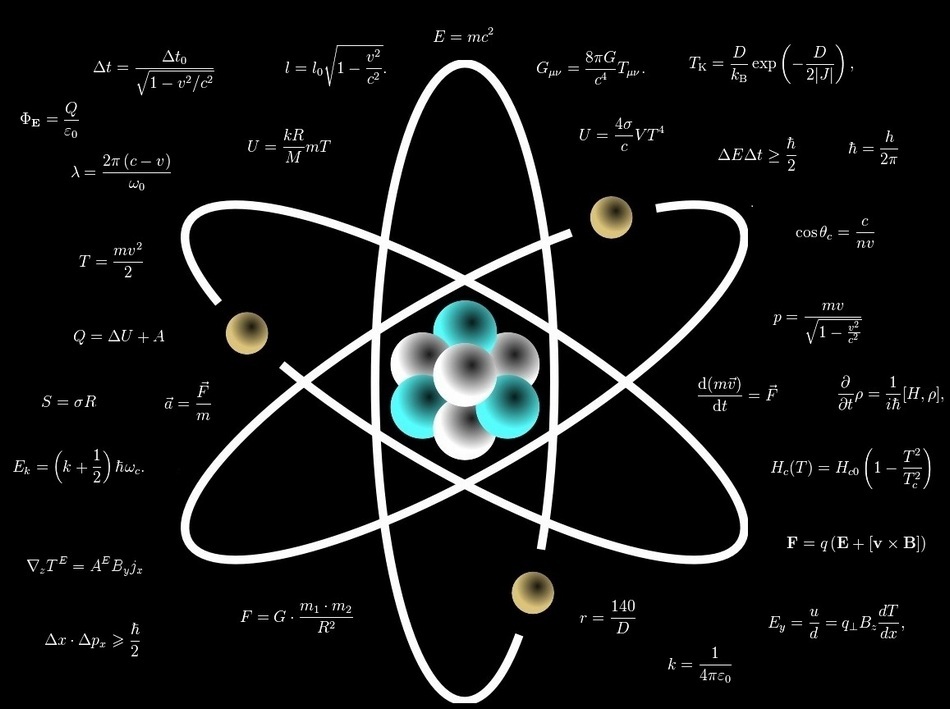
Classical mechanics The
acceleration of gravity increases in direct proportion to the mass of the body, and inversely to the square of the radius:

And since the mass of celestial bodies generally grows from the third degree of the radius (body volume), but in reality it’s even a little more (the density of heavy bodies is higher) , then such heavy bodies as giant planets and stars attract bodies quite distant from them.
Already on the conventional surface of Jupiter (gas giants and stars have the same very conventional border as the Earth’s atmosphere), you would weigh 2.5 times more, and on the Sun it would be almost 28 times more (such an acceleration a person is able to withstand only for a couple of seconds ). Due to its small size, for a white dwarf, the acceleration of gravity will be already 250,000 times higher than the earth. And for the most massive neutron stars - already 200 billion times more. This is already enough to crush not only the human body, but even any atoms:
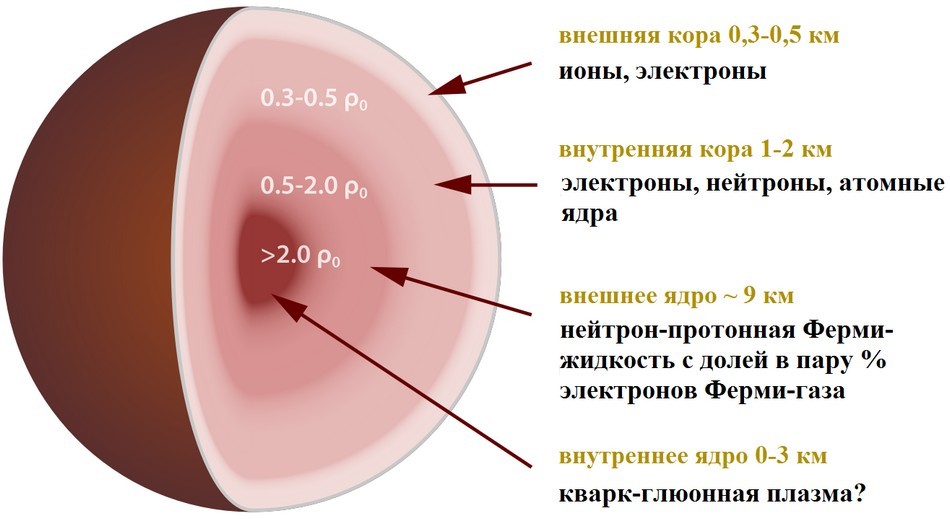
The composition of a neutron star
The density of such stars is huge - from 3.7 × 10 17 to 5.9 × 10 17 kg / m 3. Under conditions of increased attraction, one cubic nanometer of their substance (in which under normal conditions fewer than a thousand atoms are placed) on the surface of a neutron star should weigh about 100 kilograms. But a further increase in the mass of the bodies leads to a completely opposite effect - with the formation of a black hole, the acceleration of gravity (on the conditional surface of the body - the event horizon) becomes constant:

And a further increase in the mass leads to a decrease in density - the density formula of the black hole shows that it is inversely proportional the square of its mass, and doesn’t depend on anything else:
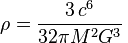
So for a black hole with a mass of 4.31 million solar masses, like Sagittarius A *(of the object in the center of our galaxy - the Milky Way) the diameter will be 17 times the solar, and the density will be 10 6 kg / m 3 . And for a black hole in the center of NGC 4889, which has 21 billion solar masses (the Gargantua mass from the Interstellar film, for example, “only” 100 million), the density will be 41 g / m 3 , which is half the hydrogen density at atmospheric pressure .
The effects of the theory of relativity
At low speeds, the effects of the theory of relativity are very weak. However, with its growth, everything changes dramatically - for example, a graph that shows the time of flight to different points of the Universe with uniform acceleration and braking halfway with acceleration of 1g:
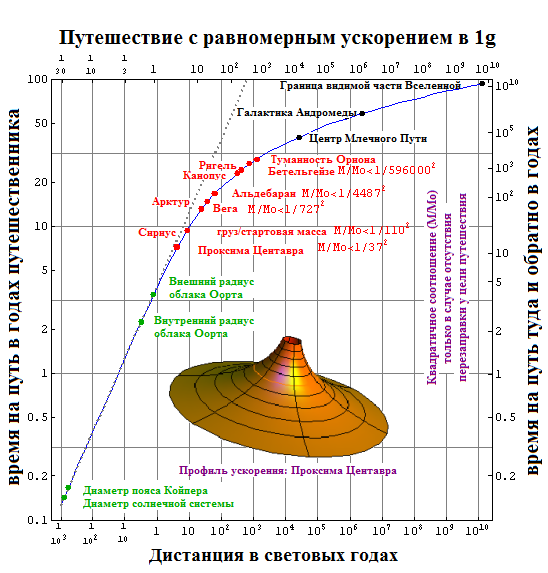
The dotted line shows the flight time without taking into account the relativistic time dilation. The annihilation reaction is taken as the energy source in calculating the payload / starting mass ratio.
The “Oh my God” particle — which had the largest recorded energy among the particles that arrived to us from outer space — had an energy of 3 * 10 20 eV — which is approximately 48 joules — which is 40 million times the energy achieved in the LHC . If this particle was a proton (this is the main version), then for a year of flight it would be only 47 nm behind the light ray. When approaching the speed of light, time dilation is very fast:

And the time for him would be slowed down by 300 billion times in comparison with a motionless observer - this means that having flown the entire Universe (the size of which is now estimated at 91 billion light years), only about 100 days would have passed for him.
Quantum effects
As is known, black hole radiation ( Hawking radiation ) is associated only with their mass:
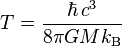
For a black hole with a mass equal to the Sun (the lower limit for black holes formed from stars is even a little higher) will evaporate over an enormous amount of time - 2 * 10 67years (which is 57 orders of magnitude longer than the lifetime of the Universe), and black holes can be detected by this radiation only at the very last stage of their evaporation (before this, evaporation is very slow and the radiation is almost imperceptible) - therefore, it does not seem to be detected at the moment no possibility.
Moreover, the temperature of the “surface” of a black hole with a mass equal to the Sun is only 6 * 10 -8 K (this is despite the fact that the relict radiationhas a temperature of ≈2.7 K), which means that at the moment - they do not even evaporate, but rather grow! So now astronomers hope to find smaller black holes that could theoretically form at the early stage of the universe (when the substance was extremely dense, and due to small irregularities in its expansion, could collapse into a black hole).
For black holes in the centers of galaxies, the time of their existence (it depends on the 3rd degree of mass):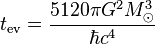
becomes even more enormous - the black hole in the center of the Milky Way should exist 10 77 more than the time that the Universe already exists (13,799 ± 0,021 billion years ), and the largest known at the moment - should last ≈2 * 10 98 years (at 10 88times the lifetime of the universe).
Due to dependence solely on its mass, the power of the “explosion” of a black hole at the last moment is the same for all of them. A second before the final evaporation (it is assumed that in the end a stable black hole with Planck dimensions should remain), its mass will be 2.28 * 10 5 kg, and 6.84 * 10 21 J of energy (about 5 * 10 12 tons of TNT).
Nuclear physics
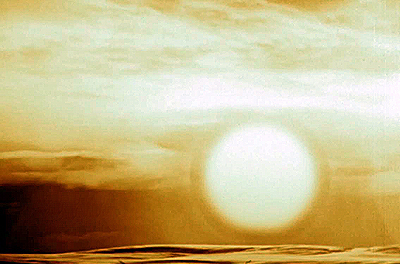
The most famous effect is the amount of energy released in the processes of nuclear reactions. So the first atomic bomb detonated on July 16, 1945 during the tests of the Trinity- had a mass of 108 tons, the amount of energy released was equivalent to the explosion of 21 thousand tons of TNT. And the most powerful thermonuclear bomb in human history, detonated already on October 30, 1961 - with a weight of 26.5 tons had a TNT equivalent of 58 million tons (2.4 * 10 17. However, a mass defect (mass directly converted into energy by the formula E = mc 2 ) amounted to only 2.65 kg, or only 0.1% of the total mass.
It would seem that the value is still huge, but on a planetary scale, it is already an insignificant quantity: so in order to melt the Martian ice caps at the poles , it would take about 55 thousand of these bombs, or 73 tons of antimatter. the resulting amount of antimatter is measuredhundreds of atoms (a value of the order of 10 -21 kg), and its retention time - in minutes. Which, in general, is good - after all, studies on its use in weapons by hundreds of atoms "> are already underway . Moreover, antimatter has no limit on the minimum power and mass of charge (like nuclear and thermonuclear weapons), and only one gram of antimatter is already equivalent 43 Thousands of tons of TNT - it’s scary to imagine what such a weapon will be capable of.
The average person’s mass is 62 kg , which is approximately 5.9 * 10 27 atoms, or almost 1.4 * 10 29 currently indivisible particles (quarks and electrons). And the total charge of electrons and prot new in the human body is at 3 x 10 9Pendant, or approximately 900 thousand Ah * (amer-hours). The charge of the car battery for comparison is about 50 A * h. We do not notice such a monstrous charge and its effects due to the fact that the negative charge of electrons is balanced by the positive charges of protons in atoms.
Classical mechanics The
acceleration of gravity increases in direct proportion to the mass of the body, and inversely to the square of the radius:
And since the mass of celestial bodies generally grows from the third degree of the radius (body volume), but in reality it’s even a little more (the density of heavy bodies is higher) , then such heavy bodies as giant planets and stars attract bodies quite distant from them.
Already on the conventional surface of Jupiter (gas giants and stars have the same very conventional border as the Earth’s atmosphere), you would weigh 2.5 times more, and on the Sun it would be almost 28 times more (such an acceleration a person is able to withstand only for a couple of seconds ). Due to its small size, for a white dwarf, the acceleration of gravity will be already 250,000 times higher than the earth. And for the most massive neutron stars - already 200 billion times more. This is already enough to crush not only the human body, but even any atoms:
The composition of a neutron star
The density of such stars is huge - from 3.7 × 10 17 to 5.9 × 10 17 kg / m 3. Under conditions of increased attraction, one cubic nanometer of their substance (in which under normal conditions fewer than a thousand atoms are placed) on the surface of a neutron star should weigh about 100 kilograms. But a further increase in the mass of the bodies leads to a completely opposite effect - with the formation of a black hole, the acceleration of gravity (on the conditional surface of the body - the event horizon) becomes constant:
And a further increase in the mass leads to a decrease in density - the density formula of the black hole shows that it is inversely proportional the square of its mass, and doesn’t depend on anything else:
So for a black hole with a mass of 4.31 million solar masses, like Sagittarius A *(of the object in the center of our galaxy - the Milky Way) the diameter will be 17 times the solar, and the density will be 10 6 kg / m 3 . And for a black hole in the center of NGC 4889, which has 21 billion solar masses (the Gargantua mass from the Interstellar film, for example, “only” 100 million), the density will be 41 g / m 3 , which is half the hydrogen density at atmospheric pressure .
The effects of the theory of relativity
At low speeds, the effects of the theory of relativity are very weak. However, with its growth, everything changes dramatically - for example, a graph that shows the time of flight to different points of the Universe with uniform acceleration and braking halfway with acceleration of 1g:
The dotted line shows the flight time without taking into account the relativistic time dilation. The annihilation reaction is taken as the energy source in calculating the payload / starting mass ratio.
The “Oh my God” particle — which had the largest recorded energy among the particles that arrived to us from outer space — had an energy of 3 * 10 20 eV — which is approximately 48 joules — which is 40 million times the energy achieved in the LHC . If this particle was a proton (this is the main version), then for a year of flight it would be only 47 nm behind the light ray. When approaching the speed of light, time dilation is very fast:
And the time for him would be slowed down by 300 billion times in comparison with a motionless observer - this means that having flown the entire Universe (the size of which is now estimated at 91 billion light years), only about 100 days would have passed for him.
Quantum effects
As is known, black hole radiation ( Hawking radiation ) is associated only with their mass:
For a black hole with a mass equal to the Sun (the lower limit for black holes formed from stars is even a little higher) will evaporate over an enormous amount of time - 2 * 10 67years (which is 57 orders of magnitude longer than the lifetime of the Universe), and black holes can be detected by this radiation only at the very last stage of their evaporation (before this, evaporation is very slow and the radiation is almost imperceptible) - therefore, it does not seem to be detected at the moment no possibility.
Moreover, the temperature of the “surface” of a black hole with a mass equal to the Sun is only 6 * 10 -8 K (this is despite the fact that the relict radiationhas a temperature of ≈2.7 K), which means that at the moment - they do not even evaporate, but rather grow! So now astronomers hope to find smaller black holes that could theoretically form at the early stage of the universe (when the substance was extremely dense, and due to small irregularities in its expansion, could collapse into a black hole).
For black holes in the centers of galaxies, the time of their existence (it depends on the 3rd degree of mass):
becomes even more enormous - the black hole in the center of the Milky Way should exist 10 77 more than the time that the Universe already exists (13,799 ± 0,021 billion years ), and the largest known at the moment - should last ≈2 * 10 98 years (at 10 88times the lifetime of the universe).
Due to dependence solely on its mass, the power of the “explosion” of a black hole at the last moment is the same for all of them. A second before the final evaporation (it is assumed that in the end a stable black hole with Planck dimensions should remain), its mass will be 2.28 * 10 5 kg, and 6.84 * 10 21 J of energy (about 5 * 10 12 tons of TNT).
Nuclear physics
The most famous effect is the amount of energy released in the processes of nuclear reactions. So the first atomic bomb detonated on July 16, 1945 during the tests of the Trinity- had a mass of 108 tons, the amount of energy released was equivalent to the explosion of 21 thousand tons of TNT. And the most powerful thermonuclear bomb in human history, detonated already on October 30, 1961 - with a weight of 26.5 tons had a TNT equivalent of 58 million tons (2.4 * 10 17. However, a mass defect (mass directly converted into energy by the formula E = mc 2 ) amounted to only 2.65 kg, or only 0.1% of the total mass.
It would seem that the value is still huge, but on a planetary scale, it is already an insignificant quantity: so in order to melt the Martian ice caps at the poles , it would take about 55 thousand of these bombs, or 73 tons of antimatter. the resulting amount of antimatter is measuredhundreds of atoms (a value of the order of 10 -21 kg), and its retention time - in minutes. Which, in general, is good - after all, studies on its use in weapons by hundreds of atoms "> are already underway . Moreover, antimatter has no limit on the minimum power and mass of charge (like nuclear and thermonuclear weapons), and only one gram of antimatter is already equivalent 43 Thousands of tons of TNT - it’s scary to imagine what such a weapon will be capable of.
The average person’s mass is 62 kg , which is approximately 5.9 * 10 27 atoms, or almost 1.4 * 10 29 currently indivisible particles (quarks and electrons). And the total charge of electrons and prot new in the human body is at 3 x 10 9Pendant, or approximately 900 thousand Ah * (amer-hours). The charge of the car battery for comparison is about 50 A * h. We do not notice such a monstrous charge and its effects due to the fact that the negative charge of electrons is balanced by the positive charges of protons in atoms.