June 1, 2016 at 15:32
Microcomputer micro: bit from BBC can already be bought
micro: bit can be of interest to both children and adults.
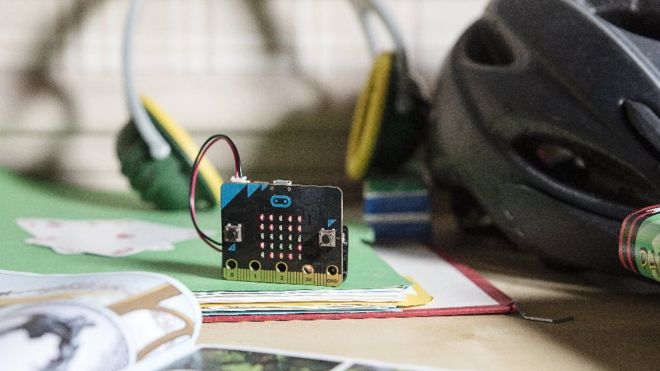
Photo: BBC
About a year ago, BBC announced its intention to distribute a million miniature PCs to UK students. Clearly, not for entertainment, but for study (development of Touch Develop, Python, and C ++). The target audience of the project were schoolchildren aged 11-12. It was also promised to make this mini-PC compatible with Raspberry Pi, Arduino, Galileo and other mini-PCs.
This year, the promise was realized, and on March 22, the company began sending outdevices to all schools that have signed up for the micro: bit program. The authors of the project believe that this kind of electronic device will allow the younger generation to develop interest in the study of modern technologies. Interestingly, this is the second such project from the Air Force, the first was implemented in the 1980s, it was called BBC Micro .
With the start of the distribution of microcomputers, the company announced that after some time the system could be bought (there were speculations about the initial price of 4-5 pounds). Partners also took part in the development itself, including Microsoft, which provided the project with its own development environment, this is the Touch Develop platform. Samsung, a South Korean company, also helped by developing an Android app. NXP provided the project with a USB controller, accelerometer and magnetometer. In general, the number of project partners increased over time to 20.
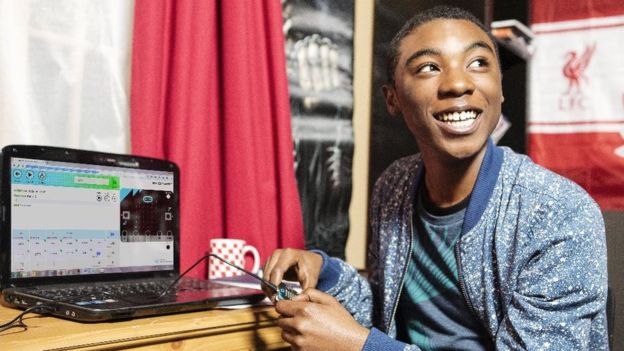
Students received not just a fee, but a whole package, with the module itself, a USB cable and a battery power supply. In addition, the instruction on the whole 32 pages was supplied with this package. For optimal work with the chip, registration on the micro: bit project website is supposed to be , where there is everything necessary for development. The site was just developed by Microsoft.
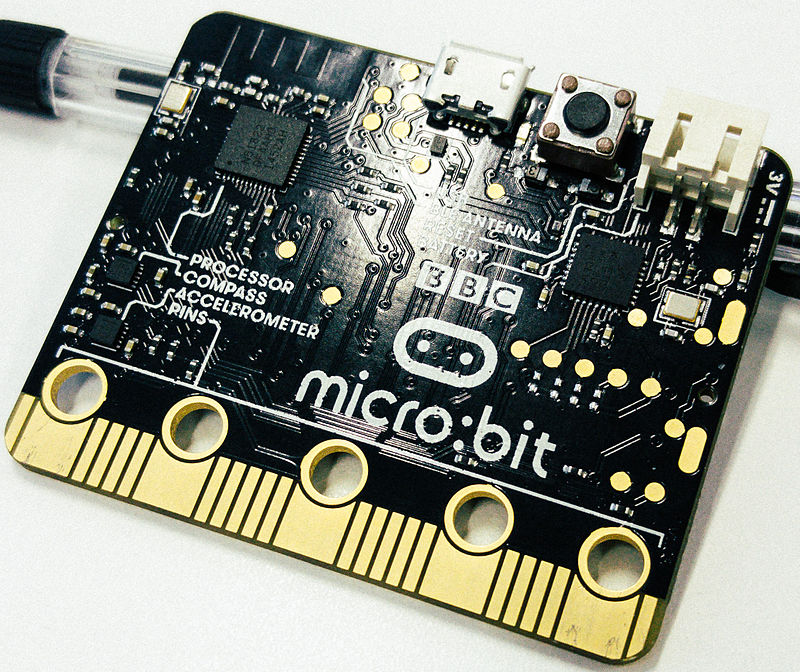
Microcomputer specifications are as follows:
Now it became known that this mini-PC has already gone on sale. True, its price is twice as high as the cost of the same raspberry, Raspberry Pi. You can buy your micro: bit for £ 12.99. This is the cost of one module. A kit with USB and a few introductory classes will cost the buyer as much as £ 15. 10 of these kits are sold at a discount of 10 pounds and can be purchased for £ 140. The company provides various kits for retailers and its partners. They can also be bought, or it will be possible after a while.
The board has several programmable buttons, a number of sensors and LEDs. Wireless data transfer via Bluetooth is also supported. There are also native applications for the iOS and Android platforms .

Third-party manufacturers produce accessories and add-ons for the project. For example, the MyMiniFactory resource provides ready-made models of cases and other parts for the board, which can be printed on a 3D printer.
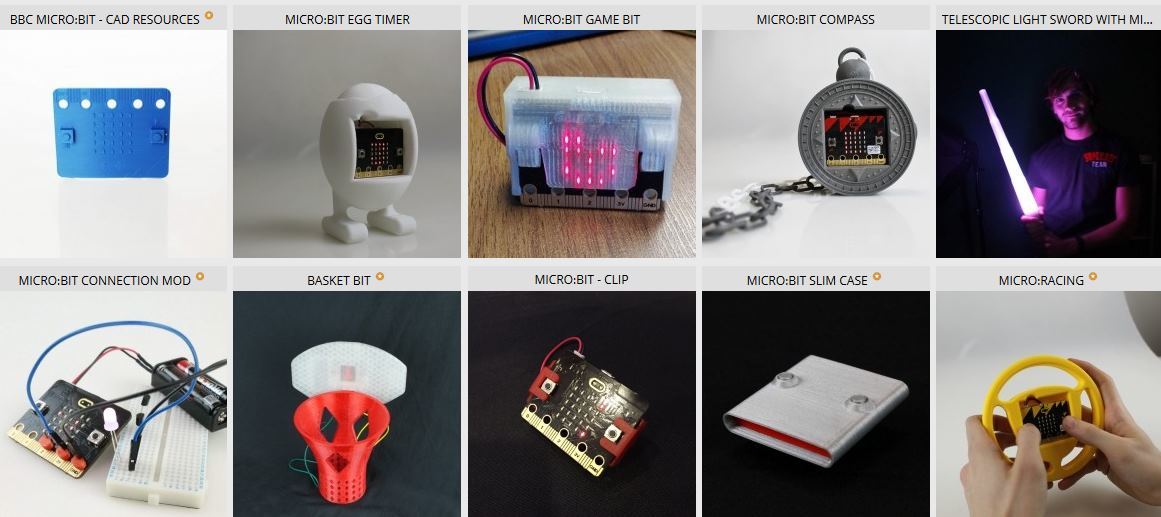
As you can see, you can do a lot of things from the board, it would be a desire and time. This board is interesting for adults, and for children - features, because on the basis of micro: bit you can create a robot, a clock, and a module for the security system of a smart home.
Photo: BBC
About a year ago, BBC announced its intention to distribute a million miniature PCs to UK students. Clearly, not for entertainment, but for study (development of Touch Develop, Python, and C ++). The target audience of the project were schoolchildren aged 11-12. It was also promised to make this mini-PC compatible with Raspberry Pi, Arduino, Galileo and other mini-PCs.
This year, the promise was realized, and on March 22, the company began sending outdevices to all schools that have signed up for the micro: bit program. The authors of the project believe that this kind of electronic device will allow the younger generation to develop interest in the study of modern technologies. Interestingly, this is the second such project from the Air Force, the first was implemented in the 1980s, it was called BBC Micro .
With the start of the distribution of microcomputers, the company announced that after some time the system could be bought (there were speculations about the initial price of 4-5 pounds). Partners also took part in the development itself, including Microsoft, which provided the project with its own development environment, this is the Touch Develop platform. Samsung, a South Korean company, also helped by developing an Android app. NXP provided the project with a USB controller, accelerometer and magnetometer. In general, the number of project partners increased over time to 20.
Students received not just a fee, but a whole package, with the module itself, a USB cable and a battery power supply. In addition, the instruction on the whole 32 pages was supplied with this package. For optimal work with the chip, registration on the micro: bit project website is supposed to be , where there is everything necessary for development. The site was just developed by Microsoft.
Microcomputer specifications are as follows:
- Board dimensions 4x5cm.
- CPU: Nordic nRF51822, 16 MHz 32-bit ARM Cortex-M0 microcontroller, 256 KB flash memory, 16 KB RAM, also this microcontroller has a built-in 2.4 GHz Bluetooth module for low power consumption.
- To maintain the USB interface, a separate Freescale Kinetis KL26Z 48 MHz microcontroller with an ARM Cortex-M0 + core is installed on the board.
- 3-axis accelerometer Freescale MMA8652 with I²C bus.
- Freescale MAG3110 3-axis magnetometer with I²C bus (can be used as a compass or as a metal detector).
- 5x5 matrix of 25 LEDs.
- Three buttons: two for the user, one locked to the reset function.
- 23 pins for general purpose I / O pins.
- Connectors: MicroUSB and power.
Now it became known that this mini-PC has already gone on sale. True, its price is twice as high as the cost of the same raspberry, Raspberry Pi. You can buy your micro: bit for £ 12.99. This is the cost of one module. A kit with USB and a few introductory classes will cost the buyer as much as £ 15. 10 of these kits are sold at a discount of 10 pounds and can be purchased for £ 140. The company provides various kits for retailers and its partners. They can also be bought, or it will be possible after a while.
The board has several programmable buttons, a number of sensors and LEDs. Wireless data transfer via Bluetooth is also supported. There are also native applications for the iOS and Android platforms .
Third-party manufacturers produce accessories and add-ons for the project. For example, the MyMiniFactory resource provides ready-made models of cases and other parts for the board, which can be printed on a 3D printer.
As you can see, you can do a lot of things from the board, it would be a desire and time. This board is interesting for adults, and for children - features, because on the basis of micro: bit you can create a robot, a clock, and a module for the security system of a smart home.