April 28, 2016 at 15:49
Nairi: an outstanding machine of an outstanding developer
Machines of the Nairi family played a significant role in the development of computer engineering in the USSR and became a worthy response to Western computers. Along with the development of the machine, the career of the chief designer, Hrachya Esaevich Hovsepyan, was also forming. The life path of this talented person was thorny and difficult, filled with development and confrontation with the system.
Future designer Hrachya Hovsepyan was born in 1933 in Lebanon. In 1946, he and his family repatriated to Armenia, where he graduated from the Physics Department of Yerevan State University. In 1956, he got a job as a laboratory assistant in the newly organized regime enterprise for the creation of computers - Yerevan Scientific Research Institute of Mathematical Machines (YERNIIMM). The Institute was headed by mathematicians, corresponding member of the Academy of Sciences of the USSR and full member of the Academy of Sciences of the Armenian SSR Sergey Nikitovich Mergelyan.

Hrachya Yesayevich Hovsepyan
As a laboratory assistant, Hovselyan worked for only a year, during which he grew to the head of the group. From the institute he had a special passion for semiconductors. Therefore, he did everything possible to get into the Brusilovsky team, which was just engaged in the development of the first Soviet computer, implemented entirely on semiconductors. The machine was called Hrazdan and was part of the family of general-purpose digital electronic computers. A group led by Hovselyan worked on a control device (CU).
Over the years of work (1958-1964) on Hrazdan, Hovselyan’s authority has grown significantly. He was invited to do "small machines", which were originally presented as electronic arithmometers. But it was clear to the young developer that machines would not be limited to the functions of large "calculators." Around the same time, Hovselyan became seriously interested in microprogramming and was inspired by the ideas of the British professor at Cambridge University Maurice Wilks. In the early 50s, a British scientist suggested designing control machines using micro-instructions that are stored in the processor's memory. This method facilitated the design of the machine and made it easy to change it. In addition, Wilkes introduced a system of mnemonic designations for machine instructions called the assembly language.
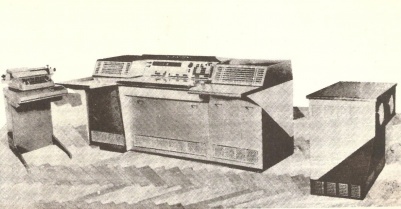
Hrazdan-2 computer (1961)
At the request of the leadership, a new machine was to be built according to the type of the French model CAB-500, which was presented at the International Exhibition of Computer Engineering in Moscow (1962). But after lengthy discussions and arguments on the part of developers who wanted to create their own machine, and not copy the western one, it was decided to build a fundamentally new computer.
The Nairi development process took several years and in 1964 the machine was created. And a year later they launched the serial production of the Nairi computer.
"Nairi" belonged to the class of electronic digital computers of discrete action of low productivity. It was performed entirely on semiconductor devices with a power consumption of about 1.6 kW. The computer was intended to solve a fairly wide range of mathematical problems arising in engineering and economic calculations and scientific research. The machine is entirely made on semiconductor devices.
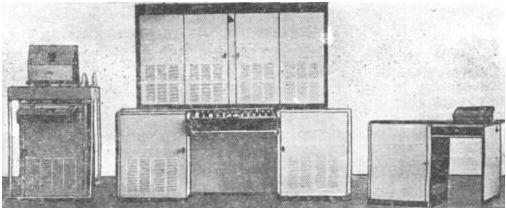
“Nairi” consisted of the main machine cabinet (arithmetic device, control device, random access memory, long-term memory device, external device, control panel) and a power cabinet (stabilized power supply units, protection and alarm unit, control unit).

Arithmetic device (AU) performed arithmetic and logical operations on numbers and commands, consisted of one register - adder (cm). The adder contained 37 digits (the 34th to represent the fractional part of the number, the 35th to represent the integer part, the 36th to sign the number, and the 37th to optional). The functions of the auxiliary registers were performed by the fixed cells of the random access memory.
The control device (UU) was intended for automatic control of the machine when executing a given program for solving the problem. It consisted of blocks:
- 14-bit instruction counter (SCC) indicating the address of the RAM or DZU cell from which it is necessary to select the next command;
- 36-bit register of commands (R gK), receiving and saving the command during its execution;
- the central control device (C U) of the machine, operating on the principle of microprogram control;
- pulse distribution unit (VRI) for the formation of pulses of elementary operations that are part of the microcommand.
The random access memory (RAM) was intended for recording, storing and issuing commands and numbers, intermediate and final results of calculations. The access time to RAM was 20 μs. The drive was made in the form of 8 cassettes, each of which had 128 cells. The valve and the ruler were selected using two decoders (potential for 64 outputs and pulse for 16 outputs).
Long-term storage device (DZU) was used to store and issue commands, various auxiliary data and control firmware. The access time to the DZU was 12 microseconds. The total capacity is 16384 numbers, of which the first 2048 had 72 bits and were allocated for storing control microprograms. The rest were used to store various subroutines for decrypting source information, automatic programming, etc. The drive consisted of 9 cells, each of which had 8 rows of oxyphers. Information was entered into the cell via firmware codes for ranks and rows. The choice of address for reading data was carried out using potential decoders for selecting a drive cell with 8 outputs, selecting a wire for 16 outputs, selecting a row for 8 outputs, and also a pulse decoder for selecting a wire for 16 outputs.
An external device (WU) was intended to enter information into the machine and output the results of the calculations. It included a printing device, a paper ribbon punch, and a transmitter. The speed of the WU apparatus was 6 characters per second. Depending on the choice of mode, the control unit could work independently of the machine in stand-alone mode.

The block diagram of "Nairi"
The Nairi control panel consisted of a signaling panel (PS) and a control panel (PU). The alarm panel was used to select the desired operating mode and light alarm. 6 modes were provided: “universal” (normal operation mode), “counting” (directly for calculations), “memory output” (data output in the form of commands or numbers), “step” (stopping the machine after the operation), “semi-automatic ”(Stopping the machine after pseudo-operation and machine operation) and“ stop at address ”(stopping at the command address). The control panel was used for various adjustment operations (code transfer to different machine registers, blanking of registers, writing and reading via RAM, etc.).
The Nairi computer was a two-address program-controlled machine with a natural order of command execution and a binary number system. Among the features it is worth highlighting: the ability to enter tasks in a language close to mathematical using automatic programming to solve problems; the ability to work as a desktop computer. The form for representing numbers is fixed point. Subroutines performed operations on floating point numbers.
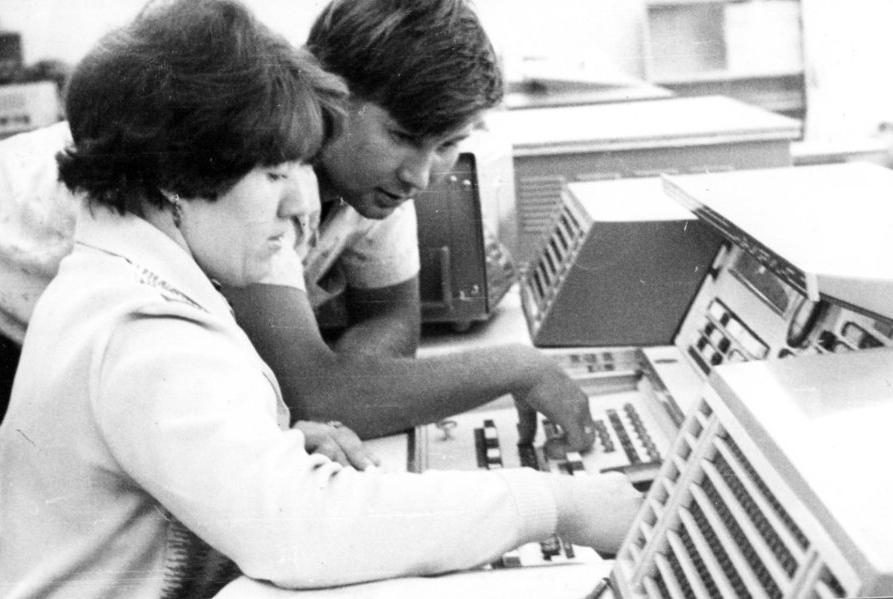
All transfers between the registers, writing to random access memory, issuing codes, arithmetic operations were carried out in a parallel way. Data was entered into “Nairi” using the keyboard of a printing press or from perforated paper tape in alphanumeric form. The results were displayed through printing in alphanumeric form or perforation.
An example of the average speed of computing some tasks:
- elementary functions (such as sinx, logx, eX, etc.) - 70 ÷ 100 ms;
- a system of linear algebraic equations of the 28th order - 20 min;
- in the calculation of determinants of the 12th order - 10 min;
- inversion of the matrix of the 12th order - 12 min;
- finding the eigenvalues of the matrix of the 12th order - 14;
- finding the eigenvalues and eigenvectors of the matrix of the 12th order - 1.5 hours;
- solving an algebraic equation of the 42nd order - 1.5 hours.
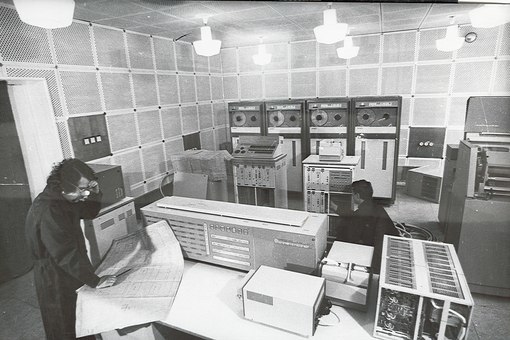
In the automatic programming mode, tasks were solved without prior programming. The algorithm for solving the problem was set in the form of operators (instructions). The program, written in this form, very much resembled the ordinary language of mathematics. A special translator, having adopted the operator program, was a working one. In turn, if necessary, such a work program could be displayed and used as an independent one. As a result, the automatic programming mode turned Nairi into a machine with a more familiar and concise language compared to a machine language. Operators were programmed in any order according to the task. There were 17 operators in total. Namely: let's say; we calculate; insert; introduce; decide; we print; program; if; go to; interval; we ask; keep; we will draw; we finish; stop; an array; we will execute.
As for the design of the computer, as already written, it consisted of a main cabinet and a power cabinet. The main cabinet was made in the form of a desk, which allowed the operator, sitting in front of the remote control of the machine, to carry out all the necessary operations, but also to make appropriate notes in the journal. And the power cabinet is a separate cabinet and is connected to the main one using a split harness. The car was
attended by 14 types of cells, made using printed wiring. The cells were connected into blocks with a printed version of the commutation, the communication of which was carried out by wired installation. For more convenient access to random access memory, the address part of the drive was brought to the door-board of the RAM cube.
So, the output of Nairi in 1964 became a real sensation in the computer engineering of the USSR. The machine had a high technical level and could solve a wide range of problems. The NAIRI Computer Users and Developers Association was even created. At meetings held every year, participants exchanged experiences on the development and improvement of software, discussed various tasks and solutions for the use of the machine itself. The flexibility of the microprogramme control method made it possible to quickly make appropriate changes to the numerous modifications of Nairi. Moreover, often even the users themselves could make the necessary changes to the computer, personalizing the machine for themselves.
From 1965 to 1967, various modifications of the machine came out. The first was the Nairi-M. It differed from the base model in the configuration of external devices - the FS-1501 photosensor and the PL-80 tape drill were introduced into the periphery. “Nairi-K” appeared after it, in which RAM increased up to 4096K words. The release of “Nairi-S” took place a year later. An electrified typewriter Consul-254 was used as an input / output device.
In 1966, Nairi-2 was released, which was distinguished by an increase in the amount of memory (up to 2048K 36-bit words) and speed. More powerful I / O devices have been applied to the new model.

Documentation for Nairi-2
But more interest from the state aroused "Nairi-3." The car became a serious project, for the implementation of which a substantial amount of money was allocated. It was the first Soviet third-generation computer implemented on hybrid integrated circuits. The microprogramming principle of controlling the first model in “Nairi-3” reached the highest development and was brought to a qualitatively new level. At the same time, it became possible to compactly store large (up to 128 thousand micro-instructions) arrays of microprograms while simultaneously drastically reducing the access time, and it was also possible to use all the necessary conventional programming techniques. Thanks to this, it was possible to provide a multilingual computer structure, a time sharing mode with simultaneous access to up to 64 terminals, each of which could perform the functions of one Nairi-2 computer,

Nairi-3
Nairi-3 met the highest technical standards of the time. Even the Americans recognized the high technology and sophistication of the machine. It was an incredible success for developers who worked hard to create computers. Accordingly, the car had considerable hopes. The plans of the leading forces ripened the launch of a series of such computers. As a result, a group of specialists headed by Hovsepyan went to Astrakhan. And in record time, they managed to debug and pass seven working Nairi-3 models to the factory commission with a high acceptance score. The thoughtfulness and high-quality elaboration of the project allowed in the future to produce serial cars without special skills and time. One of the remarkable features of the Nairi computer was their high manufacturability,
We can consider the Nairi models as Soviet ancestors of modern personal computers. In the computer "Nairi-3" was realized the simplification of user interaction with the machine while enriching and expanding it. Actually, Nairi-4 was conceived as a personal computer of that time. The computer had an original architecture, consisting of a set of computing tools that allowed you to create any configuration of problem-oriented machines, among which the base was a truncated processor with operational storage of tightly packed microprograms. "Nairi-4" was the next landmark achievement of Soviet computer technology.
The Nairi-4 model was created after the departure of Ovselyan from YernIIIMM. During this period, he was at the top of his triumph as a developer. But it so happened that his relatives were forced to submit documents to leave the USSR ... This put the scientist in a difficult choice between career and family. After much deliberation, Hovselyan made a decision, which literally shocked many. At first he left the institute. Then he went to Moscow, where he began collecting documents for traveling abroad. But unfortunately, he failed to reunite with his family so quickly ... Ovselyan was not allowed to leave the Union, moreover, he was left in the “refuseniks” (those who were not allowed to go abroad, but were not allowed to work in Soviet institutions). For almost 10 years he was in a hopeless situation, was forced to work in the lowest paid and hard jobs,
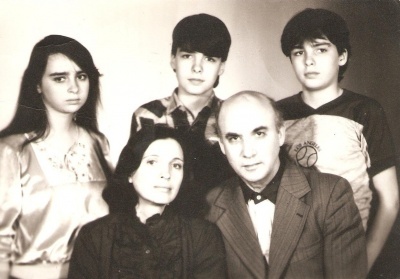
Hovsepyan with his family
And finally, at the end of 1988, thanks to the intervention of the US Congress and President Ronald Reagan personally, Hovsepyan was allowed to leave his homeland. By that time, only an old mother and brother remained from his large family. The second brother and sister were no longer alive. Personal drama was strengthened by the fact that in a new country his talent remained unclaimed. Foreign companies were distrustful of an already middle-aged Soviet developer who had not worked in his specialty for so many years and knew little about modern technologies.
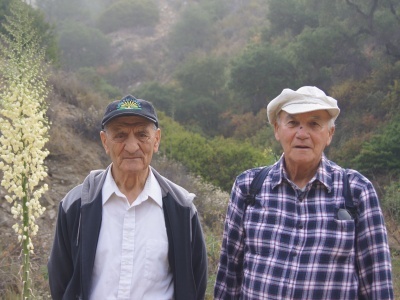
Hrachya Hovsepyan with a friend in the mountains of Los Angeles
And so the talented and once outstanding scientist became a simple worker, earning his living instruments. He settled in Los Angeles and got a job at a computer repair company. There he lives to this day. And let Hovsepyan’s achievements in the distant past, his contribution to Soviet computer engineering remain invariably as important as the legacy in the form of machines of the Nairi family.
The beginning of the story
Future designer Hrachya Hovsepyan was born in 1933 in Lebanon. In 1946, he and his family repatriated to Armenia, where he graduated from the Physics Department of Yerevan State University. In 1956, he got a job as a laboratory assistant in the newly organized regime enterprise for the creation of computers - Yerevan Scientific Research Institute of Mathematical Machines (YERNIIMM). The Institute was headed by mathematicians, corresponding member of the Academy of Sciences of the USSR and full member of the Academy of Sciences of the Armenian SSR Sergey Nikitovich Mergelyan.
Yerevan Institute of Mathematical Machines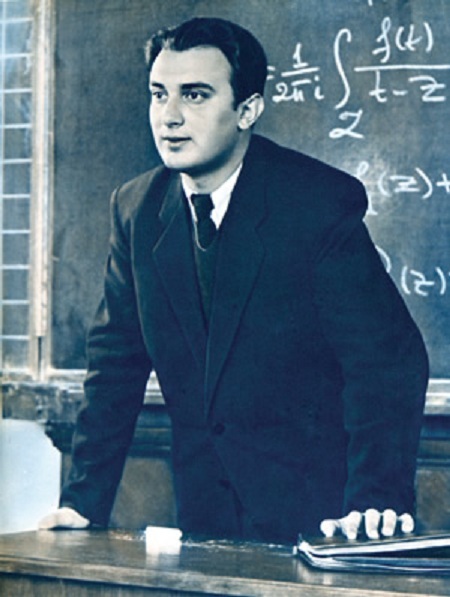
Sergey Nikitovich Mergelyan (1928 - 2008).
The Yerevan Institute of Mathematical Machines was organized by the talented mathematician Sergei Mergelyan, the youngest doctor of science in the history of the USSR (degree awarded to defend a candidate dissertation at 20) and a corresponding member of the USSR Academy of Sciences (received the title at 24 years old). His brilliant abilities and achievements in science made such a strong impression on the country's top leadership that the Soviet government considered it necessary to create an appropriate institution in Yerevan. Naturally, S. Mergelyan himself became the director of the institute. He put a lot of effort into the development and formation of this scientific institution, which in the future gave the USSR wonderful Nairi cars.
The institute formed functional units for the design of hardware and software, including their design and technological equipment. In addition, workshops were launched for the manufacture of samples of devices and components, including power supplies. Subsequently, individual workshops were combined into pilot production, and later into the YernIIIMM Experimental Plant.
Sergey Nikitovich Mergelyan (1928 - 2008).
The Yerevan Institute of Mathematical Machines was organized by the talented mathematician Sergei Mergelyan, the youngest doctor of science in the history of the USSR (degree awarded to defend a candidate dissertation at 20) and a corresponding member of the USSR Academy of Sciences (received the title at 24 years old). His brilliant abilities and achievements in science made such a strong impression on the country's top leadership that the Soviet government considered it necessary to create an appropriate institution in Yerevan. Naturally, S. Mergelyan himself became the director of the institute. He put a lot of effort into the development and formation of this scientific institution, which in the future gave the USSR wonderful Nairi cars.
The institute formed functional units for the design of hardware and software, including their design and technological equipment. In addition, workshops were launched for the manufacture of samples of devices and components, including power supplies. Subsequently, individual workshops were combined into pilot production, and later into the YernIIIMM Experimental Plant.
Hrachya Yesayevich Hovsepyan
As a laboratory assistant, Hovselyan worked for only a year, during which he grew to the head of the group. From the institute he had a special passion for semiconductors. Therefore, he did everything possible to get into the Brusilovsky team, which was just engaged in the development of the first Soviet computer, implemented entirely on semiconductors. The machine was called Hrazdan and was part of the family of general-purpose digital electronic computers. A group led by Hovselyan worked on a control device (CU).
Over the years of work (1958-1964) on Hrazdan, Hovselyan’s authority has grown significantly. He was invited to do "small machines", which were originally presented as electronic arithmometers. But it was clear to the young developer that machines would not be limited to the functions of large "calculators." Around the same time, Hovselyan became seriously interested in microprogramming and was inspired by the ideas of the British professor at Cambridge University Maurice Wilks. In the early 50s, a British scientist suggested designing control machines using micro-instructions that are stored in the processor's memory. This method facilitated the design of the machine and made it easy to change it. In addition, Wilkes introduced a system of mnemonic designations for machine instructions called the assembly language.
Hrazdan-2 computer (1961)
At the request of the leadership, a new machine was to be built according to the type of the French model CAB-500, which was presented at the International Exhibition of Computer Engineering in Moscow (1962). But after lengthy discussions and arguments on the part of developers who wanted to create their own machine, and not copy the western one, it was decided to build a fundamentally new computer.
The Nairi development process took several years and in 1964 the machine was created. And a year later they launched the serial production of the Nairi computer.
Characteristics of Nairi
"Nairi" belonged to the class of electronic digital computers of discrete action of low productivity. It was performed entirely on semiconductor devices with a power consumption of about 1.6 kW. The computer was intended to solve a fairly wide range of mathematical problems arising in engineering and economic calculations and scientific research. The machine is entirely made on semiconductor devices.
“Nairi” consisted of the main machine cabinet (arithmetic device, control device, random access memory, long-term memory device, external device, control panel) and a power cabinet (stabilized power supply units, protection and alarm unit, control unit).
Arithmetic device (AU) performed arithmetic and logical operations on numbers and commands, consisted of one register - adder (cm). The adder contained 37 digits (the 34th to represent the fractional part of the number, the 35th to represent the integer part, the 36th to sign the number, and the 37th to optional). The functions of the auxiliary registers were performed by the fixed cells of the random access memory.
The control device (UU) was intended for automatic control of the machine when executing a given program for solving the problem. It consisted of blocks:
- 14-bit instruction counter (SCC) indicating the address of the RAM or DZU cell from which it is necessary to select the next command;
- 36-bit register of commands (R gK), receiving and saving the command during its execution;
- the central control device (C U) of the machine, operating on the principle of microprogram control;
- pulse distribution unit (VRI) for the formation of pulses of elementary operations that are part of the microcommand.
The random access memory (RAM) was intended for recording, storing and issuing commands and numbers, intermediate and final results of calculations. The access time to RAM was 20 μs. The drive was made in the form of 8 cassettes, each of which had 128 cells. The valve and the ruler were selected using two decoders (potential for 64 outputs and pulse for 16 outputs).
Long-term storage device (DZU) was used to store and issue commands, various auxiliary data and control firmware. The access time to the DZU was 12 microseconds. The total capacity is 16384 numbers, of which the first 2048 had 72 bits and were allocated for storing control microprograms. The rest were used to store various subroutines for decrypting source information, automatic programming, etc. The drive consisted of 9 cells, each of which had 8 rows of oxyphers. Information was entered into the cell via firmware codes for ranks and rows. The choice of address for reading data was carried out using potential decoders for selecting a drive cell with 8 outputs, selecting a wire for 16 outputs, selecting a row for 8 outputs, and also a pulse decoder for selecting a wire for 16 outputs.
An external device (WU) was intended to enter information into the machine and output the results of the calculations. It included a printing device, a paper ribbon punch, and a transmitter. The speed of the WU apparatus was 6 characters per second. Depending on the choice of mode, the control unit could work independently of the machine in stand-alone mode.
The block diagram of "Nairi"
The Nairi control panel consisted of a signaling panel (PS) and a control panel (PU). The alarm panel was used to select the desired operating mode and light alarm. 6 modes were provided: “universal” (normal operation mode), “counting” (directly for calculations), “memory output” (data output in the form of commands or numbers), “step” (stopping the machine after the operation), “semi-automatic ”(Stopping the machine after pseudo-operation and machine operation) and“ stop at address ”(stopping at the command address). The control panel was used for various adjustment operations (code transfer to different machine registers, blanking of registers, writing and reading via RAM, etc.).
The Nairi computer was a two-address program-controlled machine with a natural order of command execution and a binary number system. Among the features it is worth highlighting: the ability to enter tasks in a language close to mathematical using automatic programming to solve problems; the ability to work as a desktop computer. The form for representing numbers is fixed point. Subroutines performed operations on floating point numbers.
All transfers between the registers, writing to random access memory, issuing codes, arithmetic operations were carried out in a parallel way. Data was entered into “Nairi” using the keyboard of a printing press or from perforated paper tape in alphanumeric form. The results were displayed through printing in alphanumeric form or perforation.
An example of the average speed of computing some tasks:
- elementary functions (such as sinx, logx, eX, etc.) - 70 ÷ 100 ms;
- a system of linear algebraic equations of the 28th order - 20 min;
- in the calculation of determinants of the 12th order - 10 min;
- inversion of the matrix of the 12th order - 12 min;
- finding the eigenvalues of the matrix of the 12th order - 14;
- finding the eigenvalues and eigenvectors of the matrix of the 12th order - 1.5 hours;
- solving an algebraic equation of the 42nd order - 1.5 hours.
In the automatic programming mode, tasks were solved without prior programming. The algorithm for solving the problem was set in the form of operators (instructions). The program, written in this form, very much resembled the ordinary language of mathematics. A special translator, having adopted the operator program, was a working one. In turn, if necessary, such a work program could be displayed and used as an independent one. As a result, the automatic programming mode turned Nairi into a machine with a more familiar and concise language compared to a machine language. Operators were programmed in any order according to the task. There were 17 operators in total. Namely: let's say; we calculate; insert; introduce; decide; we print; program; if; go to; interval; we ask; keep; we will draw; we finish; stop; an array; we will execute.
As for the design of the computer, as already written, it consisted of a main cabinet and a power cabinet. The main cabinet was made in the form of a desk, which allowed the operator, sitting in front of the remote control of the machine, to carry out all the necessary operations, but also to make appropriate notes in the journal. And the power cabinet is a separate cabinet and is connected to the main one using a split harness. The car was
attended by 14 types of cells, made using printed wiring. The cells were connected into blocks with a printed version of the commutation, the communication of which was carried out by wired installation. For more convenient access to random access memory, the address part of the drive was brought to the door-board of the RAM cube.
Success
So, the output of Nairi in 1964 became a real sensation in the computer engineering of the USSR. The machine had a high technical level and could solve a wide range of problems. The NAIRI Computer Users and Developers Association was even created. At meetings held every year, participants exchanged experiences on the development and improvement of software, discussed various tasks and solutions for the use of the machine itself. The flexibility of the microprogramme control method made it possible to quickly make appropriate changes to the numerous modifications of Nairi. Moreover, often even the users themselves could make the necessary changes to the computer, personalizing the machine for themselves.
From 1965 to 1967, various modifications of the machine came out. The first was the Nairi-M. It differed from the base model in the configuration of external devices - the FS-1501 photosensor and the PL-80 tape drill were introduced into the periphery. “Nairi-K” appeared after it, in which RAM increased up to 4096K words. The release of “Nairi-S” took place a year later. An electrified typewriter Consul-254 was used as an input / output device.
"Nairi-2" and "Nairi-3"
In 1966, Nairi-2 was released, which was distinguished by an increase in the amount of memory (up to 2048K 36-bit words) and speed. More powerful I / O devices have been applied to the new model.
Documentation for Nairi-2
But more interest from the state aroused "Nairi-3." The car became a serious project, for the implementation of which a substantial amount of money was allocated. It was the first Soviet third-generation computer implemented on hybrid integrated circuits. The microprogramming principle of controlling the first model in “Nairi-3” reached the highest development and was brought to a qualitatively new level. At the same time, it became possible to compactly store large (up to 128 thousand micro-instructions) arrays of microprograms while simultaneously drastically reducing the access time, and it was also possible to use all the necessary conventional programming techniques. Thanks to this, it was possible to provide a multilingual computer structure, a time sharing mode with simultaneous access to up to 64 terminals, each of which could perform the functions of one Nairi-2 computer,
Nairi-3
Nairi-3 met the highest technical standards of the time. Even the Americans recognized the high technology and sophistication of the machine. It was an incredible success for developers who worked hard to create computers. Accordingly, the car had considerable hopes. The plans of the leading forces ripened the launch of a series of such computers. As a result, a group of specialists headed by Hovsepyan went to Astrakhan. And in record time, they managed to debug and pass seven working Nairi-3 models to the factory commission with a high acceptance score. The thoughtfulness and high-quality elaboration of the project allowed in the future to produce serial cars without special skills and time. One of the remarkable features of the Nairi computer was their high manufacturability,
Nairi-4
We can consider the Nairi models as Soviet ancestors of modern personal computers. In the computer "Nairi-3" was realized the simplification of user interaction with the machine while enriching and expanding it. Actually, Nairi-4 was conceived as a personal computer of that time. The computer had an original architecture, consisting of a set of computing tools that allowed you to create any configuration of problem-oriented machines, among which the base was a truncated processor with operational storage of tightly packed microprograms. "Nairi-4" was the next landmark achievement of Soviet computer technology.
The fate of the creator
The Nairi-4 model was created after the departure of Ovselyan from YernIIIMM. During this period, he was at the top of his triumph as a developer. But it so happened that his relatives were forced to submit documents to leave the USSR ... This put the scientist in a difficult choice between career and family. After much deliberation, Hovselyan made a decision, which literally shocked many. At first he left the institute. Then he went to Moscow, where he began collecting documents for traveling abroad. But unfortunately, he failed to reunite with his family so quickly ... Ovselyan was not allowed to leave the Union, moreover, he was left in the “refuseniks” (those who were not allowed to go abroad, but were not allowed to work in Soviet institutions). For almost 10 years he was in a hopeless situation, was forced to work in the lowest paid and hard jobs,
Hovsepyan with his family
And finally, at the end of 1988, thanks to the intervention of the US Congress and President Ronald Reagan personally, Hovsepyan was allowed to leave his homeland. By that time, only an old mother and brother remained from his large family. The second brother and sister were no longer alive. Personal drama was strengthened by the fact that in a new country his talent remained unclaimed. Foreign companies were distrustful of an already middle-aged Soviet developer who had not worked in his specialty for so many years and knew little about modern technologies.
Hrachya Hovsepyan with a friend in the mountains of Los Angeles
And so the talented and once outstanding scientist became a simple worker, earning his living instruments. He settled in Los Angeles and got a job at a computer repair company. There he lives to this day. And let Hovsepyan’s achievements in the distant past, his contribution to Soviet computer engineering remain invariably as important as the legacy in the form of machines of the Nairi family.