October 12, 2015 at 22:54
Orthokeratology: a year of experience using night lenses
About 50% of the population does not have 100% vision - and among IT specialists and geeks who spend time closely monitoring screens of various sizes, this percentage tends to hundreds. At the moment, there are several ways to correct vision.
I tried almost all of them, and at the request of the public I describe my personal experience. Also, I was "lucky" to get on almost all the jambs that may occur in the path of the owner of orthokeratological lenses, so my experience may be useful to those who think about using them.
Glasses
Glasses have been around since the 13th century. Lenses that compensate for visual impairments are in the frame, and hang on the nose of a nearsighted person. Previously, people also used their options such as monocles and pince-nez, but today the latter have already moved into the category of atavisms.
I’ve been familiar with these crutches for eyes since school - from the moment when it became clear that I did not see the inscriptions on the board even from the first desk. I think that everyone is more or less familiar with this device.
Points pros
• someone likes the look of a person with glasses; as far as I understand, many modern hipster mods even wear glasses without correction, just because of the rim
• glasses of constant wearing are difficult to leave or forget to take on a trip somewhere
• less likely to get insects or other foreign objects in the eye
Cons points
• the frame presses on the skin and rubs it in the places of contact
• the image of the “bespectacled person” is automatically attached to the person
• even aspherical lenses distort the image
• long work at the computer with glasses noticeably tires your eyes
• they fog up when moving between rooms with different temperature and humidity
• they must be periodically cleaned of sebum and other contaminants
• in the rain they interfere with the review
• do not provide normal peripheral vision
• awkward movement can be knock down, drop, smash
• difficult anyatiya extreme sports, the use of motorcycle helmets, etc.
• with a strong difference in vision between the two eyes, full correction is often impossible
I think that bespectacled colleagues will be happy to complete this list.
Contact lenses
The first contact lens was made in the 19th century, but at that time it was glass products that were completely uncomfortable to have in the eye. Polymer soft lenses began to appear in the 1960s, and recently, science has offered more and more advanced lenses. You quickly get used to them and the sensation of a foreign body in the eye disappears.
After I got tired of glasses, I tried using contact lenses. I just got into the situation when between the two eyes the difference in vision exceeded 1.5 diopters, which leads to the impossibility of a complete correction of vision in both eyes. The eye that sees worse will not receive 100% correction.
Modern lenses, even for people with astigmatism, are sold at a very reasonable price (spending a month on disposable, simplest and most hygienic to use is about 3000 rubles). According to manufacturers, the material of modern lenses passes almost all the oxygen to the cornea and does not harm it.
Pros of Contact Lenses
• removed all the cons points; it doesn’t make sense to list them again
• it’s rather easy to handle, to learn how to remove and put them on
• disposable lenses do not require leaving
• full correction is possible for both eyes with different eyesight
Cons of contact lenses
• you must not forget to take them with you if you are going somewhere from home, including all their accessories - storage containers, cleaning liquid (in the case of reusable lenses), moisturizing drops
• if you are unexpectedly out of the house, you can stay without lenses
• in case of loss or theft as there are disadvantages
• It is necessary to carry rewetting drops, especially for people with "dry eye syndrome»
• need a few days to get used to wearing the lenses, gradually increasing the daily wearing time
• in the case of small particles falling eye pain get more intense than in the eyes without lenses
• theoretical lens can knock out hit in the head a ball or wash with water when bathing
• it’s inconvenient to go hiking and expeditions with lenses - it’s hard to wash your hands clean, you need to drag extra liquids and objects with you
• you can’t use them during illnesses with fever
The use of contact lenses was not very successful for me, they constantly “fidgeted” in my eyes, demanded abundant “watering” (due to “dry eye syndrome”), and as a result, I could not get used to them.
Night lenses
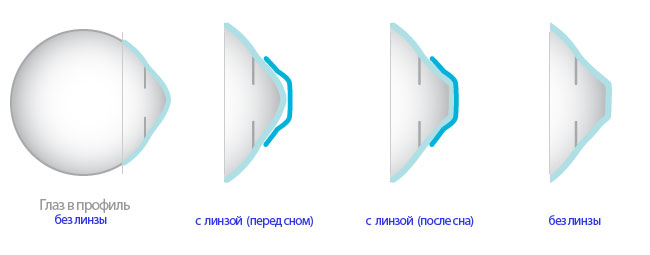
Having met somewhere the description of night lenses, I became interested in them and studied this issue. They are also called ortho lenses, night lenses, OK lenses . Their essence is that they are used at night. Since these lenses are made of rigid (albeit gas-permeable) plastic, overnight they rebuild the corneal epithelium in a predetermined manner.
The mechanism of correction of myopia in orthokeratology is a change in the shape of corneal epithelial cells under the action of a lens. Hydraulic forces under the lens through the lacrimal layer act on the surface cells of the cornea. Those, in turn, gradually flatten in the center and increase on the periphery of the cornea. The changed shape forms a natural lens that compensates for visual impairments. That is, these lenses are worn in the evening, just before bedtime, and removed in the morning, immediately after waking up.
The normal anatomy of the cornea and the integrity of its layers are not violated. The changes are so small (10-30 microns) that only special equipment can detect them. However, these changes are enough to see well all day without glasses and contact lenses.
The first attempts to manufacture such lenses were made back in the 60s, and in the 80s there was already a prototype of a modern OK lens, which became possible to manufacture on CNC machines. Gradually, apparatuses for accurately measuring the geometry of the cornea and rigid gas-permeable materials appeared.
In Russia, such lenses appeared at the beginning of this century. According to the ophthalmologists who deal with them, these lenses help inhibit the development of myopia in children and adolescents.
It all sounded pretty fantastic, but I still decided to try this method as an alternative to the expensive LASIK final correction method (which, after talking with ophthalmologists, I'm a little afraid of).
Selection and use
Lenses are made to order after measuring all parameters of the eye with the help of special equipment in ophthalmology rooms. In the Moscow company I contacted, the conditions of service were as follows: the patient pays for the cost of the lenses and the cost of the examination once, after which it is possible to visit the ophthalmologist’s office for any questions or problems for free and an unlimited number of times. In this case, the ophthalmologist appoints a periodic examination every 3 months.
The cost of the service was approximately 17 thousand rubles, of which about 3 thousand are the payment for the work of a doctor, and 14 thousand are the cost of manufacturing two lenses. The lenses serve throughout the year with proper handling.
In the office there is a decent set of ready-made lenses, and if your eyesight and eyes are not too problematic, there is a chance that they will be picked up on the spot. Of course, it was not so simple for me, and I had to order the lenses (production time - 3-4 working days).
It turned out that you need to get used to such lenses for a long time. Because they are rigid, they are felt in the eye as a foreign body. True, with my eyes closed, I almost did not feel them even from the first days - and since I sleep with my eyes closed, this is not a problem. In addition, the effect of the lenses is cumulative - immediately after the first few days, vision will not be 100%. The result appears after several weeks of constant wear.
Although these lenses are designed to be worn at night, they can function in them - they correct vision immediately after putting them on, just like regular contact lenses. But you need to get used to feeling them in the eye with open eyelids. They say that this is possible - in the end, people with complex problems have to wear hard contact lenses during the day. I did not set myself such a goal. But it’s quite possible in the evening, after putting on the lenses, to read something else, and in the morning, not immediately taking off, you can also do something.
During the initial selection of lenses, they put them in my eyes, and I sat in the waiting room for half an hour - after this time, the first effects that can be estimated using the equipment already begin. For the normal effect of correcting vision, which will last throughout the day, you must wear them at least 8-9 hours at night.
Depending on the strength of vision, the effect may last longer. In general, lenses are shown with myopia up to -6 diopters and astigmatism up to -1.5 diopters (however, literally every month new possibilities appear and borders are shifted). If your myopia is not very strong, you can wear lenses every other day. Even for me, with my -4, after several nights of continuous wearing of lenses, you can not wear them for one night, and the whole next day I can work at a computer, drive a car, etc. So if I am lucky and suddenly I stay with someone to spend the night, the next day I do not need help to get home.
After selecting the lenses, the doctor checks that they sat down normally after the first full night with them. You need to wear them in the evening, sleep, and in the morning, without taking off, get to the doctor. It checks the fit and other parameters.
The surprise was the process of removing OK lenses. They are put on and removed above the mirror lying on the table. Wearing them is as easy as contacting them. But just to remove the “pinch” does not work - they are tough. There are special sticks with suction cups that can be removed, but the ophthalmologist did not recommend this method as traumatic.
The lenses are removed in 3 stages. In the morning, when they “stuck” to the eyes during the night, it is necessary to moisten them well with drops. After a few minutes, you can massage the area around the lenses so that the drops fall under them. And then you can remove them by pulling both eyelids with your finger so that the edges of the eyelids press on the edges of the lenses. Then the lenses "pop out" of the eyes. Out of habit - they can even go to the floor, so I dropped them several times. Normally, I started to get this procedure only after three to four weeks. The finger of one hand pulls the eyelids, and the other hand catches the flying lens in the palm of the hand.
If you try too hard to remove the lens when it is still not completely “stuck”, you can damage the cornea. And I, of course, did this too. There was nothing particularly terrible - for several days I had to take a break and drip special healing drops.
Since the lenses are reusable, they must be stored and cleaned. Two storage options are available. One is the usual liquid for storing lenses, and daily cleansing with a special soapy liquid.
The second is a liquid based on hydrogen peroxide, in which the lenses are stored in a special container with a solid catalyst. As a result of the reaction, bubbles are formed that contribute to the mechanical cleaning of the lens. In this case, the lens should be washed with soapy liquid, but only once a week.
The second method is more convenient, but it has one drawback. Since gas is released during the reaction, the storage vial is made leaky. If it rolls over, fluid flows out of it. Therefore, traveling with him is problematic. If you drive a car, then for him you can come up with a box in which he will be firmly fixed. But on a hike or just a trip with a suitcase and a backpack it will already be more difficult.
If the cornea is sensitive (of course, I ran into it), the eyes get tired of such lenses overnight. True, there is a miraculous remedy "Korneregel", designed to restore the cornea, the periodic use of which solves this problem.
In dim light and at dusk, I have a halo effect around bright or luminous objects. The ophthalmologist explains this by saying that correcting the shape of the cornea affects only a small central area of the eye. With a lack of lighting, the pupil opens wide, and the light begins to refract through the area of the eye, not subject to correction. Against the background of all the advantages, I’m already used to this effect.
Pros of OK Lenses
• just like with conventional lenses, all the disadvantages of glasses are removed
• during the day you feel like a person with normal eyesight
• moisturizing drops are not needed during the day
• specks, dust, water and other factors do not bring any additional problems
• Compared to LASIK, the effect is reversible. Stopped wearing lenses - everything recovered, in a maximum of 3 days
Cons of OK Lenses
• do not forget to take them with you if you are going somewhere from home, including all their accessories - storage containers, cleaning liquid, moisturizing drops
• it is advisable not to spend the night without them more than once
• you need to get used to the removal procedure for several weeks
• hiking and walking expedition also uncomfortable
• Do not use during disease with increasing temperature
• to good effect and with poor vision should be worn 8-9 hours - people sleeping for 5-7 hours, it will be difficult
• recovery of the effect is not instant etc. absent only at more or less constant use lenses
• if in a dream at night to rub the eyes, you can grate it or damage the cornea
• you can’t sleep with your face in the pillow so that something presses on your eyes
Cost
• lenses: 14000 r / year
• maintenance: 3000 r / year
• liquid for daily cleaning: about 6000 r / year
• liquid for weekly cleaning: 700 r / year
• drops: 2300 r / year
Total: 26000 r / g, or 2200 r / month.
Summary
I have been using OK lenses for more than a year, that is, I already "demolished" the old ones and ordered new ones. After I began to deftly remove and put on lenses, there were no problems with their use. Sometimes I didn’t put them on for one night - for example, I once had a temperature and did not put them on. Found that with constant use, one night can be skipped.
Meklon :
“And what will happen in a couple of years with the cornea if it is so rammed up every day?”
There is the 15th month of the experiment. Periodic examinations every 3 months did not reveal any problems with the eyes. Moreover - the vision stopped falling (glasses fell a little every year). The redness of the eyes and fatigue at the end of the day disappeared (I work at a computer). Glasses are stored in a case for many months. I recalled a very funny sensation of the first days without glasses, when the movement of air is felt with unprotected eyes, for the first time after many years spent in glass.
Compared to glasses, this is an absolute breakthrough. With conventional lenses - also more convenient. For a couch potato who doesn't go hiking several times a year, this is a great option. It is quite possible to go on a visit, taking with you a box with a container, liquid and drops. In addition, no one bothers to combine lenses with glasses, if you suddenly needed to go to the taiga for a couple of weeks. Although, after getting used to the lenses, I do not want to return the glasses anymore.
But I still think about a permanent laser correction. It has its drawbacks - the likelihood of complications and a very high price (but I want, of course, femtolasik) But there are advantages: after that, no fuss with containers and liquids, no danger of losing or forgetting something, and the opportunity to live and travel without thinking about additional devices.