October 9, 2015 at 00:47
Astronaut Mark Watney and RTG
In the just released movie Martian ( trailer , book ). I was hooked by one plot twist. At some point, in order to go on a long trip to Mars on a rover, Mark solves the problem of heating at night (on Mars, the temperature can drop at night to -80 C). He solves it by putting something very similar to the radioisotope generator (!) (RTG) MMRTG used in the Curiosity robot into his cockpit . In turn, MMRTG is almost half of the classic American GPHS-RTG which were used on the Galileo, Cassini, New Horizons spacecraft to supply them with electricity far from the Sun. Today we will figure out how dangerous it is to put a radioisotope generator in your rover.

As we see in the picture above, the real RTGs that were delivered to Cassini are treated fairly carefully - dosimetry, shields that reduce the exposure of personnel in the room.
What is GPHS-RTG ? This is a modular RTG that uses 238 Pu decay heat to turn it into electricity on a semiconductor thermoelectric converter. However, only the radiator is visible from the outside, which works with the cold end of the converter.
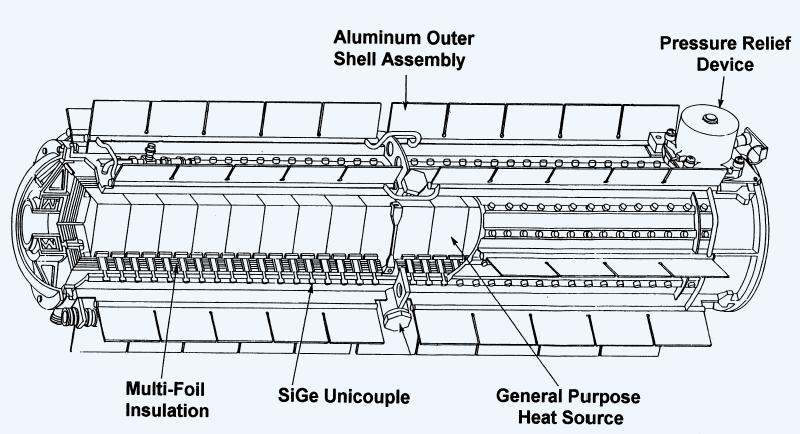
In the center of this device, 18 square General Purpose Heat Sorces are installed - general-purpose heat sources that actually contain plutonium. They, in turn, are arranged as follows:
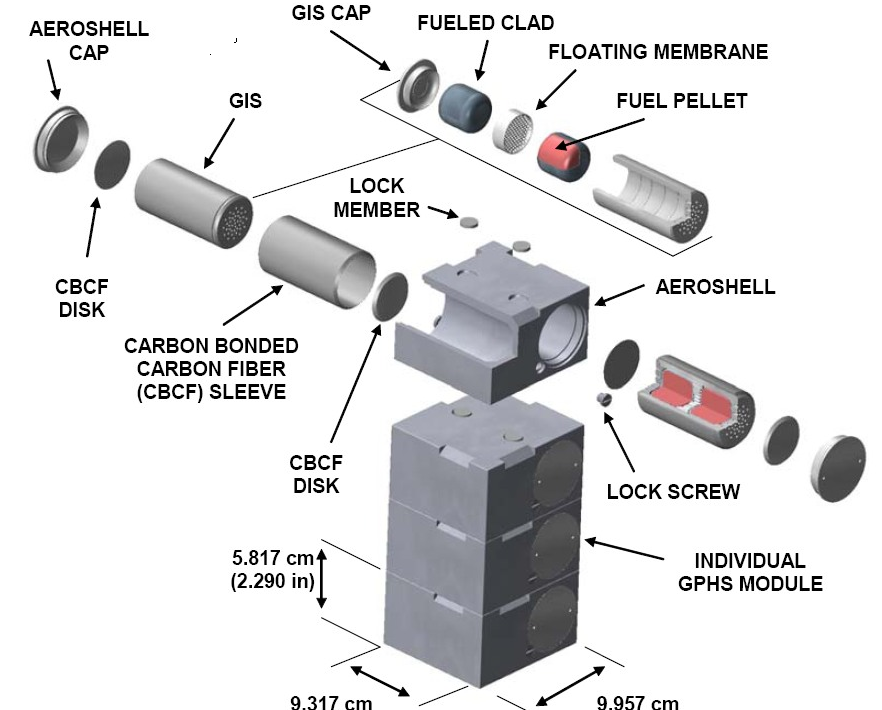
2 tablets (Fuel pellet), the size of a large nut made of plutonium oxide (151 grams of oxide or ~ 116 grams of plutonium), coated with an iridium shell (which we will talk about later) are placed in a cylindrical container made of carbon-carbon composite, which serves as protection against falling such an RTG at the stage of elimination. Two such containers, in turn, are packed in one prismatic block of graphite, which is one GHPS. The weight of one assembled unit is 1.43 kilograms, and with fresh radionuclide it generates 250 watts of heat, heating up to 1000 C. in the generator.
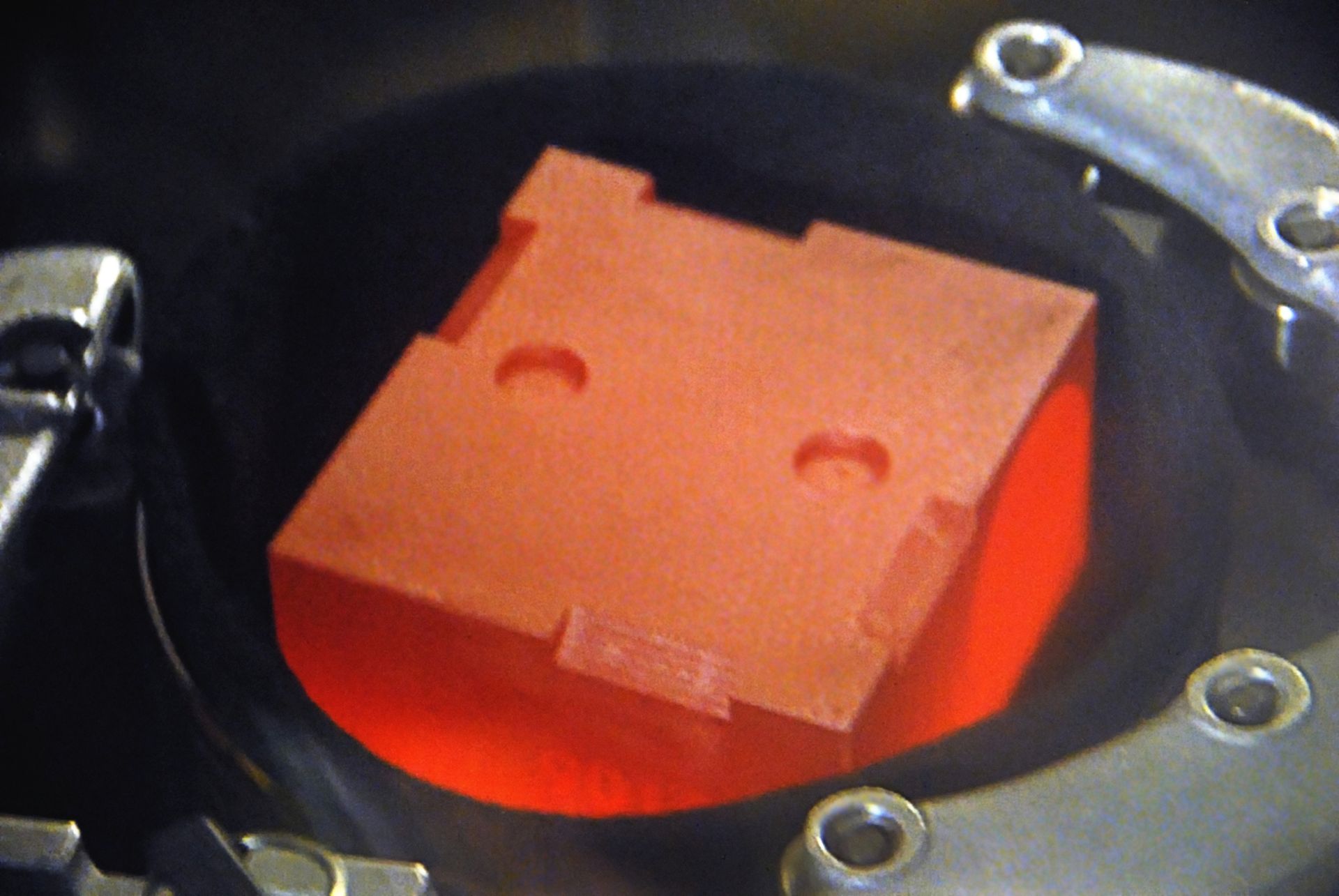
Assembled GHPS
Given an efficiency of about 6%, at the beginning of its life, the GPHS-RTG generated approximately 300 electric watts dissipating ~ 4400 watts from the radiator. For MMRTG, these numbers are 125 and 2000 watts. 14 years after plutonium is removed from the reactor, power drops by about a quarter. The most interesting thing is that the power drops not only due to the natural decay of the isotope, but also due to the degradation of thermocouples. As a heat source, this device is more attractive - 1.6% reduction in heat capacity per year.
Well, 2 kilowatts of heat looks encouraging for Mark Watney, let's talk about the dangers.
238 Pu - A good choice for RTGs. It breaks up in 234U with the emission of an alpha particle with an energy of ~ 5.5 MeV. It is easy to shield from alpha particles - all of them will be braked even in the iridium shell of the fuel pellet (iridium is needed here to resist radiation corrosion in any case, for example, when falling into the tundra). Unfortunately, there are three obstacles to the absolute non-radioactivity of our heat source:
All together gives for GPHS-RTG the level of radiation (or what is more correctly called - equivalent dose rate) from 20 to 50 milentgen per hour in different directions at a distance of a meter. This level consists of neutron and gamma radiation, and the share of the latter for real RTGs is not so great - 5 ... 10 mr / h .
For MMRTG, which uses Watney, the levels should be more than 2 times lower - about 8..20 mr / hour . Moreover, purely theoretically, from the neutron part it is possible to shield with a centimeter or other polyethylene (better boron). Even in the most unfortunate scenario, at 20 mph / hour, some level that may affect health (100 x-rays) is the hero of the “Martian” bIt will take 5000 hours, or about 202 sols (Martian days). Over the years, the gamma radiation from the RTG will increase, and the neutron radiation will fall, but these changes are noticeable over ten-year periods and do not significantly affect the overall level of radioactivity.
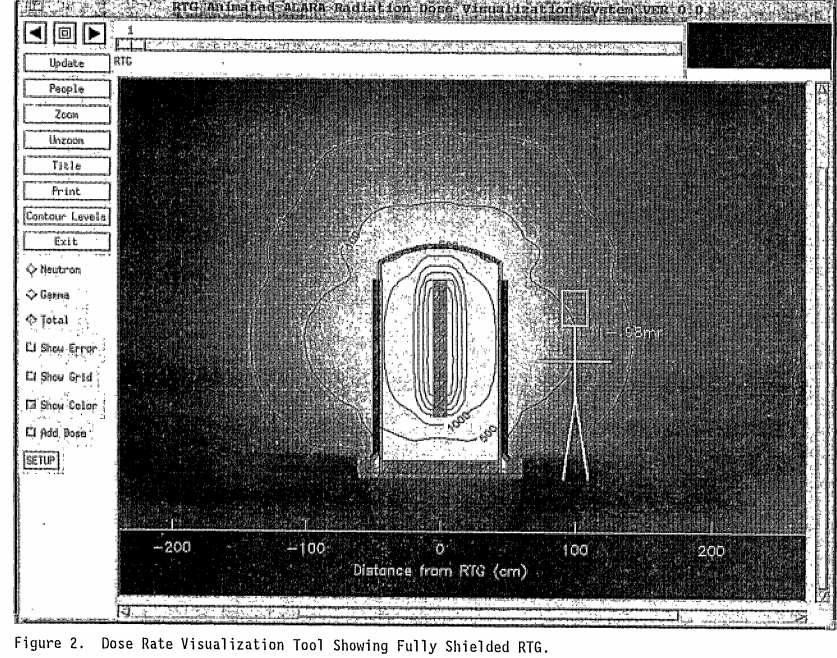
However, a simulation of the GPHS-RTG field by American nuclear scientists shows that a contact RTG can produce much more dangerous levels of 1 or even 5 X-ray / hour.
Well, if you find yourself in a similar situation, feel free to warm the interior of your rover with an RTG, just make sure it is full Pu238 and not the evil Sr90 beta emitter, as in domestic ground-based generators :).
PS By the way, the film is quite nothing to itself, although for fans of the original text full of technical details, the level of popularization can be disappointing.
As we see in the picture above, the real RTGs that were delivered to Cassini are treated fairly carefully - dosimetry, shields that reduce the exposure of personnel in the room.
What is GPHS-RTG ? This is a modular RTG that uses 238 Pu decay heat to turn it into electricity on a semiconductor thermoelectric converter. However, only the radiator is visible from the outside, which works with the cold end of the converter.
In the center of this device, 18 square General Purpose Heat Sorces are installed - general-purpose heat sources that actually contain plutonium. They, in turn, are arranged as follows:
2 tablets (Fuel pellet), the size of a large nut made of plutonium oxide (151 grams of oxide or ~ 116 grams of plutonium), coated with an iridium shell (which we will talk about later) are placed in a cylindrical container made of carbon-carbon composite, which serves as protection against falling such an RTG at the stage of elimination. Two such containers, in turn, are packed in one prismatic block of graphite, which is one GHPS. The weight of one assembled unit is 1.43 kilograms, and with fresh radionuclide it generates 250 watts of heat, heating up to 1000 C. in the generator.
Assembled GHPS
Given an efficiency of about 6%, at the beginning of its life, the GPHS-RTG generated approximately 300 electric watts dissipating ~ 4400 watts from the radiator. For MMRTG, these numbers are 125 and 2000 watts. 14 years after plutonium is removed from the reactor, power drops by about a quarter. The most interesting thing is that the power drops not only due to the natural decay of the isotope, but also due to the degradation of thermocouples. As a heat source, this device is more attractive - 1.6% reduction in heat capacity per year.
Well, 2 kilowatts of heat looks encouraging for Mark Watney, let's talk about the dangers.
238 Pu - A good choice for RTGs. It breaks up in 234U with the emission of an alpha particle with an energy of ~ 5.5 MeV. It is easy to shield from alpha particles - all of them will be braked even in the iridium shell of the fuel pellet (iridium is needed here to resist radiation corrosion in any case, for example, when falling into the tundra). Unfortunately, there are three obstacles to the absolute non-radioactivity of our heat source:
- The main working isotope of plutonium decays in U234, which gives rise to a number of radioactive isotopes, among which there are gamma emitters.
- Plutonium tablets contain other isotopes, not so friendly from the point of radiation, such as 236 Pu, 239 Pu, 241 Pu and decay products, for example, a hard gamma emitter 208 Ta. Unfortunately, the production process (by irradiating targets from another radioactive isotope - Neptunium 237 in the reactor) is always accompanied by the appearance of these parasitic isotopes. The best 238 Pu samples contain about 17% of other isotopes.
- Finally, the most interesting. Vigorous alpha particles of plutonium interact with oxygen (which is contained in plutonium oxide) and generate neutron radiation through nuclear reactions with it. Part of the neutron radiation comes from spontaneous decay of plutonium (not alpha decay, but decay into 2 parts - like uranium in a nuclear chain reaction).
All together gives for GPHS-RTG the level of radiation (or what is more correctly called - equivalent dose rate) from 20 to 50 milentgen per hour in different directions at a distance of a meter. This level consists of neutron and gamma radiation, and the share of the latter for real RTGs is not so great - 5 ... 10 mr / h .
For MMRTG, which uses Watney, the levels should be more than 2 times lower - about 8..20 mr / hour . Moreover, purely theoretically, from the neutron part it is possible to shield with a centimeter or other polyethylene (better boron). Even in the most unfortunate scenario, at 20 mph / hour, some level that may affect health (100 x-rays) is the hero of the “Martian” bIt will take 5000 hours, or about 202 sols (Martian days). Over the years, the gamma radiation from the RTG will increase, and the neutron radiation will fall, but these changes are noticeable over ten-year periods and do not significantly affect the overall level of radioactivity.
However, a simulation of the GPHS-RTG field by American nuclear scientists shows that a contact RTG can produce much more dangerous levels of 1 or even 5 X-ray / hour.
Well, if you find yourself in a similar situation, feel free to warm the interior of your rover with an RTG, just make sure it is full Pu238 and not the evil Sr90 beta emitter, as in domestic ground-based generators :).
PS By the way, the film is quite nothing to itself, although for fans of the original text full of technical details, the level of popularization can be disappointing.