November 20, 2015 at 21:03
The world's first counting device - Shikkard machine
In 1957, Director of the Kepler Science Center Franz Gammer made a presentation at a seminar on the history of mathematics, held in Germany. He made sensational news that the project of the first calculating machine appeared several decades before the famous "wheels" of Pascal. The first counting device was invented in the middle of 1623 and was called the Shikkard machine.
Hammer made the discovery of this fact almost by accident. When he worked in the Stuttgart library, he came across a mysterious photocopy of a sketch of some calculating device. And since I had never seen anything like it before, I became very interested in an unknown outline. After conducting a series of studies, Hammer found that the sketch found was an absent attachment to the letter of Wilhelm Schikkard, a professor at the University of Tübingen, addressed to his colleague mathematician Johannes Kepler. In his letter, Shikkard described the calculating machine in detail and referred to the drawing.
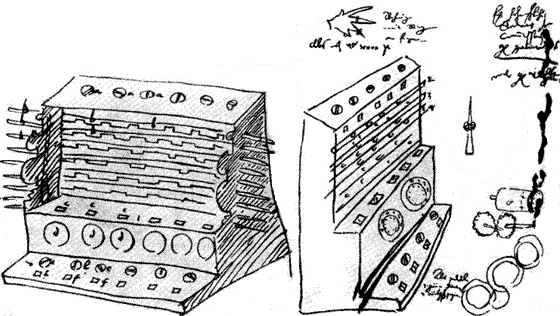
copy of the sketch
A bit of history
Wilhelm Schikkard was born on April 22, 1592 in the city of Herrenberg (Germany). He was extremely talented and at the age of 17 he received a master's degree at the University of Tubingen, and two years later he became a bachelor of science. He gained worldwide fame for his achievements in the sciences: astronomy, mathematics and oriental studies (professor of the Department of Oriental Languages at the University of Tübingen). And also, Shikkard created the first computer.
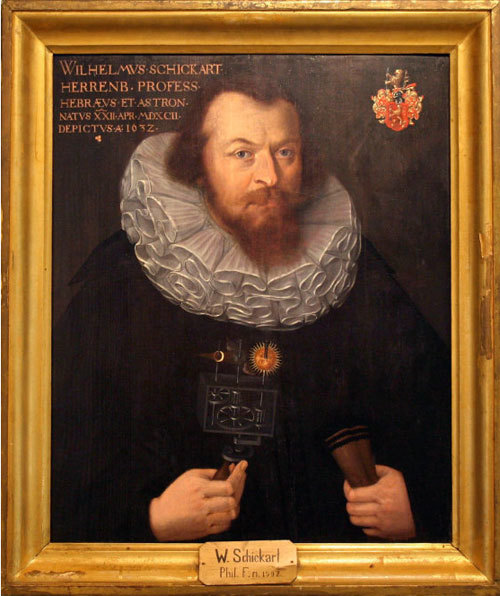
Wilhelm Schickard (1592-1635)
In 1617, Schikkard began to teach Oriental languages at the University of Tübingen. There he met Kepler, who appreciated the extraordinary abilities of the young scientist and recommended that he study mathematics. Shikkard obeyed the advice and achieved considerable success in the new field. In 1631, he became a professor of mathematics and astronomy at the University of Tübingen.
Shikkard was a pioneer in other areas. As for example - in astronomy. The scientist constantly developed, corresponded with many German, French, Italian and Dutch scientists on issues related to astronomy. He created the first mechanical planetarium, which clearly demonstrated the position of the Sun, Earth and the Moon according to the Copernican system. In addition, he observed meteors from different points to determine their trajectory.

The breadth of interests of Shikkard really deserves respect. He was an experienced mechanic, cartographer, wood and metal engraver, conducted astronomical observations, wrote treatises on Semitic languages, astronomy, mathematics, optics and meteorology. The scientist has achieved outstanding scientific success and was truly a brilliant inventor. But he was powerless before the cholera epidemic. This merciless disease of the XVII century in 1635 took the life of Shikkard and his family. The works of the scientist were temporarily forgotten due to the Thirty Years War.
Shikkard machine - the beginning of the XVII century
In one of the letters to Kepler (dated September 20, 1623), Shikkard mechanically did everything that Kepler did algebraically, namely, he designed a machine that automatically performed addition, subtraction, multiplication and division. Shikkard wrote that Kepler was pleasantly surprised if he saw how the device itself accumulates and transfers ten or a hundred digits to the left and how it takes away what it kept in memory when subtracting.
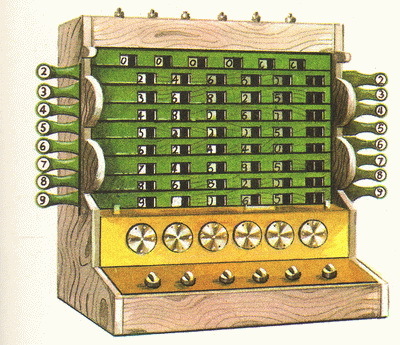
The invention, which became the first calculating machine, was created in 1623. Shikkard invented and developed a model of a six-bit mechanical computing device that performs simple mathematical functions, such as adding and subtracting numbers. It was not for nothing that he was called "hours for counting." Shikkard's machine contained a summing and multiplying device, as well as a mechanism for recording intermediate results.
From a letter to Kepler:
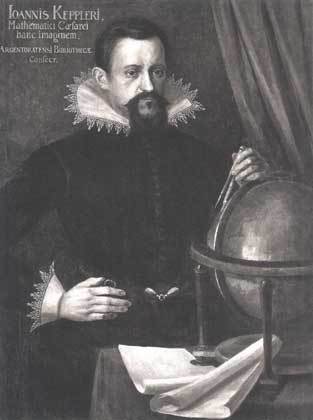
Johannes Kepler (1571-1630)
A more detailed description helps to get an idea of the invention. The first block in the form of a six-digit summing machine was a combination of gears. On each axis there was a gear with ten teeth and an auxiliary single-tooth wheel - a finger. The finger served to transfer the unit to the next rank, that is, turn the gear by a tenth of a full turn, after the gear of the previous rank makes such a turn. When subtracting gears, it was required to rotate in the opposite direction. It was possible to control the course of calculations using special windows where numbers appeared. For multiplication, a device was used, the main part of which was six axes with multiplication tables “screwed” onto them. Subtraction was performed by rotating the adjusting wheels in the opposite direction,
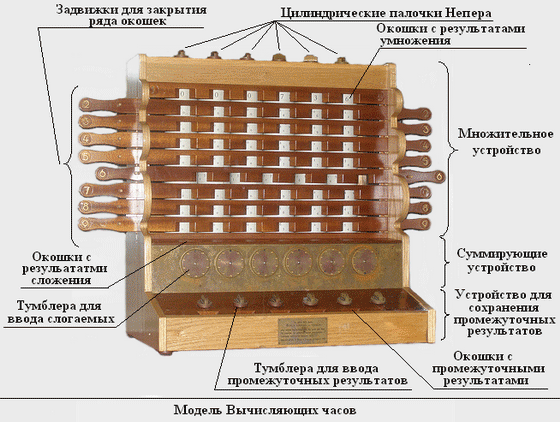
In fact, Shikkard’s car was quite simple in operation. For example, to find out what the product 296 x 73 is equal to, you need to set the cylinder in a position that allows you to display the first multiplier in the upper row of windows: 000296. The product 296 x 3 will work if you open the windows of the third row and sum the numbers seen, as in the lattice method . Then the windows of the seventh row are opened in exactly the same way, giving a product of 296 x 7 to which the glory is attributed to 0. And it remains only to add the found numbers to the summing device. Everything, the result is ready.
The question remains unanswered - was a really working model of the machine assembled during the scientist's life? There is very little data on this score. In Shikkard’s letters, all the same to Kepler, they are talking about a “practically ready” copy of the device that burned down during a fire. It was under development by the mechanic Wilhelm Pfister. Whether the second model of the car was assembled is not known for certain. Most likely, no one except Shikkard and Pfister did not see a ready-made and operational device. In any case, evidence of performance has not been preserved.

But what exactly - for a long time Shikkard's car remained known only to a narrow circle of proxies. And this invention could not influence the subsequent development of account mechanization. Who knows, maybe with the help of this project the progress of computing devices could be accelerated. But anyway, the name of the German scientist Wilhelm Schikkard is on a par with great minds, inventors of calculating devices of the XVII-XIX centuries. Such as Blaise Pascal, Gottfried Wilhelm Leibniz, Charles Babbage, Pafnuti Lvovich Chebyshev, German Hollerith and others.

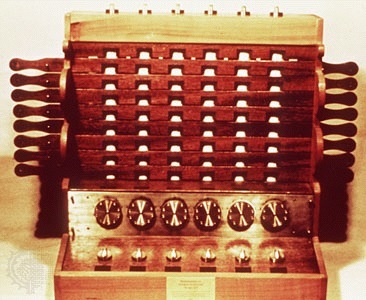
modern prototype of Shikkard machine
Based on materials found by Hammer, employees of the University of Tübingen in the early 1960s created a working model of Shikkard's machine. The operations of addition and subtraction were carried out mechanically in it, and multiplication and division - with elements of mechanization. The prototype of the invention is owned by the university.
The evolution in the field of computing technology is a rather uneven process that occurs irregularly from periods of decline to periods of decline. The achieved results are used in practice and each new step takes the process of computational evolution to a new, higher level.
Hammer made the discovery of this fact almost by accident. When he worked in the Stuttgart library, he came across a mysterious photocopy of a sketch of some calculating device. And since I had never seen anything like it before, I became very interested in an unknown outline. After conducting a series of studies, Hammer found that the sketch found was an absent attachment to the letter of Wilhelm Schikkard, a professor at the University of Tübingen, addressed to his colleague mathematician Johannes Kepler. In his letter, Shikkard described the calculating machine in detail and referred to the drawing.
copy of the sketch
A bit of history
Wilhelm Schikkard was born on April 22, 1592 in the city of Herrenberg (Germany). He was extremely talented and at the age of 17 he received a master's degree at the University of Tubingen, and two years later he became a bachelor of science. He gained worldwide fame for his achievements in the sciences: astronomy, mathematics and oriental studies (professor of the Department of Oriental Languages at the University of Tübingen). And also, Shikkard created the first computer.
Wilhelm Schickard (1592-1635)
In 1617, Schikkard began to teach Oriental languages at the University of Tübingen. There he met Kepler, who appreciated the extraordinary abilities of the young scientist and recommended that he study mathematics. Shikkard obeyed the advice and achieved considerable success in the new field. In 1631, he became a professor of mathematics and astronomy at the University of Tübingen.
Shikkard was a pioneer in other areas. As for example - in astronomy. The scientist constantly developed, corresponded with many German, French, Italian and Dutch scientists on issues related to astronomy. He created the first mechanical planetarium, which clearly demonstrated the position of the Sun, Earth and the Moon according to the Copernican system. In addition, he observed meteors from different points to determine their trajectory.
The breadth of interests of Shikkard really deserves respect. He was an experienced mechanic, cartographer, wood and metal engraver, conducted astronomical observations, wrote treatises on Semitic languages, astronomy, mathematics, optics and meteorology. The scientist has achieved outstanding scientific success and was truly a brilliant inventor. But he was powerless before the cholera epidemic. This merciless disease of the XVII century in 1635 took the life of Shikkard and his family. The works of the scientist were temporarily forgotten due to the Thirty Years War.
Shikkard machine - the beginning of the XVII century
In one of the letters to Kepler (dated September 20, 1623), Shikkard mechanically did everything that Kepler did algebraically, namely, he designed a machine that automatically performed addition, subtraction, multiplication and division. Shikkard wrote that Kepler was pleasantly surprised if he saw how the device itself accumulates and transfers ten or a hundred digits to the left and how it takes away what it kept in memory when subtracting.
The invention, which became the first calculating machine, was created in 1623. Shikkard invented and developed a model of a six-bit mechanical computing device that performs simple mathematical functions, such as adding and subtracting numbers. It was not for nothing that he was called "hours for counting." Shikkard's machine contained a summing and multiplying device, as well as a mechanism for recording intermediate results.
From a letter to Kepler:
... aaa are the upper ends of the vertical cylinders, multiplication tables are plotted on their lateral surfaces; if necessary, the numbers of these tables can be observed in the windows bbb of the sliding strips. Wheels with ten teeth are attached to the ddd discs from the inside of the machine, each of which is so engaged with its own that if any right wheel rotates ten times, the wheel to its left will make one turn, or if the first of the wheels mentioned makes 100 revolutions , the third wheel on the left will turn once. In order for the gears to rotate in the same direction, it is necessary to have intermediate wheels ...
Johannes Kepler (1571-1630)
A more detailed description helps to get an idea of the invention. The first block in the form of a six-digit summing machine was a combination of gears. On each axis there was a gear with ten teeth and an auxiliary single-tooth wheel - a finger. The finger served to transfer the unit to the next rank, that is, turn the gear by a tenth of a full turn, after the gear of the previous rank makes such a turn. When subtracting gears, it was required to rotate in the opposite direction. It was possible to control the course of calculations using special windows where numbers appeared. For multiplication, a device was used, the main part of which was six axes with multiplication tables “screwed” onto them. Subtraction was performed by rotating the adjusting wheels in the opposite direction,
In fact, Shikkard’s car was quite simple in operation. For example, to find out what the product 296 x 73 is equal to, you need to set the cylinder in a position that allows you to display the first multiplier in the upper row of windows: 000296. The product 296 x 3 will work if you open the windows of the third row and sum the numbers seen, as in the lattice method . Then the windows of the seventh row are opened in exactly the same way, giving a product of 296 x 7 to which the glory is attributed to 0. And it remains only to add the found numbers to the summing device. Everything, the result is ready.
The question remains unanswered - was a really working model of the machine assembled during the scientist's life? There is very little data on this score. In Shikkard’s letters, all the same to Kepler, they are talking about a “practically ready” copy of the device that burned down during a fire. It was under development by the mechanic Wilhelm Pfister. Whether the second model of the car was assembled is not known for certain. Most likely, no one except Shikkard and Pfister did not see a ready-made and operational device. In any case, evidence of performance has not been preserved.
But what exactly - for a long time Shikkard's car remained known only to a narrow circle of proxies. And this invention could not influence the subsequent development of account mechanization. Who knows, maybe with the help of this project the progress of computing devices could be accelerated. But anyway, the name of the German scientist Wilhelm Schikkard is on a par with great minds, inventors of calculating devices of the XVII-XIX centuries. Such as Blaise Pascal, Gottfried Wilhelm Leibniz, Charles Babbage, Pafnuti Lvovich Chebyshev, German Hollerith and others.
modern prototype of Shikkard machine
Based on materials found by Hammer, employees of the University of Tübingen in the early 1960s created a working model of Shikkard's machine. The operations of addition and subtraction were carried out mechanically in it, and multiplication and division - with elements of mechanization. The prototype of the invention is owned by the university.
The evolution in the field of computing technology is a rather uneven process that occurs irregularly from periods of decline to periods of decline. The achieved results are used in practice and each new step takes the process of computational evolution to a new, higher level.