August 24, 2015 at 17:49
[Testing] 960 gigabyte Kingston V310 SSD
Hello Giktayms! In July, a post was released about testing Kingston KC310 960 Gb and I promised that there would be a small series of such tests. I keep my promise and offer you an overview of the capabilities of another drive of similar capacity - Kingston V310 960 Gb . Despite the constant rise in prices, high-capacity solid-state drives are still in demand among enthusiasts and corporate users. Under the cut - the analysis of the abilities and endurance of this SSD drive.
The packaging is completely similar to Kingston KC310 - only the name of the series is different. The disk comes in a regular cardboard blister with a plastic insert. Inside is also a plastic adapter frame with a thickness of 7 mm to 9.5 mm, for installation in laptops or desktop computers.
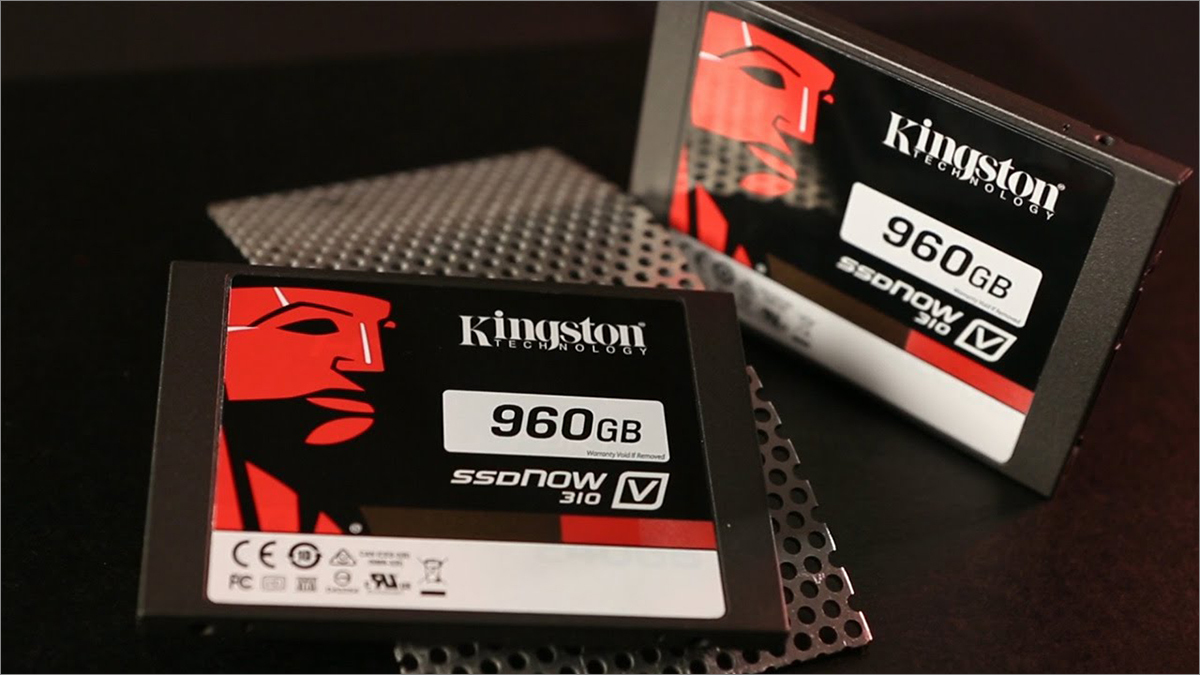
There is a second Kingston V310 delivery option on the market: it will include a metal adapter for mounting in a 3.5-inch bay, a SATA cable, an external container for connecting a USB drive, a software disk and a set of fasteners.
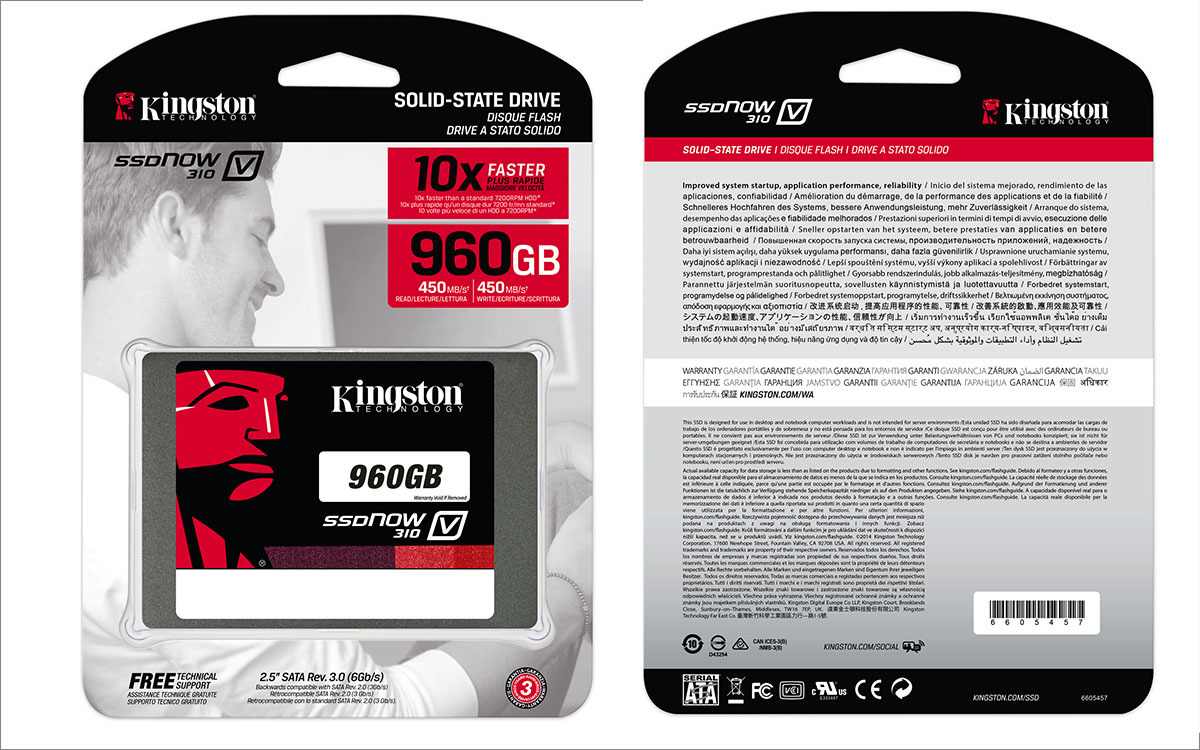
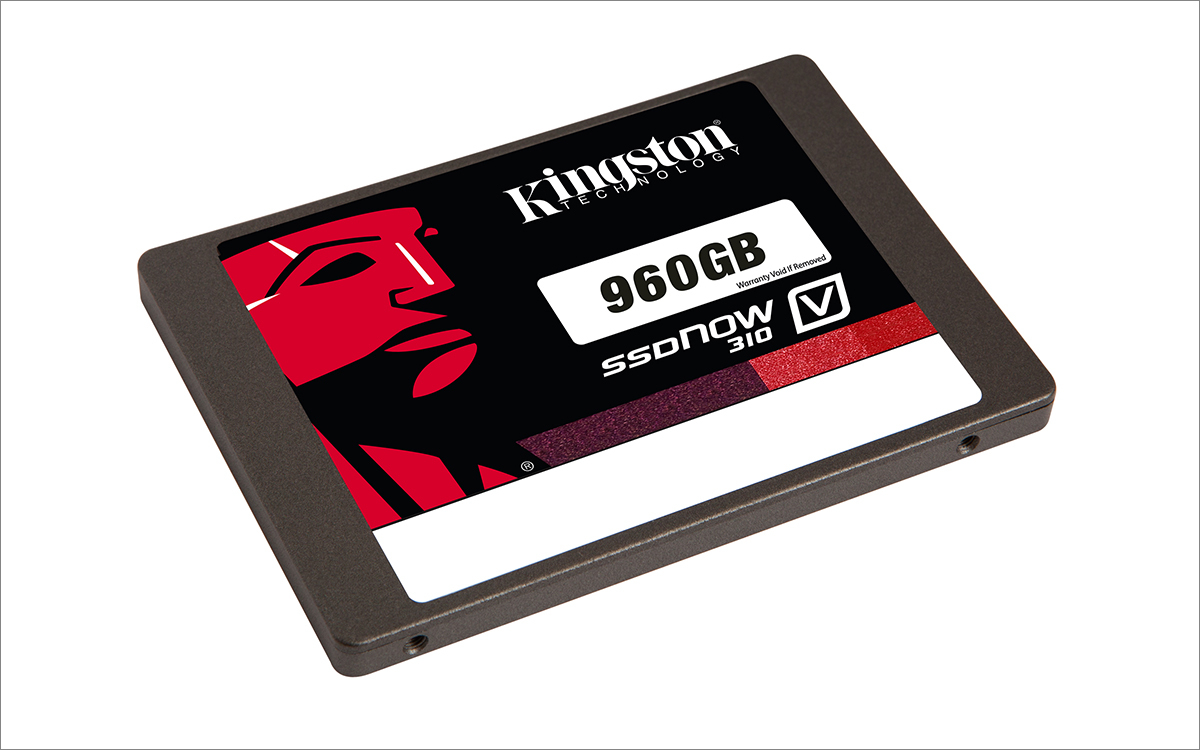
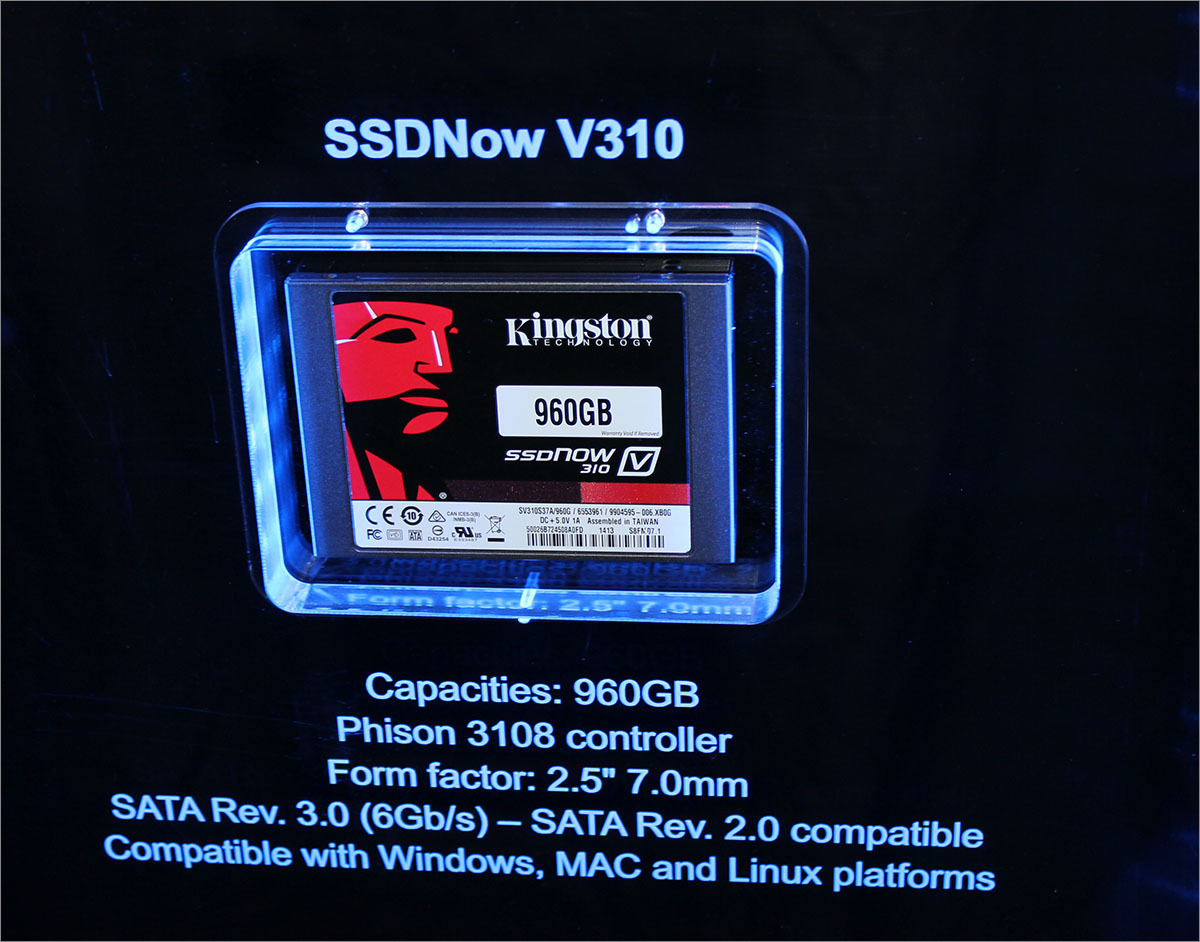
Kingston V310 960 Gb - the only disk in the V310 line, drives of smaller capacity belong to the V300 series and are based on other controllers. The drive is built on an eight-channel controller Phison PS3108-S08. This decision is due to the fact that previous products on SandForce controllers could not be more than 512 gigabytes in capacity, and the Phison PS3108-S08 itself does not support addressing more than 1 terabyte of memory, so it turns out that the disk will remain the only representative of the V310 family.
.
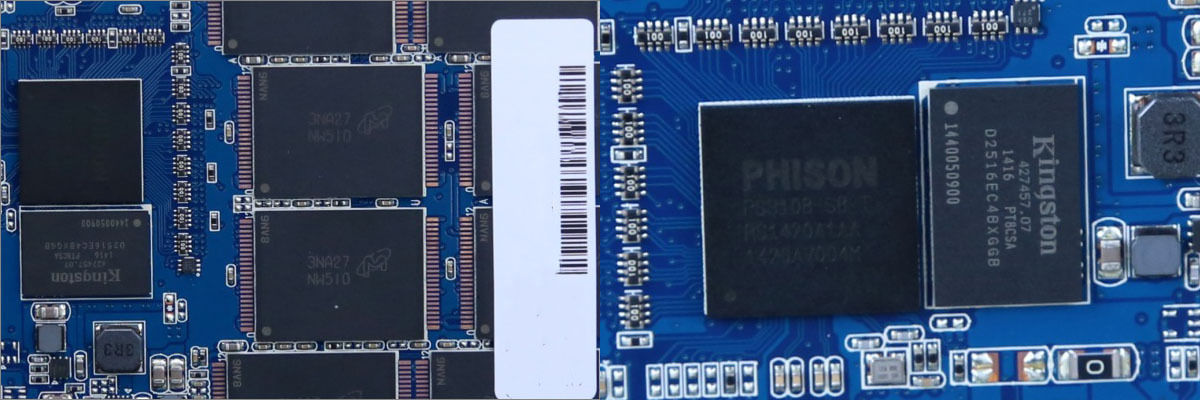
The memory is equipped with 8 Micron MLC 20nm chips with the MT29F512G08CKCABH7-6 marking, with a capacity of 128 gigabytes each. Thus, the total disk capacity is equal to 1024 gigabytes, of which not the entire volume is available to the user, but only 894 gigabytes (960 194 670 592 bytes), the rest is reserved for the backup area.
The 512 MB cache is organized by Kingston chip D2516EC4BXGGB. The newer Kingston KC310 uses a twice as large cache.
The controller supports data protection technology in case of power failure, which is implemented on the software part, of course, the TRIM command is supported.
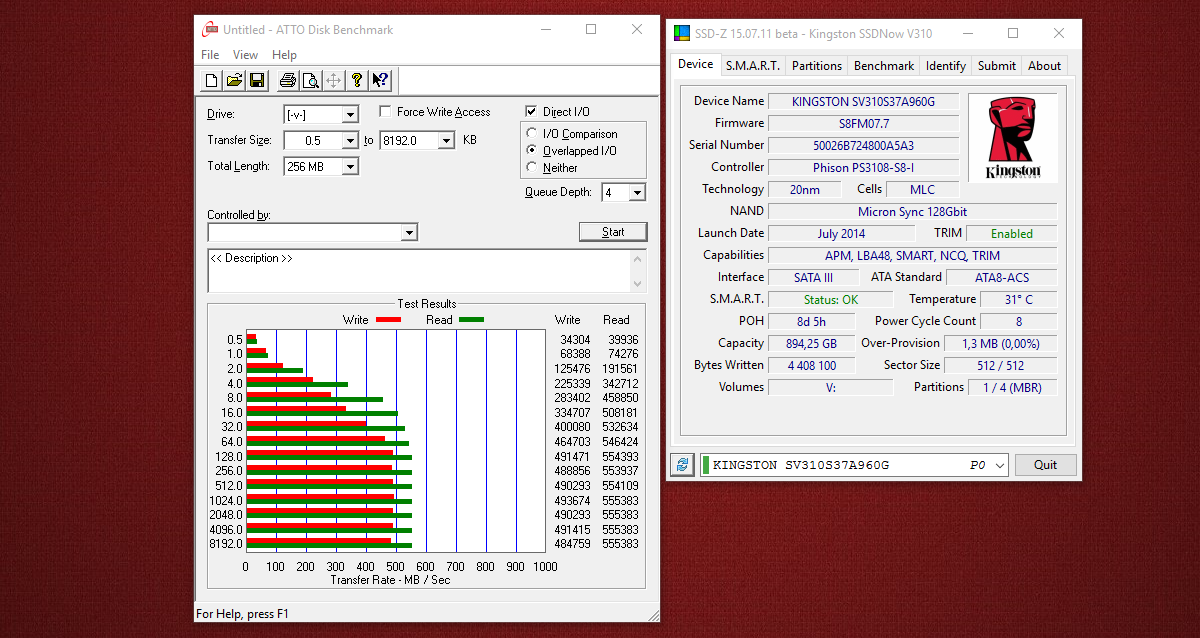
Official specificationsdisks assume a speed of sequential read / write at 450/450 MB / s, while working with random blocks of 4K size - up to 40000/20000 IOPS. The operating speed is lower than that of Kingston KC310, this is especially noticeable in random operations with small blocks.
The DWPD parameter is set at 2.65, that is, it is recommended to write no more than 2.5 terabytes of data per day to the disk. The total amount of recorded information for Kingston V310 is 2728 terabytes. These values are significantly higher than Kingston KC310.
MTBF is 1 million hours, or 41,666 days, or 114 years, which means you can work with this drive for a very long time. This figure is standard for Kingston's top-of-the-line solid state drives.
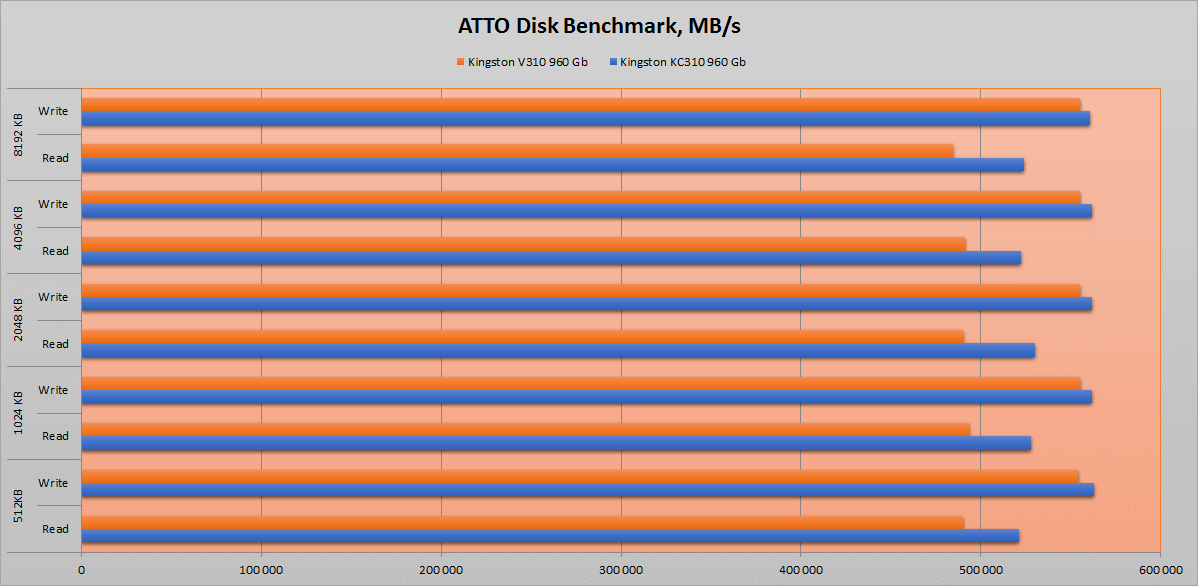
Let's move on to the practical part. I will add the test results to the comparison with those obtained in the previous test, so that you can correctly and clearly compare the disks.
The testing methodology is quite simple:
Before the tests, the amount of information that is twice as large as the disk capacity is written to the disk; after each test, a pause of half an hour is made to correctly execute the TRIM command.
A synthetic test to assess the correctness of the manufacturer's stated speeds. Actually, most of the data indicated on the boxes of SSD drives of different manufacturers was obtained using ATTO Disk Benchmark.
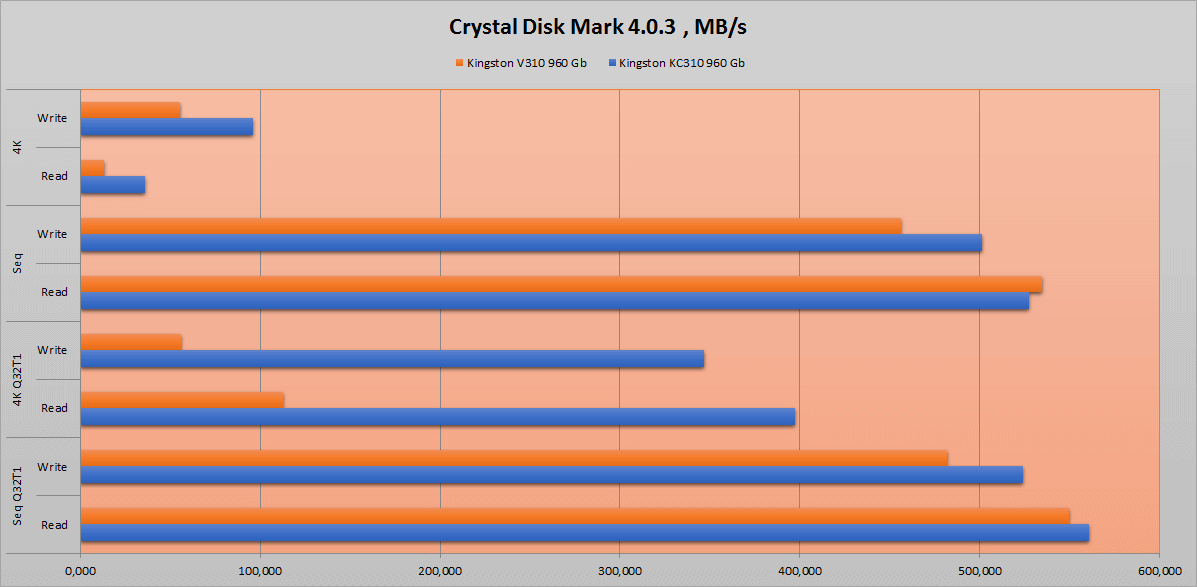
This test allows you to evaluate the operation of the drive in four modes: linear read / write, read / write blocks in 4K, linear read / write at a queue depth of 32 teams, read / write blocks in 4K at a queue depth of 32 teams.

The most advanced of the tests. I will conduct several testing options:

On read operations, the V310 turns out to be faster than Kingston KC310, but in the case of the recording, a confident revenge for the new controller.
In the PC Mark 8 test suite, it is possible to conduct performance restoration tests under continuous load.
The scheme of the package is as follows:
First, the disk (unformatted, without partitions) is filled twice in blocks of 128 KB.
Then the degradation phase follows:
The disk is filled with random blocks of different sizes from 4 KB to 1 MB. Because the blocks are not aligned, disk performance drops sharply.
The first tests begin 10 minutes after filling the disk with random blocks.
After passing the test, the filling process is repeated. Before each new test, a pause is made, which is five minutes longer than the previous one, that is, 15 minutes, 20 minutes and so on. This is repeated eight times.
After this, tests of the stable phase begin. The script is repeated five times, a pause of 5 minutes is made between runs without additional load.
This is followed by the performance recovery phase, when a five-minute pause is made between the scenarios to practice disk wipe.
Several applications are being tested in the package; I chose Adobe Photoshop (a heavy script).
I give four graphs: average access time, read speed, write speed, total disk speed.
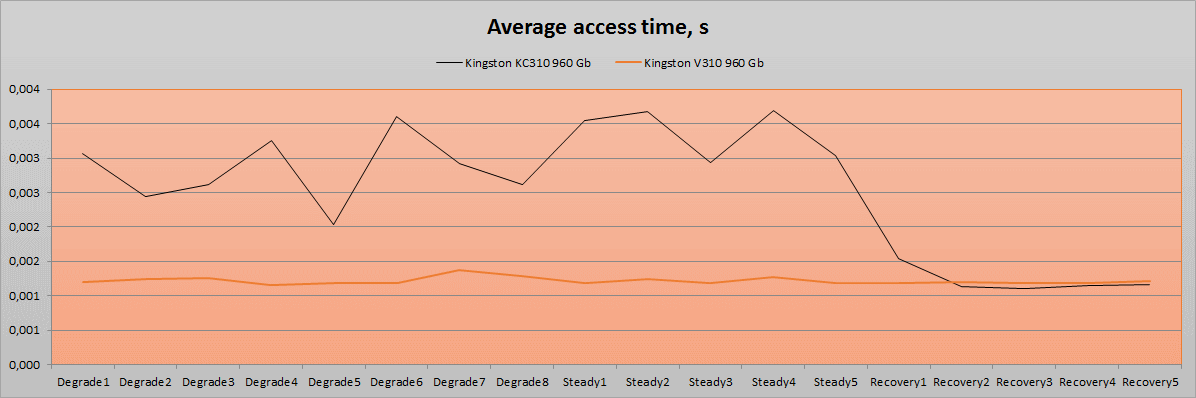
As you can see, the disk access time increases as the load increases.
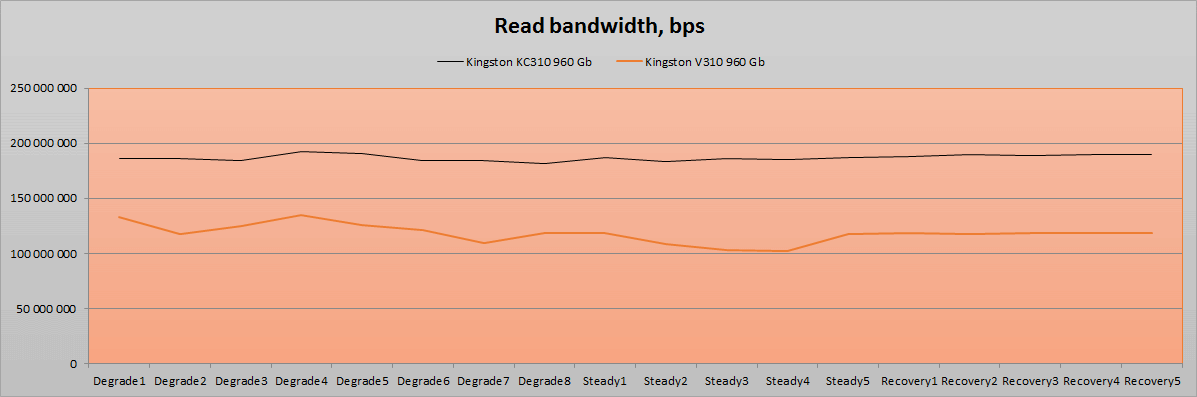
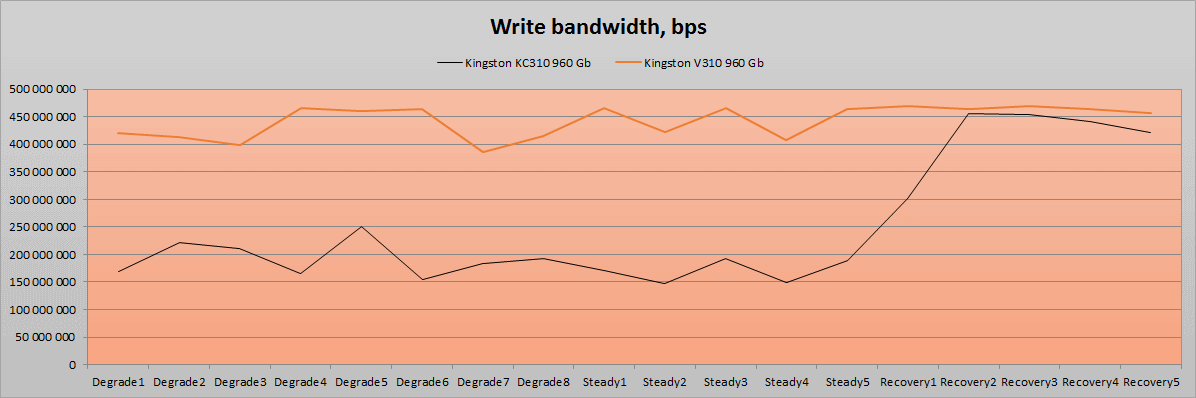
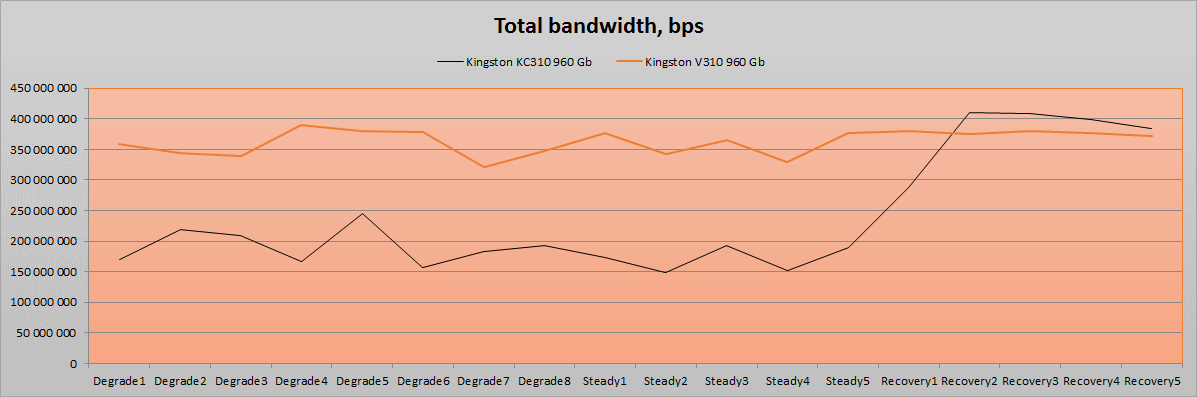
There is practically no noticeable difference in the performance of the "tired" Kingston V310 drive and the restored one, the performance graph is quite even.
The model is already a little outdated, newer generation controllers have come out, but at the height the endurance and resistance of the disk to the wear process remained. If the speed of working with small random data is not critically important to you, then Kingston V310 will still light up younger colleagues.
In the third part I will consider the representative of the HyperX brand - Savage 960 Gb. What makes this solid-state drive different? Find out soon.
Thanks for watching, stay with Kingston at Geektimes.ru!
There is a second Kingston V310 delivery option on the market: it will include a metal adapter for mounting in a 3.5-inch bay, a SATA cable, an external container for connecting a USB drive, a software disk and a set of fasteners.
Kingston V310 960 Gb - the only disk in the V310 line, drives of smaller capacity belong to the V300 series and are based on other controllers. The drive is built on an eight-channel controller Phison PS3108-S08. This decision is due to the fact that previous products on SandForce controllers could not be more than 512 gigabytes in capacity, and the Phison PS3108-S08 itself does not support addressing more than 1 terabyte of memory, so it turns out that the disk will remain the only representative of the V310 family.
.
The memory is equipped with 8 Micron MLC 20nm chips with the MT29F512G08CKCABH7-6 marking, with a capacity of 128 gigabytes each. Thus, the total disk capacity is equal to 1024 gigabytes, of which not the entire volume is available to the user, but only 894 gigabytes (960 194 670 592 bytes), the rest is reserved for the backup area.
The 512 MB cache is organized by Kingston chip D2516EC4BXGGB. The newer Kingston KC310 uses a twice as large cache.
The controller supports data protection technology in case of power failure, which is implemented on the software part, of course, the TRIM command is supported.
Official specificationsdisks assume a speed of sequential read / write at 450/450 MB / s, while working with random blocks of 4K size - up to 40000/20000 IOPS. The operating speed is lower than that of Kingston KC310, this is especially noticeable in random operations with small blocks.
The DWPD parameter is set at 2.65, that is, it is recommended to write no more than 2.5 terabytes of data per day to the disk. The total amount of recorded information for Kingston V310 is 2728 terabytes. These values are significantly higher than Kingston KC310.
MTBF is 1 million hours, or 41,666 days, or 114 years, which means you can work with this drive for a very long time. This figure is standard for Kingston's top-of-the-line solid state drives.
Let's move on to the practical part. I will add the test results to the comparison with those obtained in the previous test, so that you can correctly and clearly compare the disks.
The testing methodology is quite simple:
Before the tests, the amount of information that is twice as large as the disk capacity is written to the disk; after each test, a pause of half an hour is made to correctly execute the TRIM command.
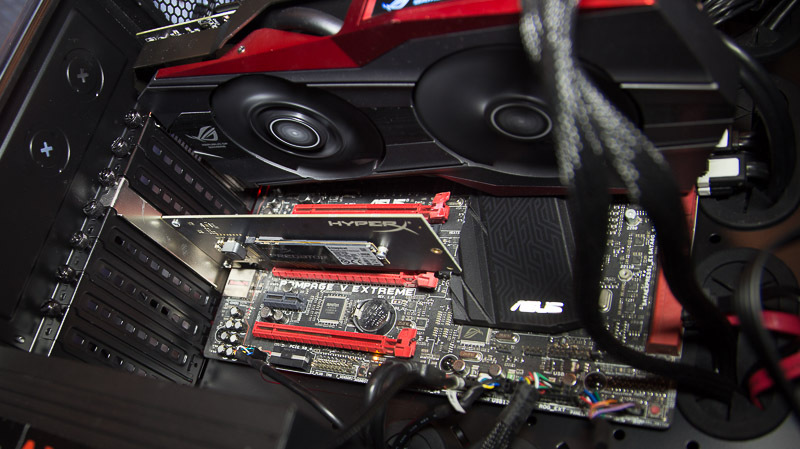
Test stand
- Processor: Intel Core i7-5960X
- Motherboard: ASUS Rampage V Extreme
- RAM: HyperX Predator DDR4-3000 16 Gb (4 * 4 Gb)
- System SSD: HyperX Predator PCI-E SSD 480 Gb
- Video card: ASUS Radeon R9 290X Matrix
- Power Supply: Corsair AX1200i, 1200W
- Operating System: Windows 8.1 Professional (64-bit)
A set of test applications:
- ATTO disk benchmark 2.4.7
- Crystal Disk Mark 3.0.3
- IOMeter 1.1.0
- PC Mark 8
ATTO disk benchmark 2.4.7
A synthetic test to assess the correctness of the manufacturer's stated speeds. Actually, most of the data indicated on the boxes of SSD drives of different manufacturers was obtained using ATTO Disk Benchmark.
Crystal Disk Mark 4.0.3
This test allows you to evaluate the operation of the drive in four modes: linear read / write, read / write blocks in 4K, linear read / write at a queue depth of 32 teams, read / write blocks in 4K at a queue depth of 32 teams.
IOMeter 1.1.0
The most advanced of the tests. I will conduct several testing options:
- linear reading and writing (blocks of 256 kilobytes in size, request depth - 16),
- random reading and writing of blocks of 4 KB with a request queue of 16 (the result will be in MB / s).
- random reading and writing of blocks of 4 KB at the request queue 4 (the result will be in MB / s).
- random reading and writing of blocks of 4 KB at the request queue 1 (the result will be in MB / s).
On read operations, the V310 turns out to be faster than Kingston KC310, but in the case of the recording, a confident revenge for the new controller.
Performance Recovery Tests
In the PC Mark 8 test suite, it is possible to conduct performance restoration tests under continuous load.
The scheme of the package is as follows:
First, the disk (unformatted, without partitions) is filled twice in blocks of 128 KB.
Then the degradation phase follows:
The disk is filled with random blocks of different sizes from 4 KB to 1 MB. Because the blocks are not aligned, disk performance drops sharply.
The first tests begin 10 minutes after filling the disk with random blocks.
After passing the test, the filling process is repeated. Before each new test, a pause is made, which is five minutes longer than the previous one, that is, 15 minutes, 20 minutes and so on. This is repeated eight times.
After this, tests of the stable phase begin. The script is repeated five times, a pause of 5 minutes is made between runs without additional load.
This is followed by the performance recovery phase, when a five-minute pause is made between the scenarios to practice disk wipe.
Several applications are being tested in the package; I chose Adobe Photoshop (a heavy script).
I give four graphs: average access time, read speed, write speed, total disk speed.
As you can see, the disk access time increases as the load increases.
There is practically no noticeable difference in the performance of the "tired" Kingston V310 drive and the restored one, the performance graph is quite even.
Final thoughts
The model is already a little outdated, newer generation controllers have come out, but at the height the endurance and resistance of the disk to the wear process remained. If the speed of working with small random data is not critically important to you, then Kingston V310 will still light up younger colleagues.
In the third part I will consider the representative of the HyperX brand - Savage 960 Gb. What makes this solid-state drive different? Find out soon.
Thanks for watching, stay with Kingston at Geektimes.ru!