March 29, 2015 at 19:03
Apology of OTRAG or how rockets explode

We continue the discussion about the modular "big stupid" OTRAG launch vehicle. In the second part, we proved with the numbers in our hands that the reliability of a large bunch of missile blocks can be ensured by adding redundant blocks. The following objection, which has repeatedly been raised in the comments, is a scenario of an avalanche-like destruction of a packet in case of failure of one block. A terrible picture is drawn when a failure of one block leads to an explosion, fragments break through neighboring blocks, which also explode, and the entire launch vehicle shatters into pieces. Therefore, today we will talk about the physics of the explosion, about what can explode in a rocket, and how it will do it.
Introduction
To start, let's see the well-known compilation of accidents of launch vehicles:
Please note that explosions are not the main type of accident, and the most impressive "broads" occur already when a rocket hits the ground or after destruction in flight.
Explosion physics
What is an “explosion" in terms of physics? Curiously, there is no simple answer. Chemical explosives, an atomic bomb, a steam boiler, a volcano, a star can explode, and even a meteorite fall can be accompanied by an explosion. Despite completely different principles, all these explosions are accompanied by the release of a large amount of energy in a small volume in a short period of time. If the explosion is associated with the combustion of a substance, then in the case when the combustion front moves faster than the speed of sound, this process is called detonation. To create a supersonic front, special devices may be required - detonators. For example, trotyl (trinitrotoluene), if set on fire, will burn quietly. But if a detonator is inserted into the TNT block, it can already initiate an explosion. Substances such as gunpowder cannot detonate, they "only" quickly burn. And if the combustion takes place in a confined space, then the pressure can increase so quickly as to effectively throw a bullet or shell from the barrel.
What can explode in a rocket?
Charges of emergency blasting . In fact, this is the only element that can detonate in a launch vehicle. So that an unguided rocket does not cause harm, it is undermined. For example, the location of the cord charges placed on the Space Shuttles:

Long charges of explosives were supposed to quickly and efficiently destroy the external fuel tank and solid fuel boosters. For example, in the Challenger crash, the boosters survived the destruction of the shuttle and fuel tank, and were blown up by these charges a few seconds later.
In the Soviet / Russian tradition, when the spaceport is far from densely populated places, the engines of an emergency rocket are simply turned off. In this case, there is no explosive on the rocket at all.
Destruction of a solid fuel accelerator. Solid fuel accelerators, as you know, cannot be turned off after ignition. And their thrust is regulated by the profile of the hole in the block of solid fuel:

If there is, for example, a crack in the fuel block, then its surface will also begin to burn, sharply increasing the pressure. If the crack is large, a burst of pressure can destroy the accelerator, making a very impressive explosion:
Engine destruction . Combustion chamber with regenerative cooling system, nozzle heads, pipelines and connections - any failure here can lead to engine destruction. So, for example, the nozzle head in the flight of Dragon CRS-2 in 2012 was destroyed:
The explosion was powerful enough - the ripped engine fairing is visible in the video. But SpaceX was lucky - there were no fragments that would damage neighboring engines, Dragon successfully flew to the ISS.
The destruction of the turbopump . A turbopump unit is a highly loaded turbine that rotates at a tremendous speed and pumps tens and hundreds of kilograms of fuel components per second:

It can collapse due to a material defect (in aviation, there are cases of turbine destruction, when the defect was laid even at the stage of casting the titanium ingot). If the rotor “strikes” along the wall, then the heat released from friction will sharply raise the pressure and cause an explosion. A foreign object from the fuel tank can also enter the TNA, which, again, will lead to an explosion. The destruction of the TNA is dangerous because a very fast rotating turbine can scatter into heavy and dangerous fragments. Presumably, the destruction of the turbopump led to the Antares Orb-3 accident in the fall of 2014. The results of the investigation have not yet been announced, but a change in the color of the flame shortly before the explosion and serious destruction of the tail of the rocket make this version very likely.
Destruction of tanks and pipelines. The least likely and least explosive option. A small leak may go unnoticed, a medium leak can start a fire, and you need to specially invent a scenario that would lead to an explosion. Something like the destruction of the fuel pipeline, which would lead to the formation of a mixture of fuel and atmospheric air in the engine compartment and the subsequent explosion of this mixture.
What could explode in OTRAG?
We recall the design of the OTRAG rocket block:

Tanks of fuel, oxidizer and boost gas cannot explode. More precisely, the simplest crimping with a slightly increased pressure allows us to find out whether this particular block will withstand the working pressure. If the unlikely event of depressurization does occur, the components will begin to leak without explosion conditions. The space between the blocks under atmospheric airflow in flight will not allow the formation of components for a volumetric explosion. Even a catastrophic loss of tightness in the case of, for example, failure of the joint fasteners, cannot lead to the formation of fragments dangerous for neighboring blocks.
A turbopump cannot collapse in OTRAG simply because it is not there. Fuel components are supplied with boost gas and do not use additional pumps.
As for the combustion chamber and engine, they are designed as simple as possible:

traction control unit. Two pipes are visible (oxidizing agent and fuel), a valve drive motor and a rod connecting the valves to simultaneously change the component supply.
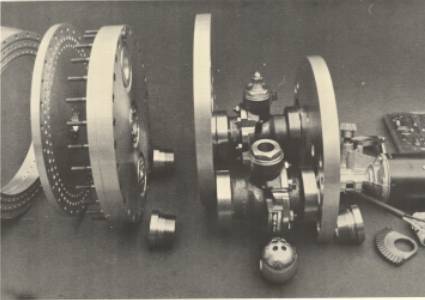
On the left is the nozzle block. The ball in the foreground, obviously, shows that the component supply valve is a regular ball valve of the

Combustion chamber. Ablation cooling of the walls.

Engine assembly on the stand.
Curiously, in the mid-2000s, Lutz Kaiser visited Armadillo Aerospace and presented them with a copy of the modern version of the injector:

Traction control unit

Top view, ball valves clearly visible Injector
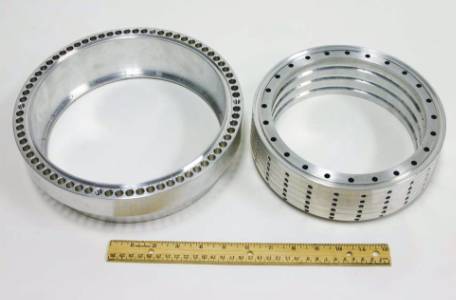
block
A similar design operating under 40 atm cannot explode. There is no regenerative cooling system that could burn out, there are no complex pipelines, and nozzle heads drilled in the metal have a visible margin of safety. In general, the engine with its simplicity resembles plumbing - two ball valves and a shower head.
Well, let’s give free rein to paranoia and try to imagine what will happen in the event of a catastrophic design failure? It's funny, but on YouTube there is a video of similar failures - some Japanese company was testing rocket engines. It's harder than OTRAG, and yet, in the worst case, the engine just flies away. If this happened in flight, then the departed engine could not have damaged neighboring blocks.
The final argument. 40 atmospheres is a bit by modern standards. The household gas cylinder has 20 atmospheres, only half the OTRAG, and this does not prevent them from being widely used, despite the fact that the quality of their service is far from space. Scuba diving cylinders work with 200 and 300 atmospheres, and, despite this, they are widespread and successfully used.
Conclusion
I hope the above arguments are enough to recognize the scenario of an avalanche-like destruction of blocks as extremely unlikely. From OTRAG, a good and reliable rocket could well have turned out.