February 2, 2015 at 10:57
Kasparov vs. Deep Blue. Part II: The Philadelphia Experiment
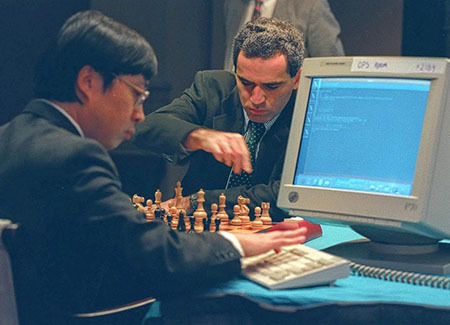
After a break, I continue a series of articles (and also promise to finish it soon) about the long-term chess struggle of two worlds - human and computer. It was planned that Rom77 would write articles about both Kasparov’s battles with Deep Blue, but, unfortunately, my co-author, who wrote a great start , doesn’t get in touch. I sometimes receive letters from grateful readers asking why there is still no continuation, therefore, once again I

Some dry facts. The match took place in Philadelphia from February 10 to 17, 1996 (hmm, only 19 years have passed). The prize fund was 500 thousand dollars, of which 80% (400 thousand) received the winner and 20% (100 thousand) - the loser.
Basically, Fen Xu was sitting at the computer opposite Kasparov , but sometimes he was replaced by Murray Campbell or Joe Hohen . All three are the creators of Deep Blue. The decision to stop or continue the game (handing over the game, agreement to a draw) was taken by a specially invited chess consultant - grandmaster Joel Benjamin . Read more about the IBM team in the first part .
1st party. Deep Blue - Kasparov. 1-0

So the match has begun. In response to the immortal 1.e2-e4, Garik chooses his formidable weapon for Black - the Sicilian defense. This keen start has repeatedly brought spectacular victories to the grandmaster, but the fact is that even Kasparov does not thoroughly know and cannot know the subtle nuances of all branches of the opening. The computer acted wisely (by the way, the creators apparently programmed it) - by its debut base, it quickly left the options preferred by Kasparov and turned the game into a channel in which Harry never won victories. Black is still unable to equalize the game. And on move 23, the computer collapsed the enemy’s position, having made a deafening pawn break d4-d5 (see diagram).

Upon further viewing of the game, it may seem that the grandmaster managed to develop an oncoming matte attack, and whoever wins is another grandmother said in two. But in fact, white from the beginning to the end controlled the situation and were always a step ahead of the
2 party. Kasparov - Deep Blue. 1-0

We must pay tribute to Garik - he always knows how to mobilize after offensive defeats. Kasparov for white chooses a solid and reliable option. Black has a balance of “minus a pawn”, but they managed to achieve “multi-colored” bishops(see diagram). With a calm position, this allows you to reasonably hope for a draw. But the times on the board are turbulent - the white king safely hid behind his pawns, but the dark lord is in full view and “colored” in the presence of queens just allows him to carry out a very dangerous attack. The computer somehow defended itself against dull threats, but for this it was necessary to give up almost all the remaining infantry. Further in the game there was a queens exchange and, despite the multi-colored bishops, there was no chance of a draw anymore - the white soldiers could not be stopped, but the only surviving black checkpoint was blocked easily.
3 party. Deep Blue - Kasparov. ½: ½

Neither white nor black in the game took any chances and the fight went without excesses. Kasparov gained some advantage due to an active rook and a better horse compared to the enemy bishop. The computer found a witty rook maneuver that finally equalized the odds. Bloodless and fast draw.
So, half the match has passed. Opponents lost once, but the peaceful third game showed that they quickly recovered from the blows. The warring parties decided that it was time again for decisive action.
4 party. Kasparov - Deep Blue. ½: ½

Kasparov played very actively with white, but Black built an impregnable fortress. The world champion offered a draw, but IBM staff decided they could hope for more than a peace agreement. Then Kasparov gave up the “quality” and created a position (see chart), where Black, in spite of the “extra” rook, has no chance of winning - it’s dangerous to move away from his king, it’s not even an hour — they will mate.
Not agreeing immediately to a draw, in this game the “Aybem members” did not risk anything at all. In the next game, in another draw position, they decided to repeat this “maneuver” again. But, as it turned out - with more fatal consequences.
5 party. Deep Blue - Kasparov. 0: 1

The computer again played reliably, and Kasparov, despite the fact that he managed to seize the initiative in the party in black, did not achieve anything special. The world champion offered a draw (see chart) and again the IBM team decided that you could play some more. Then Kasparov stepped up activity, but the car played apathetically and inappropriately. Harry led the e- pawn forward and White had to give a piece for it. The man led the bill.
It was a turning point in the match. When Harry proposed to disperse the world, Fen Xu, as usual, was sitting at the computer opposite him. The “father” of a chess supercomputer in the game understood much less than in the high-speed processors of his brainchild. Therefore, he provided the decision to Grandmaster Benjamin. Joel realized that a draw in this case was a good offer, but decided to continue the game “in the interests of science”. He later explained at a press conference that he wanted to watch how the car behaved in an approximately equal position. Kasparov thanked the heart for the experiment.
6 party. Kasparov - Deep Blue. 1-0

Inspired by success, Kasparov on the rise held the last batch of white, having carried out a series of subtle, truly “human” maneuvers. Computer doomedly played "from defense". But while the machine erected fortifications at the last frontiers, a man captured the space and maximally expanded the sphere of influence of his figures. The diagram shows the final position of the game. On the board is the so-called zutswang in the middlegame. With a full board of pieces, Black has almost no moves. Almost any kind of body movement should be, if not a forced mat, then large material losses. The computer now even has an extra pawn, but White’s position is so overwhelming that the Deep Blue team decided: there was no point in delaying the end.
At the post-match press conference, the contented Harry Kimovich did not skimp on the praise of the electronic rival and its creators:
“First of all, I would like to congratulate the IBM team on the truly outstanding achievements that have made the computer such a serious opponent.”
“This happened for the first time in history - so that a computer with a chess program created by people, most of whom cannot play chess, fights so seriously against the world champion.”
Also interestingly commented on the defeat of the computer in the last two games:
“Perhaps those who were disappointed with the 6th or 5th games may say that in many positions the machine played rather mediocre, being unable to understand the simplest things that are easily assimilated by a chess player. But, firstly, such positions still needed to be created, and secondly, it was necessary to constantly monitor tactical attacks that could instantly decide the outcome of the game - this is one of the important advantages of the machine. ”
After which Kasparov shared how he managed to find the key to the electronic rival:
“I think that the main difference between a person and a computer can be felt by studying the 1st and 2nd parties. The last two games I played, learning to play positions and choose the moves that are most unpleasant for the car. For computers, the training process is quite difficult, and during the match it is not possible at all, because the team needs time to conduct the training process in the laboratory. ”
“It was fundamentally important that I was able to learn very quickly and chose the right strategy. In fact, I avoided what had to be avoided. Already only one first batch gave me enough information. Do not create weaknesses, do not play open positions where there is a chance that your king may be in danger. And in the next five games I avoided a direct clash. The positions were open, but still the machine’s ability to create something unpleasant for my king or other figures was very, very limited. ”
And finally, he predicted a great future for computer chess:
I believe that for the first time in the history of mankind, we have something very close to artificial intelligence. It is already possible to reduce the number of errors and achieve the level of the game, which is determined by human intuition. Now - where I intuitively feel whether I play correctly or erroneously - the machine is simply sorting through billions and billions of options. But it is possible that in the future it will be possible to create an algorithm that would be comparable with the intuitive thinking of a person.

Kasparov's victory was quite convincing in the long run (two points superior), but there was no overwhelming advantage in the game. In fact, a person dominated the machine in only two of the six parties - the second and the last. The computer had an unconditional advantage in the first game, so a more “fair” score in the number of victories would be 2: 1, not 3: 1.
IBM decided to re-throw the glove to the champion, offering to play a similar match a year later. Everyone understood that this year will be spent on improving the algorithms taking into account the experience of the match, on increasing the counting power, as well as on further “sharpening” the game of the supercomputer in the style of Kasparov. Most experts agreed that the second 6-round battle will also remain with Garik, although the victory will be difficult. And this despite the fact that on the eve of the first match, the supercomputer was considered the favorite.
But, to everyone’s surprise, Deep Blue will suddenly take revenge under very controversial circumstances ...
( To be continued ... )
Additionally
Match table
| 1 | 2 | 3 | 4 | 5 | 6 | Result | Glasses | |
|---|---|---|---|---|---|---|---|---|
| Garry Kasparov | 0 | 1 | ½ | ½ | 1 | 1 | +3, –1, = 2 | 4 |
| Deep blue | 1 | 0 | ½ | ½ | 0 | 0 | +1, –3, = 2 | 2 |
Debut Statistics
Sicilian defense - 1, 3
Catalan beginning - 2
Slavic defense - 4, 6
Debut of four horses - 5
You can watch the games in detail here .
And about Deep Blue there is a detailed Wikipedia article .
All articles in the series
Kasparov - Deep Thought. One-goal game
First offenders. Fritz and Genius
Kasparov vs. Deep Blue. Part I:
Kasparov's Black Box vs. Deep Blue. Part II: The Philadelphia experiment of
Kasparov against Deep Blue. Part III: Inter-Match
Kasparov vs. Deep Blue. Part IV: The New York Secrets of
Kasparov vs. Deep Junior. Return to New York
3D Chess Show: Kasparov VS Fritz
After Kasparov. Computer Chess - Results and Prospects
First offenders. Fritz and Genius
Kasparov vs. Deep Blue. Part I:
Kasparov's Black Box vs. Deep Blue. Part II: The Philadelphia experiment of
Kasparov against Deep Blue. Part III: Inter-Match
Kasparov vs. Deep Blue. Part IV: The New York Secrets of
Kasparov vs. Deep Junior. Return to New York
3D Chess Show: Kasparov VS Fritz
After Kasparov. Computer Chess - Results and Prospects