October 15, 2014 at 17:41
Brain code and memory. Hippocampus riddle
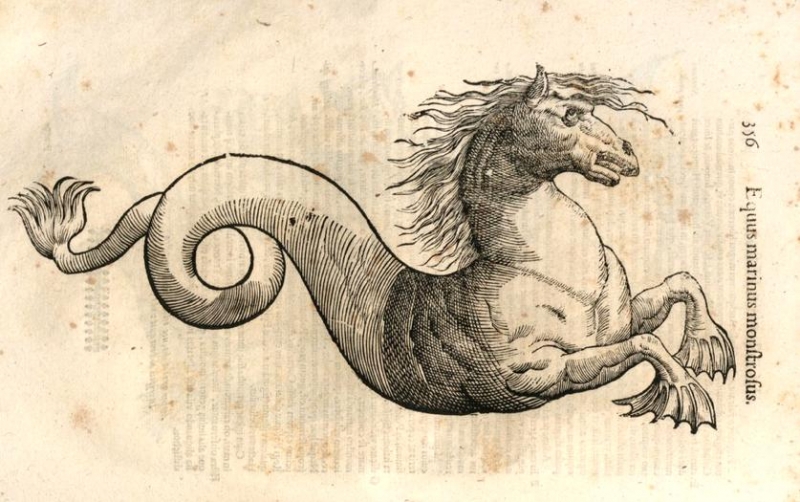
Most recently, the 2014 Nobel laureates were announced. The prize in physiology or medicine was shared by American John O`Keefe and his spouses Norwegians Edward Moser and May-Britt Moser. Studies that have been rated so highly have dealt with a small area of the brain called the hippocampus. This name comes from the Greek ἱππόκαμπος - a seahorse, it is precisely this amazing organ that remotely resembles it.

In 1971, John O'Keefe discovered cells in the hippocampus (O'Keefe J., Dostrovsky J., 1971). These cells react like an internal navigator. If a rat is placed in a long corridor, then by the activity of certain cells it will be possible to say exactly where it is located. Moreover, the reaction of these cells will not depend on how it got to this place.
In 2005, in the entorhinal region of the cortex, which is part of the hippocampal formation, Mosers discovered neurons that encode spatial position, forming something like a coordinate grid (Hafting T., Fyhn M., Molden S., Moser MB, Moser EI, 2005) .
It is natural that both of these discoveries were combined in one prize with the formulation: for the discovery of cells that make up the positioning system in the brain.
But these discoveries did not remove questions about the role of the hippocampus, but rather multiplied them. In 2011, it turned out that there are cells in the hippocampus that encode time intervals in a certain way. Their activity forms rhythmic patterns, even if nothing else happens around (Christopher J. MacDonald, Kyle Q. Lepage, Uri T. Eden, Howard Eichenbaum, 2011). That is, it turns out that in addition to orientation in space, the hippocampus is also responsible for orientation in time.
But not only that, it has long been shown that the hippocampus plays a key role in the formation of memory. In 1953, the patient, commonly called HM, the surgeon completely removed the hippocampus (W. Scoviille, B. Milner, 1957). It was a risky attempt to cure severe epilepsy. It was known that the removal of the hippocampus of one of the hemispheres really helps with this disease. Given the exceptional power of epilepsy in HM, the doctor removed the hippocampus from both sides. As a result, HM completely lost the ability to remember anything. He remembered what happened to him before the operation, but everything new flew out of his head as soon as his attention switched. Mysteriousness is enhanced by the fact that the removal of the hippocampus is only on one side or on both sides, but partial, the ability to remember new things practically does not affect.
There are hypotheses that the hippocampus is a repository of short-term memory, which is then redistributed into long-term memory, similar to computer RAM. But no one was able to give clear explanations about how such a memory can be arranged and how memories can be transmitted from place to place.
Of course, we can assume that the hippocampus is just such a place in the brain where several completely different systems accidentally intersected, each with its own independent function. But, following the logic of a good detective, all these wonderful properties of the hippocampus cannot be a coincidence. In the detective story, and in science it is always the same, there must be an explanation that will show the inextricable connection of all the evidence and highlight their previously hidden meaning.
It’s easy to figure out that the solution to the hippocampus should, no less, explain how human memory works. But it is clear that it is impossible to explain the memory device without answering questions about how the brain encodes and processes information in general. Unfortunately, no generally accepted theories on this subject exist. The difficulty is that the information algorithms implemented on computers cannot be compared with the operation of neurons of the real brain. And those features that are usually attributed to biologically reliable neural networks do not allow to realize anything of little interest.
Those who read my previous materialsThey know that I’m working on a model of the cortex, which I call the wave pattern. Of course, this will sound immodest, but it seems that the main mysteries of the information code of the brain and the memory mechanism in this model were solved. It turns out that not the last place in this explanation is given to that very mysterious hippocampus. In the pattern-wave model, it turned out to naturally bring together all its so amazing properties. And not to fit the explanation of how all of the above can get along together, but to show that in the memory model, which in my approach is characteristic of the real cortex, all the properties of the hippocampus are inevitably predetermined.
If I managed to intrigue you, then below is a relatively recent lecture recording, which gives my explanation of the principles of the brain and the role of the hippocampus in all of this.
Unfortunately, the “Lectorium” , which kept the record, badly messed up with sound, in connection with which I hesitated for a long time whether it should be laid out on Habr (Giktaym). But such a coincidence as the Nobel Prize precisely for the study of the hippocampus was the decisive argument for.
Continued on thinking and the role of emotions .
UPD
Thanks to user Alexufo for processing the sound, which somewhat reduced the interference.