February 14, 2018 at 13:57
Multitasking or marijuana?
- Transfer
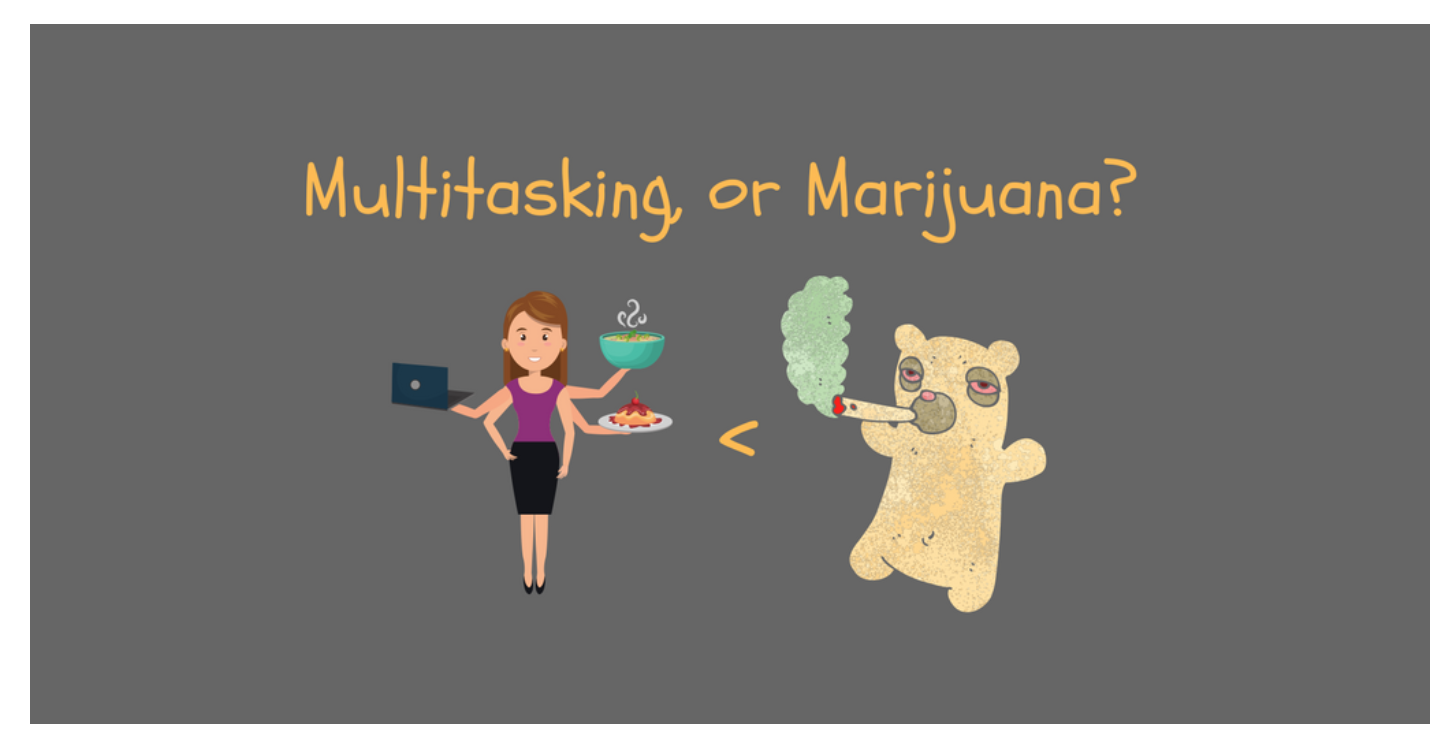
Take a look at this picture. The character on the right is a bear. It so happened that he smokes marijuana (do not ask where he got it. I don’t want to know). The woman on the left I called Sally. Except that she has five arms, Sally is a completely ordinary, unremarkable business woman. Sally, like many other ordinary business women, is also an inveterate multitasker. In the picture she holds her laptop, prepares some dessert, and even balances a bowl with some kind of scorching hot stew, probably from seafood. And now the main question. Suppose Sally and the bear have the same level of intelligence (this is a very smart bear), then which of them will show the best result when testing cognitive activity? In other words, if I was interested in mental activity, what is worse for me: to be multitask or to hammer a joint?
Disclaimer: we are against drugs! Drugs are evil!
Daniel Levitin, a writer and neurophysiologist, in his book The Organized Mind: Thinking Straight in the Age of Information Overload, claims that multitasking is worse (in terms of mental activity ... not sure about the social consequences) than smoking marijuana:
“... the main component of marijuana, cannabinol, activates certain receptors in the brain and deeply interferes with memory and our ability to simultaneously concentrate on several tasks. [Someone named] Wilson has proven that cognitive decline due to multitasking has even surpassed cognitive decline from smoking marijuana. ”
To understand why multitasking is so bad, let's take a short digression into the mechanics of human attention.
Balls and Switches
Try to remember the first hours of your today. What did you eat for breakfast? What did you drink? What about brushing your teeth after waking up? I think most of you will remember all these details without any problems.
Now let's complicate the task. Can you recall the number of tiles on the floor of the bathroom or kitchen? The number of steps to your apartment or office? The size and shape of blades of grass breaking into asphalt cracks at the entrance? Most of you (sincerely hope) will not remember.
In the stories about Sherlock Holmes, the detective plays with Watson because he did not count the number of steps (seventeen) to the apartment on Baker Street 221B. But Watson’s reaction was natural.
Most people don't give a damn about how many steps they climb every day. So why pay attention to this? Attention - the resource is limited.
Monkey business
In terms of data processing, brains are many times weaker than the slowest supercomputer. We compensate for this disadvantage due to the high selectivity of attention.
This thesis is often illustrated for first-year students of the Faculty of Psychology using similar videos. Try to honestly calculate, without cheating, how many times the team in the WHITE passed the ball?
If you took the task seriously, you probably didn’t notice the black bear (this time without marijuana), which crossed the whole scene. Personally, I do not notice him even knowing that he is there. By focusing on something, you stop noticing everything else.
Now you see, but now no
According to Levitin, multitasking doesn't just make you dumber. It is also impossible. Or, more precisely, it does not work as most of us think.
You will say: “ What nonsense. I do several tasks all the time at the same time. I speak on the phone while driving. I make the sauce while I cook the spaghetti. I am chatting with friends while sitting in a meeting . ”
Yes, we can perform several actions in one period of time. But we never do anything at the same time:
“Everyone wants to believe that we can do several things at once, and that our attention is endless, but this is a persistent myth. In fact, our attention quickly shifts from one task to another. As a result, we are not paying enough attention to any case, and we are reducing the quality of attention given to each task. ”
With multitasking, our attention is forced to quickly jump back and forth, like a spotlight on a watchtower. These constant shifts cost our brain dearly:
“Forcing the brain to shift attention from one activity to another leads to the burning of oxygen-rich glucose in the frontal cortex and striatum, but we need this“ fuel ”to focus on the task. In addition, fast and frequent switching causes the brain to burn “fuel” so quickly that a feeling of exhaustion and disorientation soon arises. We are literally depleting the supply of nutrients in the brain. ”
But the bad news does not end there.
Multitasking triggers the production of cortisol, a stress hormone. As a result, task juggling increases anxiety and impairs mood. Cortisol also impedes learning: students watching TV during class leads to the fact that information is stored in unnecessary sections of the brain.
Multitasking harms our ability to make decisions. Switching, we make micro-decisions, and as a result, for important cases in life, we have less “decision-making energy”:
“The situation is compounded by the fact that multitasking requires decisions. Should I reply to the message, or ignore it? How to answer it? How to send this letter? Should I continue to work on the current task, or interrupt? Decision making also puts a heavy strain on our neural resources, and small decisions consume as much energy as large ones. And first of all, we lose self-control. This quickly develops into a state of exhaustion, and as a result, having made many unimportant decisions, we can make an erroneous decision in something important. "
To summarize, multitasking:
• Deteriorates the quality of attention
• Tires faster
• Increases stress and
lowers mood • Decreases learning efficiency
• Leads to making bad decisions in the present and future
Oh. But since multitasking is so bad, why haven’t we abandoned it yet?
Honey it's so nice
According to Levitin, we do not refuse multitasking for several reasons.
Firstly, it is part of our evolution. The ability to notice red edible fruit in the jungle often, or a poisonous creature crawling underfoot, was a matter of life and death.
That is, our brain is adapted to respond to new and distracting information:
“The brain section responsible for focusing on the task is easily distracted by some noteworthy new objects. With multitasking, we unknowingly enter the cycle of addiction, because the centers of novelty in the brain are rewarded for processing new stimuli, to the detriment of our frontal cortex, which does not want to give up the current task and receives a reward for long-term efforts and attention. ”
Another reason for our love of multitasking is our feeling of it:
“Do you think people will understand that they are poor at multitasking and will refuse it. But a cognitive illusion arises, partly supported by the dopamine-adrenaline feedback loop, which makes multitaskers very happy with themselves. ”
Part of the blame lies with the corporate culture, which often encourages employees to counterproductive behavior:
“... at work, people are mistakenly encouraged to be multi-tasking. ... Many managers introduce rules like “You must reply to the letter within 15 minutes” or “You must keep the chat window open”, but this leads to the fact that you interrupt your work, fragment your attention, empty resources of the frontal cortex, which is tens of thousands years has evolved with a focus on focus on the current task. ”
With all that said, the last question arises. If multitasking doesn't work, what should we do with it?
And now what?
The book of Levitin offers a lot of ideas, we will not describe them in detail here. Here are just examples of how you can manage your multitasking, hold attention, increase creativity and improve the overall quality of life:
- Check your mail once a day with services like Boomerang
- Transfer tasks to be performed from working memory to cards (to be processed later in the style of Getting Things Done)
- Organize your schedule according to the “metronome” principle, so that it switches you between requiring concentration and relaxing tasks (for example, after working at the computer you can take a shower or take a walk in the forest). We need the latter to restore strength; and multitasking - no
- Store information not in the brain, but in the environment, using the so-called Gibsonian opportunities
- For work and entertainment, highlight different spaces or computer environments.
- In the most important day hours, give up everything distracting (mail, Internet, phone calls, correspondence, and so on)
But first of all, you need to understand: multitasking does not work.