January 18, 2018 at 13:22
Past, Present, and Future of Speech Recognition Technology
- Transfer

Voice is the future. Global technology giants are demanding vital market share, and ComScore predicts that "up to 50% of all searches will be carried out by voice by 2020."
However, the historical antecedents that led us to this moment are just as important as they are amazing. In this report, we set off on a journey through the history of speech recognition technology before providing a comprehensive overview of the current landscape, and giving tips that all marketers should consider to prepare for the future.
History of Speech Recognition Technology
Speech recognition technology has entered public consciousness relatively recently, with brilliant launch events from high-tech giants of leading global trends.
Our admiration is instinctive: we are fascinated by machines that can understand us.
From an anthropological point of view, we developed the spoken word long before its written counterpart, and we can speak 150 words per minute, compared to the insignificant 40 words that an average person can write in 60 seconds.
In fact, communicating with technological devices using voice has become so popular and natural that we justifiably wonder why the richest companies in the world have just begun to provide us with these services.
The history of technology shows that speech recognition is far from a new concern, even if the pace of development did not always correspond to the level of interest in this topic. As we see later, the major breakthroughs dating back to the 18th century provided a platform for digital assistants, of which we all know today.
The earliest advances in speech recognition focused mainly on creating vowels as the basis of a system that could also learn to interpret phonemes (building blocks of speech) from interlocutors.
These inventors were hindered by the technological context in which they lived, with only the basic means for creating a talking machine at their disposal. However, they provided an important precursor to later innovations.
Voice recorders, first created by Thomas Edison at the end of the 19th century, were able to record speech and became popular among doctors and secretaries, who made a large number of recordings daily.
However, it was not until the 1950s that this line of research led to genuine voice recognition. So far, we see attempts to create and record speech, but not yet interpretation.
Audrey, a machine created by Bell Labs, could figure out numbers from 0-to-9 with an accuracy of 90%. Interestingly, this level of accuracy was recorded only when its inventor spoke; but only from 70% to 80% when other people spoke to Audrey.
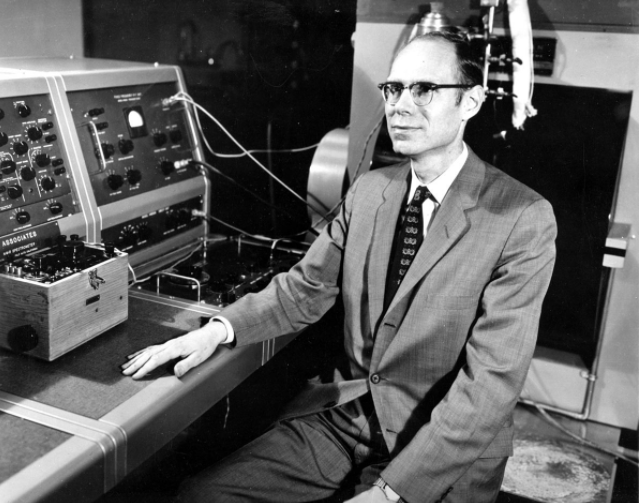
This points to some of the ongoing problems of speech recognition; each person has his own voice, and spoken language can be very inconsistent. Unlike text, which has a much higher level of standardization, the spoken word varies greatly depending on regional dialects, speed, emphasis, even social class and gender. Therefore, scaling of any speech recognition system has always been a significant obstacle.
Alexander Weibel, who worked at Harpy, developed a machine at Carnegie Mellon University that could understand more than 1,000 words built on this principle:
“So, you have things like 'Crippled,' which could be 'While being treated.' Or, if you say 'Awkward things', it can be understood as 'I bring different things.' ”Until the 1990s, even the most advanced systems were based on pattern matching, where sound waves were translated into a set of numbers and stored. Then they will be triggered when the same sound is heard in the device. Of course, this meant that it was necessary to speak very clearly, slowly and in conditions without background noise, in order to have good chances of recognizing sounds.
IBM Tangora, released in the mid-1980s and named after Albert Tangor, became the fastest typist in the world and could adapt to the speaker's voice. This still required slow, clear speech and the absence of background noise, but the use of hidden Markov models increased flexibility by clustering data and predicting future phonemes based on previous patterns.
Although each user took 20 minutes of training (in the form of a recorded speech), Tangora could recognize up to 20,000 English words and several complete sentences.

The seeds of voice recognition technology sown then were one of the most significant and important events in this area. There was a belief that speech recognition can only be achieved by adapting to each person’s unique way of communicating, but achieving this breakthrough was very difficult.
It was only in 1997 that the world's first “continuous speech recognizer” (i.e., no longer had to pause between each word) was released in the form of Dragon's NaturallySpeaking software. Able to understand 100 words per minute, it is still in use today (albeit in an updated form) and is in demand by doctors.
Machine learning, as in many areas of scientific discovery, has provided the most breakthroughs in speech recognition in this century. Google has combined the latest technology with the power of cloud computing to exchange data and improve the accuracy of machine learning algorithms.
This led to the launch of the Google Voice Search iPhone app in 2008.
Thanks to the large amount of training data, Voice Search has shown remarkable accuracy improvements over previous speech recognition technologies. Google introduced personalization elements into its voice search results, and used this data to develop its Hummingbird algorithm, gaining a much more subtle understanding of the language used. These threads were connected in the Google Assistant, which now has almost 50% of all smartphones.
It was Siri, Apple released the voice recognition market, which first captured the imagination of the public. As a result of many years of research, this digital assistant with AI has led humanity into the world of speech recognition.
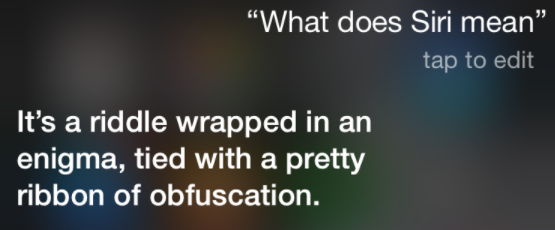
After Siri, Microsoft launched Cortana, Amazon launched Alexa, and the gears were set in motion. There is a battle for supremacy among the hi-tech giants for the most advanced voice recognition platform.
In fact, we spent hundreds of years learning cars to complete a journey that takes an average person just a few years. Starting from the phoneme and creating individual words, then phrases and, finally, sentences, machines can now understand speech with an accuracy of 100%.
The methods used to make these leaps forward have become more sophisticated to the extent that they now freely summarize principles based on the schemes of the human brain. Cloud-based computers have entered millions of homes and can be controlled by voice, even offering interactive answers to a wide range of requests.
This journey is still incomplete, but we have moved quite far from room-sized computers since the 1950s.
Speech Recognition Sphere Today
Smartphones were originally the only habitat for digital assistants such as Siri and Cortana, but this concept has been decentralized over the past few years.
Currently, the focus is mainly on voice activated home applications, but this is essentially a Trojan horse strategy. Capturing a dominant place in the consumer’s home, these systems are the gates for the distribution of smart (tracking) devices that can be classified under the broad concept of “Internet of things”. Google Home or Amazon Echo can already be used to manage a wide range of Internet-enabled devices, and by 2020, even more inventions can be added to their list: smart refrigerators, headphones, mirrors and fire systems, as well as a rapidly growing list of side innovations.
A recent Google study found that more than 50% of users support a voice-activated system in their living room, with a significant number also reporting that they have one in their bedroom or kitchen.
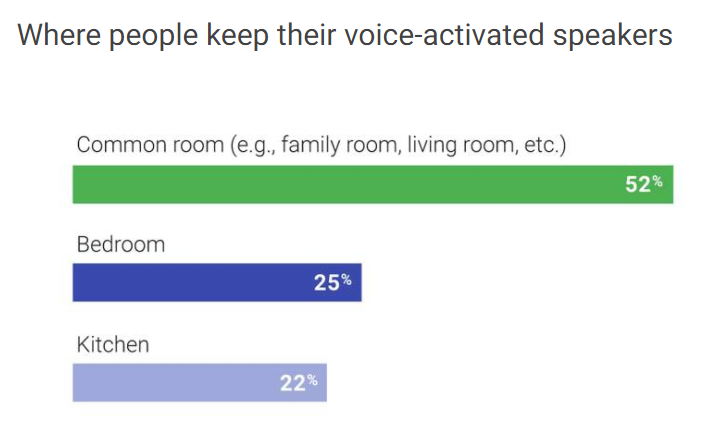
And this, in fact, is the essence; Google (and its competitors) want us to buy more than one of these home devices. And the more convenient they are, the more people will continue to use them.
Their ambitions are greatly assisted by the fact that the technology is now truly useful for everyday tasks. Ask Alexa, Siri, Cortana or Google what the weather will be like tomorrow, and it will provide a completely intelligible, verbal report. The device is still imperfect, but speech recognition has now reached an acceptable level of accuracy for most people, with all major platforms reporting an error rate of less than 5%.
As a result, these companies try to “hoist their flag” in our homes as early as possible. Hardware, for example in the form of a home speaker system, is not something often bought by most. For example, if consumers buy GoogleHome, then it seems likely that they will complement it with devices that support Google, instead of buying from a competing company and creating unrelated digital ecosystems under their roof. It's much easier to look for devices that provide stability and convenience.
For this simple reason, it makes sense for Amazon to sell Echo Dot for only $ 29.99. This is equivalent to short-term financial losses for Amazon on every device sold, but long-term gains will more than compensate for this.
According to today's estimates, about 33 million smart devices have already been installed (Voice Labs report 2017), and both young and old generations are rapidly adopting this technology.
Tech Crunch reports that,
In fact, the demographics of the “superuser” assistant are those who spend twice as much time with personal assistants every month. On average, she’s a 52-year-old woman spending 1.5 hours a month using network assistants.Perhaps the most important thing for large technology companies is to force consumers to make more active use of voice communications when shopping through their devices.
Google reports that 62% of users plan to make a purchase using voice over the next month, while 58% use it to create a weekly shopping list:

Short-term findings on existing business strategies at Amazon and Google, in particular, are relatively transparent . The pioneer’s advantage seems to be a breakthrough in this arena, especially since speech recognition continues to evolve into communicative interactions that comfortably lead to shopping.
We have already written about the two focal points of a voice search strategy for high-tech giants: technology must be ubiquitous and smooth. The voice is already a multi-platform ecosystem, but we are still some distance from the omnipresence that it pursues.
To get an idea of the likely outcome of the current competition, it is worth evaluating the strengths and weaknesses of four key players in the Western markets: Amazon, Google, Apple and Microsoft.
Amazon
Initial Equipment: Echo, Echo Dot, Echo Show, Fire TV Stick, Kindle.
Digital Assistant: Alexa
Usage statistics:
“Tens of millions of Alexa-enabled devices sold worldwide during the 2017 holiday season (Amazon) 75% of all smart devices sold to date are Amazon devices (Tech Republic)
Echo Dot was number one selling the device on Amazon during the holidays, and Alexa is included in the Fire TV Stick in second place. (Amazon) The
average Alexa user spends 18 minutes per month interacting with the device, compared to five minutes for Google Home (Gartner)
Currently, over 25,000 skills are available for Alexa (Amazon).
Overview:
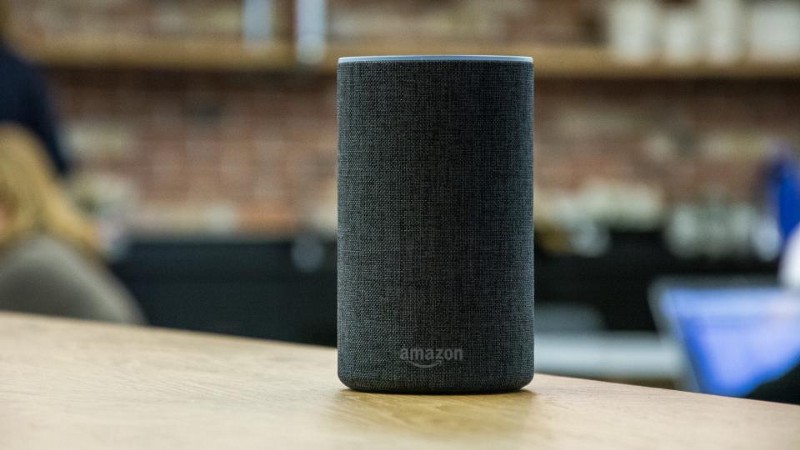
The cylindrical device Echo and his younger brother, Echo Dot, were an unbridled breakthrough of smart devices. By connecting systems to a number of popular third-party services, Amazon has made Echo a useful addition to millions of households.
As Amazon spokesman Dave Limp recently said, "We think of it as important computing that provides system access, less of a burden to you personally, but that solves more extensive tasks."
Ubiquity seems like a real opportunity based on sales metrics.
After the festive season, when Echo Dot became the most popular Amazon product worldwide, the Alexa app took the top position in the App Store, ahead of the rival Google product.
Amazon’s legacy as an online store gives it a built-in edge when it comes to technology monetization. The acquisition of Whole Foods adds extra weight to this, with the ability to integrate offline and online worlds so that other companies are jealous.
Moreover, Amazon has never been dependent on advertising to keep stock prices soaring. On the contrary, in fact. Consequently, there is less short-term pressure, which allows us to seize the initiative in this aspect and lead the field of smart applications.
With advertisers looking to find a true online alternative to Google and Facebook, Amazon is in a great relationship with real capitalization. But the balance here is too fragile, it is worth the titanic effort to stay here. Amazon loses the most in terms of consumer trust and reputation, so it will carefully switch to advertising for Alexa.
The company denies that it has plans to do this, but, as research company L2 Inc recently reported, Amazon has turned to major brands asking if they are willing to pay for Amazon's Choice, designating the best products in a particular category.
Amazon is expected to see more attempts to provide something other than paid ads in search results. The voice requires new advertising solutions, and Amazon will first begin to back off a bit to ensure that it does not violate Alexa's rights. And the recently announced partnership with publishing giant Hurst is a sign of a future surprise.
The key to Alex’s success will be Amazon’s integration of its own assets, as well as third-party support, which has already led to more than 25,000 innovations. With the support announced for new headphones, watches, refrigerators, etc., Amazon seems to be ahead of voice recognition technology for some time to come.
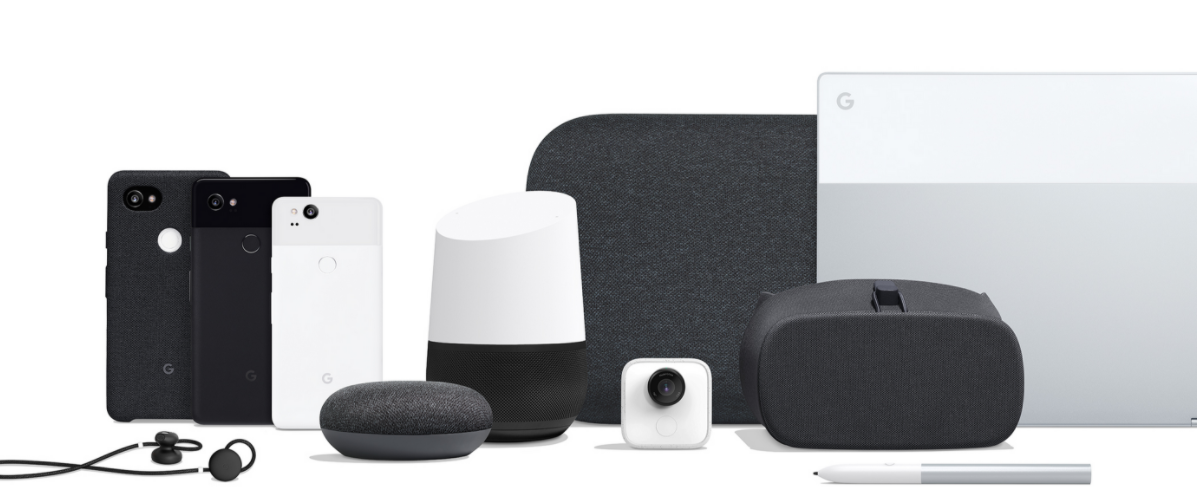
Original equipment: Google Home, Google Home Mini, Google Home Max, Pixelbook, Pixel smartphones, Pixel Buds, Chromecast, Nest smart home products.
Digital Assistant: Google Assistant
Usage statistics:
Google Home has a 24% market share in the US smartphone market (eMarketer)
. Google Home (Google) has more than 1,000 actions.
Google Assistant is available on more than 225 home control brands and more than 1,500 devices (Google).
Most Google Assistant's popular apps are games followed by home control apps (Voicebot.ai)
Overview:
The Google Assistant is directly tied to the world's largest search engine, giving users direct access to the largest database humanity has ever known. This is not a bad repository for working with a digital assistant, especially since Google continues to improve its speech recognition programs.
Recent research conducted by Stone Temple Consulting on 5,000 queries showed that Google provides the most accurate solutions over a fairly long distance:
In combination with Google Photos, Google Maps, YouTube and a number of other effective Google Assistant services, there is no lack of integration capabilities.
Perhaps Google did not plan to enter the hardware market again after it received a warm welcome in the past for its products. However, this new market has prompted the search giant to take very serious action. At the moment, there is no room for errors, so Google took matters into its own hands with the help of Pixel smartphones, Chromecast, and, of course, home smart devices.
The Home Mini was very popular, and Google added Home Max to the collection, which comes at a higher price than even the Apple HomePod. All bases are provided with excellent coverage.
Google knows gaming devices are not a long-term solution. This is a necessary strategy for the here and now, but Google will want to convince other equipment manufacturers to integrate the assistant, just like with the software for Android smartphones. This will eliminate costly production costs, but preserve the vital currency — consumer attention.
This plan has already been launched, and even support has been announced for a number of smart displays:
This innovation adds a fresh visual element to consumer interactions with smart devices and, vitally, gives you the ability to use Google Photos, Hangouts and YouTube.
Google also wants to add a “more human touch” to its AI assistant and has hired a team of comedians, video game designers and empathy experts to add some personality to the product.
Google is, after all, an advertising company, so the next project will undoubtedly monetize this technology. At the moment, the main goal is to provide a better, more human experience than competition, and to gain substantial territory in more households. The search giant will undoubtedly find new ways to make money from this situation.
Although it was slower than Amazon, Google’s new ads and a growing range of products mean that it is still a serious contender both in the short and long term.
Apple
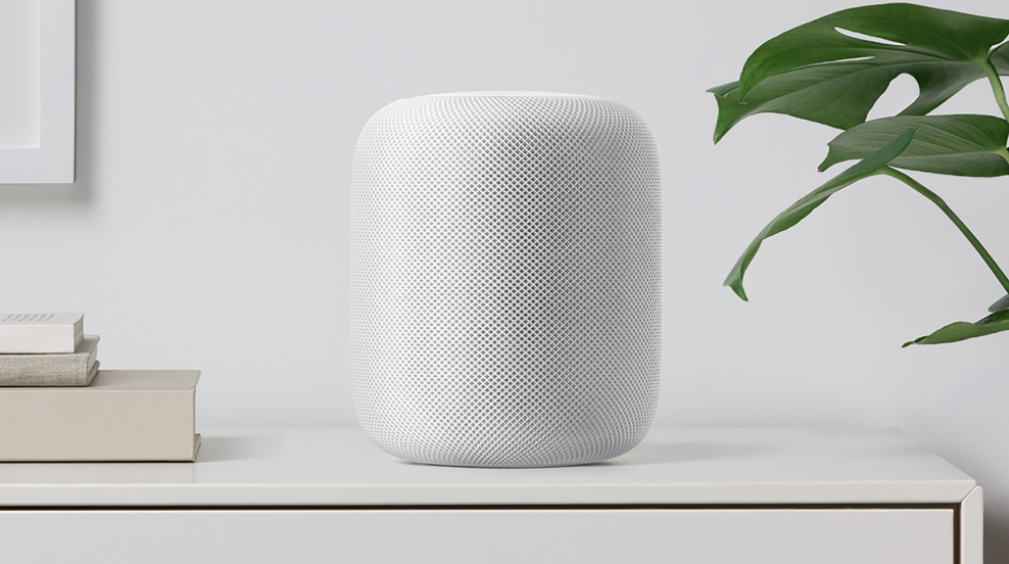
Equipment: Apple HomePod (due to launch in 2018 at a price of $ 349), iPhone, MacBooks, AirPods
Digital Assistant: Siri
Usage statistics:
42.5% of smartphones have Apple Siri digital assistant (increased visibility)
41.4 million. Active users in the US as of July 2017, which is 15% less than in the previous year (Verto Analytics)
19% of iPhone users interact with Siri at least daily (HubSpot)
Overview:
Apple maintains an enviable position in the smartphone and laptop markets, which allowed it to integrate Siri with its OS in such a way that other companies simply cannot replicate. Even Samsung, with its Bixby assistant, cannot boast of this level of synergy, since smartphones run on Android and, as a result, must compete with Google Assistant for the user's attention.
However, according to statistics, they are slightly behind when it comes to using equipment in consumer smart homes. The HomePod will almost certainly provide a much better sound than the Echo Dot or Google Home Mini, priced at $ 350. It will contain many impressive features, including the ability to evaluate the environment and adjust sound quality accordingly.
The launch of the HomePod was delayed, and industry officials said the reason was Siri. Apple protection provides certain user benefits, but it has some disadvantages when it comes to technologies such as voice recognition. Google has access to a huge amount of information that it processes in the cloud, and uses it to improve the work of the assistant for all users. Apple does not have such a valuable resource, and nothing but one and the same - quantity, which slows the development of Siri since its appearance on the market.
However, it seems that these are most likely short-term problems.
Apple will remain aloof from its core business strategy, and so far, very good. HomePod will sit at the premium end of the market and build on Apple's design heritage to focus on delivering superior sound. It will be launched only with support for Apple Music, so if Apple does not open its doors to third parties, it can only stay with its ardent fans. Fortunately for Apple, they are enough to make the product a springboard. We will see.
Microsoft
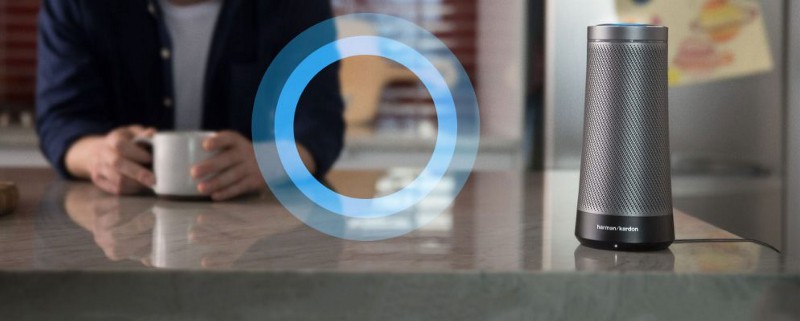
Hardware: Harman / kardon Invoke, Windows-based smartphones, Microsoft laptops
Digital assistant: Cortana
Usage statistics:
5.1% of smartphones have a Cortana assistant.
Cortana now has 133 million users per month (Tech Radar)
25% of Bing-by-voice queries (Microsoft)
Overview:
Microsoft was relatively stable on the front of speech recognition, but its trump card is in having many of the components necessary for the success of a speech recognition product.
With a very significant market share, Office suite of services and popular products such as Skype and LinkedIn, Microsoft should not be discarded.
Apple’s decision to fail Google over Bing on its assistant Siri has been a blow to Microsoft’s ambitions, but Bing can still be a competitive advantage for Microsoft in this arena. Bing is a source of invaluable data and has helped transform Cortana into a much more effective speech recognition tool.
The Invoke speaker, developed by Harman / kardon with Cortana, integrated into the product, has also been reduced to the more affordable $ 99.95.
There are new speakers in development with Cortana support, as well as smart home products such as thermostats. This, I suppose, may surprise us with an increase in demand, but there is a sharp feeling that Microsoft may be a little late for this party.
Where Microsoft can compete very seriously, this is an office environment that has also become a central factor for Amazon. Microsoft is ready to take a different path to gain a foothold in this market, but it can still be an extremely profitable segment.
The future of speech recognition technology
We are still some distance from realizing the true potential of voice recognition technology. The problem concerns both the sophistication of the technology itself and its integration into our lives. Current digital assistants can interpret speech very well, but they are not the interactive interfaces that technology providers expect. Moreover, speech recognition is still limited by not very few finished products.
The pace of progress, compared with the earliest discoveries in speech recognition, is actually quite phenomenal.
And, on this basis, we can look into the near future and predict the transformation of the way we interact with the world around us. Amazon's concept of "ambient computing" seems, here, quite appropriate.
The smart device market has significant room for growth, with 75% of US homes projected to have at least one by the end of 2020.
Now, when users begin to overcome the initial awkwardness in a conversation with their devices, the idea of asking Alexa to boil a kettle or making an espresso does not seem so wild.
The voice becomes its own interface, extending beyond the smartphone to the home, and soon, to many other informing contexts.
We expect to see more complex I / O relationships as technology advances. Voice communications, for the time being, somewhat limit the response potential, but innovations such as the Amazon Echo Show and Google support for smart displays will open up many new opportunities for interaction. Apple and Google will also include their AR and VR applications when consumer appetite reaches the required level.
However, minor issues still remain. First of all, voice search providers must find a way to provide a choice through the medium that is best for short answers. Otherwise, how can we ensure that the user receives the best response to his request, and not the answer with the highest budget for the solution?
Modern consumers are sensible people and have access to an almost endless information base, so any bugs from brands will be documented and distributed on the network by users.
A new study conducted by Google showed that there is growing recognition among consumers that brands will use smart speakers to communicate with them. A significant number showed willingness to receive information about transactions and sales, almost half of which wanted individual advice.
Speech recognition technology provides a platform for reliable communication, but marketers need an honest and mutually beneficial relationship with their audience.
Main outputs
Brands need to consider how they can make engagement more valuable to the user. The undoubted advantage of voice search is that it is fast, convenient and productive. But, on the other hand, due to the assimilation and strengthening of the relationship between technology and the consumer, they will be able to disconnect us. The Beauty and the Beast example provides a warning in advance for all of us.
Amazon is in an excellent position to monetize its speech recognition technology, but is still facing obstacles. Amazon's Choice sponsorship has been defined as a route to generating revenue without losing customers.
Google has made voice identifier the center of attention for the growth of its business. With a massive amount of data at its disposal and increasing third-party support, Google Assistant will provide a serious threat to Alexa Amazon this year.
Marketers should use technical recommendations for voice search to increase the transparency of devices today. Although this technology is still in development, we must lend a helping hand to it, as it completes, truly, gigantic tasks.
The best way to understand how people can use speech recognition technology is to interact with it as often as possible. Marketers who are serious about identifying areas with additional capabilities should conduct their own research at home, at work, and on the go.