January 16, 2018 at 16:40
TeamLead is our everything: the most popular reports with HighLoad ++ 2017. Part 1
At HighLoad ++ 2017, there were many interesting reports on almost all aspects of the team lead - from finding the same person among ordinary developers to the details of work and the subsequent movement to a higher-level leader up to CTO.
For this review, we selected the eight most popular performances.
The selected speeches are united by the fact that the participants expressed general thoughts about the problems of managing technological teams through the prism of personal experience, which, importantly, each had its own. And since the speakers work in different companies and on different tasks, the presented selection allows you to look at the problem from a variety of points of view.
Our speakers agree on only one thing: technology teams should be led by those who understand how this all works, so it’s easier to grow a team leader and a higher level inside the team than to hire an administrator and train him in technology.
A lot has been said about who the team leader is, what are his main responsibilities and how to solve certain administrative tasks. In this case, we do not pretend to be a complete picture, but want to recommend videos of our best reports for viewing.
We divided the review into two parts. In the first, we will dwell on reports on the transition from an engineer (developer) to team leaders, as well as on some tips regarding daily routine. In the second part, we will go further and discuss the development of team lead as a leader of a higher level, and also look at the development teams and their typical problems from a different angle - through the prism of psychology.
Abstracts
In the first report from our digest, Andrei Ryzhkin (company AGIMA) describes his own formalized procedure for growing timlides within the team, simultaneously warning developers about what will change in their lives if they switch to the “dark side”, i.e. to leaders.
As many conference participants note in their reports, the newly-made team leader will have to get used to the fact that he will no longer have time for development and interesting tasks related to some research. In addition, you will have to get out of a comfortable streaming mode of operation - somehow getting along in the world with parallel tasks arriving simultaneously through several channels, as well as with a large number of communications and planning. In his report, Andrei Ryzhkin gives some tips on how to cope with an unusual situation and not burn out under the pressure of responsibility, or maybe leave yourself a foundation for further development (although according to his data 90% of team leaders still stop at this level).
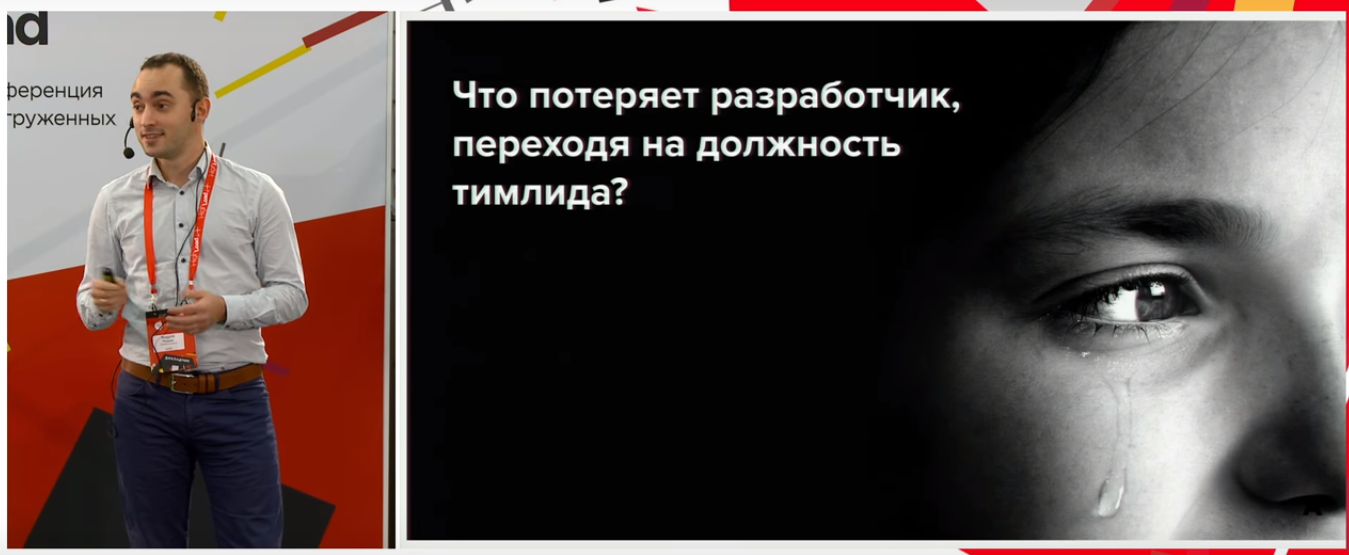
The report will be of interest not only to today's developers tagging in team leads, but also to leaders who are trying to grow a replacement for themselves in the team. Andrei will help them answer the questions: who should be taken in team lead? What qualities should I pay attention to? Should I assign these responsibilities to the best developer in the team?
According to the speaker’s experience, in order to predict the likely success of a character as a team lead, he only needs to have only three qualities: empathy for the team, determination and technical competence. But everything is not so simple: at the start, the team leader needs help, which can sometimes be provided through the right habits within the team. One of the examples discussed is the so-called “sanitary day” (and actually, sanitary hours) - the time allotted for writing reports and planning. The practices adopted by AGIMA and described in detail in the report suggest how to approach the solution of the problems of team lead in general.
Naturally, the other side of the issue was also considered - the “shoals” of an inexperienced team lead, which can and should be fought (as one example, the love of digging in long tasks). In the course of questions after the report, the process of teaching the rest of the team how to interact with team lead was discussed.
In addition, Andrei Ryzhkin proposed a list of literature that will be useful to the future team leader. You will still find this link in the speaker’s presentation, but we decided to submit it to our announcement.
Abstracts
The next report is for the successful team leaders. A potential adherent of the “dark side” has already been identified in the team and thrown into the embrasure (that is, formally or informally put in a team lead). But to say that he coped with the situation is still too early. And at this stage, not only the help of the team and corporate habits described above, but also the self-development of a specialist will be required. This is what Artem Kalichkin (CFT Group of Companies) talks about, relying on his 11 years of experience.
In the form of abstracts, Artem tells how to “not drown” in a new position: what aspects of the self should you pay attention to, what to develop, and what, on the contrary, to refuse.
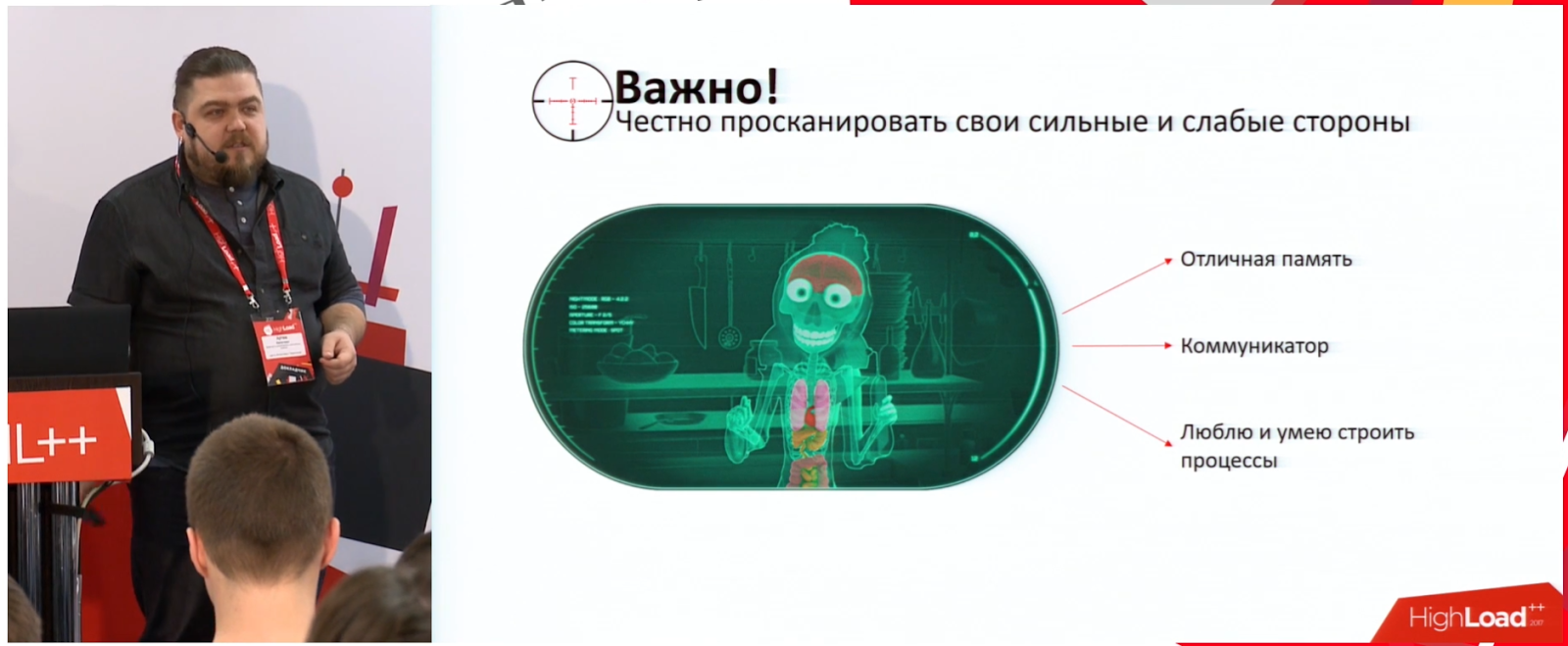
The report examined the most striking “cockroaches” of beginning team leaders: screening off subordinates from any attacks from outside the team - “maternal instinct”, suffering when the engineer’s brain adapts to administrative work, the desire to make the best decision possible - “excellent student syndrome”, attempts to do all the work of the unit by yourself. The speaker stops in detail on each of the listed behavioral patterns, describing it from several angles at once (why it is bad for the team, company and why it is bad for the team lead) - one can feel experience at different levels of leadership.
By the way, Artem believes that almost immediately from the moment of transfer to the position of team leader, a specialist should begin to raise his deputy. To help this process, he considers three of the five stages of growing the future leader that he has identified: identifying, testing, and starting the path. In fact, this is a slightly different view of the same problems that are described in the first report of our digest. Antipatterns of behavior and ways to deal with them are proposed for each of the stages.
Abstracts
The following report brings us to the topic of daily duties of the Timlid. Despite the fact that the HR department seems to be engaged in personnel in companies, the future direct manager of a new employee should participate in the hiring - in the end, he will then be led by this person. Stepan Ovchinnikov (Intervolga company) gives a squeeze of useful information about where to look and what to grab the team lead that was included in the team gathering process.
The presented experience was gained in a company with 60 employees (32 of whom are programmers), which implements custom projects on Bitrix, which, as it were, limits its applicability. However, with certain reservations, these recommendations can be used in a variety of situations.
The speaker walked through all the main points of working with staff from the side of the team: hiring, motivation and even dismissal (although this is considered blasphemy in the modern world). He made recommendations on what to ask at the interview in order to reveal motivation and identify inadequacies, suggested ways to keep employees already hired in a state of increased motivation, and suggested the best way to fire a person so as not to disturb the rest of the team.
The value of the report is that it gives very specific advice - what to do in order to assemble a team and not lose it. For example, Stepan recommends periodically conducting informal conversations with colleagues in order to monitor their mood and timely notice emerging problems. Another useful recommendation is to constantly increase the complexity of tasks in order to save developers from boredom. And if this is impossible for some reason (changing technology in most companies is not so simple), you can allocate time for professional growth for an employee.
For other ideas, we recommend that you turn to the report. There, all the recommendations are complemented by very colorful examples from life.
By the way, and here there was a discussion of the typical problems of the beginning team leader, for example, the love of deep immersion in any issue or the fear of dismissal of his subordinates. So from the point of view of forming the image of the team lead, the report supplements the two previous ones.
Abstracts
In his report, Anton Potapov (Ingram Micro company) draws an analogy between the development team and the problematic, highly loaded application, in order to explain to intimate introverts how to understand the interaction of people. The specialist believes that by analogy with how problems are solved in a software product, one can cope with team difficulties. And the examples presented in the report are his personal experience in solving very specific problems.
In the report, for example, such a typical pattern as an overloaded timber, which deals with small turnover and accumulates "technical debt" to the task at hand, is analyzed. To eliminate this problem, by analogy with load balancing, the so-called Exception man was highlighted in the team, whose task is to serve all incoming calls, protecting the team from external irritants. And in order to share the expertise in the team, the Exception man status became “transitional” (each “on duty” for a week). This paid off and, by the way, aroused considerable interest of the audience present at the report.
In a similar way, Anton analyzed other typical situations - overloading a team that breaks deadlines, again, accumulates technical debt, offering crutches instead of normal solutions; the presence of people with unique skills, which jeopardizes the solution of the problem during sick leave, vacations and dismissals; opaque development statuses, etc. For each situation, an analogy from the world of development and its interpretation in terms of the team is proposed. It also gives fairly obvious, but not always applicable tips, for example, using a single list of improvements.
The digest of the next portion of reports will be ready with us in a couple of days. In the meantime, we want to remind you that the next stage in the exchange of experience in team leadership and leadership will take place in early February as part of the TeamLeadConf 2018 conference . There will be about 40 reports.
By the way, on the conference website we posted videos of ten of the most interesting last year's speeches.
For this review, we selected the eight most popular performances.
The selected speeches are united by the fact that the participants expressed general thoughts about the problems of managing technological teams through the prism of personal experience, which, importantly, each had its own. And since the speakers work in different companies and on different tasks, the presented selection allows you to look at the problem from a variety of points of view.
Our speakers agree on only one thing: technology teams should be led by those who understand how this all works, so it’s easier to grow a team leader and a higher level inside the team than to hire an administrator and train him in technology.
A lot has been said about who the team leader is, what are his main responsibilities and how to solve certain administrative tasks. In this case, we do not pretend to be a complete picture, but want to recommend videos of our best reports for viewing.
We divided the review into two parts. In the first, we will dwell on reports on the transition from an engineer (developer) to team leaders, as well as on some tips regarding daily routine. In the second part, we will go further and discuss the development of team lead as a leader of a higher level, and also look at the development teams and their typical problems from a different angle - through the prism of psychology.
How to become a team leader
Abstracts
In the first report from our digest, Andrei Ryzhkin (company AGIMA) describes his own formalized procedure for growing timlides within the team, simultaneously warning developers about what will change in their lives if they switch to the “dark side”, i.e. to leaders.
As many conference participants note in their reports, the newly-made team leader will have to get used to the fact that he will no longer have time for development and interesting tasks related to some research. In addition, you will have to get out of a comfortable streaming mode of operation - somehow getting along in the world with parallel tasks arriving simultaneously through several channels, as well as with a large number of communications and planning. In his report, Andrei Ryzhkin gives some tips on how to cope with an unusual situation and not burn out under the pressure of responsibility, or maybe leave yourself a foundation for further development (although according to his data 90% of team leaders still stop at this level).
The report will be of interest not only to today's developers tagging in team leads, but also to leaders who are trying to grow a replacement for themselves in the team. Andrei will help them answer the questions: who should be taken in team lead? What qualities should I pay attention to? Should I assign these responsibilities to the best developer in the team?
According to the speaker’s experience, in order to predict the likely success of a character as a team lead, he only needs to have only three qualities: empathy for the team, determination and technical competence. But everything is not so simple: at the start, the team leader needs help, which can sometimes be provided through the right habits within the team. One of the examples discussed is the so-called “sanitary day” (and actually, sanitary hours) - the time allotted for writing reports and planning. The practices adopted by AGIMA and described in detail in the report suggest how to approach the solution of the problems of team lead in general.
Naturally, the other side of the issue was also considered - the “shoals” of an inexperienced team lead, which can and should be fought (as one example, the love of digging in long tasks). In the course of questions after the report, the process of teaching the rest of the team how to interact with team lead was discussed.
In addition, Andrei Ryzhkin proposed a list of literature that will be useful to the future team leader. You will still find this link in the speaker’s presentation, but we decided to submit it to our announcement.
Goth2Boss: breaking and waste during the transition from engineer to team lead
Abstracts
The next report is for the successful team leaders. A potential adherent of the “dark side” has already been identified in the team and thrown into the embrasure (that is, formally or informally put in a team lead). But to say that he coped with the situation is still too early. And at this stage, not only the help of the team and corporate habits described above, but also the self-development of a specialist will be required. This is what Artem Kalichkin (CFT Group of Companies) talks about, relying on his 11 years of experience.
In the form of abstracts, Artem tells how to “not drown” in a new position: what aspects of the self should you pay attention to, what to develop, and what, on the contrary, to refuse.
The report examined the most striking “cockroaches” of beginning team leaders: screening off subordinates from any attacks from outside the team - “maternal instinct”, suffering when the engineer’s brain adapts to administrative work, the desire to make the best decision possible - “excellent student syndrome”, attempts to do all the work of the unit by yourself. The speaker stops in detail on each of the listed behavioral patterns, describing it from several angles at once (why it is bad for the team, company and why it is bad for the team lead) - one can feel experience at different levels of leadership.
By the way, Artem believes that almost immediately from the moment of transfer to the position of team leader, a specialist should begin to raise his deputy. To help this process, he considers three of the five stages of growing the future leader that he has identified: identifying, testing, and starting the path. In fact, this is a slightly different view of the same problems that are described in the first report of our digest. Antipatterns of behavior and ways to deal with them are proposed for each of the stages.
Everything a team leader needs to know about hiring and firing
Abstracts
The following report brings us to the topic of daily duties of the Timlid. Despite the fact that the HR department seems to be engaged in personnel in companies, the future direct manager of a new employee should participate in the hiring - in the end, he will then be led by this person. Stepan Ovchinnikov (Intervolga company) gives a squeeze of useful information about where to look and what to grab the team lead that was included in the team gathering process.
The presented experience was gained in a company with 60 employees (32 of whom are programmers), which implements custom projects on Bitrix, which, as it were, limits its applicability. However, with certain reservations, these recommendations can be used in a variety of situations.
The speaker walked through all the main points of working with staff from the side of the team: hiring, motivation and even dismissal (although this is considered blasphemy in the modern world). He made recommendations on what to ask at the interview in order to reveal motivation and identify inadequacies, suggested ways to keep employees already hired in a state of increased motivation, and suggested the best way to fire a person so as not to disturb the rest of the team.
The value of the report is that it gives very specific advice - what to do in order to assemble a team and not lose it. For example, Stepan recommends periodically conducting informal conversations with colleagues in order to monitor their mood and timely notice emerging problems. Another useful recommendation is to constantly increase the complexity of tasks in order to save developers from boredom. And if this is impossible for some reason (changing technology in most companies is not so simple), you can allocate time for professional growth for an employee.
For other ideas, we recommend that you turn to the report. There, all the recommendations are complemented by very colorful examples from life.
By the way, and here there was a discussion of the typical problems of the beginning team leader, for example, the love of deep immersion in any issue or the fear of dismissal of his subordinates. So from the point of view of forming the image of the team lead, the report supplements the two previous ones.
Team as a Highly Loaded System
Abstracts
In his report, Anton Potapov (Ingram Micro company) draws an analogy between the development team and the problematic, highly loaded application, in order to explain to intimate introverts how to understand the interaction of people. The specialist believes that by analogy with how problems are solved in a software product, one can cope with team difficulties. And the examples presented in the report are his personal experience in solving very specific problems.
In the report, for example, such a typical pattern as an overloaded timber, which deals with small turnover and accumulates "technical debt" to the task at hand, is analyzed. To eliminate this problem, by analogy with load balancing, the so-called Exception man was highlighted in the team, whose task is to serve all incoming calls, protecting the team from external irritants. And in order to share the expertise in the team, the Exception man status became “transitional” (each “on duty” for a week). This paid off and, by the way, aroused considerable interest of the audience present at the report.
In a similar way, Anton analyzed other typical situations - overloading a team that breaks deadlines, again, accumulates technical debt, offering crutches instead of normal solutions; the presence of people with unique skills, which jeopardizes the solution of the problem during sick leave, vacations and dismissals; opaque development statuses, etc. For each situation, an analogy from the world of development and its interpretation in terms of the team is proposed. It also gives fairly obvious, but not always applicable tips, for example, using a single list of improvements.
The digest of the next portion of reports will be ready with us in a couple of days. In the meantime, we want to remind you that the next stage in the exchange of experience in team leadership and leadership will take place in early February as part of the TeamLeadConf 2018 conference . There will be about 40 reports.
By the way, on the conference website we posted videos of ten of the most interesting last year's speeches.