November 17, 2017 at 19:21
How we created the new “Turn on” tariff type
We constantly and in detail evaluate how our subscribers consume various services, and collect big-big data. In late spring, based on the analysis of these data, a new tariff line “Turn on!” Was launched. In it, we went beyond the simple offer of certain SMS / minutes / megabytes packages, and filled the tariffs with services depending on the use of these gigabytes. In this post, we will share interesting observations that led us to take these steps.
Packet tariff plans have existed since the launch of mobile networks. Until 2007, they included minutes and SMS. In 2007, bundles appeared - package tariff plans with the inclusion of the Internet. Just in October, it was exactly 10 years since the launch of the first bundle in the North-West region - the Lux Express tariff, where for 500 rubles 500 MB and 500 minutes were provided.
Since then, mobile Internet has taken an increasingly important place in life. Today, 85% of young people in Russia have a smartphone. 80% of them check it as soon as they woke up. And the use of abstract Internet passes into the use of specific mobile applications - there are already more than 2 million of them. And the number of users of social networks has already exceeded billions.
Given the growing number of various services based on mobile Internet, stratification of subscriber needs is inevitable. He is already actively going and will continue only to continue. In order to ensure 100% customer satisfaction, it is necessary to create various partnerships with companies in related markets.
This is precisely our mission: we connect opportunities. And with this we understand, we have come to the conclusion that we need to create, in the literal sense of the word, the current tariff line. So that the client can say: "This is exactly my tariff." Old tariffs do not give such a feeling and do not allow consuming at affordable prices as many services as needed.
To develop a new tariff, from January to March we analyzed the behavior of two million subscribers using big data. The data, of course, was anonymized. First of all, we divided two segments of users of mobile services: traditional and digital subscribers.
We will deal with the first. Their share is about 30%. They believe that the minimum is enough for them to communicate. It is interesting that at least half of this group considers itself far from modern technology. They do not have smartphones, and they mainly use only voice communication to communicate with loved ones.
The second category is digitalsubscribers. They are more than two times more, about 70%. For them, mobile Internet has become a daily occurrence, and the smartphone screen has become the main, first screen. These people receive information from online media, other online resources, use online shopping, online banking, etc. Among digital subscribers, we have identified four subgroups.
And here is how Internet scenarios are ranked by popularity among digital subscribers:
And finally, a few more observations in the behavior of the audience.
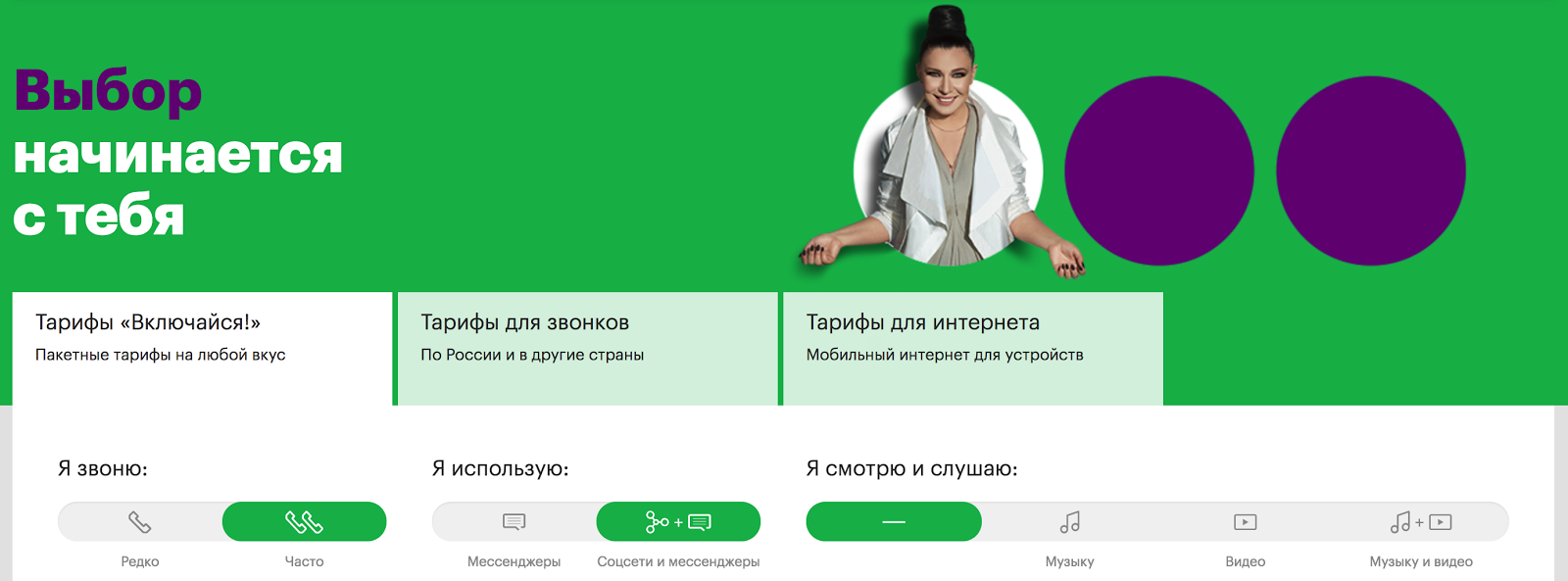
The group that speaks a lot and practically does not use Internet applications is clearly defined. We have offered such clients the tariff plan “Turn on!” Speak. "
Music lovers speak less on the phone than active users of social networks. Therefore, in the tariff line, we have provided a product for both some and others. If we made one proposal, the client would be forced to overpay for some service that he does not need.
Noticed another such trend. Digital clients listen to music in services, in their friends playlists or playlists, but prefer to use traditional channels like radio and friends' advice to find out about new music.
If you compare genres: music and video, then music dominates. They turn to her more often than watching movies. Since November 16, for video buffs, we have made unlimited on Youtube as part of the “Turn on! Watch ”and“ Turn on! ” Premium ".

Shooting a promotional video of the “Turn on!” Line
Based on the results of data analysis, we identified six behavioral models that formed the basis of the “Turn on!” Line. There are subscribers who write more in instant messengers or watch Youtube or talk, etc. As a result, we created seven tariffs:
The results of the new approach are now visible. If we compare the sales of tariffs “before” the new line and “after”, then the picture has changed dramatically. In our previous line “All Inclusive”, more than 50% were sales of a tariff with a monthly fee of about 300 rubles, and now they consciously choose tariffs more expensive on a monthly fee (“Communicate”, “Listen”, “Speak”), but saturated with services as they see this is practical benefit for oneself. The share of “Talk”, “Listen”, “Talk” tariffs (500-600 rubles / month in Moscow and the region) is more than 70% of the entire “Turn on!” Line.
The creation of a new successful tariff line was made possible thanks to technologies of big data analysis and machine learning, the use of which ceases to be costly. It is possible that in the near future each subscriber will have his own tariff with personal parameters at the level of individual Internet services.
How have tariffs evolved?
Packet tariff plans have existed since the launch of mobile networks. Until 2007, they included minutes and SMS. In 2007, bundles appeared - package tariff plans with the inclusion of the Internet. Just in October, it was exactly 10 years since the launch of the first bundle in the North-West region - the Lux Express tariff, where for 500 rubles 500 MB and 500 minutes were provided.
Since then, mobile Internet has taken an increasingly important place in life. Today, 85% of young people in Russia have a smartphone. 80% of them check it as soon as they woke up. And the use of abstract Internet passes into the use of specific mobile applications - there are already more than 2 million of them. And the number of users of social networks has already exceeded billions.
Given the growing number of various services based on mobile Internet, stratification of subscriber needs is inevitable. He is already actively going and will continue only to continue. In order to ensure 100% customer satisfaction, it is necessary to create various partnerships with companies in related markets.
This is precisely our mission: we connect opportunities. And with this we understand, we have come to the conclusion that we need to create, in the literal sense of the word, the current tariff line. So that the client can say: "This is exactly my tariff." Old tariffs do not give such a feeling and do not allow consuming at affordable prices as many services as needed.
How we broke the audience
To develop a new tariff, from January to March we analyzed the behavior of two million subscribers using big data. The data, of course, was anonymized. First of all, we divided two segments of users of mobile services: traditional and digital subscribers.
We will deal with the first. Their share is about 30%. They believe that the minimum is enough for them to communicate. It is interesting that at least half of this group considers itself far from modern technology. They do not have smartphones, and they mainly use only voice communication to communicate with loved ones.
The second category is digitalsubscribers. They are more than two times more, about 70%. For them, mobile Internet has become a daily occurrence, and the smartphone screen has become the main, first screen. These people receive information from online media, other online resources, use online shopping, online banking, etc. Among digital subscribers, we have identified four subgroups.
- Active voice users. They use a smartphone mainly for calls, and the Internet just to read news and check mail.
- Minimalists are users of instant messengers. Almost do not use voice communication, the functions of which are taken over by messengers.
- Active users of the Internet and online services. Among the services, social networks prevail, but at the same time, voice communication is important to people, they have not gone 100% into the virtual environment. This, by the way, is the largest percentage.
- A premium group that uses all the services - both the Internet and voice.
And here is how Internet scenarios are ranked by popularity among digital subscribers:
- Social networks and email.
- Internet surfing, information search.
- Instant messengers. Many communicate through personal messages of social networks, so WhatsApp and company only have third place.
- Video and music.
- Download content.
- Online shopping.
- Online Games.
And finally, a few more observations in the behavior of the audience.
The group that speaks a lot and practically does not use Internet applications is clearly defined. We have offered such clients the tariff plan “Turn on!” Speak. "
Music lovers speak less on the phone than active users of social networks. Therefore, in the tariff line, we have provided a product for both some and others. If we made one proposal, the client would be forced to overpay for some service that he does not need.
Noticed another such trend. Digital clients listen to music in services, in their friends playlists or playlists, but prefer to use traditional channels like radio and friends' advice to find out about new music.
If you compare genres: music and video, then music dominates. They turn to her more often than watching movies. Since November 16, for video buffs, we have made unlimited on Youtube as part of the “Turn on! Watch ”and“ Turn on! ” Premium ".
Shooting a promotional video of the “Turn on!” Line
What happened
Based on the results of data analysis, we identified six behavioral models that formed the basis of the “Turn on!” Line. There are subscribers who write more in instant messengers or watch Youtube or talk, etc. As a result, we created seven tariffs:
- “Listen” (unlimited messengers and music streaming)
- "Communicate" (unlimited messengers and social networks)
- “Watch” (unlimited messengers, social networks and Youtube)
- "Write" (unlimited messengers and the included SMS package)
- "Talk" (unlimited messengers and many minutes)
- Premium (unlimited messengers, social networks, music, SMS, Youtube, large packages of everything else)
The results of the new approach are now visible. If we compare the sales of tariffs “before” the new line and “after”, then the picture has changed dramatically. In our previous line “All Inclusive”, more than 50% were sales of a tariff with a monthly fee of about 300 rubles, and now they consciously choose tariffs more expensive on a monthly fee (“Communicate”, “Listen”, “Speak”), but saturated with services as they see this is practical benefit for oneself. The share of “Talk”, “Listen”, “Talk” tariffs (500-600 rubles / month in Moscow and the region) is more than 70% of the entire “Turn on!” Line.
The creation of a new successful tariff line was made possible thanks to technologies of big data analysis and machine learning, the use of which ceases to be costly. It is possible that in the near future each subscriber will have his own tariff with personal parameters at the level of individual Internet services.